How to Calculate Wall Square Footage
Estimating wall square footage accurately ensures you purchase the correct volume of masonry units, rebar anchors, and mortar joint compounds:
Quickly calculate the gross and net square footage of your masonry walls. Subtract door and window openings to find exact blocks, mortar, and rebar.
CMU estimates use nominal face dimensions and illustrative mortar yields (30 standard 8-inch units per 80-lb premix bag before waste; thickness adjustments apply). Confirm product yields, unit core volumes, supplier pack sizes and local prices before ordering. Reinforcement quantities are material allowances; laps, hooks, embedment and engineered design are excluded.
Small Garden Border
Standard Garden Wall
Residential Garage Shell
Commercial Warehouse Wall
| Masonry Wall Application | Dimensions (Square Feet) | Est. Blocks (10% waste) | 80lb Mortar Bags | Rebar (20ft sticks) |
|---|---|---|---|---|
| Small Garden Border | 20' × 3' (60 sq ft) | ~68 pcs | ~6 bags | none |
| Standard Garden Wall | 30' × 5' (150 sq ft) | ~169 pcs | ~15 bags | ~10 sticks |
| Residential Garage Shell | 40' × 8' (320 sq ft) | ~360 pcs | ~32 bags | ~24 sticks |
| Commercial Warehouse Wall | 80' × 12' (960 sq ft) | ~1,080 pcs | ~94 bags | ~72 sticks |
Estimating wall square footage accurately ensures you purchase the correct volume of masonry units, rebar anchors, and mortar joint compounds:
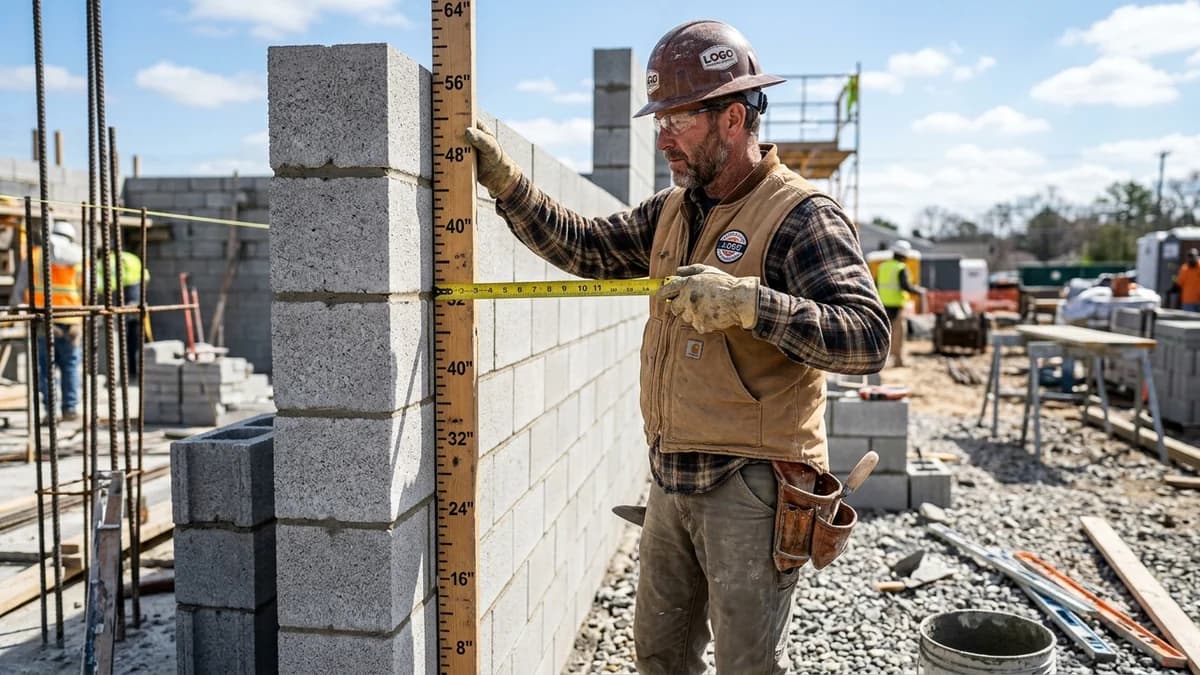
Measure the total horizontal length and vertical height of your planned block wall in linear feet.
Multiply total horizontal length by vertical height. For example, a 30' × 8' wall equals 240 gross square feet.
Identify doors, windows, and garage openings. Calculate their individual square footages and subtract from the gross area.
Standard 8" blocks cover exactly 0.89 sq ft. Divide your net wall square footage by 0.89 (or multiply by 1.125).
Cutting half-blocks around corners and portals produces scrap. Add a strict 10% waste buffer to your block totals.
Each standard 8x8x16 block laid requires standard joint mortar. One 80lb bag covers approximately 11.5 blocks.
Choosing different block thicknesses affects individual unit coverage, weight, and costs:
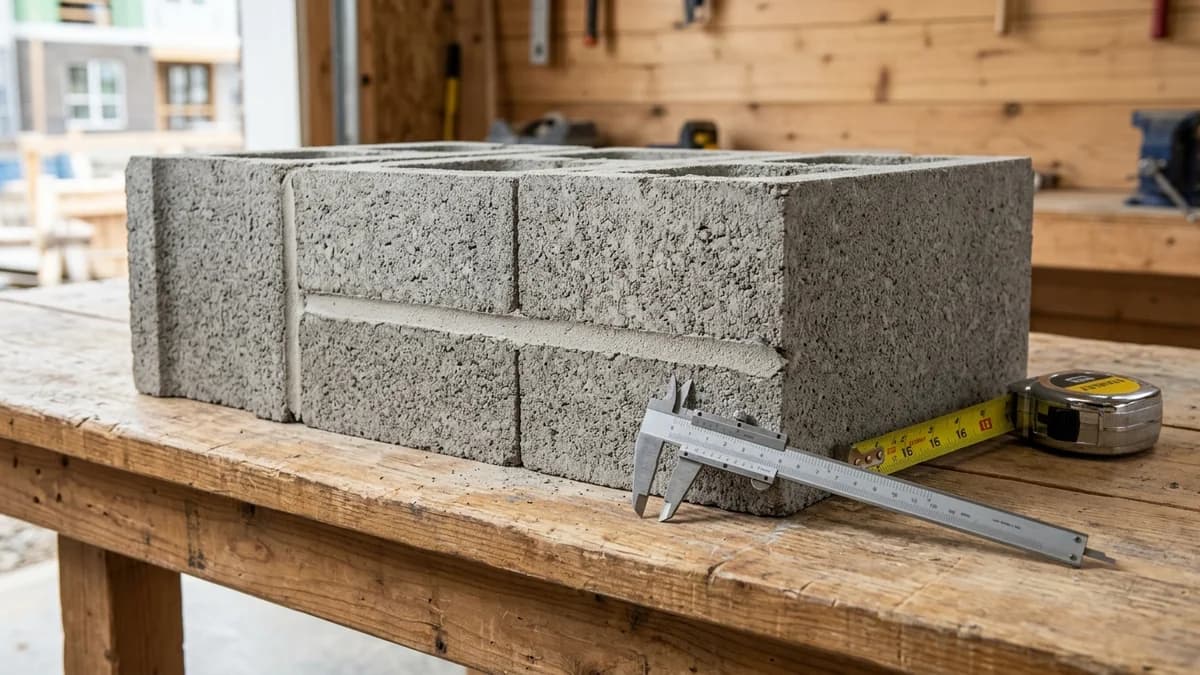
4" × 8" × 16" Partition
6" × 8" × 16" Medium
8" × 8" × 16" Standard
12" × 8" × 16" Large
| CMU Dimension Sizing | Standard Applications | Square Foot Unit Coverage | Unit Weight |
|---|---|---|---|
| 4" × 8" × 16" Partition | Shallow landscape dividers, garden borders, flower boxes | 0.89 sq ft per block (1.125 blocks/sqft) | 22 lbs |
| 6" × 8" × 16" Medium | Interior non-load partitions, shallow retaining garden structures | 0.89 sq ft per block (1.125 blocks/sqft) | 28 lbs |
| 8" × 8" × 16" Standard | Load-bearing residential walls, deep retaining walls, foundations, garages | 0.89 sq ft per block (1.125 blocks/sqft) | 38 lbs |
| 12" × 8" × 16" Large | Heavy commercial structures, industrial retaining walls, deep sub basements | 0.89 sq ft per block (1.125 blocks/sqft) | 55 lbs |
Standard Mortar Joint Size
Applying a consistent 3/8-inch mortar joint is critical so standard blocks line up perfectly in 8-inch grids vertically and 16-inch grids horizontally.
Material estimates depend on the selected dimensions, product yields, and waste allowance.
Verified geometric calculations for wall surface areas, opening deductions, and net block counts.
Illustrative takeoffs with stated assumptions; verify project quantities
Standard 8x8x16 nominal coverage benchmark
High-volume logistics & bulk pallet freight
Standard residential yard & garden wall run
Illustrative hollow-unit range; check supplier specs
Specialized tools for foundation, core fill, and budgeting
Direct wall dimensions with window and door deductions
Step-by-step masonry formulas and corner waste rules
Straight and multi-wall runs with mortar and waste allowances
Standard nominal 8x8x16 block takeoff with mortar joints
Practical guides to block sizing, material estimates and project planning