Quick Summary: The Contractor Verdict on Asphalt vs Concrete
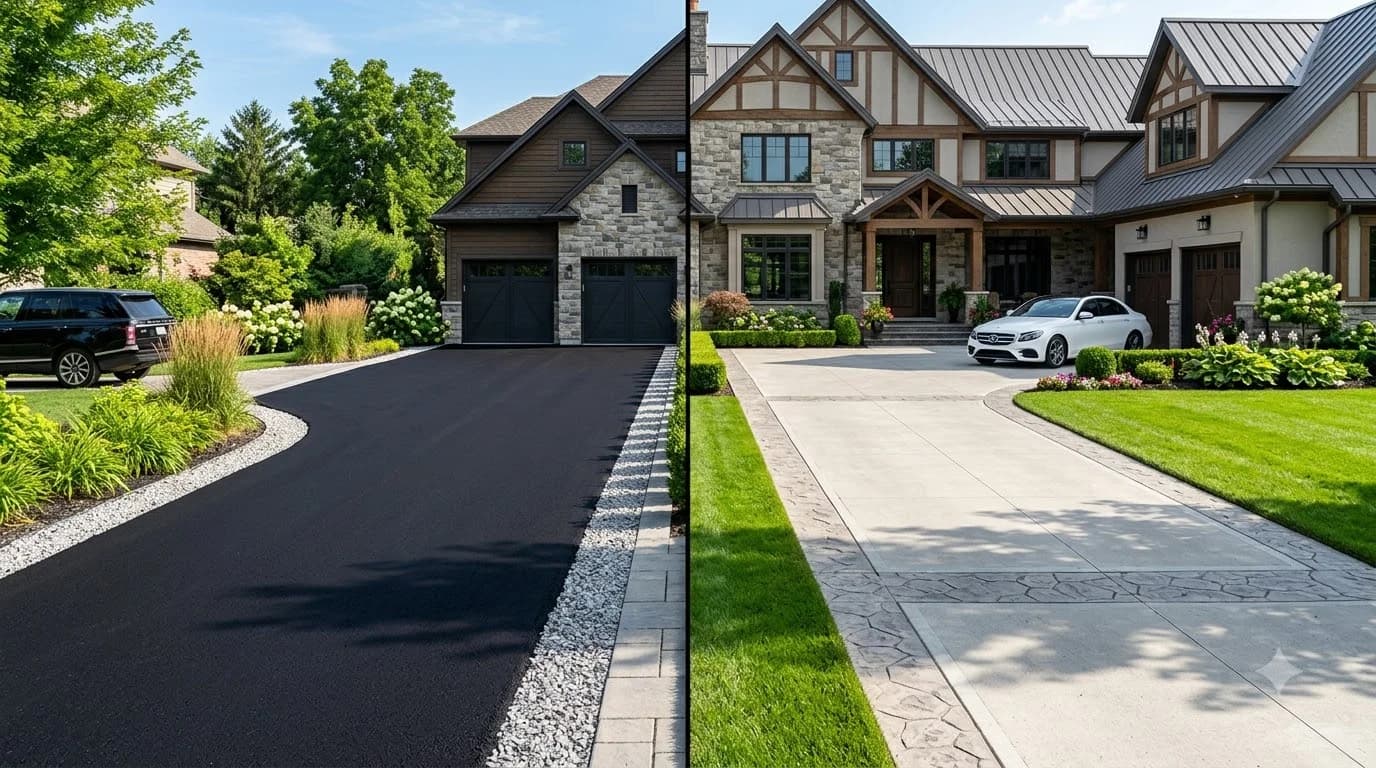
Choose Asphalt ($4.00 – $7.00 / sq ft): If you need the lowest upfront installation cost, have a long rural driveway (over 100 feet), live in extreme northern freeze zones with heavy road salting, or need to park vehicles within 48 hours.
Choose Concrete ($7.00 – $11.00 / sq ft): If you want a 30 to 50-year structural lifespan, zero routine sealcoating, maximum curb appeal and home appraisal equity, or live in warm southern climates where asphalt softens under summer heat.
1. Initial Installation Cost Comparison (2026 Prices)
The upfront cost difference is the primary reason many homeowners choose asphalt. For an average 2-car suburban driveway (18 ft × 35 ft = 630 square feet):
- Unit Cost: $4.00 to $7.00 per sq ft turnkey.
- Base Prep: 4″ to 6″ crushed stone base (CR-6) compacted.
- Paving: 2″ to 3″ compacted hot-mix asphalt (HMA).
- Economy: Extremely fast installation (1 day).
- Unit Cost: $7.00 to $11.00 per sq ft for standard broom finish.
- Base Prep: 4″ compacted aggregate subbase (#57 stone).
- Paving: 4″ thick 4,000 PSI concrete with #4 rebar grid.
- Decorative: $14.00 to $20.00 / sq ft for stamped patterns.
2. 30-Year Lifecycle Cost Analysis (The True Cost of Ownership)
While asphalt is 35% to 45% cheaper on Day 1, its ongoing maintenance demands balance the financial equation over a 30-year span:
| Timeline Event | Asphalt Pavement (630 sq ft) | Concrete Flatwork (630 sq ft) | Cost Analysis |
|---|---|---|---|
| Year 0: Initial Installation | $3,450 ($5.50 / sq ft) | $5,670 ($9.00 / sq ft) | Asphalt saves $2,220 upfront |
| Years 3 to 12: Sealcoating (3×) | $750 ($250 per coat) | $0 (Optional wash) | Asphalt requires coal-tar/acrylic coat |
| Year 15: Resurfacing / Overlay | $2,200 (Milling & 1.5″ cap) | $250 (Penetrating silane sealer) | Asphalt oxidized; requires 1.5″ cap |
| Years 18 to 27: Sealcoating (3×) | $900 ($300 per coat) | $0 (Minimal routine care) | Asphalt ongoing chemical barrier |
| Year 30: Condition at 30 Years | End-of-life; full reconstruction ($4,500+) | Fully functional (Expected 40–50 yrs) | Concrete still performing cleanly |
| Total 30-Year Ownership Cost | $7,300 (Plus replacement needed) | $5,920 Total | Concrete is cheaper over 30 years |
3. Climate Performance: Cold Frost Heave vs Southern Scorching Heat
Geographic location is often the single most decisive factor when choosing between flexible asphalt and rigid concrete:
Asphalt Advantage: Asphalt is an aggregate-bitumen flexible pavement that can flex slightly with winter frost heaving without fracturing. Its dark black color absorbs solar radiation, accelerating snow and ice melting. Furthermore, asphalt is chemically unaffected by sodium chloride (rock salt). Concrete in northern zones requires strict air-entrainment and silane sealing to prevent surface scaling.
Concrete Advantage:Under high summer ambient temperatures (95°F+), asphalt surface temperatures can exceed 140°F. The petroleum bitumen softens, causing car tires, RV jack stands, and bicycle kickstands to sink and leave permanent indentations. Soft tar also tracks onto shoes and interior carpets. Concrete has high solar reflectance (albedo), staying 20°F to 30°F cooler and remaining rigid regardless of ambient heat.
4. Curb Appeal, Color, & Home Appraisal Equity
Curb appeal directly affects perceived property value and neighborhood appraisal comparables:
Design Versatility
Asphalt is limited to a matte black or dark charcoal finish with occasional rolled borders. Concrete offers unlimited architectural expression: clean contemporary broom finish, scored geometric patterns, integral earthy colors, exposed river pebbles, or stamped textures resembling natural flagstone, slate, or European cobblestone.
Real Estate Appraisal Impact
In suburban subdivisions where most homes feature concrete flatwork, installing an asphalt driveway can look industrial or unkempt, potentially lowering buyer appeal. A clean concrete driveway signals high-grade construction and requires zero immediate maintenance from prospective buyers.
5. Five Common Mistakes When Choosing Pavement Materials
Itinerant contractors frequently knock on doors claiming they have leftover hot asphalt from a nearby highway project at a massive discount. They lay an ultra-thin 1-inch layer directly over grass or soft dirt without compaction. The driveway crumbles within 3 months. Always use licensed, insured local paving contractors.
Mature oak, maple, or pine trees with expansive lateral surface roots will heave and shatter rigid concrete panels within 5 to 10 years. Asphalt can tolerate gradual root elevation better and is much cheaper to saw-cut, root-prune, and patch than concrete.
Applying driveway sealer every single year is detrimental. Thick built-up layers of coal-tar or asphalt emulsion develop “alligator cracking” and peel off in large flakes. Asphalt should only be sealcoated once every 3 to 5 years when the stones begin to show gray.
A 300-foot rural driveway (3,600 sq ft) costs over $30,000 in concrete flatwork, which can exceed the homeowner's budget. Asphalt costs roughly $15,000 to $18,000, and chip-seal (tar and chip) costs even less ($7,000–$10,000). Use asphalt or chip-seal for long access roads, and transition to decorative concrete near the house.
Asphalt has zero tensile edge strength. If vehicles drive off the edge of an asphalt driveway where no compacted soil or concrete curb exists, the edge will break off in chunks. Always bevel edges at 45 degrees during compaction and backfill with firm topsoil.
Planning Your Driveway Project?
Get an instant estimate for concrete yardage, subbase stone, and 2026 contractor costs.
Frequently Asked Questions
Is asphalt or concrete cheaper for a driveway in 2026?
Asphalt is significantly cheaper upfront, costing $4.00 to $7.00 per square foot installed compared to $7.00 to $11.00 per square foot for standard concrete. On a standard 600-square-foot 2-car driveway, asphalt saves $2,000 to $3,500 on initial installation.
Which driveway lasts longer: asphalt or concrete?
A properly installed concrete driveway lasts 30 to 50 years with minimal maintenance. Asphalt lasts 15 to 25 years and requires sealcoating every 3 to 5 years, plus a resurfacing overlay around year 15 to 20.
Is asphalt or concrete better in freezing winter climates?
Asphalt performs exceptionally well in subfreezing northern climates because it is flexible, absorbs winter solar heat to melt snow faster, and is immune to salt scaling. Concrete can also excel in cold climates, but it strictly requires 5% to 7% air-entrainment (ASTM C94) and penetrating silane water-repellent sealing to prevent spalling from deicing salts.
Does concrete add more home resale value than asphalt?
Yes. Real estate appraisers and home buyers consistently view concrete as a premium, permanent structural feature. Stamped or decorative concrete driveways can recoup 60% to 75% of their cost at home resale, whereas asphalt is viewed as a standard utility surface.
How soon can you drive on asphalt vs concrete?
Asphalt cools and hardens rapidly; you can drive on it within 24 to 48 hours after rolling compaction. Concrete requires hydraulic curing and must not be driven on by passenger vehicles for at least 7 full days (and 14 to 28 days for heavy trucks or RVs).
Building Codes & Primary Standards Cited
AASHTO Guide for Design of Pavement Structures
Establishes structural layer coefficients, life-cycle cost analysis methods, and serviceability loss for flexible versus rigid pavements.
Guide for the Design and Construction of Concrete Site Paving
Governs subbase preparation, rebar reinforcement criteria, and joint spacing for residential concrete driveways.
National Asphalt Pavement Association - Residential Paving Best Practices
Defines minimum hot-mix asphalt (HMA) compaction densities and subbase aggregate thickness standards.
Estimations adhere to standard North American modular 3/8-inch mortar joint physics and 5% to 10% material waste factors. Local municipal building inspectors, stamped architectural blueprints, and local frost depth requirements supersede general reference guidelines.
Popular Quick Estimates
Pre-engineered takeoffs & benchmarks matched to this project
Related Calculators
Specialized tools for foundation, core fill, and budgeting
Cost per square foot, material prices and excavation budget
Turnkey material costs, rebar, delivery and mason labor
Installed cost per square foot and full budget forecast
Heavyweight structural blocks and bond beam units
Blogs & Construction Guides
Technical articles, IRC code standards, rebar schedules & freight logistics
How Much Does a Bag of Concrete Cost? (2026 Prices)
How Much Do Concrete Blocks Cost? (2026 CMU Prices)
How Much Does a Yard of Concrete Cost? (2026 Pricing)