Direct Cost Overview: Are Concrete Floors Expensive?
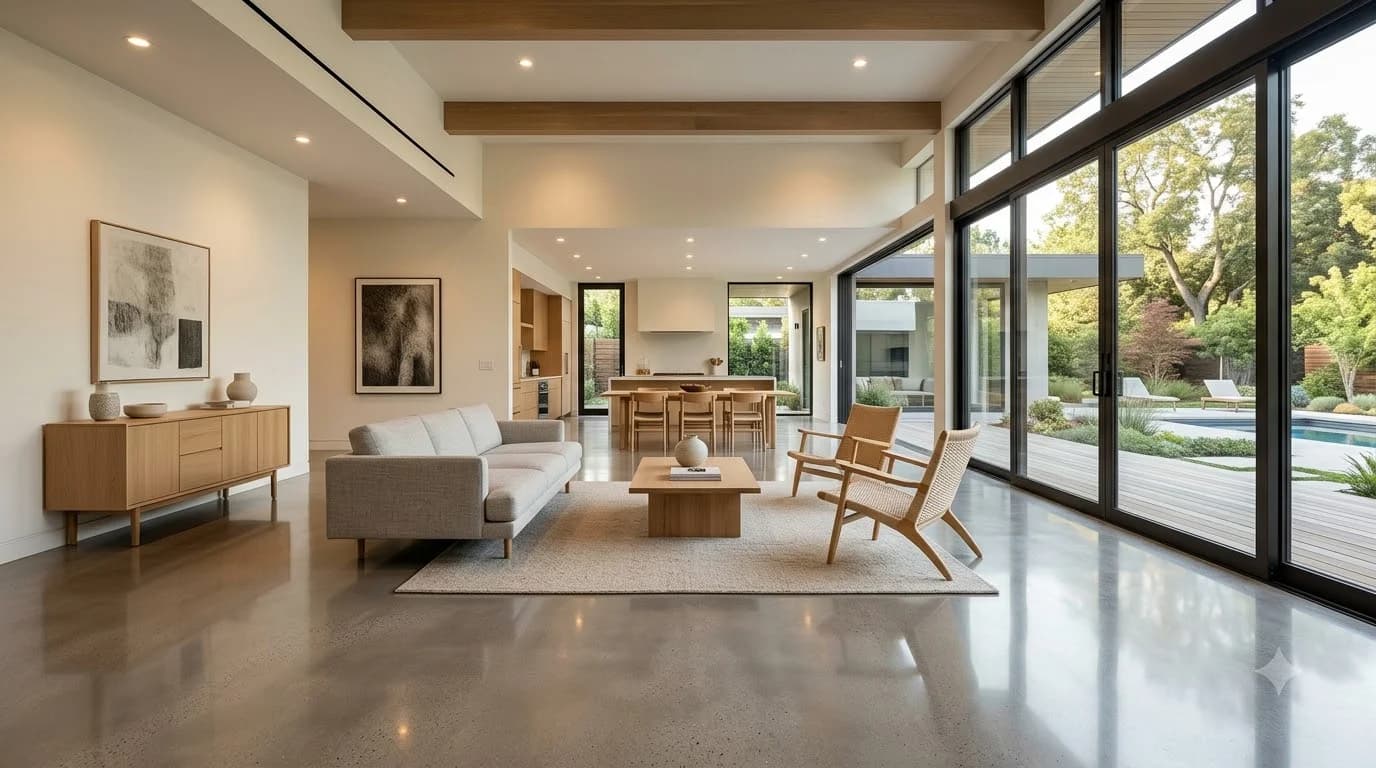
No—in existing homes built on a slab foundation, concrete floors are one of the most affordable flooring options available. Polishing an existing slab costs $3.00 to $8.00 per square foot (compared to $9.00–$16.00/sq ft for hardwood or $8.00–$18.00/sq ft for tile). High-end designer treatments (multi-tone acid stains or 3D metallic epoxy) cost $8.00 to $15.00 per sq ft. If you are building new construction requiring a fresh structural slab, pouring and polishing together costs $10.00 to $16.00 per sq ft.
1. 2026 Concrete Flooring Costs by Treatment Tier
Interior concrete finishing spans four distinct architectural levels depending on aggregate exposure, sheen level, and chemical enhancements:
The slab is mechanically cleaned and lightly ground with 60–80 grit diamond pads to remove carpet glue, paint, and surface drywall mud. A clear topical acrylic or polyurethane sealer is applied. Leaves a low-sheen satin finish. Ideal for basements, laundry rooms, and workshops.
A true mechanical polish. The floor undergoes 4 to 6 progressive grinding passes (up to 800 or 1,500 grit resin diamonds) with a penetrating lithium silicate densifier applied midway through. Crystalline reaction hardens the top pore matrix, creating a glassy, mirror-like reflection with zero topical film.
Hydrochloric acid and metallic salt solutions are applied to react with calcium hydroxide in the concrete. Produces rich, translucent earthy marbling resembling natural marble, leather, or terracotta. Sealed with high-durability urethane.
100% solids epoxy blended with shimmering pearlescent mica flakes, manipulated with denatured alcohol mists and leaf blowers to create dynamic flowing wave patterns. Topped with a scratch-resistant polyaspartic clear shield.
2. Master 30-Year Financial Comparison: Concrete vs Other Flooring
Evaluating flooring based on initial installation price alone is a costly mistake. Below is an authentic 30-year lifecycle cost model for a 1,000-square-foot living area:
| Flooring Material | Initial Cost (1,000 sq ft) | Lifespan | 30-Year Maintenance / Replacement | 30-Year Total Cost | Flood / Water Resistance |
|---|---|---|---|---|---|
| Polished Concrete | $5,000 ($5.00 / sq ft) | 50 – 100+ Yrs | $800 (Buffing / micro-guard) | $5,800 Total | 100% Waterproof |
| Luxury Vinyl Plank (LVP) | $6,500 ($6.50 / sq ft) | 12 – 15 Yrs | $6,500 (Replaced once) | $13,000 Total | Water-resistant (mold underneath) |
| Solid Hardwood Oak | $12,000 ($12.00 / sq ft) | 40 – 60 Yrs | $4,500 (Refinished 3×) | $16,500 Total | Ruined by standing water |
| Porcelain Tile | $11,000 ($11.00 / sq ft) | 30 – 50 Yrs | $2,200 (Grout cleaning & repair) | $13,200 Total | Waterproof (grout porous) |
| Plush Carpet & Pad | $4,000 ($4.00 / sq ft) | 7 – 10 Yrs | $11,000 (Replaced 3×) | $15,000 Total | Must be gutted if flooded |
3. The 6-Step Mechanical Diamond Polishing Process
Unlike painting or applying a thin clear sealer, true polished concrete is a precise mechanical refinement governed by ACI 310R (Guide to Decorative Concrete):
Heavy 800-lb planetary grinders with diamond segmented metal shoes cut away the top 1/16 inch of weak laitance paste, exposing aggregate and flattening minor elevation ridges.
Semi-metal or ceramic hybrid pads erase the harsh scratch patterns left by the metal-bond cut, creating a smooth matte canvas.
Liquid lithium silicate is flooded across the surface. It soaks into pores, reacting with free calcium hydroxide to grow dense Calcium-Silicate-Hydrate (C-S-H) crystals, increasing surface hardness by 40% (ASTM C779).
Diamond impregnated resin discs hone the densified concrete, developing a natural low-to-medium sheen that reflects overhead lighting.
Ultra-fine diamond grits tighten surface pores to optical tolerances, producing a brilliant mirror reflection without any chemical wax or topical plastic film.
A micro-guard penetrating impregnator is applied and burnished with a 2,000 RPM propane machine, chemically curing the stain barrier against wine, oils, and acids.
4. Radiant In-Floor Heating: The Ultimate Luxury Pairing
The most frequent objection to concrete floors is that they feel cold in winter. This is easily solved during construction by incorporating hydronic radiant in-floor heating:
Flexible 1/2-inch oxygen-barrier PEX tubing is tied to the rebar grid on 6 to 9-inch centers before concrete is poured. Warm water (85°F to 110°F) circulates through the slab. Because concrete has immense thermal mass, it absorbs and radiates thermal energy evenly upward into the room. Heating efficiency increases by 20% to 35% over forced-air furnaces, and the floor remains warm on bare feet throughout winter.
5. Five Costly Mistakes When Installing Concrete Floors
Grinding a soft 2,500 PSI concrete slab without applying a lithium or sodium silicate densifier will result in a floor that powders, scuffs easily, and loses its sheen within months. Densification is what transforms porous lime into diamond-hard C-S-H.
Epoxy requires an open Concrete Surface Profile (CSP 2 to 3) to achieve a mechanical grip. Rolling DIY epoxy over a smooth power-troweled floor without diamond grinding will cause the entire coating to peel up in large sheets under hot car tires (hot-tire pickup).
Existing basement slabs have ghost marks from old walls, plumbing trenches, and variable trowel passes. If you polish an existing slab, expect industrial character, organic variations, and aggregate mottling. If you demand 100% color uniformity, install a 3/8-inch micro-topping overlay first.
Vinegar, bleach, ammonia, and citrus cleaners have a low pH that chemically etches polished concrete, dulling the mirror finish and turning it cloudy white. Clean polished floors exclusively with pH-neutral stone and concrete cleaners.
If pouring a new interior slab, never skip the continuous 15-mil sub-slab polyolefin vapor retarder (ASTM E1745). Without it, hydrostatic groundwater vapor will push upward, blooming efflorescence crystals and ruining high-gloss coatings.
Planning an Interior Flooring Project?
Calculate total square footage, polish grits, sealer gallons, and 2026 contractor pricing in seconds.
Frequently Asked Questions
Are concrete floors cheaper than hardwood or tile?
If your home is built on an existing concrete slab, concrete flooring is significantly cheaper than hardwood or tile. Polishing an existing slab costs $3.00 to $8.00 per square foot, compared to $9.00 to $16.00 per sq ft for solid hardwood or $8.00 to $18.00 per sq ft for installed porcelain tile. If you must pour a brand-new suspended structural slab, costs are roughly equal.
Are polished concrete floors cold on bare feet in winter?
Concrete has high thermal mass and will feel cold if uninsulated or unheated. However, interior concrete floors are the ideal medium for hydronic radiant in-floor heating (PEX tubing embedded in the slab). Radiant concrete radiates gentle, uniform warmth from the ground up and holds heat hours after boilers shut off.
Can any existing basement or foundation slab be polished?
Most slabs can be polished, provided the concrete has reached at least 3,000 PSI compressive strength and is structurally sound. Slabs with severe differential settling cracks, extensive spalling, or soft crumbly screed paste may require a 3/8-inch self-leveling cementitious polishable overlay ($5.00 to $9.00/sq ft) before grinding.
How long do polished concrete floors last?
A professionally densified and polished concrete floor lasts 50 to 100+ years. Because mechanical polishing hardens the actual cement matrix rather than gluing down a topical plastic film, it will never peel, bubble, chip, or delaminate. It requires only dust mopping and periodic high-speed buffing.
Are polished concrete floors slippery when wet?
Surprisingly, clean and dry polished concrete meets or exceeds OSHA and ADA static coefficient of friction standards (>0.50). However, when wet, high-gloss polished floors can become slick. In bathrooms or kitchens, contractors apply penetrating slip-resistant silica sealers to maintain wet traction.
Building Codes & Primary Standards Cited
Standard Test Method for Abrasion Resistance of Horizontal Concrete Surfaces
Establishes wear durability standards and resistance to vehicular and foot traffic on densified polished concrete.
Guide to Concrete Floor and Slab Construction
American Concrete Institute guidelines establishing floor flatness (F_F) and levelness (F_L) standards for interior slabs.
Guide to Decorative Concrete
Defines standards for diamond grinding, chemical acid staining, densification, and polishing finishes.
Estimations adhere to standard North American modular 3/8-inch mortar joint physics and 5% to 10% material waste factors. Local municipal building inspectors, stamped architectural blueprints, and local frost depth requirements supersede general reference guidelines.
Popular Quick Estimates
Pre-engineered takeoffs & benchmarks matched to this project
Related Calculators
Specialized tools for foundation, core fill, and budgeting
Cost per square foot, material prices and excavation budget
Turnkey material costs, rebar, delivery and mason labor
Installed cost per square foot and full budget forecast
Heavyweight structural blocks and bond beam units
Blogs & Construction Guides
Technical articles, IRC code standards, rebar schedules & freight logistics
How Much Do Concrete Blocks Cost? (2026 CMU Prices)
How Much Does a Bag of Concrete Cost? (2026 Prices)
How Much Does a Yard of Concrete Cost? (2026 Pricing)