Direct Answer: The Golden Conversion Numbers
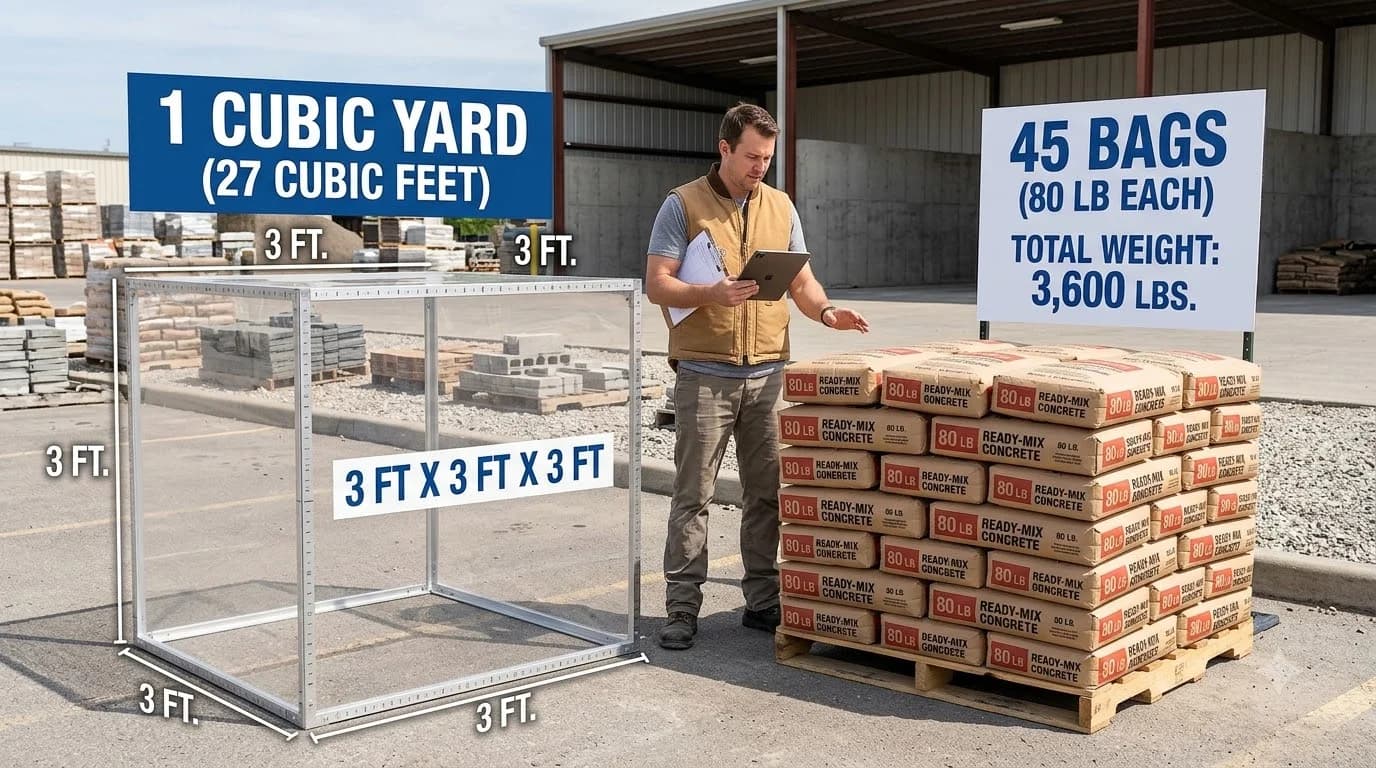
One cubic yard of concrete equals 27 cubic feet. Dry premixed concrete bags yield significantly less volume than their weight implies because dry sand, gravel, and cement consolidate when water is added. To yield 1 cubic yard (without waste), you need exactly:
- 80 lb Bags: 45 bags (yield: 0.60 cu ft/bag) → Order 50 bags with 10% waste
- 60 lb Bags: 60 bags (yield: 0.45 cu ft/bag) → Order 66 bags with 10% waste
- 50 lb Fast-Setting: 72 bags (yield: 0.375 cu ft/bag) → Order 80 bags with 10% waste
- 40 lb Bags: 90 bags (yield: 0.30 cu ft/bag) → Order 99 bags with 10% waste
1. The Mathematics of Concrete Bag Consolidation (ASTM C387)
A common misconception among first-time builders is that an 80-pound bag of dry concrete mix will fill roughly one cubic foot. In reality, wet concrete weighs approximately 133 to 145 pounds per cubic foot once consolidated and vibrated. Therefore, an 80-pound bag of dry mix produces only 0.60 cubic feet of wet, plastic concrete.
Under ASTM C387 (Standard Specification for Packaged, Dry, Combined Materials for Mortar and Concrete), manufacturers blend graded sand, pea gravel or crushed stone aggregate, and Type I/II Portland cement in tightly controlled ratios. When you add clean water (typically 3.0 quarts per 80-lb bag), the water lubricates the aggregate and fills the microscopic air voids between sand grains. This consolidation causes the dry volume to shrink by nearly 20% into its final dense state.
Standard Mathematical Formula:
Number of Bags = 27 cu ft ÷ (Bag Volume Yield in cu ft) × 1.10 (Waste Buffer)
For 80 lb Bags: 27 ÷ 0.60 = 45 bags net × 1.10 = 49.5 → 50 Bags Total
2. Bag Yields, Pallet Counts, Weights & Pricing Matrix
Compare standard commercial concrete bag sizes available at Home Depot, Lowe's, and professional masonry supply yards across the United States (verified 2026 contractor averages):
| Bag Weight | Yield / Bag | Bags / Cu Yd | Bags / Pallet | Pallet Weight | Retail Price / Bag | Cost per Cu Yd |
|---|---|---|---|---|---|---|
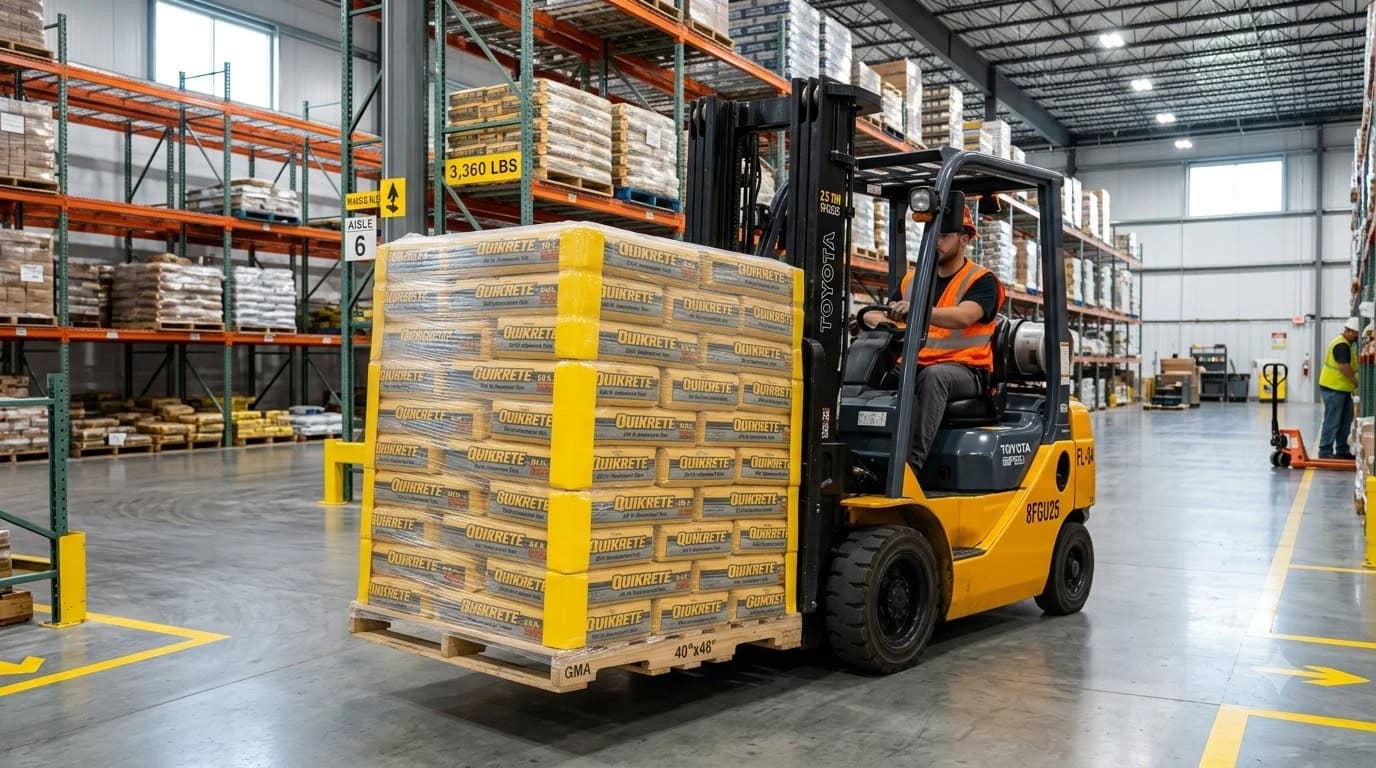
| 80 lb Standard (4000 PSI) | 0.60 cu ft | 45 Bags | 42 Bags (0.93 yd³) | 3,360 lbs | $5.50 – $6.50 | $248 – $293 |
| 60 lb Standard (4000 PSI) | 0.45 cu ft | 60 Bags | 56 Bags (0.93 yd³) | 3,360 lbs | $4.50 – $5.25 | $270 – $315 |
| 50 lb Fast-Set (Quikrete Red) | 0.375 cu ft | 72 Bags | 64 Bags (0.88 yd³) | 3,200 lbs | $6.75 – $7.75 | $486 – $558 |
| 40 lb Lightweight Mix | 0.30 cu ft | 90 Bags | 80 Bags (0.88 yd³) | 3,200 lbs | $3.75 – $4.50 | $338 – $405 |
3. Bagged Mix vs. Ready-Mix Truck Delivery: When to Switch?
One of the most critical logistical decisions on any concrete job is determining whether to mix bagged concrete on-site or hire a professional ready-mix barrel truck.
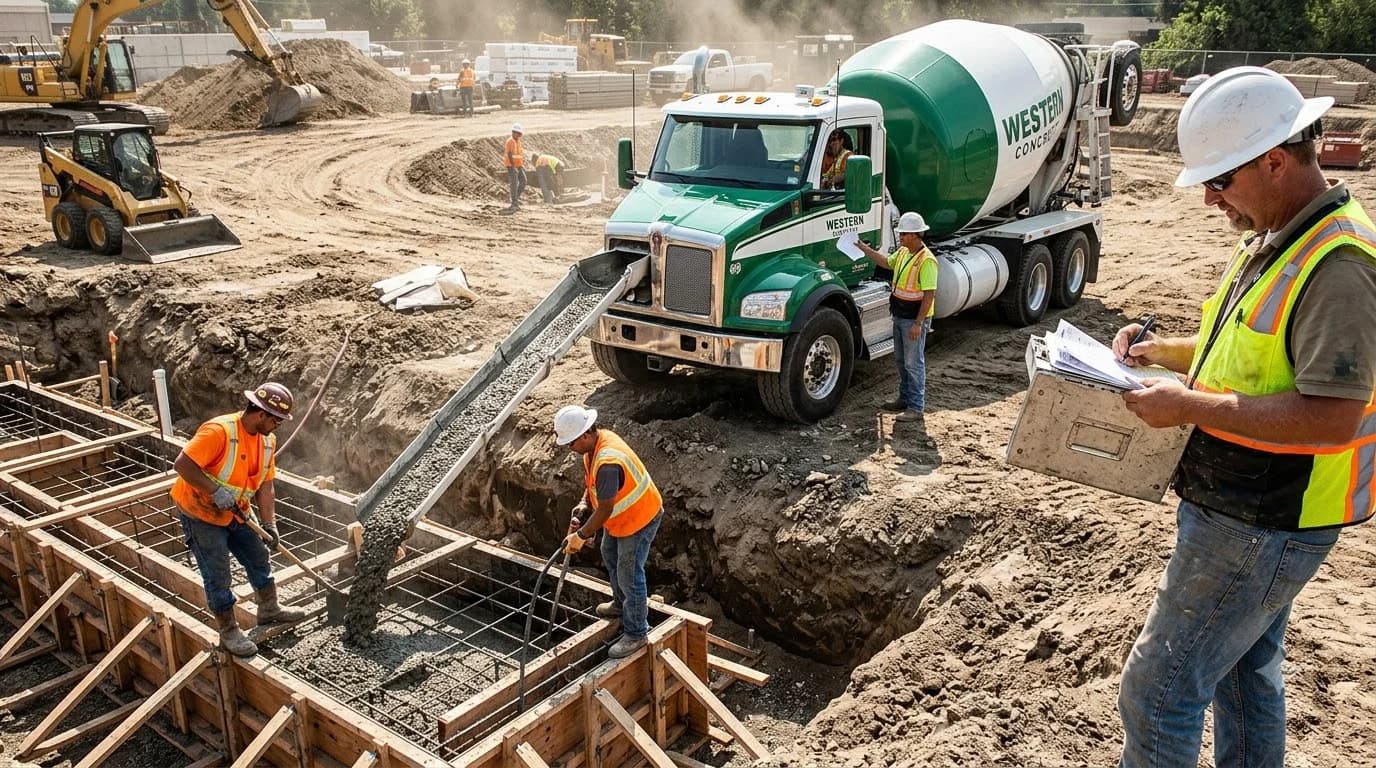
The 2-Cubic-Yard Rule: If your project requires less than 1.5 to 2.0 cubic yards(under 65 to 90 eighty-pound bags), buying bagged concrete from a home center is virtually always cheaper. Ready-mix dispatch companies enforce "short-load fees" (typically $80 to $150 per truck) whenever an order is smaller than 4 or 5 cubic yards, driving small ready-mix deliveries to over $250 to $300 per yard.
However, once your pour reaches 3 cubic yards or more (such as a 12x24 ft patio or 20x20 ft garage slab), buying bags becomes economically foolish and physically brutal:
- Best For: Fence posts, deck footings, small walkways (<1.5 yd³).
- Equipment Needed: Wheelbarrow, mortar hoe, or rented 3.5 cu ft drum mixer ($45/day).
- Pacing: 1 person mixes roughly 8 to 12 bags per hour by hand.
- Cold Joint Risk: High risk if batching takes longer than 45 minutes between pours.
- Best For: Driveways, large patios, house slabs, foundation stem walls (>3 yd³).
- Speed: Discharges 8 to 10 cubic yards down chutes in 20 minutes.
- Monolithic Strength: Zero cold joints; 100% consistent water-cement ratio and slump.
- Cost: $145 to $185 per cubic yard delivered (with full 8+ yard order).
4. Step-by-Step Slab Volume Calculation Protocol
Follow this standard 4-step field takeoff procedure to calculate exactly how many bags of concrete you need for any rectangular slab:
- Measure Length and Width in Feet: Measure the exact inside dimensions of your wooden form boards (e.g., 10 feet wide by 12 feet long).
- Convert Thickness to Feet:Divide your slab thickness in inches by 12. For a standard 4-inch slab: 4 ÷ 12 = 0.333 ft. For a 5-inch driveway: 5 ÷ 12 = 0.417 ft. For a 6-inch heavy pad: 6 ÷ 12 = 0.50 ft.
- Calculate Cubic Feet:Multiply Length × Width × Thickness in feet:10 ft × 12 ft × 0.333 ft = 40.0 cu ft
- Convert to Bags and Add 10% Waste: Divide total cubic feet by the bag yield (0.60 cu ft for 80 lb bags) and multiply by 1.10:40.0 ÷ 0.60 = 66.7 bags × 1.10 = 73.3 → 74 Bags of 80 lb Mix
5. Costly Jobsite Mistakes to Avoid When Bag-Mixing
1. Adding Too Much Water ("Soupy Concrete")
Pouring excess water into the wheelbarrow makes mixing easier, but every extra quart of water beyond the manufacturer's specified 3 quarts per 80-lb bag reduces the concrete compressive strength by up to 1,000 PSI (25% reduction) and causes severe drying shrinkage cracking.
2. Forgetting the 10% Waste Factor
Wood forms bow under wet concrete pressure, and subgrade dirt is never laser-flat. Running out of concrete with 5 square feet left creates an ugly cold joint that permanently compromises slab integrity.
3. Overloading Light Pickup Trucks
One cubic yard of dry concrete mix weighs 3,600 pounds. Loading 45 eighty-pound bags into a standard Ford F-150 bed will bottom out leaf springs, blow tires, and void vehicle warranties. Make two trips or pay for flatbed boom-truck delivery.
4. Creating Cold Joints Between Wheelbarrow Batches
If you take a 45-minute lunch break mid-pour, the previous batch will begin its initial set. Pouring fresh wet concrete against stiffening green concrete prevents aggregate interlock, leaving a permanent structural fissure.
5. Troweling with Bleed Water on the Surface
Finishing concrete while free bleed water is standing on top works water back into the surface paste. This dilutes the surface cement matrix, resulting in a weak, dusty top crust that flakes and spalls during winter freezing.
Plan Your Concrete Pour Instantly
Input your slab dimensions to calculate exact bags, truck yards, and rebar requirements.
Frequently Asked Questions
How many 80 lb bags of concrete make 1 cubic yard?
Exactly 45 bags of 80-pound concrete mix make one cubic yard. Each 80 lb bag yields 0.60 cubic feet, and there are 27 cubic feet in a cubic yard (27 ÷ 0.60 = 45 bags). With a recommended 10% waste buffer for formwork deflection and irregular subgrades, plan on purchasing 50 bags.
How many 60 lb bags of concrete make a cubic yard?
It takes 60 bags of 60-pound concrete mix to yield one cubic yard. Each 60 lb bag yields 0.45 cubic feet (27 ÷ 0.45 = 60 bags). Adding a 10% allowance for spillage and subbase leveling brings your order to 66 bags.
Is it cheaper to buy bags of concrete or order a ready-mix truck?
For projects requiring under 1.5 to 2 cubic yards (up to 90 eighty-pound bags), bagged mix is cheaper ($250 to $500 total). For projects requiring 3 cubic yards or more, ready-mix trucks delivered to your site are significantly more cost-effective ($145 to $185 per yard) and eliminate hours of strenuous hand mixing.
Can a standard 1/2-ton pickup haul a full pallet of concrete bags?
No. A full pallet of 80 lb concrete (42 bags) weighs 3,360 pounds, which severely exceeds the 1,400 to 2,000 lb maximum payload capacity of half-ton pickup trucks (like an F-150 or Silverado 1500). Hauling a full pallet requires a 3/4-ton or 1-ton truck, or a dual-axle utility trailer.
How much extra concrete should I order for waste and spillage?
Order a 10% contingency buffer for straight wooden slab forms and sidewalk runs. For rough-excavated post holes, trench footings, or uneven earthen subgrades, increase your waste margin to 12% to 15% to prevent mid-pour shortages.
Building Codes & Primary Standards Cited
Standard Specification for Packaged, Dry, Combined Materials for Concrete
Defines volumetric yield standards and compressive strength requirements for bagged mixes.
Building Code Requirements for Structural Concrete
Governs structural thickness tolerances and slump consolidation standards.
Standard Specification for Ready-Mixed Concrete
Authoritative technical guidelines for batching tolerances and short-load logistics.
Estimations adhere to standard North American modular 3/8-inch mortar joint physics and 5% to 10% material waste factors. Local municipal building inspectors, stamped architectural blueprints, and local frost depth requirements supersede general reference guidelines.
Popular Quick Estimates
Pre-engineered takeoffs & benchmarks matched to this project
Related Calculators
Specialized tools for foundation, core fill, and budgeting
Cubic yards, bags, and slab volume for flatwork and footings
Heavyweight structural blocks and bond beam units
Core grout volume in cubic yards and 80-lb pre-mix bags
Cell fill requirements for low-lift and high-lift grouting
Blogs & Construction Guides
Technical articles, IRC code standards, rebar schedules & freight logistics
How Much Does a Yard of Concrete Cost? (2026 Pricing)
How Much Does a Yard of Concrete Weigh? (Full Spec)
How Many Bags of Concrete on a Pallet? (Full Spec)