Direct Specification: Bags per Pallet by Weight Tier
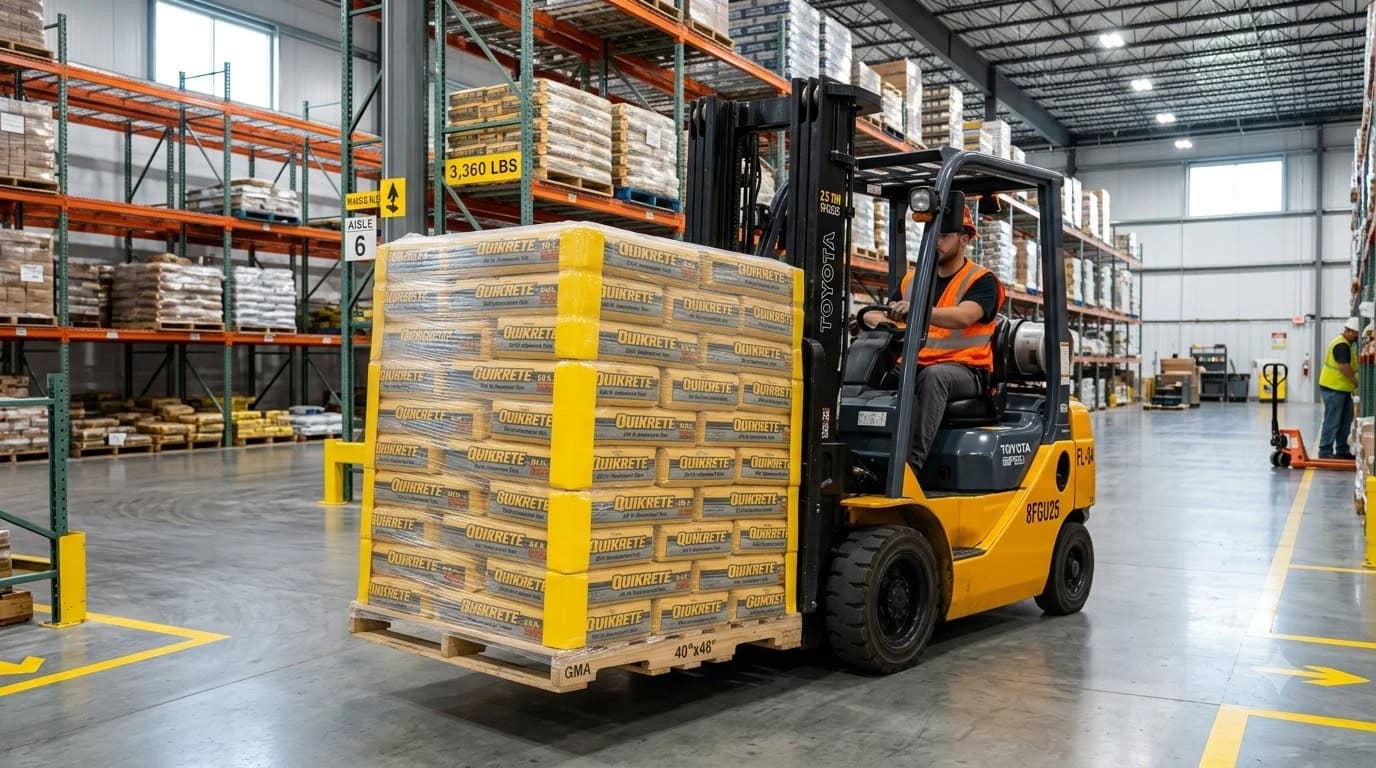
In commercial distribution, manufacturers target a standardized pallet weight cap of 3,360 lbs of dry material (plus ~50 lbs for the wooden skid):
• 80-lb Bags: Exactly 42 bags per pallet(7 layers of 6 bags) → Yields 0.93 cu yd.
• 60-lb Bags: Exactly 56 bags per pallet(8 layers of 7 bags) → Yields 0.93 cu yd.
• 50-lb Fast-Setting: Exactly 64 bags per pallet(8 layers of 8 bags) → Yields 0.88 cu yd.
• 40-lb Bags: Exactly 80 bags per pallet(10 layers of 8 bags) → Yields 0.88 cu yd.
1. Why All Concrete Pallets Weigh Exactly 3,360 Pounds
Whether you purchase 42 bags of 80-pound concrete or 56 bags of 60-pound concrete, the total net weight of dry material is identical: 3,360 pounds. This is not a coincidence.
Major dry-mix manufacturers (Quikrete, Sakrete, SpecChem, and Quick-Mix) calibrate automated packaging robots to three strict industrial constraints:
- Standard 4,000-lb Forklift Capacity: Most commercial yard forklifts and flatbed piggyback forklifts (Moffett) are rated for 4,000 to 5,000 lbs. When accounting for forward mast extension and bouncing on gravel yards, a 3,410-lb gross load (including wooden skid) provides the necessary 15% safety buffer.
- Freight Semi-Truck Axle Limits: Under US Department of Transportation (DOT) highway regulations, a standard 53-foot flatbed semi trailer has an 80,000-lb gross weight limit, translating to roughly 46,000 to 48,000 lbs of cargo payload. Shippers can load exactly 14 full pallets(14 × 3,410 lbs = 47,740 lbs) perfectly centered over the tractor-trailer axles.
- Warehouse Racking Deflection: Standard heavy-duty teardrop pallet racking beams are engineered for 3,500 to 4,000 lbs per beam pair. A 3,360-lb pallet eliminates beam bowing and collapse risk.
2. Master Concrete Pallet Specification & Pricing Matrix (2026)
The following matrix compares bag counts, cubic volume yields, slab surface coverage, and current 2026 retail versus pallet bulk discounted pricing:
| Mix Product / Weight | Bags / Pallet | Net Pallet Wt. | Cu Yd Yield | 4″ Slab Coverage | Unit Price (Retail) | Pallet Cost (2026) |
|---|---|---|---|---|---|---|
| 80-lb Standard Mix (4,000 PSI) | 42 Bags | 3,360 lbs | 0.93 cu yd | 75.6 sq ft | $6.25 / bag | $235 – $255 |
| 60-lb Standard Mix (4,000 PSI) | 56 Bags | 3,360 lbs | 0.93 cu yd | 75.6 sq ft | $5.25 / bag | $260 – $280 |
| 50-lb Fast-Setting (Red Bag) | 64 Bags | 3,200 lbs | 0.88 cu yd | 71.3 sq ft | $7.80 / bag | $450 – $495 |
| 50-lb High-Early (5,000 PSI) | 64 Bags | 3,200 lbs | 0.88 cu yd | 71.3 sq ft | $8.50 / bag | $490 – $535 |
| 40-lb Lightweight / Crack-Resist | 80 Bags | 3,200 lbs | 0.88 cu yd | 71.3 sq ft | $6.90 / bag | $495 – $540 |
| 80-lb Type S Mortar Mix | 42 Bags | 3,360 lbs | Masonry unit | Lays ~1,400 CMU | $9.20 / bag | $350 – $385 |
3. Truck Hauling Capacity & Highway Payload Safety
Placing an entire pallet of concrete into the bed of a pickup truck is one of the most hazardous mistakes made by homeowners and novice contractors. The total weight loaded is over 3,410 lbs:
Payload Rating: 1,600 to 2,100 lbs max.
Pallet Result: Overloaded by 1,300+ lbs. Bottoms out bump stops, overheats transmission, and risks tire rupture. Safe max: 20 to 24 bags (80-lb) across two trips.
Payload Rating: 3,100 to 3,900 lbs.
Pallet Result: Can safely carry ONE full pallet centered squarely over the rear axle. Requires proper tire inflation to 65–80 PSI cold.
Payload Rating: 4,800 to 7,200 lbs.
Pallet Result: Handles 1 full pallet with ease, and long-bed dual rear-wheel configurations can carry up to 2 full pallets safely within GVWR.
If you do not have a 3/4-ton or 1-ton truck, haul your pallet on a dual-axle utility trailer with a minimum 7,000-lb GVWR. Under FMCSA 49 CFR 393 cargo securement rules, heavy pallets must be secured with at least two 2-inch ratchet straps rated for 3,333 lbs working load limit (WLL) each.
4. Jobsite Weatherproofing & Storage Protocols
A common misconception is that the factory stretch-wrap enclosing a new pallet makes it waterproof. It does not.
Industrial plastic wrap is micro-perforated to prevent air ballooning during warehouse stacking. If rain hits the top of a factory pallet, moisture pools in the plastic recesses and migrates into the paper bags. Within 48 hours, hydraulic cement absorbs the ambient humidity, forming hard calcified lumps (“warehouse pack”) that ruin the concrete.
OSHA 1926.250 Jobsite Storage Checklist
- Elevate Off Soil: Never set pallets directly on dirt or grass. Ground moisture wicks upward into bottom layer bags. Keep pallets elevated on 4×4 timber dunnage.
- Tent with Heavy Tarp: Drape a heavy-duty 10-mil canvas or poly tarp over the entire pallet. Secure the tarp at the bottom with bungee cords, leaving a 2-inch gap at ground level for airflow.
- Create a Ridge Slope: Place an empty 5-gallon bucket upside down on the top center bag before throwing the tarp over. This creates a pitched tent peak that sheds rainfall outward rather than pooling water in the middle.
5. Pallet vs Ready-Mix: When to Switch to Truck Delivery
At what project volume does buying concrete by the pallet become more expensive and inefficient than calling a ready-mix barrel truck?
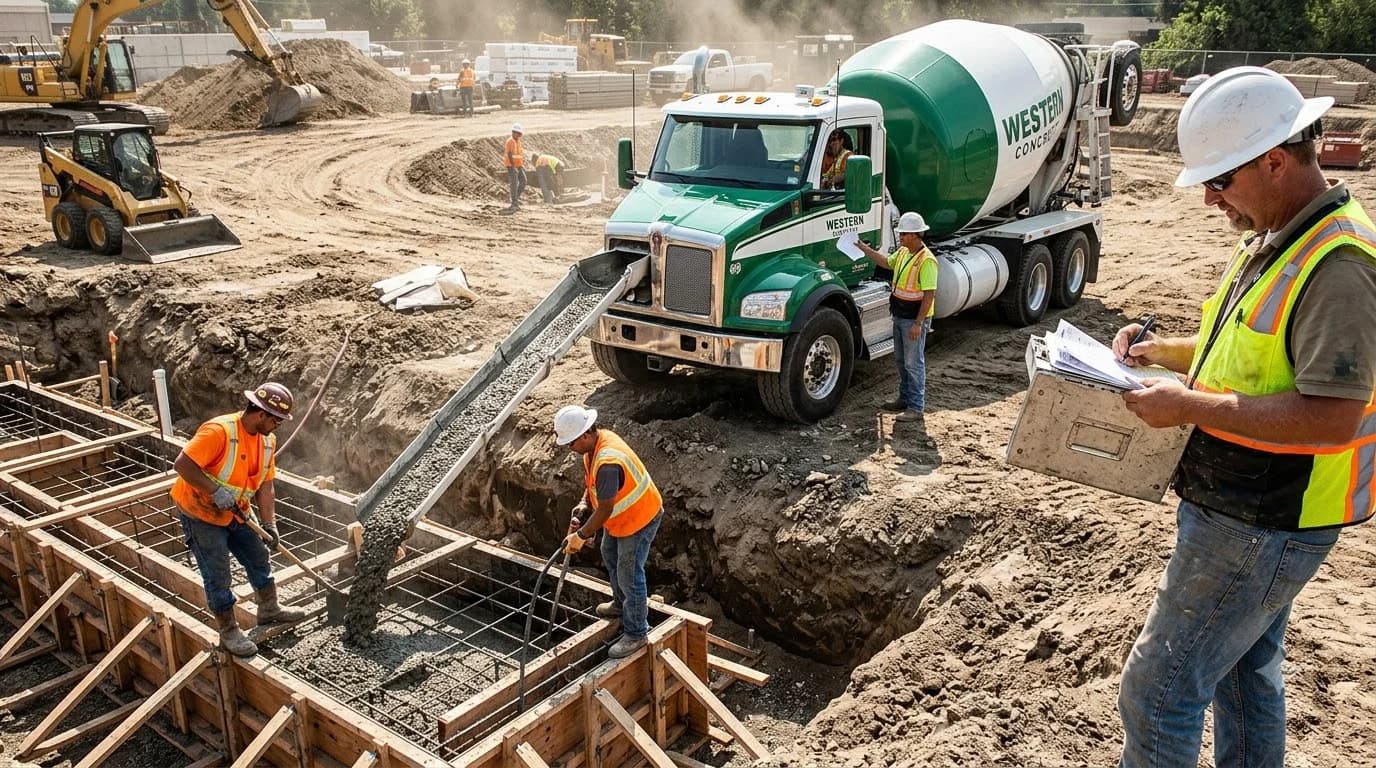
Choose Pallets:Ready-mix companies charge a “short-load fee” of $120 to $180 for deliveries under 4 cubic yards. For a 1-yard project (42 bags of 80-lb), bagged mix costs ~$245, whereas a ready-mix truck costs $155 + $150 short-load = $305. Bagged concrete allows you to work at your own pace without 60-minute truck unload penalties.
Call Ready-Mix: Three pallets equal 126 bags of 80-lb concrete (over 10,000 lbs). Hand-mixing 126 bags in a wheelbarrow requires 6 to 8 hours of intense physical labor, resulting in cold joints as earlier batches set before later batches are placed. A ready-mix truck discharges 3 yards in 15 minutes with consistent ACI water-cement ratios.
6. Five Costly Mistakes When Buying & Handling Pallets
Walking to the self-checkout register with 42 individual bags scanned triggers full retail pricing. Always order through the Pro Desk or Contractor Commercial Counter to ensure the 10% to 15% pallet volume discount is applied to your receipt.
Subcompact tractors (like Kubota BX or John Deere 1-Series) have bucket lift capacities of 800 to 1,200 lbs. Attempting to lift a 3,400-lb pallet of concrete with clamp-on pallet forks will flip the tractor or blow the hydraulic pump. Hand-unload the top 25 bags before attempting to lift the pallet.
Forklift delivery drivers often drop pallets on the unsupported outer edge of a 4-inch asphalt or concrete driveway. A concentrated 3,400-lb point load will shear and crack the concrete slab edge. Have the driver place the pallet on the center of the driveway slab or directly on firm ground.
Many commercial masonry supply yards charge a $15 to $25 pallet core deposit on heavy hardwood pallets. Keep your receipt and return the intact wooden skids once the job is completed to recover your deposit.
Never cut off the factory shrink-wrap while the pallet is still in your truck bed or trailer. The interlocking layers rely on the tensioned wrap for structural stability. Removing it early can cause the bags to shift and avalanche off the skid during vehicle transit.
Need Exact Material Quantities for Your Job?
Calculate total bags, full pallets, ready-mix yards, and 2026 local prices in seconds.
Frequently Asked Questions
How many 80 lb bags of concrete are on a full pallet?
There are exactly 42 bags of 80-pound concrete on a standard full pallet. The concrete weighs 3,360 lbs (plus roughly 50 lbs for the wooden pallet) and yields 25.2 cubic feet, or 0.933 cubic yards of mixed concrete.
How many 60 lb bags of concrete are on a full pallet?
A standard pallet holds exactly 56 bags of 60-pound concrete, arranged in 8 layers of 7 bags. The net concrete weight is 3,360 lbs, delivering 25.2 cubic feet (0.933 cu yd) of cured concrete.
Can a half-ton pickup truck carry a full pallet of concrete?
No. A full pallet of concrete weighs over 3,410 lbs including the pallet. Standard half-ton pickups (Ford F-150, Chevy Silverado 1500, Ram 1500) have payload capacities between 1,600 and 2,200 lbs. Hauling a whole pallet overloads the suspension, damages the axle, and violates highway gross vehicle weight ratings (GVWR). Transport a pallet across two trips or use a 3/4-ton truck.
Do big-box stores like Home Depot and Lowe's offer pallet discounts on concrete?
Yes. Most national suppliers provide a 10% to 15% bulk discount when purchasing full shrink-wrapped pallets. In 2026, an 80-lb bag drops from $6.20 individually to approximately $5.40 to $5.60 per bag when bought by the full 42-bag pallet.
How much does a full pallet of concrete cost in 2026?
A full pallet of 80-lb concrete (42 bags) costs between $230 and $265 before tax. A pallet of 60-lb concrete (56 bags) costs between $250 and $285. A pallet of 50-lb fast-setting concrete (64 bags) costs between $440 and $510.
Building Codes & Primary Standards Cited
Standard Specification for Packaged, Dry, Combined Materials for Mortar and Concrete
Governs moisture-barrier packaging standards, yield tolerances, and compressive strength criteria.
Federal Motor Carrier Safety Administration - Protection Against Shifting Cargo
Establishes legal tie-down requirements and gross vehicle weight ratings for palletized material transport.
Occupational Safety and Health Administration - General Requirements for Storage
Mandates maximum stack heights, dunnage requirements, and stability standards for palletized construction materials.
Estimations adhere to standard North American modular 3/8-inch mortar joint physics and 5% to 10% material waste factors. Local municipal building inspectors, stamped architectural blueprints, and local frost depth requirements supersede general reference guidelines.
Popular Quick Estimates
Pre-engineered takeoffs & benchmarks matched to this project
Related Calculators
Specialized tools for foundation, core fill, and budgeting
Heavyweight structural blocks and bond beam units
Cubic yards, bags, and slab volume for flatwork and footings
Core grout volume in cubic yards and 80-lb pre-mix bags
Dry block weight, filled core weight and hauling loads
Blogs & Construction Guides
Technical articles, IRC code standards, rebar schedules & freight logistics
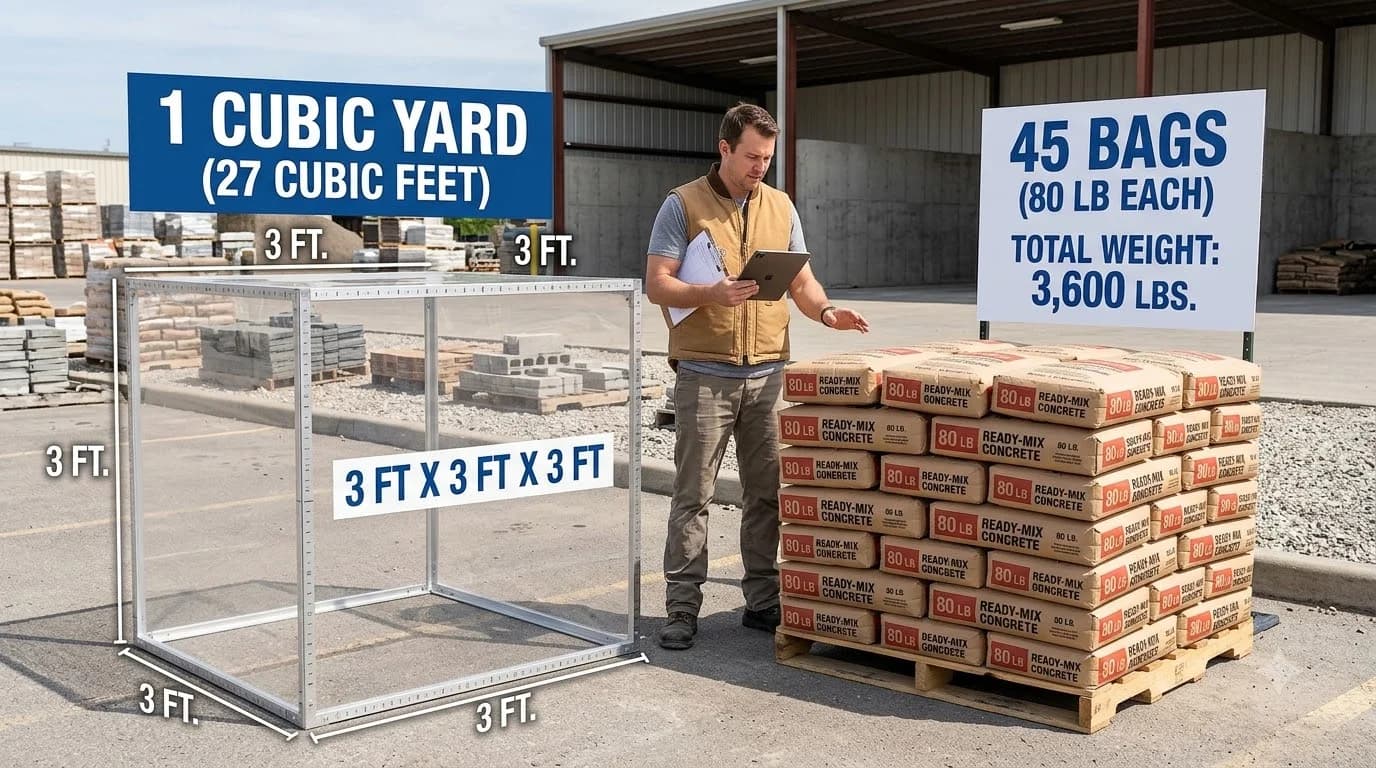
How Many Bags of Concrete in a Yard? (60 & 80 lb Guide)
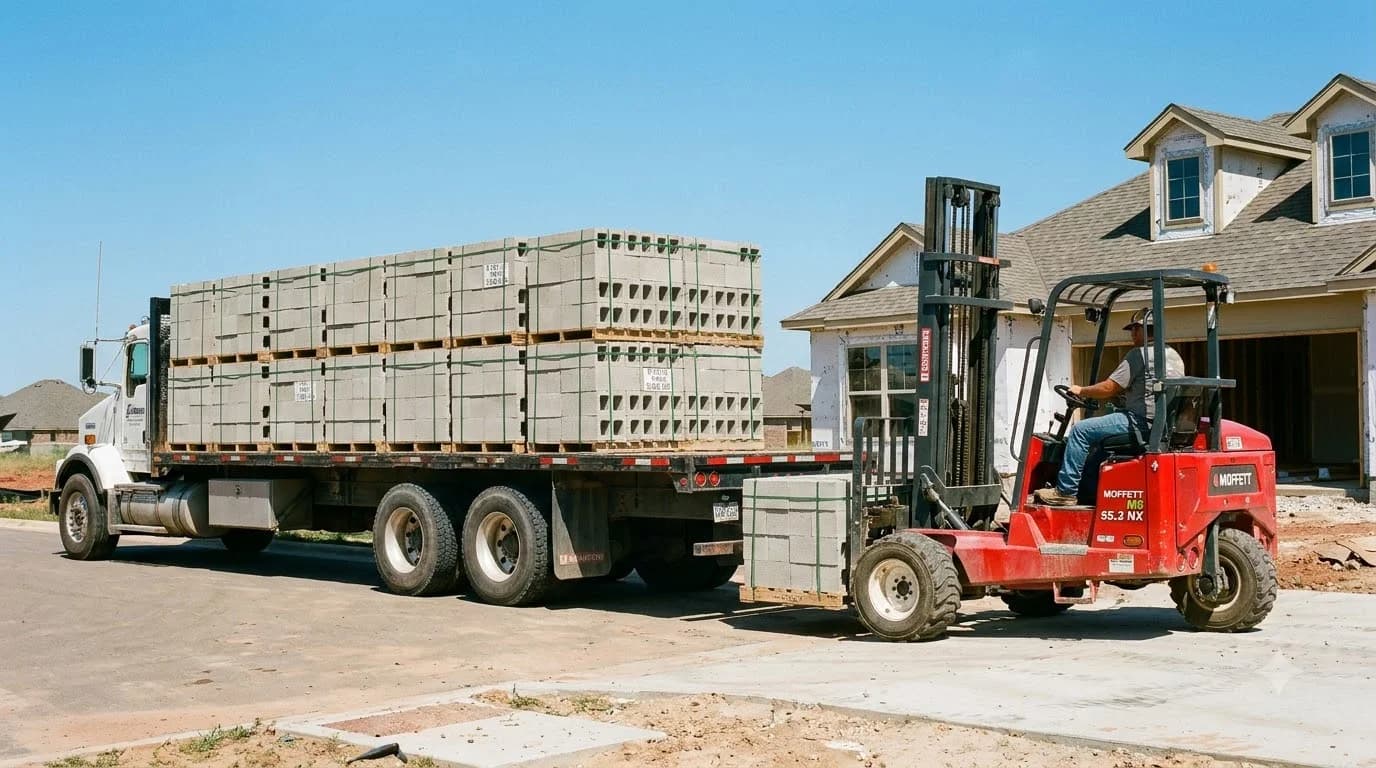
How Much Does a Pallet of Concrete Weigh? (2026 Guide)
How Much Does a Yard of Concrete Weigh? (Full Spec)