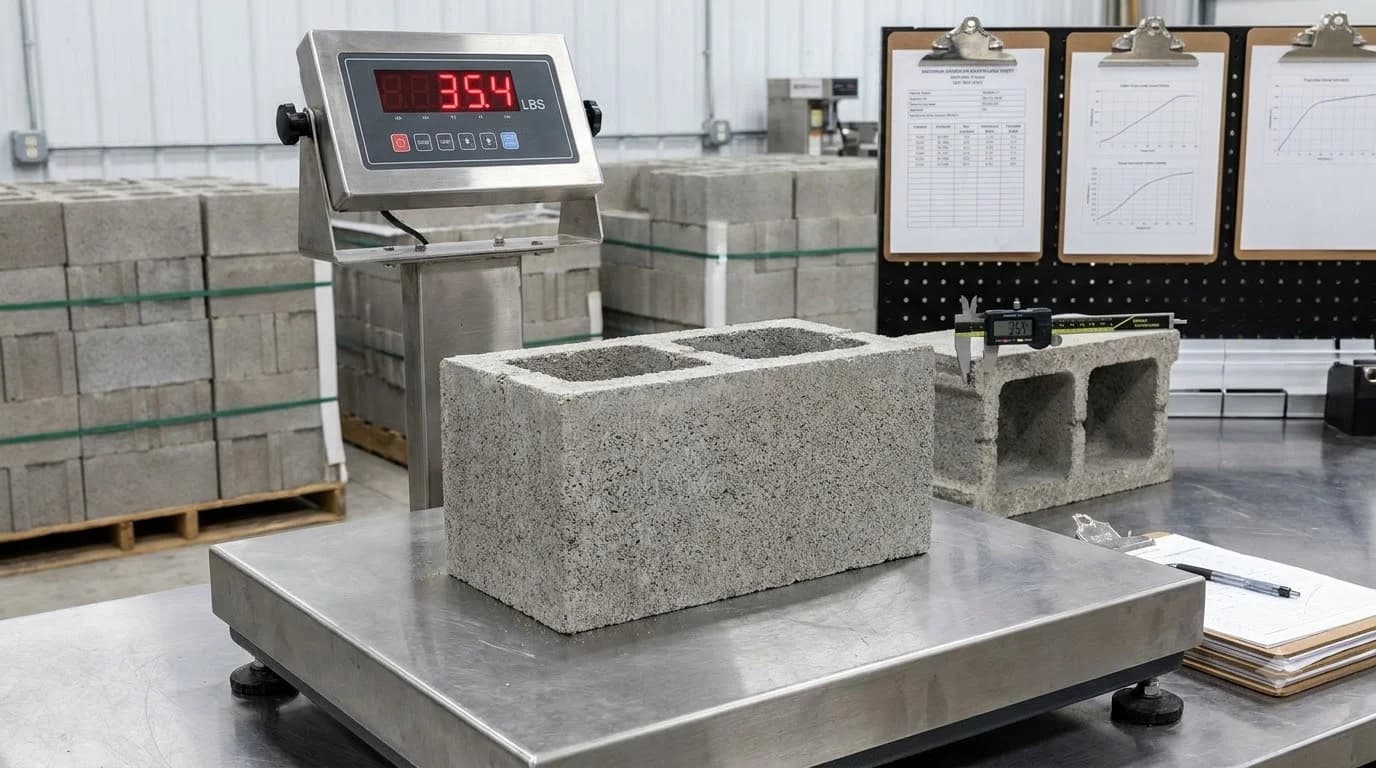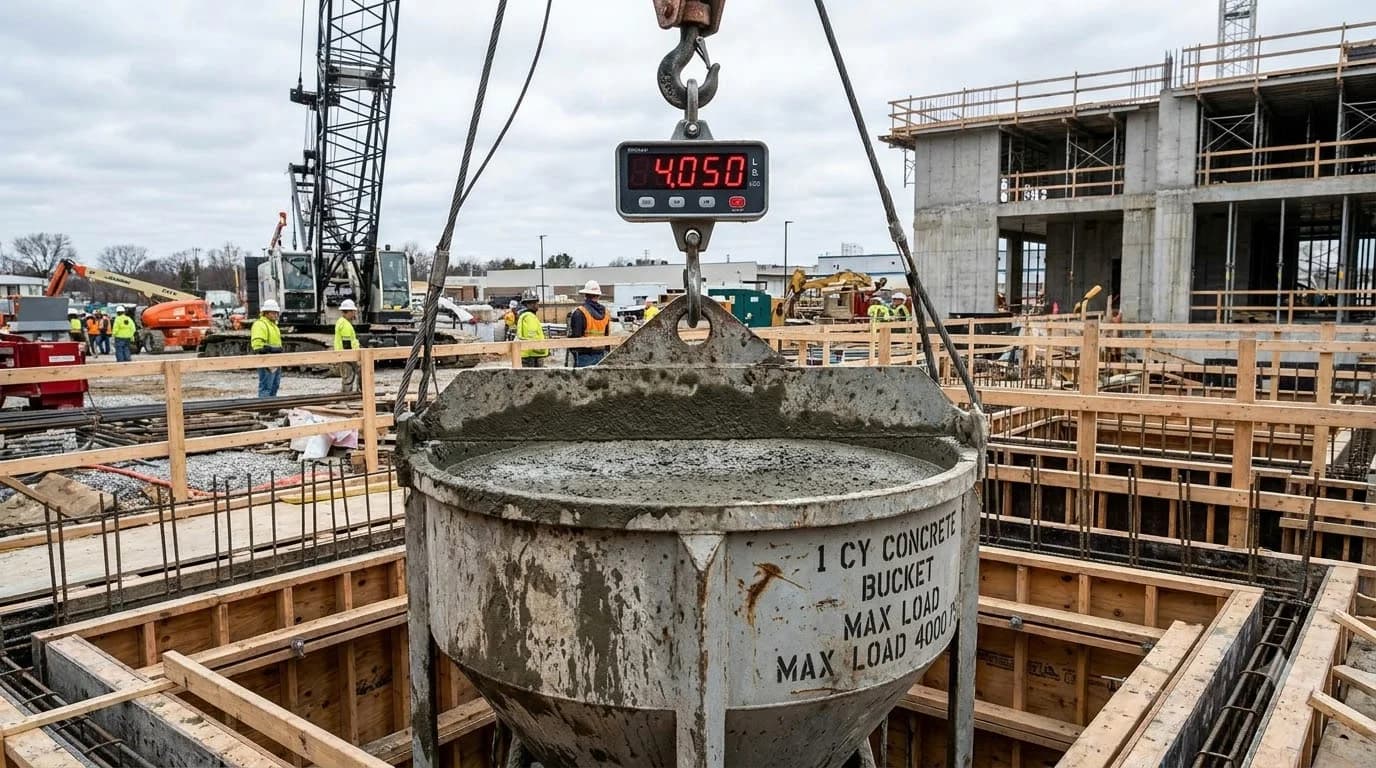
Quick Contractor Answer: 4,050 lbs (2.025 US Short Tons) per Cubic Yard
A standard cubic yard (27 cu ft) of normal-weight cured concrete weighs approximately 4,050 lbs (150 lbs/cu ft). When freshly mixed and wet, that same cubic yard weighs between 4,150 and 4,200 lbs due to free batch water. Lightweight mixes weigh 2,430 to 3,100 lbs, while radiation-shielding heavy concrete can surpass 6,000 lbs per yard.
1. The Mathematical Physics: Why Concrete Weighs ~4,050 lbs per Yard
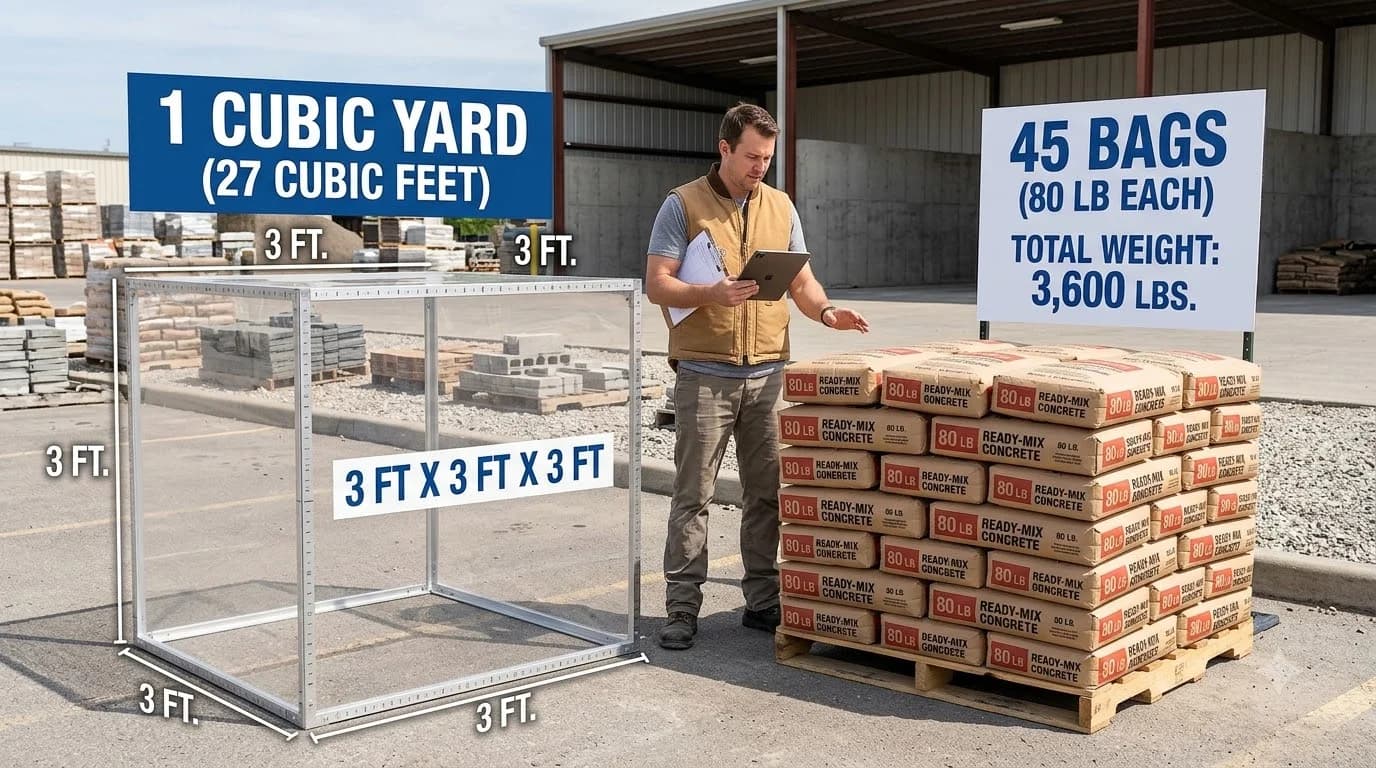
To understand concrete mass, we look at dimensional geometry and volumetric density under ASTM C138 (Standard Test Method for Density, Yield, and Air Content of Concrete). A cubic yard measures 3 feet wide by 3 feet long by 3 feet high:
Standard residential and commercial structural concrete incorporates crushed limestone or river gravel aggregates, washed coarse sand, Portland cement (ASTM C150 Type I/II), and batch water. Consolidated ready-mix concrete has a mass density between 145 and 150 pounds per cubic foot (pcf). Multiplying this density across 27 cubic feet yields:
If steel reinforcement (rebar cages, welded wire mesh) is installed, reinforced concrete dead loads are conventionally calculated by civil and structural engineers at 150 to 155 pcf (roughly 4,185 lbs/yd³) to account for the steel density of 490 lbs/cu ft.
2. Density Classification & Aggregate Weight Comparison
Concrete density is primarily determined by aggregate selection, which occupies 60% to 75% of the total mix volume. The American Concrete Institute (ACI 213R) recognizes three primary density categories:
| Concrete Classification | Density (lbs / cu ft) | Weight per Yard (lbs) | Weight in Short Tons | Dominant Aggregate & Use Case |
|---|---|---|---|---|
| Structural Lightweight | 90 – 115 lbs/cu ft | 2,430 – 3,105 lbs/yd³ | 1.21 – 1.55 Tons | Expanded shale, slate, or clay (ASTM C330); elevated bridge decks & high-rise slabs |
| Insulating / Cellular Concrete | 30 – 60 lbs/cu ft | 810 – 1,620 lbs/yd³ | 0.40 – 0.81 Tons | Preformed foam bubbles, perlite, vermiculite; roof insulation fills & lightweight leveling |
| Normal Weight (Ready-Mix) | 145 – 150 lbs/cu ft | 3,915 – 4,050 lbs/yd³ | 1.96 – 2.02 Tons | Crushed limestone, granite, natural gravel & quartz sand; foundations, slabs, driveways |
| Reinforced Concrete (1-2% Steel) | 150 – 155 lbs/cu ft | 4,050 – 4,185 lbs/yd³ | 2.02 – 2.09 Tons | Standard aggregate with deformed steel rebar cages; grade beams, columns, suspended slabs |
| Heavyweight (High-Density) | 180 – 240+ lbs/cu ft | 4,860 – 6,480+ lbs/yd³ | 2.43 – 3.24 Tons | Barite, magnetite, limonite, iron shot (ASTM C637); medical X-ray bunkers & nuclear shielding |
3. Wet vs. Cured vs. Dry Equilibrium Weight
Why do transit mix delivery tickets show higher weights than dry structural engineering tables? The answer lies in the hydration chemistry of Portland cement:
- Wet, Freshly Placed Concrete (4,150 – 4,200 lbs/yd³): When concrete is discharged from the chute, it contains all the batch water required for chemical hydration and mechanical slump placement (typically a water-to-cement ratio between 0.40 and 0.50, equating to 250 to 300 lbs of water per cubic yard).
- Cured Concrete at 28 Days (4,050 lbs/yd³): As the calcium silicate hydrate (C-S-H) gel crystalline matrix matures, approximately 50% of the initial mix water chemically binds into the permanent mineral structure.
- Oven-Dry / Equilibrium Concrete (3,900 lbs/yd³): Over months or years in heated residential or commercial structures, unbound evaporable water leaves the capillary pores, resulting in an ultimate long-term equilibrium weight reduction of 3% to 4%.
4. Hauling Logistics: Bagged Mixes vs. Ready-Mix Concrete Trucks
A common contractor and DIY dilemma is deciding between hauling bagged concrete from the home improvement center or ordering ready-mix delivery. Understanding the haul weight is critical for truck safety:
45 Bags = 1 Yard
Dry Weight: 3,600 lbs. Requires 450 lbs of water on site.
60 Bags = 1 Yard
Dry Weight: 3,600 lbs. Easier to handle but requires more cuts.
10 Yards = 40,500 lbs
Total truck GVW: ~66,500 – 70,000 lbs. Delivers in 1 pour.
Pickup Truck Warning: A standard half-ton pickup (Ford F-150, Chevy Silverado 1500, Ram 1500) has a typical payload capacity of 1,600 to 2,100 lbs. Loading 45 bags of 80 lb concrete (3,600 lbs) will severely crush the suspension, blow tires, and void warranties. Hauling 1 full cubic yard in bagged form requires a 1-ton pickup (F-350 / 3500 series) or two balanced trips in a 3/4-ton truck.
5. Formwork Pressure Calculations Under ACI 347R
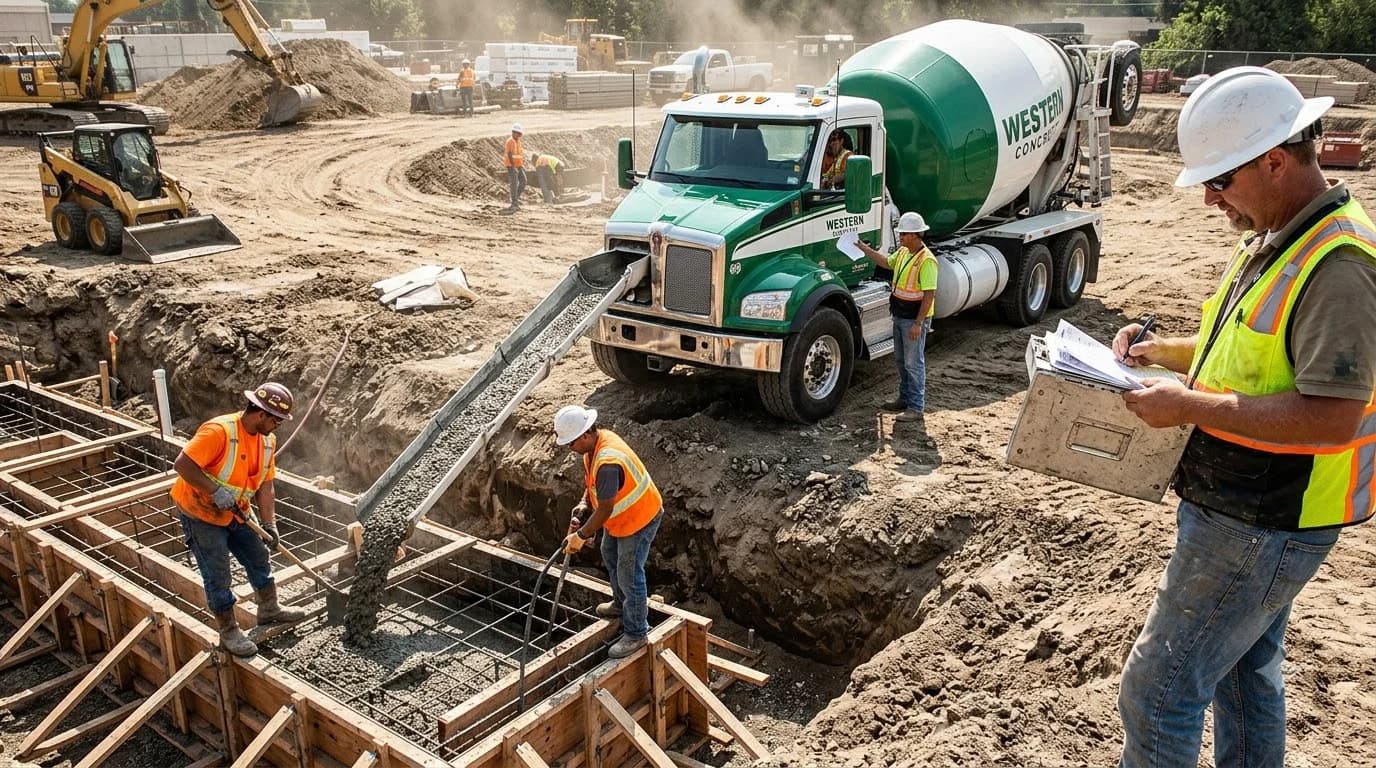
Formwork carpenters and foundation contractors must understand concrete weight because wet concrete acts as a heavy fluid exerting lateral hydrostatic pressure against vertical wall forms. According to ACI 347R (Guide to Formwork for Concrete):
For an 8-foot-tall foundation wall placed rapidly without setting, the hydrostatic head pressure at the bottom of the form reaches 1,200 pounds per square foot (psf). Inadequate snap-ties, walers, or strongbacks will experience catastrophic blowout under this immense hydrostatic tonnage.
6. Real-World Calculation: 24' × 24' Garage Slab Takeoff
Let's calculate the total concrete volume, weight, and subbase load for a standard residential two-car garage slab measuring 24 feet by 24 feet poured 4 inches thick:
- Calculate Slab Surface Area:24 ft × 24 ft = 576 square feet.
- Calculate Cubic Volume:576 sq ft × (4 / 12) ft = 192 cubic feet.
- Convert to Cubic Yards: 192 / 27 = 7.11 cubic yards. Adding a standard 10% allowance for grade variations and spillage gives 7.82 cubic yards (rounded to an 8.0-yard truck order).
- Compute Total Mass: 7.82 cu yd × 4,050 lbs/cu yd = 31,671 pounds (15.84 short tons).
- Subgrade Soil Bearing Load: 31,671 lbs ÷ 576 sq ft = 55 psf dead load transmitted to the compacted gravel subbase.
5 Critical Jobsite & Hauling Mistakes to Avoid
Overloading Residential Driveways
Allowing a fully loaded 10-yard concrete truck (70,000 lbs GVW) onto an unreinforced 4-inch residential concrete or asphalt driveway will crack and pulverize the surface. Have the truck chute from the street or hire a concrete line pump.
Exceeding Pickup Truck Axle Ratings
Loading two pallets or 45 bags of 80 lb concrete into a half-ton pickup will bottom out the bump stops, compromise steering geometry, and cause catastrophic brake fade. Never exceed your door-jamb GVWR sticker.
Under-bracing Tall Wall Formwork
Failing to calculate the 150 pcf hydrostatic fluid pressure of wet concrete leads to wall form blowouts. Pour high walls in controlled 3-to-4 foot lifts to allow partial initial stiffening before placing subsequent lifts.
Ignoring Subbase Compaction
A concrete patio or slab transmits 50 to 75 psf of dead load directly to the earth. Pouring over uncompacted backfill or native soil leads to uneven differential settling, cracking, and water ponding.
Need Exact Concrete Volume & Bag Counts?
Calculate precise cubic yards, 80 lb bags, gravel base, and estimated 2026 delivery costs.
Frequently Asked Questions
How many tons is a yard of concrete?
One cubic yard of normal-weight concrete weighs roughly 4,050 lbs, which equals approximately 2.025 US short tons (1 ton = 2,000 lbs).
How much does a 10-yard concrete truck weigh loaded?
A 10-yard concrete truck carries roughly 40,500 lbs of concrete. Adding the truck's empty tare weight (roughly 26,000 to 30,000 lbs), the total gross vehicle weight reaches 66,500 to 70,500 lbs (over 33 to 35 tons).
Can my pickup truck haul a yard of concrete in bags?
A cubic yard requires 45 bags of 80 lb concrete mix, weighing 3,600 lbs. A standard half-ton pickup (F-150 or Silverado 1500) has a payload limit of 1,600 to 2,200 lbs and will be severely overloaded. You need a 1-ton pickup (F-350) or two separate trips.
Why is wet concrete heavier than cured concrete?
Freshly placed wet concrete contains free water added for workability and batching (roughly 30 to 36 gallons per yard, weighing 250 to 300 lbs). As concrete hydrates and cures, roughly 100 to 150 lbs of surplus unreacted moisture evaporates into the atmosphere.
How much does a yard of lightweight concrete weigh?
Structural lightweight concrete manufactured with expanded shale, slate, or clay aggregates under ASTM C330 weighs between 2,430 and 3,100 lbs per cubic yard (90 to 115 lbs per cubic foot), saving up to 40% in structural dead load.
Building Codes & Primary Standards Cited
Standard Test Method for Density (Unit Weight), Yield, and Air Content of Concrete
Defines testing protocols and calculations for fresh and consolidated concrete unit mass.
Guide for Structural Lightweight-Aggregate Concrete
Establishes mix design limits and unit weight classifications for low-density structural concretes.
Guide to Formwork for Concrete
Governs lateral pressure formulas and formwork bracing requirements based on fresh concrete unit weight.
Estimations adhere to standard North American modular 3/8-inch mortar joint physics and 5% to 10% material waste factors. Local municipal building inspectors, stamped architectural blueprints, and local frost depth requirements supersede general reference guidelines.
Popular Quick Estimates
Pre-engineered takeoffs & benchmarks matched to this project
Related Calculators
Specialized tools for foundation, core fill, and budgeting
Cubic yards, bags, and slab volume for flatwork and footings
Dry block weight, filled core weight and hauling loads
Heavyweight structural blocks and bond beam units
Core grout volume in cubic yards and 80-lb pre-mix bags
Blogs & Construction Guides
Technical articles, IRC code standards, rebar schedules & freight logistics
How Much Does a Yard of Concrete Cost? (2026 Pricing)
How Many Bags of Concrete in a Yard? (60 & 80 lb Guide)
How Much Does a Pallet of Concrete Weigh? (2026 Guide)