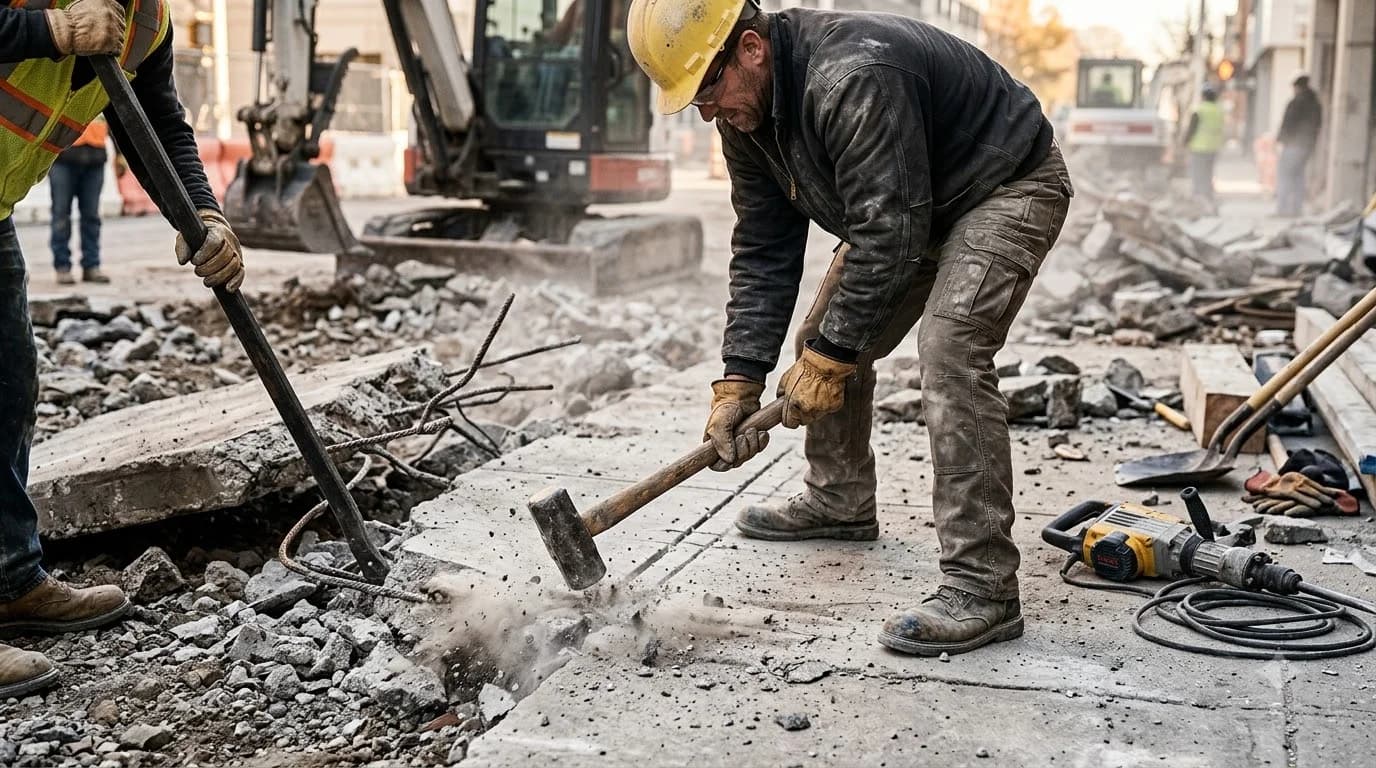
Quick Contractor Answer: Use Guillotine Splitters for Straight Runs, Angle Grinders for Curves
For high-speed straight cuts along patio borders, a manual mechanical paver splitter (guillotine) snaps pavers in 3 seconds with zero dust and no electricity. For curved walkways, radiuses, and intricate corner notches, use a 4.5-inch angle grinder equipped with a turbo-rim diamond blade. Score 1/2" deep on the top face, score the rear, and tap off the waste with a hammer.
1. High-Density Paver Physics: Why Standard Masonry Blades Dull
Interlocking concrete pavers are significantly tougher than standard cinder blocks or poured slabs. Under ASTM C936 (Standard Specification for Solid Concrete Interlocking Paving Units):
- Compressive Strength: Pavers must exceed an average compressive strength of 8,000 PSI (compared to 2,000 PSI for CMU blocks and 3,500 PSI for standard patio slabs).
- Low Porosity: Maximum water absorption is restricted to less than 5%, achieved through intense hydraulic press compaction and dense quartz/granite aggregate mixes.
- Abrasive Cutting Requirement: Inexpensive abrasive composite discs will disintegrate in one cut. Paver cutting requires industrial diamond tooling—specifically laser-welded diamond blades or high-pressure mechanical splitters capable of exerting 5 to 10 tons of localized shearing force.
2. Paver Cutting Tool Selection & Output Matrix
Match the tool to your patio design, cut geometry, and site conditions:
| Cutting Tool | Cut Style & Edge Finish | Cuts per Hour | Dust Emission | Ideal Application |
|---|---|---|---|---|
| Manual Mechanical Guillotine Splitter | Straight clean snap with natural chiseled edge | 80 – 120 cuts/hr | Zero Airborne Dust | Long straight patio borders, driveways, retaining walls |
| 4.5" Angle Grinder (Turbo Diamond) | Crisp clean edge with minor chipping | 30 – 50 cuts/hr | High (Requires HEPA shroud) | Serpentine curves, radius borders, corner notches |
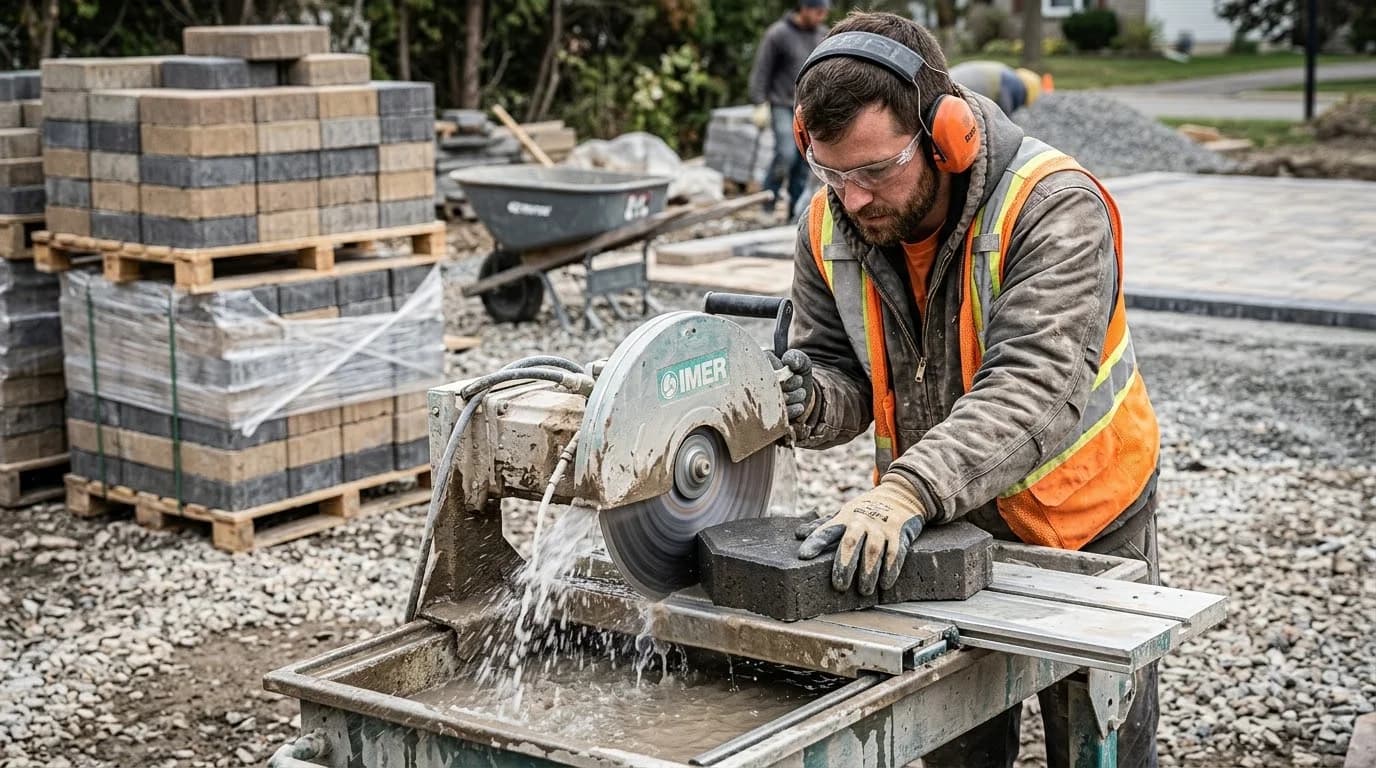
| Wet Masonry Sliding Table Saw | Factory glass-smooth edge | 40 – 60 cuts/hr | Zero Dust (Water slurry) | Precision pool coping, luxury commercial plazas |
| Masonry Cold Chisel & 3-lb Sledge | Rough irregular split | 10 – 15 cuts/hr | Very Low | Minor DIY repairs (fewer than 10 pavers) |
3. Step-by-Step Angle Grinder Cutting Protocol
Because a 4.5-inch angle grinder blade has a maximum cutting depth of approximately 1-1/4 inches, and standard driveway pavers are 2-3/8 inches (60mm) or 3-1/8 inches (80mm) thick, you cannot cut completely through in a single pass:
- Mark the Cut: Place the paver in position against your border line and scribe with a white grease pencil or permanent marker.
- Establish a Stable Base: Rest the paver on a sacrificial piece of 2x6 scrap lumber or rigid foam insulation. Never cut a paver while resting it on loose bedding sand, as sand shifts and binds the blade.
- Score the Face (1/2-Inch Deep): Run the spinning turbo diamond blade along your layout line, cutting 1/2 inch deep into the face. Keep both hands on the grinder and pull smoothly backward.
- Score the Back Face: Flip the paver over, align your cut line on the reverse side, and score 1/2 inch deep into the back.
- Snap and Clean: Place the paver over the edge of your timber with the scored line aligned with the wood corner. Strike the overhanging waste piece firmly with a rubber mallet or brick hammer. The paver will fracture cleanly along the scored core. Rasp any high core nubs with the diamond blade side.
4. Cutting Curved Patio Borders & Radiuses
Measuring and cutting individual curved pavers one by one is slow and creates jagged, uneven margins. Use the professional over-lay and cut-in-place technique:
- Lay All Pavers Past the Border: Install your field pavers normally, letting whole, uncut pavers run wild and extend past the planned curved perimeter.
- Scribe the Continuous Arc: Lay a flexible 1-inch PVC conduit pipe, heavy garden hose, or bender board across the surface to define the curved radius. Use marking spray paint or lumber chalk to trace the line continuously across all overlapping pavers.
- Cut in Place: Use an angle grinder or cutoff saw with a diamond blade to slice continuously along the chalk line, cutting through pavers while they remain bedded in sand.
- Install Edge Restraint Immediately: Pull away the cut waste pieces and install commercial spiked paver edging (ICPI Tech Spec 2) tight against the newly cut curve, driving 10-inch steel spikes every 12 inches.
5. OSHA Silica Safety & Dust Containment
Dry cutting 8,000 PSI pavers generates intense white clouds of respirable crystalline silica dust. Under OSHA 1926.1153 Table 1:
Always use water suppression or vacuum containment. When cutting with an angle grinder outdoors, attach a universal dust-shroud connected to a certified HEPA extractor delivering at least 25 CFM per inch of blade diameter. When wet-sawing, wear rubber safety boots and safety glasses to shield against projectile aggregate fragments.
5 Critical Concrete Paver Cutting Mistakes to Avoid
Cutting Small Slivers Less Than 2 Inches
Paver pieces under 2 inches wide lack the mass to withstand compactor vibration and vehicle traffic. They will crack or shift under load. Adjust field layout to ensure all cut pieces are at least half a paver width.
Cutting Directly on Bedding Sand
Cutting a paver resting on the uncompacted sand bed allows the paver to tilt, binding the high-speed blade and blowing silica sand into the operator's face.
Letting Wet Slurry Dry on Paver Faces
Slurry from wet saws dries within minutes into stubborn white efflorescent staining on colored decorative pavers. Rinse cut pavers with clean water before laying them in the sand bed.
Delaying Edge Restraint Installation
Leaving cut paver borders un-spiked overnight allows edge sand to erode during rain or foot traffic, destroying joint alignment before polymeric sand can be vibrated into place.
Planning a Paver Patio or Walkway?
Calculate paver counts, bedding sand, crushed stone base, and estimated 2026 material costs.
Frequently Asked Questions
Can you cut concrete pavers with a chisel and hammer?
Yes, for small DIY jobs. Use a 3-inch wide hardened masonry cold chisel and a 3-lb drilling sledge. Score a 1/8-inch deep groove along all four faces of the paver, then strike firmly in the center groove to snap the paver cleanly.
What is the best blade for cutting interlocking pavers?
A 4.5-inch or 7-inch continuous turbo-rim diamond blade delivers the best balance of fast aggregate grinding and chip-free top chamfer edges. Segmented blades run cooler for dry cuts, but turbo blades leave a cleaner finish on decorative pavers.
How do you cut curved borders and radius corners on a paver patio?
Lay all border pavers fully intact, extending outward over the proposed curve. Lay a flexible PVC conduit or garden hose across the pavers to define the arc, trace with lumber chalk, and cut along the line in place using an angle grinder with a diamond blade.
Why do pavers crack irregularly when using a guillotine splitter?
Guillotine splitters require uniform pressure across the paver thickness. If the paver has a textured or tumbled slate surface, the hardened steel splitting blades make uneven contact, causing the fracture to wander off the intended layout line.
How do you control concrete dust when cutting pavers in a backyard?
Use a wet masonry table saw with continuous water recirculating pump, or attach a water-feed kit to your handheld saw. If dry cutting with an angle grinder, connect a vacuum shroud with an OSHA Table 1 compliant HEPA extractor.
Building Codes & Primary Standards Cited
Standard Specification for Solid Concrete Interlocking Paving Units
Establishes minimum 8,000 psi compressive strength and maximum 5% absorption standards.
Construction of Interlocking Concrete Pavements
Interlocking Concrete Pavement Institute specifications for edge restraints, cut tolerances, and sand bedding.
Respirable Crystalline Silica Standard - Handheld Saws
Governs mandatory water suppression and HEPA vacuum engineering controls during masonry cutting.
Estimations adhere to standard North American modular 3/8-inch mortar joint physics and 5% to 10% material waste factors. Local municipal building inspectors, stamped architectural blueprints, and local frost depth requirements supersede general reference guidelines.
Popular Quick Estimates
Pre-engineered takeoffs & benchmarks matched to this project
Related Calculators
Specialized tools for foundation, core fill, and budgeting
Heavyweight structural blocks and bond beam units
Cubic yards, bags, and slab volume for flatwork and footings
Core grout volume in cubic yards and 80-lb pre-mix bags
Step-by-step masonry formulas and corner waste rules
Blogs & Construction Guides
Technical articles, IRC code standards, rebar schedules & freight logistics
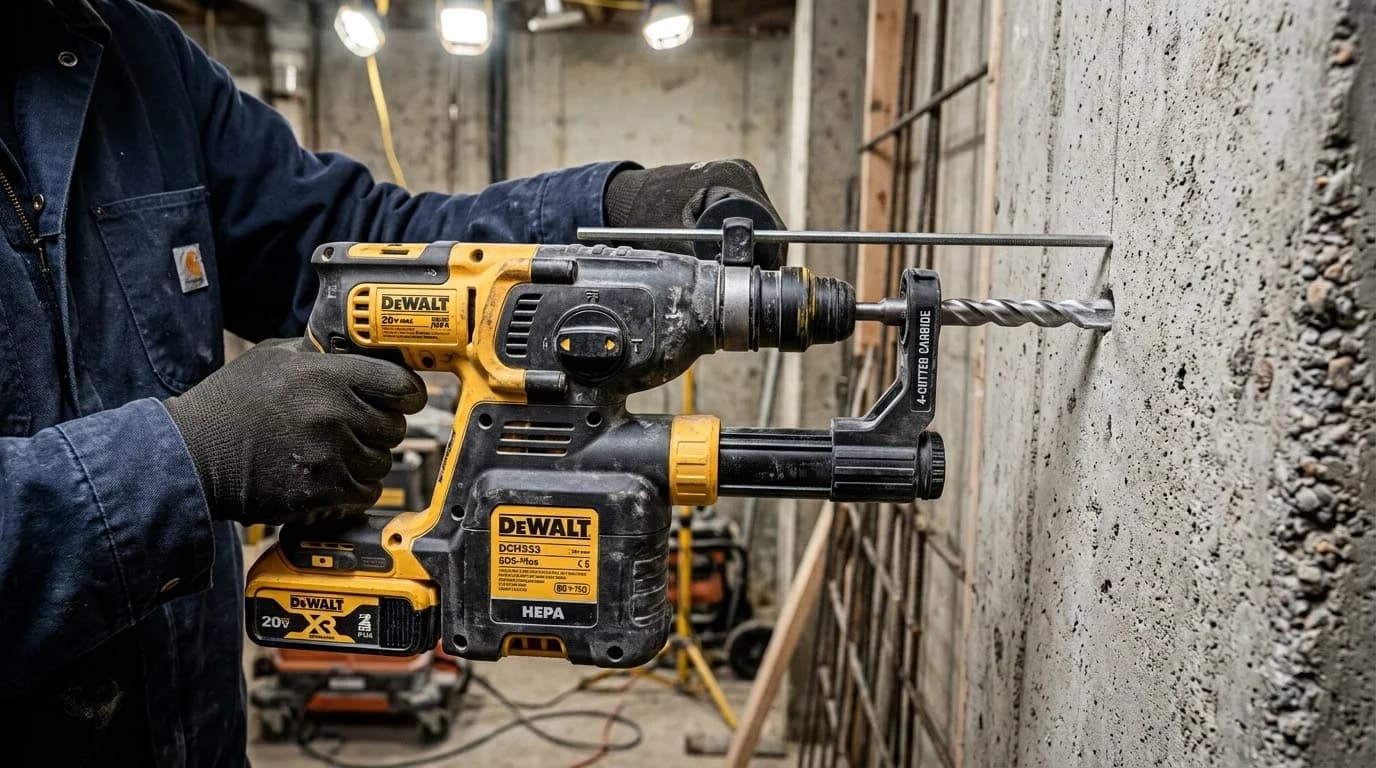
How to Drill into Concrete: Hammer Drills & SDS Bits
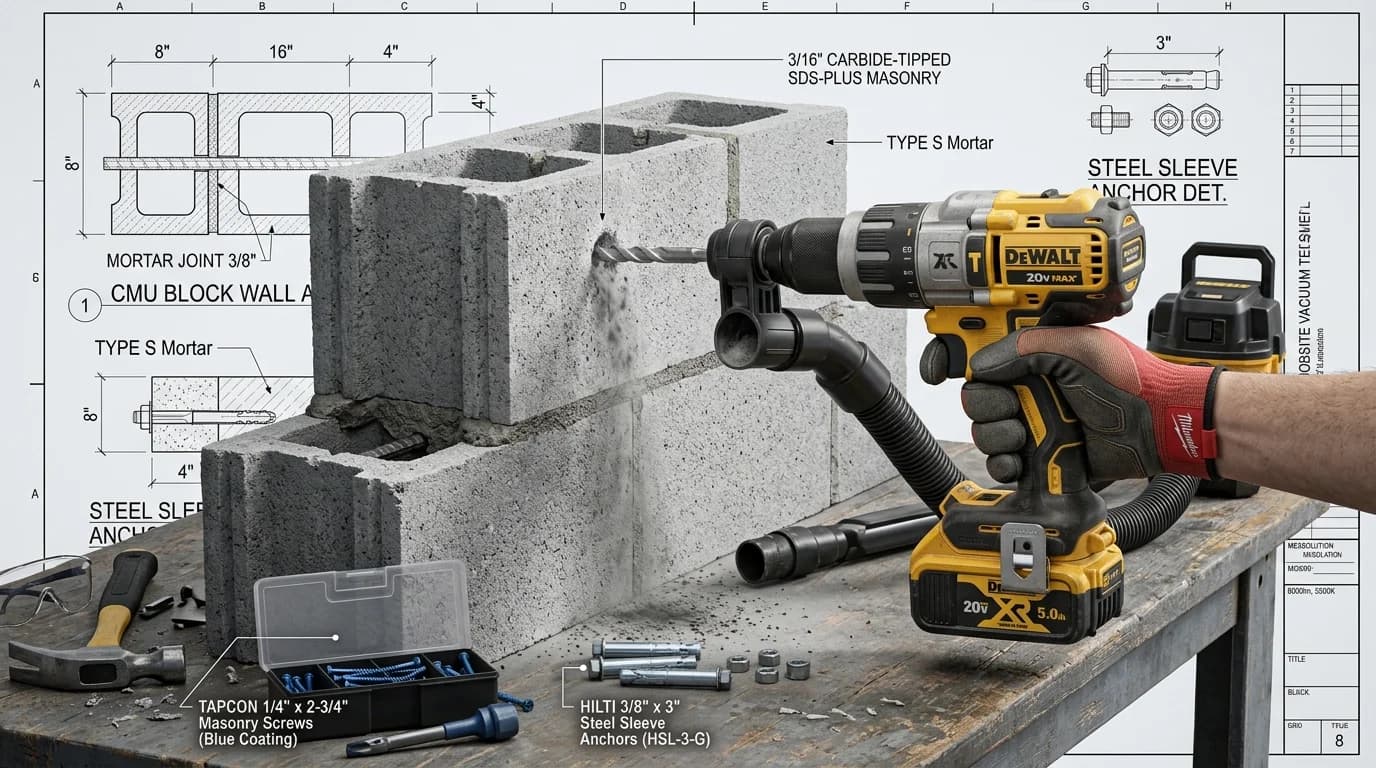
How to Drill into Cinder Block & Fasten Heavy Anchors
How to Cut Concrete Slabs: Circular Saw & Diamond Blades