Quick Answer: The Golden Rules for Drilling Cinder Block
- Use a Hammer Drill: A standard rotary drill will spin and overheat; a hammer drill delivers 20,000–40,000 blows per minute to shatter the aggregate.
- Respect the 1-1/4" Shell: Hollow CMUs only have 1-1/4 inches of concrete before breaking into empty core cavities. Don't use wedge anchors in hollow cells.
- Avoid the Mortar Bed: Never drill into mortar lines for structural loads; anchor directly into the block face shell for maximum pull-out resistance.
- Clear the Dust: Vacuum or blow out the hole before driving Tapcons; compacted masonry dust causes screws to bind and snap heads off.
1. Anatomy of a Cinder Block: Where to Drill
Standard ASTM C90 Concrete Masonry Units (CMUs) are not solid concrete throughout. A standard 8x8x16 unit has three structural zones that dictate how fasteners behave:
Exterior Face Shells
The front and back walls measure exactly 1-1/4" to 1-3/8" thick. Once your bit drills through this shell, it immediately enters hollow air. Ideal for Tapcons (short embedment) and toggle bolts.
Hollow Core Cavities
Two large hollow voids (each roughly 5" x 5") designed for weight reduction and vertical rebar grouting. Wedge anchors will simply slip or break the backside shell here.
Central Webs & Grout
The cross-ribs (webs) connecting the shells measure 1" to 1-1/8" thick. If the cores are filled with ASTM C476 concrete grout, the entire wall is solid, permitting heavy wedge anchors.
2. Cinder Block Anchor Selection Matrix
Selecting the wrong anchor is the #1 cause of failed installations on concrete block walls. Review the engineered load capacities and applications below:
| Anchor Type | Substrate Zone | Working Shear Load | Working Tension Load | Best Application |
|---|---|---|---|---|
| Tapcon Concrete Screw (3/16") | Face Shell (1" embedment) | 80–120 lbs | 60–90 lbs | Electrical boxes, conduit, furring strips |
| Tapcon Large Diameter (1/4") | Face Shell or Grout Core | 150–220 lbs | 110–160 lbs | 2x4 framing, light shelving, hose reels |
| Strap Toggle / Snaptoggle (1/4") | Hollow Core Cavity | 200–280 lbs | 150–210 lbs | Heavy TV wall mounts, heavy cabinetry |
| Steel Sleeve Anchor (3/8") | Solid Central Web or Grout | 350–500 lbs | 280–420 lbs | Garage door tracks, heavy workshop tools |
| Plastic Ribbed Plug (Avoid) | Face Shell | < 25 lbs | < 15 lbs | Light picture frames only (easily fails) |
3. Step-by-Step: How to Drill Concrete Block Like a Pro
Mark Location & Test for Voids
Tap the wall lightly with the plastic handle of a screwdriver. A hollow, resonant ping indicates you are in front of a hollow core cavity (perfect for toggle bolts). A dull, solid thud indicates a center web, corner jamb, or rebar-filled grout cell (ideal for Tapcons or sleeve anchors).
Set Drill Depth & Match Bit Diameter
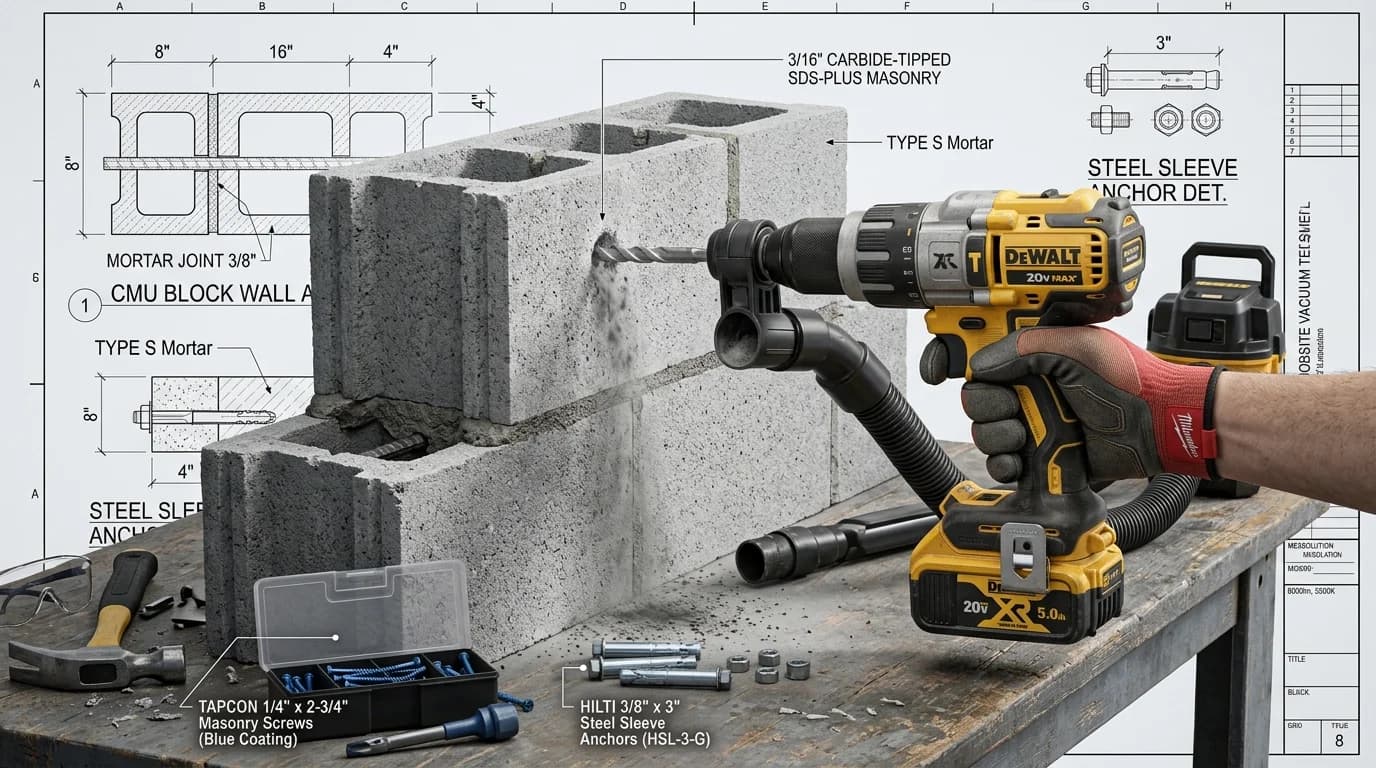
For Tapcons, the drill bit diameter must match the proprietary screw manufacturer specs (5/32" bit for 3/16" Tapcon; 3/16" bit for 1/4" Tapcon). Set your drill stop gauge to drill at least 1/4" deeper than the screw length to give dust room to settle.
Start at Low RPM with Moderate Hammer Action
Hold the drill perpendicular (90 degrees) to the wall. Start at low RPM without hammer mode for 5 seconds to establish a pilot indent so the bit does not skate across the block. Once indented, engage hammer mode and apply firm, steady pressure. Let the percussion do the work—forcing the drill overheats the carbide tip.
Clean the Borehole (OSHA Dust Protocol)
Concrete masonry contains respirable crystalline silica (OSHA 29 CFR 1926.1153). Use a HEPA vacuum nozzle placed directly beneath the drill hole during drilling. Before inserting anchors, blow out residual powder with a rubber bulb blower or vacuum tube.
Drive Fastener Without Over-Torquing
When driving Tapcon screws, use a standard drill/driver with clutch set to medium, or a hand ratcheting screwdriver for the final two turns. High-torque impact drivers can strip out the soft concrete threads in the 1-1/4" face shell, ruining anchor holding power.
4. Mounting Heavy TV Brackets, Cabinets & Gym Rigs
For dynamic cantilevered loads (such as an articulating TV arm extending 20 inches out from the wall), standard expansion anchors can pry free under cyclic leverage. Here is the contractor standard for mounting heavy hardware:
Hollow Wall Mounting (Toggle Bolts)
Drill a 1/2" hole through the face shell into the void. Insert a metal Toggler Snaptogglewith 1/4"-20 machine bolt. The solid metal bar rests flat against the inside face of the concrete shell, supporting up to 265 lbs ultimate tensile load per anchor.
Solid Web or Grout Core (Wedge Anchors)
If cores have been filled with concrete grout under IRC Section R606 structural codes, use 3/8" x 3-1/2" zinc-plated steel wedge anchors. Torque the hex nut to 25 ft-lbs to draw the expansion collar outward against the rock-solid grout core.
Frequently Asked Questions
Can I drill into a cinder block with a regular cordless drill?
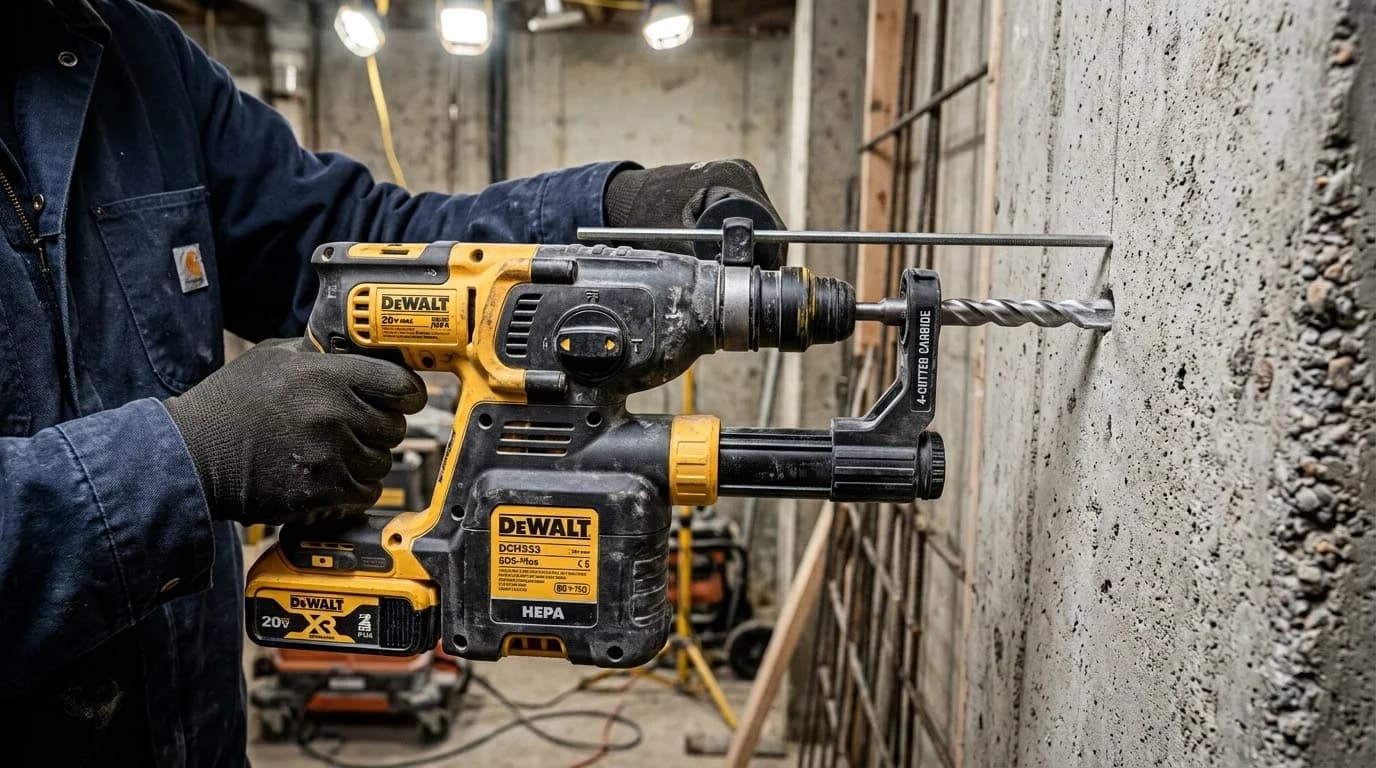
Yes, for a few small 3/16-inch or 1/4-inch holes using a sharp carbide-tipped masonry drill bit, a standard rotary drill will work, though it will take significantly more time and arm pressure. For multiple holes, hard aggregate, or holes 5/16-inch and larger, a dedicated hammer drill or SDS-Plus rotary hammer is essential to pulverize the cured concrete matrix without burning out the bit.
Should you drill into the cinder block face or the mortar joint?
Always drill into the concrete block face shell (or solid central web) for structural loads. Mortar joints (typically ASTM C270 Type N or S) are softer and have significantly lower tensile pull-out strength than the ASTM C90 concrete face shell (1,900+ PSI). Fasteners anchored in mortar joints frequently loosen over time under dynamic or heavy loads.
What are the best anchors for hanging heavy items on hollow cinder block?
For hollow block cavities, heavy-duty 1/4-inch toggle bolts or strap toggles (such as Toggler Snaptoggles) are the strongest option, supporting 100 to 250 lbs per anchor. For solid webs or grout-filled cores, Tapcon masonry screws (up to 60-120 lbs shear) or steel sleeve anchors provide rapid, rigid fastening.
How do I hang a heavy TV or gym equipment on a cinder block wall?
To hang heavy flat-screen TVs, pull-up bars, or heavy garage shelving, use four 1/4-inch or 3/8-inch toggle bolts placed through the face shell into the hollow cavity, or 3/8-inch sleeve anchors if drilling directly into a solid grout-filled core. Never rely on plastic expansion plugs for overhead or high-vibration cantilevered loads.
Building Codes & Primary Standards Cited
Standard Specification for Loadbearing Concrete Masonry Units
Governs face shell minimum thickness (1.25 inches) and minimum net compressive strength of 1,900 psi.
Respirable Crystalline Silica Standard for Construction
Requires HEPA vacuum shrouds and commercial dust extraction during all power drilling in concrete masonry.
General Masonry Construction - Grout & Rebar Embedment
Regulates concrete grout placement in core cells and fastener embedment criteria for structural ties.
Estimations adhere to standard North American modular 3/8-inch mortar joint physics and 5% to 10% material waste factors. Local municipal building inspectors, stamped architectural blueprints, and local frost depth requirements supersede general reference guidelines.
Popular Quick Estimates
Pre-engineered takeoffs & benchmarks matched to this project
Related Calculators
Specialized tools for foundation, core fill, and budgeting
Standard 8-inch series wall and reinforcement estimates
Dry block weight, filled core weight and hauling loads
Straight and multi-wall runs with mortar and waste allowances
Complete 4-wall structures, sheds and masonry workshops
Blogs & Construction Guides
Technical articles, IRC code standards, rebar schedules & freight logistics
How to Drill into Concrete: Hammer Drills & SDS Bits
How to Cut Cinder Blocks: Grinder, Saw & Chisel Guide
How to Insulate & Frame a Cinder Block Wall (Guide)