Quick Contractor Answer: Use Step-Cutting with Continuous Water Lubrication
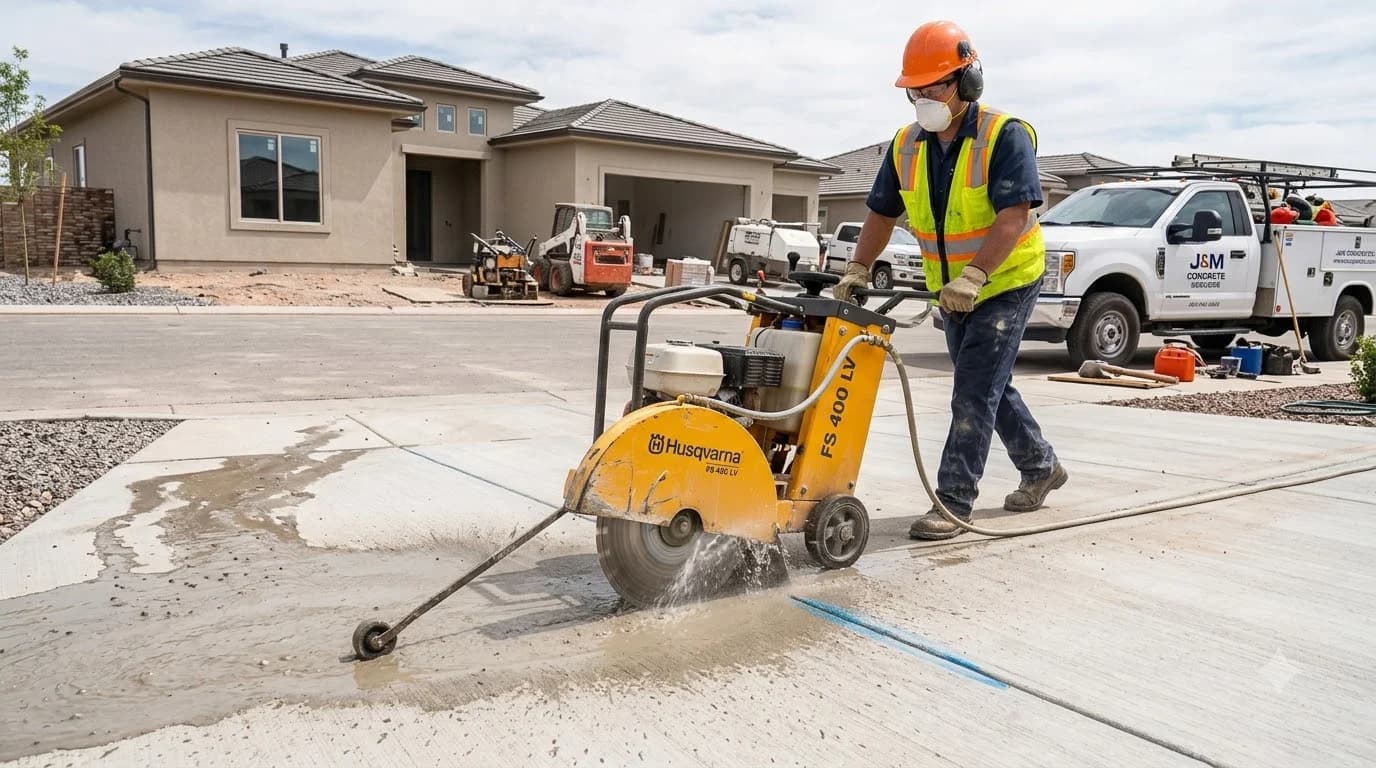
Never force a saw to cut 4 inches of concrete in a single pass. Equip a handheld circular saw (up to 2-1/4" depth) or 14-inch demolition cutoff saw with a laser-welded segmented diamond blade. Make an initial shallow 1/2-inch guide cut, then lower the blade in 1-inch increments. Feed continuous water to cool the blade and eliminate airborne silica dust under OSHA Table 1.
1. Diamond Blade Mechanics: How Concrete Is Cut
A diamond blade does not cut concrete like a wood saw blade—it pulverizes and grinds the aggregate through abrasive friction. The perimeter consists of synthetic diamond crystals encased in a powdered metal matrix (cobalt, bronze, and iron) laser-welded to a high-tension steel core under ANSI B7.1 safety standards:
- Segment Matrix Wear: As the diamond crystals grind hard granite or river gravel aggregates, they fracture and dull. The abrasive concrete paste slowly wears away the metal bonding matrix, exposing fresh layers of razor-sharp diamonds underneath.
- Hard Concrete vs. Soft Concrete Bond: Hard aggregate concrete (flint, quartz, trap rock) requires a soft-bond diamond blade so the matrix wears fast enough to expose new diamonds. Soft aggregate (limestone, cinder) requires a hard-bond blade to prevent premature segment consumption.
2. Concrete Saw Equipment & Depth Matrix
Match the tool to your slab thickness and project scale:
| Saw Equipment Type | Blade Diameter | Max Cutting Depth | Power Source | Best Application |
|---|---|---|---|---|
| Standard Handheld Circular Saw | 7-1/4 inches | 2-1/4 to 2-3/8 inches | 15A Electric (Corded) | Control joints in 4" slabs, decorative scoring, DIY patios |
| Handheld Cut-Off Saw (Demolition) | 12 – 14 inches | 4 to 5 inches | 2-Stroke Gas or 60V Battery | Full-depth cuts through 4" slabs, plumbing trenches, curbs |
| Walk-Behind Floor Saw | 14 – 20 inches | 5 to 8 inches | Gas / Diesel Engine | Commercial parking lots, long highway expansion joints |
| Early-Entry Green Concrete Saw | 6 – 8 inches | 1 to 1-1/2 inches | Small Gas Engine with Skid Plate | Cutting green concrete 2 hours after finishing (Soff-Cut) |
3. The Professional Step-Cut Procedure
Attempting to plunge a circular saw to full depth in one pass overloads the motor, glazes the diamonds, and increases kickback hazard. Follow this step-cut protocol:
- Snap and Seal the Layout Line: Snap a high-contrast chalk line. Spray a thin coat of clear acrylic lacquer over the chalk line; this prevents the continuous water stream from washing your guideline away.
- Pass 1 - The 1/2-Inch Tracking Kerf: Set your saw blade depth to exactly 1/2 inch. Turn on the water feed and guide the saw smoothly along the line. This shallow initial pass creates a straight track that prevents the blade from wandering or binding during subsequent passes.
- Pass 2 - Intermediate Depth: Increase the blade depth to 1-1/2 inches. Run the saw through the established groove. Let the motor maintain maximum RPM; never force forward pressure.
- Pass 3 - Final Full Cut: Lower the blade to the final target depth (e.g., 2-1/2 inches on a 7-1/4" saw, or full 4 inches on a cut-off saw). Keep both hands firmly on the saw grips.
- Slurry Management: Vacuum the wet slurry immediately using a wet-vac. Concrete slurry that dries on adjacent slab surfaces creates stubborn white calcium carbonate staining.
4. Control Joint Timing & Depth Rules (ACI 302.1R)
Concrete shrinks as moisture evaporates during curing (roughly 1/16 inch per 10 feet). Control joints create weakened planes that predetermine where shrinkage cracks occur:
- Depth Requirement (D/4): Under ACI 302.1R, the saw kerf must be at least one-fourth of the total slab thickness. For a standard 4-inch slab, cut exactly 1 inch deep. For a 6-inch slab, cut 1-1/2 inches deep.
- Timing Window: Conventional wet saw cutting must occur between 12 and 24 hours after finishing (as soon as the concrete can support foot traffic without marring). Cutting too early causes aggregate unraveling (frayed edges). Cutting too late allows random drying shrinkage cracks to develop before joints are cut.
- Joint Spacing Rule:Multiply slab thickness in inches by 2 to 2.5 to determine maximum joint spacing in feet. For a standard 4-inch slab: 4 × 2 = 8 feet to 4 × 2.5 = 10 feet square panels.
5. OSHA Silica Safety & Electrical Precautions
Cutting concrete dry releases hazardous concentrations of respirable crystalline silica dust. Under OSHA 29 CFR 1926.1153 Table 1:
- Mandatory Water Delivery: Handheld saws must be equipped with an integrated water delivery system that supplies continuous water to the blade collar.
- Dry Cutting Alternative: If water is prohibited (such as near electrical panels), you must use a commercially manufactured dust-extraction shroud connected to a HEPA vacuum with at least 25 CFM per blade inch, accompanied by an APF 10 half-mask respirator.
- GFCI Protection: When wet cutting with an electric circular saw, plug into an inline Ground Fault Circuit Interrupter (GFCI) to prevent electrical shock from slurry splash.
5 Critical Concrete Slab Cutting Mistakes to Avoid
Cutting Full Depth in a Single Plunge
Plunging a 14-inch saw straight to 4 inches binds the blade, causes severe dangerous kickback, overheats the engine, and burns out the diamond segments. Always step-cut in passes.
Twisting or Tilting the Blade in Kerf
Pivoting the saw sideways while running pinches the diamond segments against concrete sidewalls, instantly warping the steel core and potentially shedding diamond segments.
Waiting Too Long to Cut Control Joints
Waiting 48 hours after pouring means internal tensile stresses have already triggered cracks. Random jagged cracks will appear adjacent to your newly cut straight lines.
Letting Wet Slurry Dry on Finished Concrete
Allowing wet concrete slurry to dry on surrounding driveways or patios creates permanent white mineral staining that cannot be washed away without harsh acid washing.
Planning a Slab Replacement or Pour?
Calculate ready-mix concrete yards, joint spacing, rebar, and 2026 pricing in seconds.
Frequently Asked Questions
Can you cut concrete with a regular wood circular saw?
Yes, you can cut concrete with a standard 7-1/4" circular saw by installing a diamond masonry blade. However, concrete dust is abrasive and will destroy open-vented electric motors; always connect a GFCI outlet, make shallow 1/2-inch passes, and blow out motor vents with compressed air immediately after use.
How deep should contraction control joints be cut in a slab?
Under ACI 302.1R, contraction control joints must be saw-cut to a depth of one-fourth of the total slab thickness (1 inch deep for a 4-inch slab, or 1.5 inches deep for a 6-inch slab) within 4 to 24 hours of pouring to prevent random shrinkage cracking.
What happens if you cut concrete dry without water?
Dry cutting concrete without a vacuum shroud releases dangerous clouds of respirable crystalline silica dust (an OSHA Table 1 violation). In addition, dry friction overheats the blade core, causing steel warping, diamond segment glazing, and loss of cutting speed.
How do you prevent saw kickback when cutting concrete?
Never twist or tilt the saw in the kerf cut. Use the 'step-cutting' method by making an initial 1/2-inch deep tracking score before lowering the blade in 1-inch increments. Support both sides of the slab to prevent the kerf from pinching the blade.
Can a diamond blade cut through steel rebar in concrete?
Yes, standard laser-welded segmented diamond blades can cut through embedded steel rebar and wire mesh. When hitting steel, reduce forward feed pressure and let the blade cut through the rebar at high RPM to prevent overheating the diamond bond.
Building Codes & Primary Standards Cited
Guide to Concrete Floor and Slab Construction
Establishes timing, depths (D/4), and spacing rules for contraction control joints.
Respirable Crystalline Silica Standard - Handheld Saws
Mandates integrated continuous water delivery systems feeding saw blades during operation.
Safety Requirements for the Use, Care, and Protection of Abrasive Wheels
Sets rotational speed limits, flange specifications, and blade core safety inspections.
Estimations adhere to standard North American modular 3/8-inch mortar joint physics and 5% to 10% material waste factors. Local municipal building inspectors, stamped architectural blueprints, and local frost depth requirements supersede general reference guidelines.
Popular Quick Estimates
Pre-engineered takeoffs & benchmarks matched to this project
Related Calculators
Specialized tools for foundation, core fill, and budgeting
Cubic yards, bags, and slab volume for flatwork and footings
Heavyweight structural blocks and bond beam units
Core grout volume in cubic yards and 80-lb pre-mix bags
Cell fill requirements for low-lift and high-lift grouting
Blogs & Construction Guides
Technical articles, IRC code standards, rebar schedules & freight logistics
How to Drill into Concrete: Hammer Drills & SDS Bits
How to Drill into Cinder Block & Fasten Heavy Anchors
How to Cut Concrete Pavers: Angle Grinder & Splitters