Quick Takeoff & Specifications Summary: Stamped Concrete Slabs
For an exterior stamped patio or driveway poured at 4 inches thick: specify a 4,000 PSI 6-sack mix (564 lbs cement/cu yd) with 3/8-inch pea gravel or #67 crushed aggregate, 4-inch slump, and 1.0 lb/cu yd polypropylene microfibers. Typical 2026 turnkey contractor costs run $14.00 to $28.00 per square foot installed ($14–$18 for single pattern/color; $20–$28 for contrasting borders and dual antique releases). Begin stamping when bleed water is fully absorbed and the surface yields a 1/4-inch thumbprint impression without paste transfer.
1. Structural Mix Design and Subgrade Preparation for Stamped Slabs
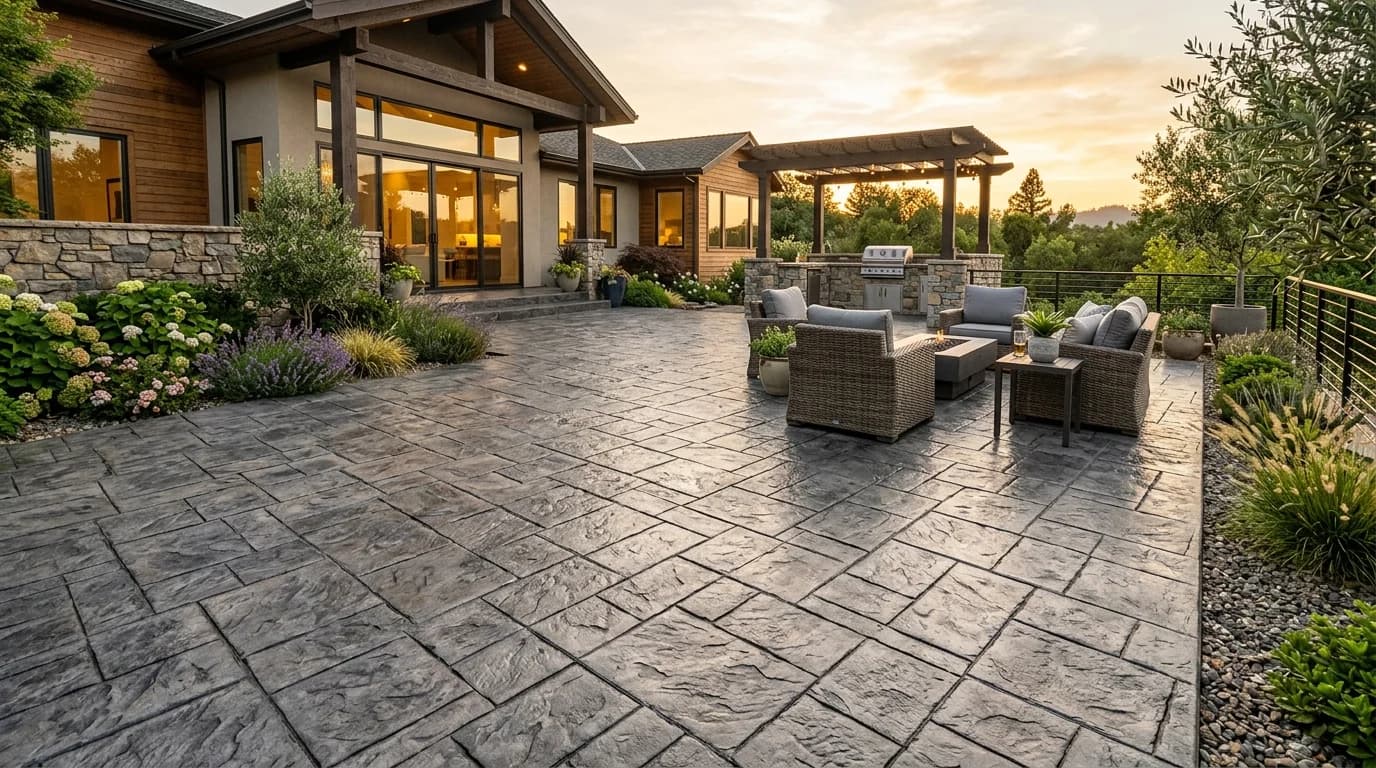
Architectural stamped concrete is not ordinary flatwork. Because stamping tools displace paste and drive aggregate downward by 1/4 to 1/2 inch to form realistic stone clefts and simulated grout lines, the ready-mix batch design must balance plasticity, workability, and cohesive shear strength. Standard commercial slab mixes containing large 1-inch or 1.5-inch gravel aggregate cause severe telegraphing and crushed stamp tool edges.
Under the American Concrete Institute decorative guide (ACI 310R), stamped concrete slabs require a minimum compressive strength of 4,000 PSI at 28 days, formulated with a 6-sack cement content (564 pounds of Portland cement per cubic yard). The aggregate gradation should specify a maximum coarse aggregate size of 3/8 inch (often termed pea gravel or ASTM C33 size #8) or well-graded 1/2-inch stone (#67 aggregate). This small-aggregate matrix provides a generous, aggregate-free surface cream layer measuring roughly 3/8-inch deep, ensuring that polyurethane texture mats imprint sharply without catching on protruding stones.
Subgrade preparation dictates whether your decorative investment survives winter frost cycles. The natural soil base must be excavated, cleared of organic topsoil, and backfilled with a minimum of 4 inches of crushed angular road base aggregate (such as 3/4-inch minus limestone or crushed gravel). Compact the aggregate mechanically using a vibratory plate compactor to at least 95 percent Modified Proctor density. Uneven settlement of even 1/4 inch beneath a decorative slab will cause shear cracks that rupture the continuous stone pattern.
2. Color Chemistry: Integral Pigments vs. Dry-Shake Color Hardeners
Achieving authentic, multi-dimensional stone aesthetics requires mastering two distinct color delivery methods: through-body integral pigmentation and surface broadcast color hardeners.
Synthetic iron oxide pigments conforming to ASTM C979 are batched directly into the ready-mix truck drum at the plant, typically dosed at 1 to 5 pounds per 94-pound sack of cement. Because the pigment permeates the entire 4-inch slab thickness, incidental chipping, corner spalling, or heavy surface abrasion does not expose uncolored gray concrete. However, integral coloring produces subtle, earth-toned pastel bases rather than vibrant primary colors.
Dry-shake color hardener is a dry powder blend of Portland cement, ultra-hard graded silica quartz aggregates, synthetic pigments, and wetting agents. Finishers broadcast the material by hand over freshly bull-floated concrete at 60 to 80 pounds per 100 square feet in two separate passes. It yields a high-density, abrasion-resistant surface cap testing above 6,000 PSI with vivid color saturation, but requires substantial manual bull-floating labor.
Regardless of the primary base color method chosen, a contrasting powdered or liquid antique release agent is essential. Powdered release agents contain calcium stearate hydrophobic powders mixed with finely milled accent pigments (such as charcoal, burnt amber, or dark walnut). The release powder acts as a physical bond-breaker between wet concrete and polyurethane rubber stamps while depositing rich dark pigment into low-lying texture crevices, joint valleys, and faux grout lines.
3. Texture Patterns, Mat Alignment & The Critical Stamping Window
Concrete stamping is a high-pressure, time-sensitive operation. The window of opportunity begins when surface bleed water has fully evaporated. If stamps are placed while bleed water remains, moisture is trapped beneath the rubber, destroying paste bond and creating spongy, weak voids that scale off later.
Contractors verify readiness using the 1/4-inch thumbprint test: press your thumb with approximately 20 pounds of force into the slab surface. If the impression depresses 1/4 inch deep and your thumb comes away clean with no wet cream sticking to your skin, stamping must commence immediately. If the impression exceeds 1/2 inch, the slab is too plastic and mats will sink, causing uneven liquid squeeze-out. If the thumb leaves no impression, the concrete has set too hard, and mats cannot imprint full joint depth even under heavy mechanical tamping.
Professional crews maintain a minimum set of 6 to 10 rigid interlocking mats plus 2 flexible (“floppy”) polyurethane mats. Rigid mats feature molded handles and internal structural stiffeners that distribute the finisher’s weight evenly across the pattern. Floppy mats are cast from ultra-pliable urethane without stiffeners, allowing them to bend 90 degrees against vertical walls, foundation footings, and step risers where rigid mats cannot sit flush.
Stamped Concrete Pattern, Joint Depth & 2026 Cost Matrix
Detailed comparison of commercial stamping patterns, stamp joint profiles, antique release rates, and national average 2026 contractor pricing:
| Pattern Style | Joint Depth | Color System | Material Cost/Sq Ft | 2026 Turnkey Cost/Sq Ft |
|---|---|---|---|---|
| Ashlar Cut Slate | 1/4" to 3/8" | Integral Tan + Charcoal Powder Release | $4.50 – $6.20 | $15.00 – $19.50 |
| Random Flagstone | 5/16" to 1/2" | Buff Integral + Walnut Antique Accent | $4.80 – $6.50 | $16.50 – $21.00 |
| Reclaimed Wood Plank | 1/8" Shiplap | Chestnut Hardener + Ebony Liquid Release | $5.20 – $7.00 | $18.00 – $24.00 |
| European Cobblestone Fan | 3/8" Radiused | Granite Gray Integral + Dark Slate Release | $5.00 – $6.80 | $19.00 – $25.50 |
| Seamless Roman Texture Skin | 1/16" to 1/8" | Sandstone Integral + Medium Brown Release | $3.80 – $5.00 | $13.50 – $17.00 |
4. Control Joints, Pressure Washing & Antique Release Revealing
After imprinting the entire slab, two critical post-stamping steps govern the long-term durability and aesthetic depth of the finished floor: contraction joint cutting and release washing.
Contraction Joint Saw Cutting: Contraction (control) joints must be saw-cut into the slab within 12 to 24 hours of placement using an early-entry green concrete saw (such as a Soff-Cut diamond blade). Cut joints to a minimum depth of one-fourth the slab thickness (1 full inch for a 4-inch slab). Space contraction joints no further apart than 24 to 30 times the slab thickness in inches (8 to 10 feet apart for 4-inch slabs). Experienced finishers align saw cuts to follow existing stamp grout lines whenever possible to conceal the straight cut within the stone pattern.
Release Washing Protocol: Allow the slab to cure for 24 to 48 hours to lock in the surface paste. Using a pressure washer calibrated between 1,800 and 2,200 PSI with a 25-degree fan tip, wash away roughly 70 to 80 percent of the loose topical release powder. The objective is to leave approximately 20 to 30 percent of the darker accent release permanently embedded inside the low-lying texture valleys, chiseled joints, and simulated fossil impressions. Scrubbing with a mild biodegradable cleaner (such as simple trisodium phosphate substitute) neutralizes residue, leaving a clean, bondable concrete surface ready for clear sealers.
5. Sealer Chemistry: Acrylic Solid Content, Breathability & Traction
The final clear sealer coat activates the optical depth of stamped concrete, transforming flat, chalky pastel colors into vibrant stone tones while protecting against deicing chemicals, gasoline, and solar UV radiation.
Specify a solvent-based, non-yellowing pure acrylic sealer conforming to ASTM C1315 Type I Class Awith 20 to 25 percent solids by weight. Pure methyl methacrylate or styrenated acrylic polymers provide maximum clarity and re-emulsify upon subsequent re-coating, preventing unsightly peeling. In regions with strict Volatile Organic Compound (VOC) caps (such as California South Coast AQMD or Northeast OTC states requiring ≤ 100 g/L VOC), water-based pure acrylic or hybrid polyurethane emulsions are mandated.
Always apply the sealer in two thin, uniform coats using a chemical-resistant solvent roller (1/4-inch to 3/8-inch nap) or an industrial acetone sprayer. The first coat acts as a primer coat, penetrating deeply into concrete pores. The second coat builds a uniform protective sheen. In the second coat, blend micronized polymer anti-skid additive (40 to 60 mesh polypropylene beads) at 3 to 4 ounces per gallon. This creates microscopic surface texture that prevents hazardous slipping when the sealed concrete becomes wet.
6. Five Costly Mistakes to Avoid in Stamped Concrete Work
Broadcasting powdered release agent or placing rubber mats while surface water is actively bleeding traps moisture beneath an impermeable barrier. This dilutes the surface cement-to-water ratio, severely weakens the top 1/8-inch paste layer, and results in catastrophic surface scaling, blister delamination, and powdery efflorescence during the first winter freeze.
Because stamped patterns look like interlocking stones, inexperienced installers often hesitate to cut straight contraction joints across the slab. If joints are not cut within 12 to 24 hours of pouring, concrete shrinkage stresses will relieve themselves through jagged, uncontrollable diagonal cracks that bisect stamped stones, permanently ruining the architectural aesthetic.
Using high-pressure turbo nozzles exceeding 3,000 PSI or scrubbing with harsh acid washes strips away 100 percent of the antique release pigment. This leaves the slab flat, dull, and monochromatic like plastic laminate. Pressure washing must remain gentle (under 2,200 PSI with a wide fan tip) to retain 20 to 30 percent of the darker secondary accent pigment inside the stamp indentations.
Applying solvent-based acrylic sealers to concrete surfaces exceeding 85°F (29°C) causes flash evaporation of solvent carriers before the resin penetrates the capillary pores. This traps expanding vapor bubbles, resulting in micro-blistering, pinhole cratering, and an opaque, milky white haze known as “blushing” that requires expensive chemical stripping to remediate.
A smooth, glossy acrylic sealer transforms a stamped patio or pool deck into an extreme slip-and-fall hazard when wet with rain, irrigation spray, or pool water. Never apply the final protective topcoat without broadcasting or stirring in polymer anti-skid grit. The microscopic texturing is imperceptible to bare feet while providing vital wet traction meeting OSHA and ADA guidelines.
Planning a Stamped Concrete Slab Project?
Calculate concrete yardage, ready-mix truck loads, subbase gravel, and 2026 material costs instantly.
Frequently Asked Questions
Why is stamped concrete so slippery when wet, and how is it fixed?
Stamped concrete becomes slick because the topical acrylic curing membrane creates an impervious, non-porous film over the textured slab. Water cannot absorb into the matrix and rests on top as a lubricating film. To achieve adequate slip resistance under ASTM C1028 and ANSI A137.1 dynamic friction standards, finishers broadcast or blend micronized polymer anti-skid additives (such as 40 to 60-mesh polypropylene grip beads) directly into the final topcoat of acrylic sealer at a rate of 3 to 4 ounces per gallon.
How often does stamped concrete require resealing, and what sealer is best?
Exterior stamped concrete patios, pool decks, and driveways require resealing every 24 to 36 months depending on direct solar UV exposure and freeze-thaw cycles. The industry benchmark is a breathable, non-yellowing, solvent-based pure acrylic sealer meeting ASTM C1315 Type I Class A specifications with 20% to 25% solids. Breathable formulations permit internal hydrostatic subgrade moisture vapor to escape without creating white blushing, blistering, or milky peeling.
How long after pouring concrete can you start stamping?
Stamping begins precisely when all bleed water has evaporated and the slab passes the contractor thumbprint test: pressing a thumb firmly into the concrete surface creates a depression approximately 1/4-inch deep without wet slurry adhering to the glove. Depending on ambient temperature, wind velocity, and cement hydration rate, this timing window opens between 45 and 90 minutes after initial screeding and bull-floating, remaining workable for roughly 45 to 75 minutes.
Can hairline cracks in stamped concrete be repaired invisibly?
Hairline cracks cannot be repaired completely invisibly due to the intricate multi-tonal antique color accents and deep stamp joint impressions. The cleanest structural repair utilizes a color-matched low-viscosity epoxy or polyurea resin injected into the fissure, followed by hand-tooling texture and touching up with localized powdered antique release pigment suspended in acetone before resealing the entire panel to blend sheen levels.
What is the total turnkey cost per square foot for stamped concrete in 2026?
In 2026, professional turnkey stamped concrete installation ranges from $14.00 to $28.00 per square foot. Basic single-pattern installations with one integral color run $14.00 to $17.50 per square foot. High-end multi-color designs featuring hand-detailed contrasting borders, saw-cut bands, and secondary chemical stains average $20.00 to $28.00 per square foot including 4-inch 4,000 PSI concrete, rebar reinforcement, subgrade preparation, and high-solids acrylic sealer.
Building Codes & Primary Standards Cited
Guide to Decorative Concrete
American Concrete Institute guidelines for subgrade preparation, decorative mix designs, stamping timing, and secondary coloring.
Standard Specification for Pigments for Integrally Colored Concrete
Establishes strict laboratory criteria for lightfastness, alkali resistance, and chemical stability of synthetic iron oxide pigments.
Liquid Membrane-Forming Compounds Having Special Properties for Curing and Sealing Concrete
Specifies moisture-retention, UV resistance, and minimum solids standards for architectural high-performance acrylic curing sealers.
Estimations adhere to standard North American modular 3/8-inch mortar joint physics and 5% to 10% material waste factors. Local municipal building inspectors, stamped architectural blueprints, and local frost depth requirements supersede general reference guidelines.
Popular Quick Estimates
Pre-engineered takeoffs & benchmarks matched to this project
Related Calculators
Specialized tools for foundation, core fill, and budgeting
Heavyweight structural blocks and bond beam units
Cubic yards, bags, and slab volume for flatwork and footings
Core grout volume in cubic yards and 80-lb pre-mix bags
Cell fill requirements for low-lift and high-lift grouting
Blogs & Construction Guides
Technical articles, IRC code standards, rebar schedules & freight logistics
How Much Does a Concrete Driveway Cost? (2026 Guide)
Asphalt vs Concrete: Cost, Lifespan & Driveway Guide
Who Invented Concrete? Roman Concrete to Portland Cement