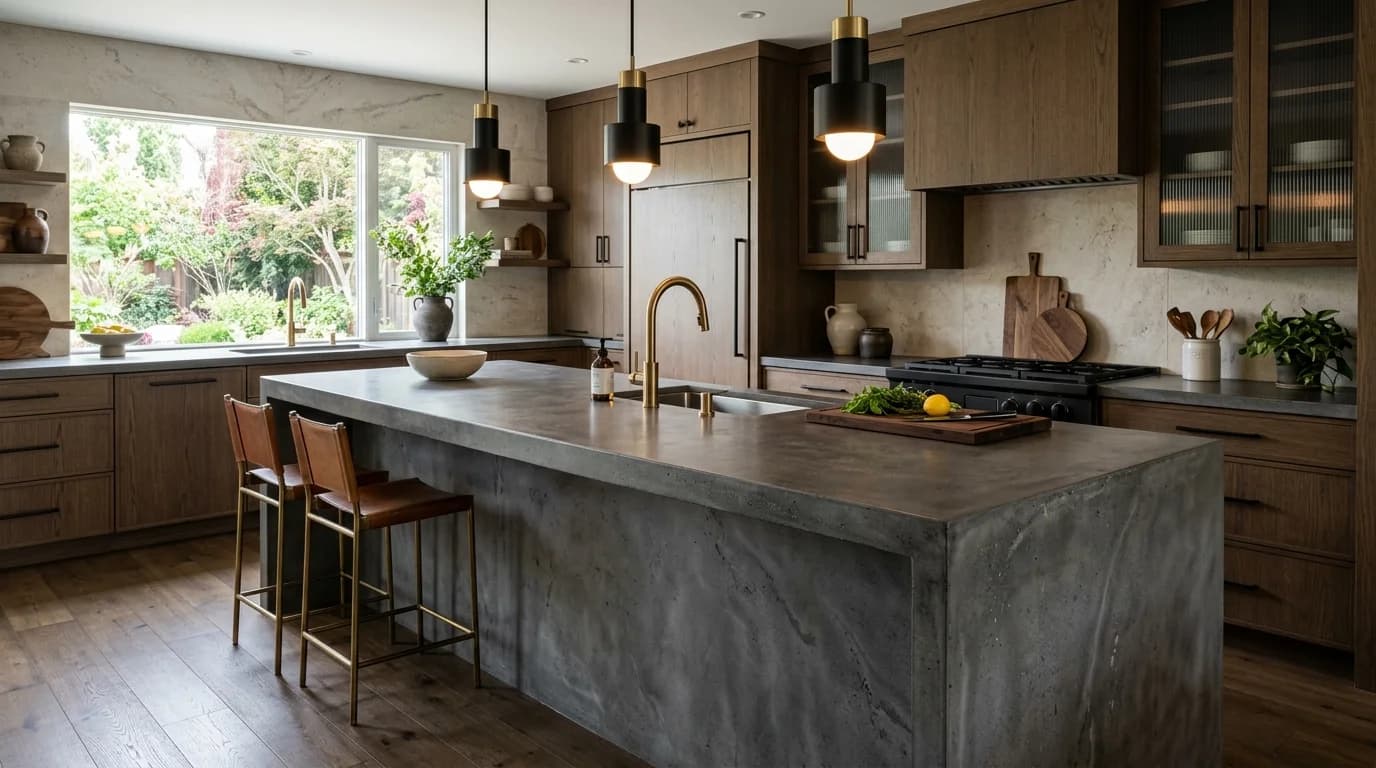
Under ACI 304R and ASTM C1116 guidelines, building premium concrete countertops requires either the inverted precast method (building double-sided melamine molds and pouring upside down for a factory-smooth top face) or cast-in-place (framing directly atop kitchen cabinets for seamless L-shaped runs). Utilizing Glass Fiber Reinforced Concrete (GFRC) with alkali-resistant (AR) glass fibers and acrylic polymer dispersion yields 8,000+ PSI compressive strength and high flexural ductility at half the weight of traditional wet-cast concrete (just 9 lbs/sq ft for a 3/4-inch shell with dropped edge). Always seal with an FDA-compliant food-contact reactive urethane (FDA 21 CFR 175.300) to permanently block lemon acid and red wine staining.
1. Inverted Precast vs. Cast-in-Place Methodologies
The first architectural decision in concrete countertop fabrication is selecting between the two fundamentally different construction methods:
Method A: Inverted Precast (Shop Built)
RecommendedBuilt upside down on a flat workbench using 3/4-inch melamine-faced particle board. The bottom of the mold becomes the finished countertop face. Because melamine has a mirror-like resin coating, the cured concrete demolds with an ultra-smooth, glass-like surface requiring almost zero hand-troweling.
Method B: Cast-in-Place (In-Situ)
Cabinet PouredFramed directly on top of the installed kitchen cabinets using 1/2-inch cement backerboard and specialized polystyrene or rigid plastic forms (such as Z Counterform). Concrete is mixed and poured right in the kitchen, then hand-troweled flat right-side up.
2. Mix Design Engineering: Traditional Sand-Mix vs. GFRC
Using standard coarse gravel concrete (such as 4,000 PSI Quikrete or Sakrete) for countertops is a critical mistake. Coarse 3/4-inch gravel creates massive voids around form edges, while high water content causes extreme shrinkage cracking.
Professional artisans engineer their countertop slurries using one of two advanced concrete mix designs:
- Traditional Dense Mortar Sand-Mix: A blend of 1 part Portland cement (Type I/II white or gray), 2 parts clean graded masonry silica sand (30 to 50 mesh), pozzolanic micro-silica or metakaolin (to consume free lime and boost density), and a polycarboxylate water reducer to achieve a self-consolidating consistency at an ultra-low water-cement ratio of 0.35. Reinforced with an internal grid of welded wire ladder mesh or structural carbon fiber scrim.
- Glass Fiber Reinforced Concrete (GFRC): The gold standard of modern architectural casting (ASTM C1116). GFRC replaces steel rebar with alkali-resistant (AR) glass fibers containing at least 17% zirconia (ZrO2) to resist alkaline degradation. The mix includes a liquid acrylic curing polymer (such as Forton VF-774) which eliminates the need for 7-day wet curing. GFRC has tremendous flexural tensile strength (over 1,500 PSI), allowing 3/4-inch thin-shell castings with 8,000+ PSI compressive strength.
3. Countertop Fabrication Matrix: GFRC vs. Wet-Cast vs. Cast-in-Place
Compare physical specifications, structural reinforcement, production difficulty, and 2026 material costs across all three methods:
| Fabrication Parameter | Precast GFRC (Spray/Hand-Pack) | Precast Wet-Cast (Vibrated) | Cast-in-Place (Direct on Cabinets) |
|---|---|---|---|
| Slab Thickness | 0.75" core with 1.5" dropped apron | 1.5" solid monolithic core | 1.5" to 2.0" solid monolithic core |
| Slab Weight / Sq Ft | 9.0 – 10.5 lbs / sq ft (Lightweight) | 18.0 – 19.5 lbs / sq ft (Heavy) | 18.0 – 20.0 lbs / sq ft (Heavy) |
| Internal Reinforcement | 3% AR Glass Fibers (No steel mesh) | Welded wire mesh + #3 perimeter rebar | Wire mesh or fiberglass mesh scrim |
| Compressive Strength | 8,000 – 10,500 PSI | 5,000 – 6,500 PSI | 4,000 – 5,500 PSI |
| Top Surface Quality | Glass-smooth (Form molded) | Glass-smooth (Form molded) | Hand-troweled (Variable texture) |
| Corner Seam Requirement | Modular seams required at corners | Modular seams required at corners | 100% Seamless continuous pours |
| 2026 DIY Material Cost | $14.00 – $22.00 / sq ft | $8.00 – $14.00 / sq ft | $10.00 – $16.00 / sq ft |
4. Melamine Mold Construction, Caulk Fillets & Cutouts
In the inverted precast method, any flaw, scratch, or misaligned screw on the melamine formwork will be permanently duplicated in the hardened concrete face. Follow strict cabinet-maker woodworking tolerances:
- Base and Side Rails: Cut 3/4-inch white two-sided melamine sheet stock using a circular saw with a 60-tooth carbide laminate blade running against a rigid clamped guide rail. Rip the side perimeter forms to exact slab thickness (typically 1.5 inches to 2 inches wide).
- Fastening Side Rails: Pre-drill clearance holes through the side forms every 6 inches using a countersink drill bit. Secure the side forms to the melamine base with 1-5/8-inch coarse-thread drywall screws. Never nail or glue the forms—they must be unscrewed cleanly during demolding without jarring the green concrete.
- Silicone Corner Fillets (Crucial Step): Acute 90-degree internal corners in melamine forms will produce razor-sharp, chip-prone concrete edges. Run a thin, continuous bead of 100% pure black or clear silicone caulk along every inside corner joint. Immediately smooth the caulk bead using a specialized 3/8-inch radius rubber caulk-tool ball or the back of a plastic spoon. After 15 minutes, peel away blue painter's tape along the margins to leave a flawless, uniform rounded bead that creates a smooth 3/8-inch radius bevel on the countertop edge.
- Faucet & Sink Knock-outs: For undermount sink cutouts and faucet holes, build knock-out inserts using 1.5-inch thick rigid extruded polystyrene (XPS) foam or PVC pipe wrapped in packing tape. Apply a 5-degree inward draft angle to all knock-outs to ensure they pop free easily after curing.
5. Casting, Compaction, Demolding & Slurry Pinhole Filling
Placing the concrete requires careful vibration to eliminate cosmetic air pockets (bugholes):
The Two-Stage GFRC Placement: When using GFRC, first spray or hand-pack an unreinforced face coat (1/8-inch thick slurry containing zero glass fibers) against the melamine bottom and sides. This ensures that no raw glass fiber strands will peek through the decorative surface. Next, hand-pack the backer coat (containing 3% alkali-resistant glass fibers) in two 5/16-inch layers, consolidating with ribbed compaction rollers to interlock the glass fibers.
Vibration Protocol for Wet-Cast: If pouring a traditional wet-cast mix, vibrate the perimeter forms by pressing a pad sander (with 80-grit paper removed) against the exterior side rails and underside of the workbench. Rapid vibration liquefies the thixotropic paste, dislodging trapped air bubbles and allowing them to float upward away from the critical bottom face.
Demolding and Slurry Filling: Cover the mold with heavy 6-mil poly sheeting and allow to cure for at least 48 hours at 70°F. Carefully back out all screws and remove the melamine side rails. Using heavy-duty glass suction cups and at least two workers, lift the slab vertically on its edge—never lift or carry a concrete slab horizontally, as its self-weight will cause instant flexural tension snapping across the sink cutout.
Wash away any residual form release. Mix a matching cementitious paste (cement powder + acrylic polymer + pigment) and hand-rub it across the entire surface in circular motions with a rubber squeegee. This fills all microscopic pinholes and bugholes. Once the slurry dries, hone with a 400-grit wet diamond hand pad to leave a silky-smooth surface ready for sealer.
6. Food-Safe Sealer Chemistry: Penetrating vs. Reactive Coatings
A concrete countertop is only as durable as its sealer. Kitchen countertops face aggressive chemicals: citric acid (lemons), acetic acid (vinegar), red wine tannins, mustard, cooking oils, and thermal shock from hot cookware.
Under FDA 21 CFR 175.300, sealers for surfaces in direct contact with food must be chemically inert and non-toxic after curing:
- Two-Component Reactive Polyurethanes (Gold Standard): Modern water-based or solvent-borne aliphatic polyurethanes (such as Buddy Rhodes ICT or Cheng ProFormula) chemically cross-link across the surface. They form an ultra-thin (1 to 2 mil), crystal-clear micro-coating that is 100% impervious to lemon juice, vinegar, and red wine with zero staining after 24-hour pool tests. They maintain heat resistance up to 300°F.
- Penetrating Silicates + Carnauba Wax (Natural Patina): An old-world approach using densifying silicates followed by hand-rubbed beeswax and carnauba wax. Produces a soft, warm stone feel. However, it requires monthly re-waxing and will etch within minutes if citrus juice or vinegar is left sitting on the counter.
- Avoid Standard Hardware-Store Acrylic Sealers: Cheap clear acrylic masonry sealers sold in home centers are designed for outdoor flagstone and pavers, not kitchen counters. Acrylics soften under hot coffee mugs, turn white from water glasses, and dissolve instantly under vinegar or alcohol.
5 Costly Mistakes to Avoid in DIY Concrete Countertops
Concrete has immense compressive capacity but virtually zero flexural tensile strength. Carrying a 7-foot or 8-foot slab flat like a piece of plywood creates massive bending moments; the slab will snap in half instantly under its own dead weight, especially across narrow sink or cooktop rails. Always lift, transport, and install countertops vertically on their edge.
Standard 4,000 PSI bag concrete from big-box stores contains 3/4-inch aggregate and high water demand. The heavy gravel creates massive honeycomb pockets along the melamine edges and prevents clean rounded corner fillets. Always use a dedicated sand-based countertop mix or professional GFRC formulation with micro-pozzolans and superplasticizers.
Even with thorough vibration, microscopic air bubbles inevitably cling to the melamine bottom. If you skip hand-rubbing a matching cement slurry coat, those microscopic voids remain open. When you apply your clear sealer, the liquid bridges over the pinholes; under kitchen use, hot dishwater or grease punches through the thin sealer skin, trapping rotting food bacteria inside the counter.
In an unheated garage sitting at 50°F, cement hydration occurs at less than half its standard rate. Unscrewing form side rails after 24 hours under these conditions will cause corners to shear off and edges to chip away. Allow at least 48 to 72 hours of cure time at room temperature before peeling formwork.
While traditional wet-cast mixes require aggressive table vibration, GFRC backer coats must NEVER be vibrated with mechanical vibrators. High-frequency vibration forces glass fibers to align vertically and sink toward the bottom decorative face, destroying the three-dimensional fiber tensile matrix and exposing sharp glass whiskers through the finished countertop skin. Use compaction hand rollers only.
Calculating Concrete Slab Volumes or Project Bags?
Compute cubic yards, bag quantities, and water-to-cement ratios with our interactive contractor calculators.
Frequently Asked Questions
How thick should a concrete countertop be to prevent structural cracking?
Traditional wet-cast concrete countertops reinforced with welded wire mesh or structural rebar must be cast at a minimum thickness of 1.5 inches (weighing approximately 18 pounds per square foot). In contrast, modern Glass Fiber Reinforced Concrete (GFRC) countertops can be cast as thin as 0.75 inches across the main span, utilizing a 1.5-inch to 2.0-inch dropped perimeter apron (edge buildup) to create the optical illusion of a massive solid slab while cutting total countertop weight in half (9 to 10 pounds per square foot).
Are concrete countertops truly food-safe for food preparation and meal cutting?
Raw unsealed concrete is porous and will absorb oils, animal blood, and bacteria, making it unsanitary for food preparation. However, concrete countertops treated with an FDA-compliant food-contact sealer meeting FDA 21 CFR 175.300 (such as two-component reactive aliphatic urethanes or cross-linking polyaspartics) create an impenetrable, non-toxic, and antimicrobial surface. However, cutting directly on concrete with chef knives will dull the blades and scratch the sealer film; always use cutting boards.
What is the difference between precast upside-down and cast-in-place countertops?
The inverted precast method involves building smooth melamine molds in a garage or workshop and casting the concrete upside down. The bottom of the mold becomes the glass-smooth top of the finished counter, completely eliminating the need for difficult top troweling. Cast-in-place involves building forms directly on top of kitchen cabinets over cement backerboard. Cast-in-place allows 100% seamless, continuous L-shaped countertops without crane lifting, but requires hand-troweling the wet top surface.
How do you prevent hairline tension cracks from forming around sink cutouts?
Sink and cooktop cutouts create severe stress concentration points where countertop slabs are narrowest (often only 3 inches of concrete in front and back of the sink bowl). To prevent flexural tension snapping, embed continuous #3 steel rebar or structural basalt fiber rebar along the front and rear rails. In precast slabs, introduce an engineered mechanical silicone expansion seam right through the center of the sink cutout rather than attempting a brittle continuous 10-foot run.
How much does it cost to build DIY concrete countertops compared to quartz or granite?
Building your own DIY concrete countertops costs approximately $8.00 to $22.00 per square foot in raw materials (melamine board, specialty countertop mix or GFRC ingredients, alkali-resistant glass fibers, diamond hand pads, and professional food-safe urethane sealer). By comparison, professionally fabricated and installed granite, quartz, or custom precast concrete counters range from $85.00 to $165.00 per square foot installed.
Building Codes & Primary Standards Cited
Guide for Measuring, Mixing, Transporting, and Placing Concrete
American Concrete Institute standard establishing placement, compaction, and consolidation guidelines for specialized architectural concretes.
Standard Specification for Fiber-Reinforced Concrete
Governs alkali-resistant (AR) glass fiber specifications and flexural ductility performance requirements in GFRC matrices.
Code of Federal Regulations: Resinous and Polymeric Coatings
Establishes food safety, chemical migration limits, and non-toxicity standards for residential and commercial food preparation surfaces.
Estimations adhere to standard North American modular 3/8-inch mortar joint physics and 5% to 10% material waste factors. Local municipal building inspectors, stamped architectural blueprints, and local frost depth requirements supersede general reference guidelines.
Popular Quick Estimates
Pre-engineered takeoffs & benchmarks matched to this project
Related Calculators
Specialized tools for foundation, core fill, and budgeting
Heavyweight structural blocks and bond beam units
Cubic yards, bags, and slab volume for flatwork and footings
Core grout volume in cubic yards and 80-lb pre-mix bags
Cell fill requirements for low-lift and high-lift grouting
Blogs & Construction Guides
Technical articles, IRC code standards, rebar schedules & freight logistics
How to Pour a Concrete Slab DIY: Formwork, Rebar & Finishing
Asphalt vs Concrete: Cost, Lifespan & Driveway Guide

Who Invented Concrete? Roman Concrete to Portland Cement