1. The Physics of Freeze Damage: What Happens Inside Capillaries
Portland cement requires liquid water to undergo hydration. When liquid water freezes into ice, it expands by approximately 9% in volume. In fresh concrete, this expansion exerts hydrostatic pressures exceeding the tensile capacity of the fragile developing cement paste matrix.
According to ACI 306R, once concrete reaches a compressive strength of 500 PSI (3.5 MPa)—which typically occurs within 24 to 48 hours under proper thermal protection—the volume of free evaporable capillary water has been sufficiently consumed by chemical hydration. The remaining pore water is tightly bound within the gel structure and cannot freeze to cause disruption at moderate subfreezing temperatures.
However, if fresh concrete freezes during its initial plastic stage:
- Ice Lenses Form: Distinct crystalline ice sheets grow between the aggregate and cement paste, permanently debonding the matrix.
- 50% Compressive Strength Loss: The cured slab will never attain its 4,000 PSI engineering rating, maxing out at roughly 2,000 PSI.
- Catastrophic Surface Scaling: The top 1/8-inch paste layer loses cohesion and spalls away in powder and sheets during the very first spring thaw.
2. ACI 306R Minimum Placement & Protection Standards
Review the minimum concrete temperatures at placement and the mandatory protection durations based on slab thickness and cement type:
| Slab Dimension | Min Temp as Placed | Min Maintained Temp | Protection (Standard) | Protection (Type III / NCA) |
|---|---|---|---|---|
| < 12 in (Slabs / Patios) | 55°F (13°C) | 50°F (10°C) | 6 Days (R-4 blanket) | 3 Days (R-4 blanket) |
| 12 to 36 in (Footings / Piers) | 50°F (10°C) | 45°F (7°C) | 5 Days (R-3 blanket) | 2 Days (R-3 blanket) |
| 36 to 72 in (Mass Concrete) | 45°F (7°C) | 40°F (4°C) | 4 Days (R-2 blanket) | 2 Days (R-2 blanket) |
| Max 24-Hr Cooling Rate | 50°F drop max | Prevent thermal shock | Gradually vent blankets to prevent tensile stress cracking | |
3. Winter Batch Mix Adjustments: What to Order at the Plant
When ordering ready-mix concrete during winter months, specify these chemical and physical adjustments with the dispatch manager:
Heated Water & Aggregates
Batch plants heat mix water to 140°F to 160°F and inject live steam into coarse aggregate storage bins. This guarantees the concrete arrives on site at 60°F to 65°F despite subfreezing transit temperatures.
Non-Chloride Accelerators (NCA)
Add ASTM C494 Type C non-chloride chemical accelerators (calcium nitrate). Unlike calcium chloride, NCAs speed up initial set times and early heat generation without corroding structural steel rebar or wire mesh.
Extra Cement or Type III
Add 100 lbs of extra Portland cement per cubic yard (a "winter-rich" mix) or specify ASTM C150 Type III high-early cement. The extra cement produces significantly higher exothermic heat of hydration during early curing.
4. Five Critical Winter Jobsite Mistakes to Avoid
1. Pouring Concrete on Frozen Subgrade
Frozen soil contains ice crystals that prevent compaction. When the ground thaws months later, the soil volume shrinks, leaving hollow cavities beneath the slab that result in sudden structural fractures under vehicle loads.
2. Using Unvented Heaters (Surface Carbonation)
Using open-flame propane "torpedo" heaters in an enclosed tent floods the air with carbon dioxide. CO2 reacts with fresh moist calcium hydroxide to create soft calcium carbonate, destroying surface abrasion resistance.
3. Abrupt Thermal Shock (Stripping Blankets Fast)
If you pull insulated blankets off a 65°F concrete slab while the outside air is 20°F, the rapid surface contraction induces extreme tensile stresses, resulting in severe crazing and thermal shock cracking.
4. Adding Water on Site for Slump
Cold concrete sets slower, tempting crews to add water to help finishing. Excess water drastically increases the volume of freezable capillary pores and prolongs bleeding, making the slab exponentially more vulnerable to frost damage.
5. How to Thaw Frozen Ground Before Pouring
If your jobsite experiences severe frost before the pour date, follow these proven thawing methods:
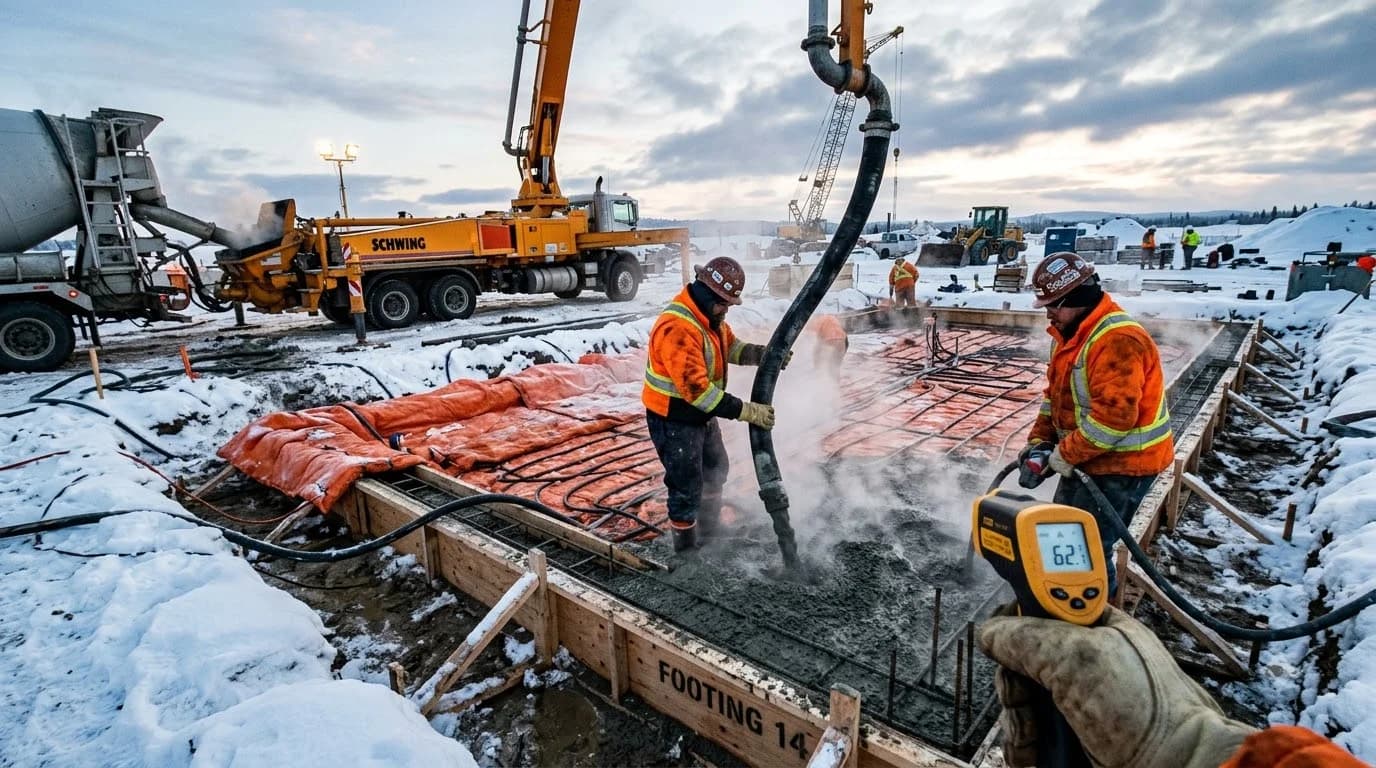
- Hydronic Ground-Thaw Heaters: For large residential driveways or commercial slabs, rent a mobile hydronic ground heater. Loop glycol hoses across the frozen subgrade at 12-to-16-inch spacing, cover with vapor barriers and insulated blankets, and run for 24 to 48 hours to thaw frost 24 inches deep.
- Pre-Covering with Thermal Blankets: If frost is forecasted 2 days prior to the pour, lay R-6 insulated blankets over the dry, compacted gravel subbase immediately. Trapping natural geothermal earth heat prevents frost from penetrating the subgrade entirely.
- Check Subgrade Temperature: Use an infrared laser thermometer or a metal probe thermometer to confirm the subgrade is above 35°F (preferably 40°F+) across the entire footprint before the ready-mix truck arrives.
6. 2026 Winter Concreting Cost & Pricing Surcharges
Pouring concrete between November and March in cold climates incurs specialized material and equipment surcharges that should be factored into every contractor takeoff:
Hot Water / Steam Surcharge
Ready-mix plants charge between $8.00 and $15.00 per cubic yard for boiler-heated mix water and steam-injected heated aggregate piles during sub-40°F weather.
Chemical Accelerators
Non-chloride accelerating admixtures (NCA) add approximately $5.00 to $12.00 per cubic yard depending on dosage (1% vs 2% by cement weight) to accelerate setting times.
Thermal Blanket Rentals
Heavy-duty insulated concrete blankets (6' × 25' R-4 to R-6) rent for $12 to $25 per week or retail for $85 to $140 per roll, an essential cost for zero-freeze insurance.
Frequently Asked Questions
Can you pour concrete at 32 degrees Fahrenheit (0 degrees Celsius)?
Yes, but strictly under ACI 306R cold-weather procedures. The subgrade must be completely thawed, the ready-mix batch plant must heat mix water and aggregates to deliver concrete at a minimum of 55°F (13°C), an accelerating admixture must be utilized, and the finished slab must be sealed under insulated curing blankets (minimum R-4 value) for at least 3 to 7 days.
What happens if fresh concrete freezes overnight?
If fresh concrete freezes before attaining 500 PSI (3.5 MPa) compressive strength, uncombined water in the capillary pores expands by 9% in volume. This ice crystal formation shatters the cement paste matrix and permanently breaks the bond between paste and stone aggregate. The concrete will suffer a permanent 50% loss of ultimate compressive strength and peel off in loose flakes the following spring.
Why can you never pour concrete onto frozen ground?
Pouring concrete on frozen dirt or gravel causes two disastrous failures: first, the frozen subgrade instantly sucks heat from the bottom of the fresh concrete, freezing the bottom paste; second, when spring arrives, the frozen subgrade thaws and consolidates, creating hollow voids beneath the slab that trigger catastrophic cracking under vehicle traffic.
Is calcium chloride safe to use as a concrete accelerator in winter?
Calcium chloride (ASTM C494 Type C) accelerates early set times, but it is strictly prohibited in reinforced concrete with steel rebar, post-tension cables, or metal decking. Chloride ions penetrate the passive oxide layer on steel, accelerating severe electrochemical rust corrosion and expansion spalling. Use non-chloride accelerators (NCAs) such as calcium nitrate or calcium formate instead.
Why are unvented propane heaters dangerous for curing concrete?
Unvented propane or kerosene heaters (salamanders) emit large volumes of carbon dioxide (CO2). Carbon dioxide reacts chemically with fresh, moist calcium hydroxide on the slab surface to form calcium carbonate in a defect known as carbonation. This creates an extremely soft, chalky surface layer that turns to dust under foot traffic.
Building Codes & Primary Standards Cited
Guide to Cold Weather Concreting
Primary international standard establishing temperature thresholds, blanket R-values, and protection durations.
Standard Specification for Ready-Mixed Concrete
Mandates minimum delivery temperatures for batch materials in freezing ambient environments.
Standard Specification for Chemical Admixtures for Concrete
Defines Type C accelerating and Type E water-reducing and accelerating chemical admixtures.
Standard Test Method for Temperature of Freshly Mixed Hydraulic-Cement Concrete
Standard testing procedure for verifying jobsite batch temperature compliance.
Estimations adhere to standard North American modular 3/8-inch mortar joint physics and 5% to 10% material waste factors. Local municipal building inspectors, stamped architectural blueprints, and local frost depth requirements supersede general reference guidelines.
Popular Quick Estimates
Pre-engineered takeoffs & benchmarks matched to this project
Related Calculators
Specialized tools for foundation, core fill, and budgeting
Type S and M bags, cubic feet and batching sand volume
Surface area converted into standard 8x8x16 block totals
Patio and driveway interlocking pavers with base sand
Cost per square foot, material prices and excavation budget
Blogs & Construction Guides
Technical articles, IRC code standards, rebar schedules & freight logistics
Pouring Concrete in Hot Weather: ACI 305R (2026 Guide)
Calcium Chloride in Concrete: Accelerators & Cold Weather
Can You Pour Concrete in the Rain? (Risks & Fixes)