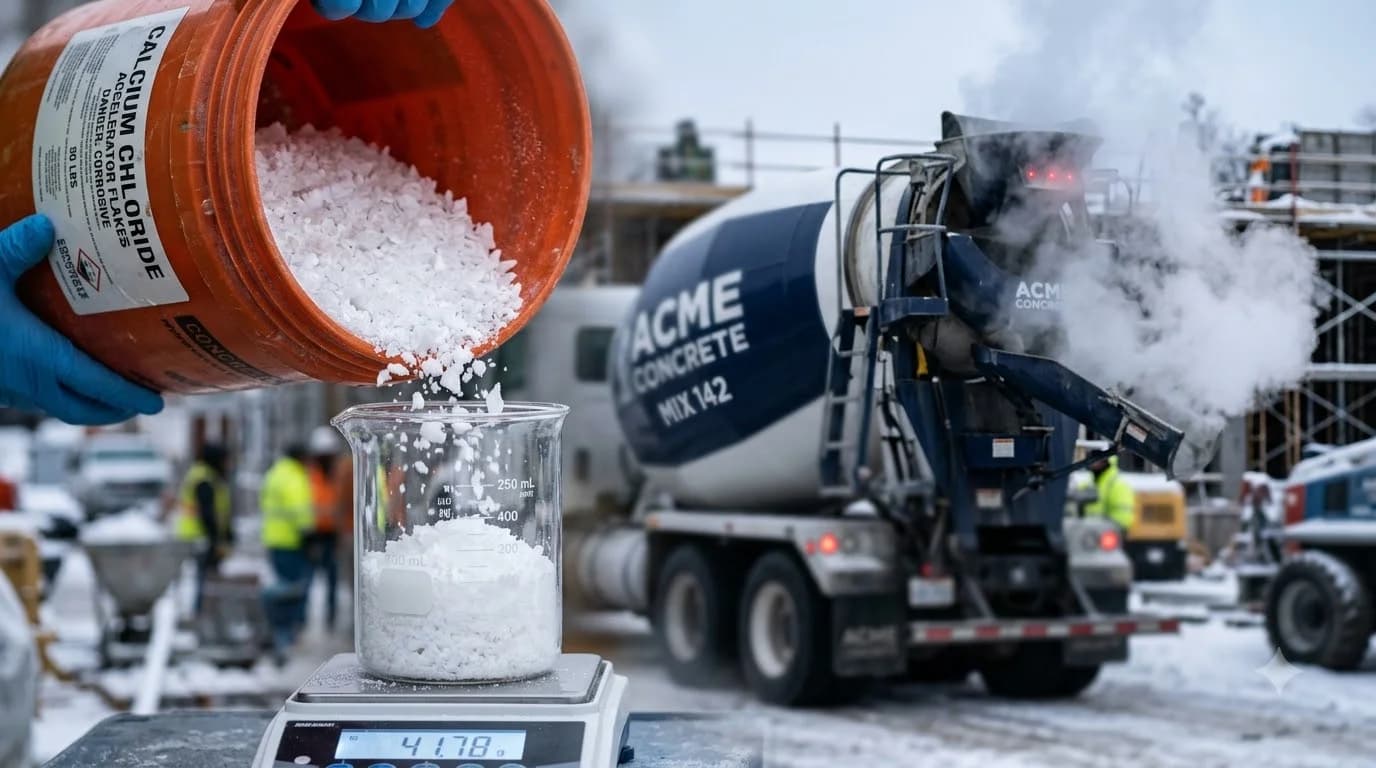
Calcium chloride (ASTM C494 Type C) is the most powerful and economical set-accelerating chemical in construction. It cuts initial set times in half and doubles 1-to-3 day compressive strengths in cool weather (35°F to 50°F). However, it does not prevent freezing below 29°F without thermal blankets. Dosage must never exceed 2.0% by weight of cement, and it is strictly banned in prestressed concrete or structures with embedded steel rebar due to rapid electrochemical corrosion.
1. Chemical Kinetics: How Calcium Chloride Accelerates Cement Hydration
Hydration is the exothermic reaction between Portland cement silicates and water. At 70°F (21°C), standard Type I/II concrete reaches initial set in roughly 4 to 5 hours. However, when concrete temperatures drop to 40°F (4°C), hydration kinetics decelerate by over 60%, pushing initial set times out past 8 to 10 hours.
When commercial calcium chloride flakes (CaCl2) dissolve into the batch water, calcium and chloride ions enter solution:
- Catalyzing Tricalcium Silicate (C3S): Chloride ions act as a chemical catalyst, drastically accelerating the dissolution of C3S and the rapid nucleation of Calcium Silicate Hydrate (C-S-H) crystal needles.
- Elevated Exothermic Heat: The early hydration surge releases peak heat of hydration hours earlier, warming the interior core of the slab and self-insulating the concrete against ambient cold.
- Early Strength Multiplication: Concrete dosed with 2% calcium chloride develops roughly double the 1-day compressive strength of non-accelerated mixes, enabling contractors to strip forms and tool saw-cut joints on schedule.
2. Cold Weather Concreting (ACI 306R): Why It Is Not an Antifreeze
A dangerous jobsite misconception is that adding calcium chloride allows contractors to pour concrete in sub-freezing weather without cold-weather protection.
In reality, a standard 2% dosage of calcium chloride depresses the freezing point of water by only 2°F to 3°F (down to ~29°F or -1.7°C). If fresh concrete freezes before reaching 500 PSI compressive strength, expanding ice crystals physically disrupt the fragile C-S-H crystalline network, permanently destroying up to 50% of the concrete ultimate strength.
Under ACI 306R (Guide to Cold Weather Concreting), calcium chloride serves solely to shorten the vulnerable early period before the concrete reaches 500 PSI (typically 6 to 8 hours instead of 24 hours). Once placed, the slab must still be covered with closed-cell thermal curing blankets (R-value 4 to 8) to trap internal heat until minimum design strengths are secured.
3. Rebar Corrosion & ACI 318 Chloride Ion Limits
While calcium chloride is exceptionally effective for plain, unreinforced concrete (such as sidewalk slabs, post footings, and mass gravity retaining walls), it poses extreme risks when embedded steel rebar is present:
Breakdown of the Passivating Layer: Cured concrete maintains a high alkaline environment (pH 12.5 to 13.5) that naturally deposits a microscopic passivating gamma-ferric-oxide film over steel rebar, completely halting rust. Free chloride ions (Cl-) actively penetrate and dissolve this protective film.
Corrosion Spalling (Rust Expansion): Once the passivating layer is compromised, oxygen and moisture initiate electrochemical galvanic corrosion. As steel rebar rusts, iron oxide expands to 600% of the original metal volume. This radial expansion generates internal bursting pressures exceeding 5,000 PSI, cracking the concrete from the inside out and blowing off massive surface spalls.
For this reason, ACI 318 Section 19.3.2 caps water-soluble chloride ions in reinforced concrete exposed to moisture at a minuscule 0.15% by weight of cement—a threshold easily breached by adding even 0.5% calcium chloride.
4. Master Accelerating Admixture Specification Matrix
Compare chemical classifications, performance standards, and cost profiles across ASTM C494 accelerating admixtures:
| Admixture Classification | ASTM C494 Type | Standard Dosage Rate | Set Time Reduction | Rebar Corrosion Risk | Primary Construction Application |
|---|---|---|---|---|---|
| Calcium Chloride Flake (77%) | Type C (Accelerating) | 1.0% – 2.0% Cement Wt | 45% – 60% Faster | Severe (Avoid Rebar) | Unreinforced footings, mass fill, sidewalks |
| Liquid Calcium Chloride (32%) | Type C & E | 16 – 32 oz / 100 lbs cement | 40% – 55% Faster | Severe (Avoid Rebar) | Batch-plant metered unreinforced ready-mix |
| Calcium Nitrite (NCA) | Type C & Corrosion Inhibitor | 30 – 60 oz / 100 lbs cement | 35% – 50% Faster | Zero (Inhibits Rust) | Structural bridge decks, parking ramps, marine piers |
| Calcium Nitrate / Formate (NCA) | Type C (Non-Chloride) | 15 – 30 oz / 100 lbs cement | 30% – 45% Faster | Zero Risk | Commercial slabs on grade with rebar or wire mesh |
| Triethanolamine (TEA Complex) | Type C & E Modifier | Trace chemical (< 0.1%) | 20% – 30% Faster | Zero Risk | Precast architectural elements and fast-setting mortars |
5. Proper Batching & Dissolution Protocols
Improper jobsite handling of calcium chloride flakes ruins concrete batches:
- Never Throw Dry Flakes Directly into the Mixer Drum: Adding dry calcium chloride crystals into a ready-mix truck or drum mixer results in un-dissolved chemical clumps that stick to the aggregate. These form concentrated chemical "hot spots" that produce soft popouts and white efflorescence blemishes on the finished surface.
- Pre-Dissolve in Gauging Water: Always dissolve dry calcium chloride flakes completely in clean water before introducing it to the batch. Note that dissolving calcium chloride in water is highly exothermic (it releases intense heat); use sturdy chemical-rated buckets and stir thoroughly.
- Account for Added Liquid Volume: When using pre-mixed 32% liquid calcium chloride solutions, remember that roughly two-thirds of the liquid volume is water. Subtract this liquid volume from the batch design water to keep your water-to-cement ratio strictly on target.
6. Five Critical Chemical Accelerator Mistakes to Avoid
Dosing concrete at 3% or 4% calcium chloride causes severe flash-setting, where the mix stiffens in the chute before it can be placed. It also causes rapid drying shrinkage cracking and permanently reduces 28-day strength.
Chloride attack causes catastrophic hydrogen embrittlement and stress corrosion cracking in high-strength post-tensioned steel cables, resulting in sudden structural collapse. Always specify Non-Chloride Accelerators (NCA).
Accelerators should only be used when temperatures are below 50°F. Adding accelerators in warm weather induces flash-setting, leaving finishing crews unable to float or trowel the slab before it hardens into rough ridges.
Calcium chloride alters the hydration kinetics of iron oxide pigments, causing severe blotchy gray staining, dark patches, and mottled color variation that cannot be fixed without grinding.
Because calcium chloride is not an antifreeze, pouring at 25°F without insulating blankets will allow the top 1/2 inch of the slab to freeze, causing immediate flaking, dusting, and total surface loss in the spring.
Calculating Concrete Batches & Sacks?
Determine exact cement bag counts, ready-mix yards, sand volumes, and 2026 material costs.
Frequently Asked Questions
Does calcium chloride lower the freezing point of concrete?
Contrary to popular myth, calcium chloride does not act as an antifreeze. At the maximum permissible 2% dosage, it only lowers the freezing point of mix water by 2°F to 3°F (from 32°F down to 29°F). Its true benefit is dramatically accelerating early chemical hydration so the concrete generates internal exothermic heat and reaches the critical 500 PSI freeze-resistance benchmark before ambient temperatures freeze the water.
How much calcium chloride can you add to concrete?
Under ASTM C494 and ACI 212.3R, the maximum allowable dosage of commercial calcium chloride is 2% by weight of Portland cement. For standard 4,000 PSI concrete containing 564 lbs of cement per cubic yard (6 sacks), this equates to a maximum of 11.3 lbs of calcium chloride flakes per yard. For a single 80-lb pre-mixed concrete bag (containing ~16 lbs of cement), the maximum dose is 0.32 lbs (roughly 5 ounces or 1/2 cup).
Why is calcium chloride banned in reinforced concrete?
Under ACI 318 Section 19.3.2, calcium chloride is strictly prohibited in prestressed concrete and post-tensioned slabs, and severely restricted in reinforced concrete. Free chloride ions (Cl-) break down the alkaline passive iron oxide film that naturally shields embedded steel rebar, initiating rapid electrochemical pitting and galvanic corrosion that causes concrete cracking and spalling.
What is the difference between chloride and non-chloride accelerators?
Calcium chloride is inexpensive ($0.30 to $0.50 per lb) and offers rapid set acceleration, but poses high corrosion risks for embedded metals. Non-chloride accelerators (NCAs), formulated from calcium nitrite, calcium nitrate, or calcium formate, cost 3x to 5x more but provide equal set acceleration without corroding rebar, making NCAs mandatory for reinforced slabs, bridge decks, and metal deck floors.
Does calcium chloride cause concrete surface discoloration?
Yes. Calcium chloride retards the hydration of ferrite compounds in Portland cement, often creating dark, mottled, or blotchy gray discoloration across hard-troweled flatwork. Consequently, accelerators should never be used in architectural, stained, or decorative concrete.
Building Codes & Primary Standards Cited
Standard Specification for Chemical Admixtures for Concrete
Establishes performance requirements for Type C (accelerating) and Type E (water-reducing accelerating) admixtures.
Guide to Cold Weather Concreting
Authoritative American Concrete Institute manual governing temperature monitoring, thermal protection, and accelerators.
Building Code Requirements for Structural Concrete
Specifies maximum water-soluble chloride ion limits to safeguard embedded steel rebar from catastrophic corrosion.
Estimations adhere to standard North American modular 3/8-inch mortar joint physics and 5% to 10% material waste factors. Local municipal building inspectors, stamped architectural blueprints, and local frost depth requirements supersede general reference guidelines.
Popular Quick Estimates
Pre-engineered takeoffs & benchmarks matched to this project
Related Calculators
Specialized tools for foundation, core fill, and budgeting
Cubic yards, bags, and slab volume for flatwork and footings
Heavyweight structural blocks and bond beam units
Core grout volume in cubic yards and 80-lb pre-mix bags
Cell fill requirements for low-lift and high-lift grouting
Blogs & Construction Guides
Technical articles, IRC code standards, rebar schedules & freight logistics
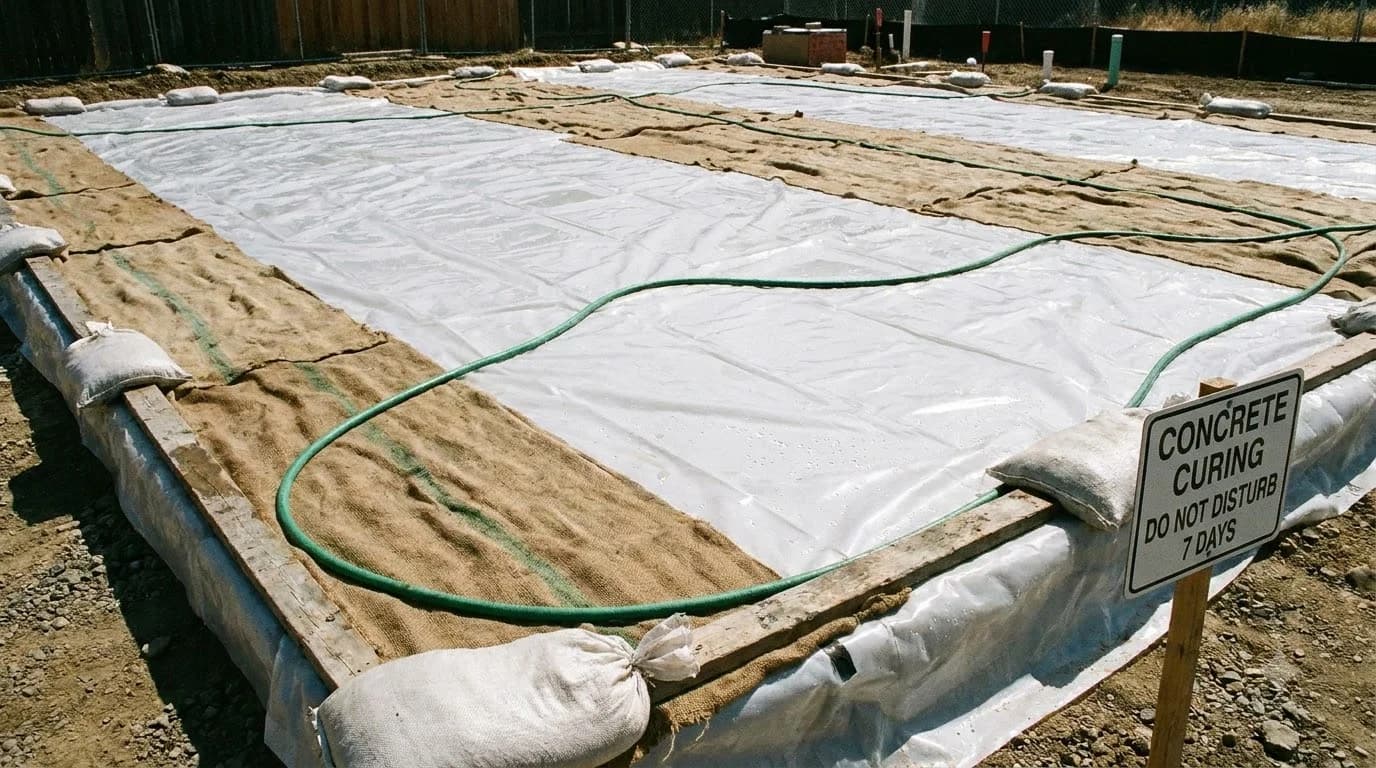
How to Cure Concrete: Wet Curing vs Curing Compounds
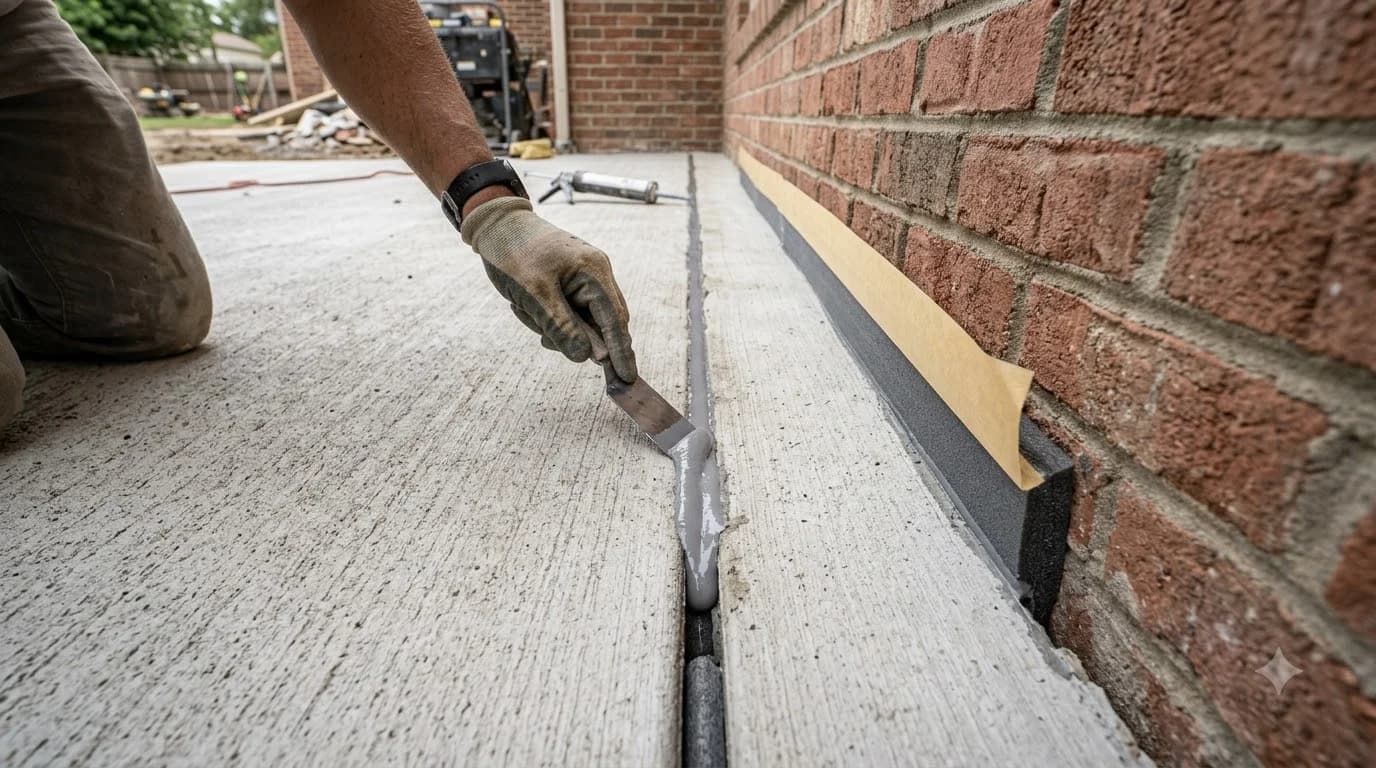
Concrete Expansion Joints: Spacing, Foam & Sika Sealant

Concrete vs Cement vs Mortar: Key Differences & Uses