ACI 305R Hot Weather Rules of Thumb
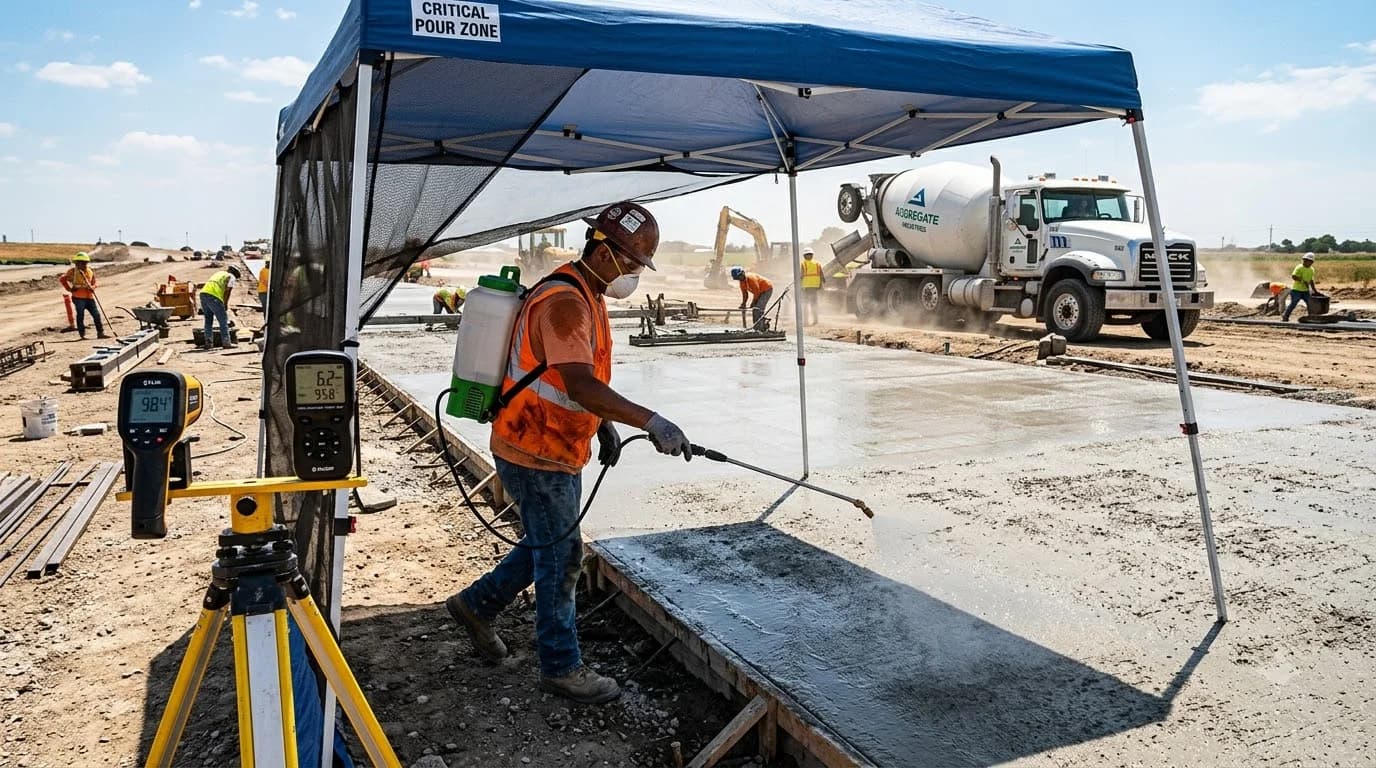
Under ACI 305R, hot weather concreting conditions exist whenever ambient temperatures, solar radiation, low relative humidity, and wind combine to push evaporation rates above 0.20 lbs/sq ft/hr (or when fresh concrete temperature reaches 90°F / 32°C). To prevent catastrophic flash setting and surface cracking: schedule pours at dawn (5:00–7:00 AM), pre-soak subgrades and forms, dose chemical set retarders (ASTM C494 Type B/D), and mist monomolecular evaporation retarders immediately after bull floating.
1. The Physics of Heat on Concrete: Why Hot Pours Fail
High temperature is an aggressive catalyst for the hydraulic hydration of Portland cement. Every 20°F (11°C) increase in concrete temperature doubles the rate of chemical reaction:
At 70°F, ready-mix concrete maintains workable slump for 60 to 90 minutes. At 95°F, concrete loses 1 to 2 inches of slump every 15 minutes, stiffening in the chutes before finishers can rake and screed it.
Accelerated hydration causes Calcium-Silicate-Hydrate (C-S-H) gel to precipitate rapidly and non-uniformly around cement grains, forming a dense shell that prevents deeper unhydrated cores from reacting. 28-day compressive strength drops by 10% to 20%.
When solar radiation and ambient wind pull surface moisture off faster than bleed water can migrate upward from the slab bottom, the top 1/4 inch shrinks violently, ripping open parallel cracks 2 to 4 inches deep.
2. The ACI 305R Evaporation Rate Benchmark
ACI 305R provides an engineering nomograph calculating surface evaporation rate based on four jobsite variables:
// The ACI 305R Evaporation Variables
1. Concrete Slurry Temperature (°F)
2. Ambient Air Temperature (°F)
3. Relative Humidity (%)
4. Average Wind Velocity at 20 inches above slab (mph)
// Critical Thresholds
• E < 0.10 lb/ft²/hr: Normal conditions; standard curing applies.
• 0.10 ≤ E ≤ 0.20 lb/ft²/hr: Precautions required; monitor surface drying.
• E > 0.20 lb/ft²/hr: DANGER ZONE. Plastic shrinkage cracks guaranteed without evaporation retarders or sunshades.
For example, on an 85°F summer day with 30% relative humidity and a 12-mph breeze, concrete at 85°F will experience an evaporation rate of 0.24 lb/ft²/hr—well above the danger threshold.
3. Master Hot-Weather Concreting Protocol & Mitigation Matrix
Review the mandatory adjustments required at each phase of hot weather construction:
| Jobsite Phase | Standard Practice | Hot Weather Protocol (ACI 305R) | Technical Benefit |
|---|---|---|---|
| Batch Plant Dispatch | Standard tap water | Chilled water, shaved ice, or liquid N&sub2; | Lowers concrete temperature by 10°F to 15°F |
| Chemical Admixtures | Standard mix | Type B or D Retarders (ASTM C494) | Extends initial set time by 60 to 90 minutes |
| Subbase Preparation | Dry gravel base | Thoroughly soak subbase & forms (no puddles) | Prevents dry stone from sucking mix moisture |
| Finishing Operations | Bull float and wait | Spray monomolecular evaporation retarder | Reduces evaporation by up to 80% |
| Curing Regime | Air dry or light hose | Continuous wet burlap or ASTM C309 wax cure | Preserves 100% internal moisture for 7 days |
4. The Secret Weapon: Monomolecular Evaporation Retarders
One of the most cost-effective tools for summer flatwork is an aliphatic alcohol spray (such as Euclid Confilm, MasterKure ER 50, or SikaFilm):
How Evaporation Retarders Work
Unlike curing compounds, evaporation retarders are applied while the concrete is still plastic, immediately after initial screeding and bull floating. Sprayed through a pump sprayer, the chemical forms a monomolecular barrier one molecule thick across the bleed water surface. This microscopic film cuts evaporation by up to 80% without altering the water-cement ratio or interfering with subsequent trowel finishing or broom texturing.
5. Five Deadly Mistakes When Pouring Summer Concrete
Pouring between 11:00 AM and 2:00 PM guarantees that concrete temperatures will spike above 95°F. The slab surface will crust over while the bottom remains spongy. Always pour at dawn so the slab sets during the coolest hours of the morning.
When the truck arrives and the mix feels stiff, workers often tell the driver to add 15 gallons of water. Adding unmeasured water elevates the water-cement ratio, destroys compressive strength by 1,000+ PSI, and leads to massive drying shrinkage cracking. Use superplasticizers or retarding admixtures instead of extra water.
Dry gravel or dirt beneath your forms acts as an industrial desiccant, sucking water out of the bottom 2 inches of the slab before cement can hydrate. Always saturate the subgrade with a garden hose an hour before the pour, ensuring damp soil with zero standing puddles.
Flinging water from a bucket or brush onto dry concrete to make floating easier weakens the surface paste. The surface will chalk, powder, and peel off (delaminate) under traffic. Use aliphatic evaporation retardants only.
In 90°F weather, concrete loses 50% of its critical hydration water within the first 6 hours. Waiting until tomorrow morning to apply a curing compound or wet burlap is too late. Begin curing immediately after final broom finishing.
Planning a Hot-Weather Pour?
Calculate ready-mix cubic yards, retarder dosing, and curing materials with 2026 contractor pricing.
Frequently Asked Questions
What is the maximum temperature for pouring concrete?
Under ACI 305R, the maximum recommended temperature of fresh concrete at the time of discharge is 90°F (32°C). When ambient summer temperatures exceed 90°F, batch plants must use chilled mixing water, shaved ice, or liquid nitrogen to keep internal slurry temperatures within specification.
What time of day is best to pour concrete in hot summer weather?
The ideal time to pour concrete during summer is at daybreak (between 5:00 AM and 7:00 AM). Ambient temperatures are at their daily low, wind speeds are calm, the subgrade gravel is cool, and finishers can complete initial floating and edging before peak afternoon solar radiation.
Why does concrete crack so easily when poured in hot weather?
Hot weather causes high surface evaporation rates. When evaporation exceeds 0.20 lbs per square foot per hour, surface water vanishes faster than internal bleed water can rise. The top 1/4 inch shrinks rapidly while the lower concrete remains soft and plastic, pulling open unsightly plastic shrinkage cracks.
Can you spray water on concrete in the sun to keep it wet while finishing?
Never spray water directly onto concrete during troweling or finishing (known as 'troweling in water'). Troweling water into the surface raises the water-cement ratio of the top skin, causing severe dusting, crazing (spiderweb cracks), and premature surface delamination. Instead, spray an aliphatic alcohol evaporation retarder.
Does concrete poured in hot weather end up weaker?
Yes. While concrete cured at 90°F gains high early strength in the first 24 to 48 hours, accelerated hydration produces a coarser, more porous C-S-H crystalline microstructure. Studies show that hot-weather concrete suffers a permanent 10% to 20% reduction in 28-day ultimate compressive strength compared to concrete cured at 70°F.
Building Codes & Primary Standards Cited
Guide to Hot Weather Concreting
American Concrete Institute standard defining temperature thresholds, evaporation nomographs, and placement guidelines.
Standard Specification for Chemical Admixtures for Concrete
Governs Retarding (Type B) and Water-Reducing and Retarding (Type D) admixtures used for slump retention.
Guide to External Curing of Concrete
Establishes moist curing durations and sealing protocols necessary to prevent surface dehydration under high heat.
Standard Specification for Liquid Membrane-Forming Compounds for Curing Concrete
Sets moisture retention performance criteria for liquid curing compounds applied to freshly placed slabs.
Estimations adhere to standard North American modular 3/8-inch mortar joint physics and 5% to 10% material waste factors. Local municipal building inspectors, stamped architectural blueprints, and local frost depth requirements supersede general reference guidelines.
Popular Quick Estimates
Pre-engineered takeoffs & benchmarks matched to this project
Related Calculators
Specialized tools for foundation, core fill, and budgeting
Heavyweight structural blocks and bond beam units
Primer, acrylic block filler and topcoat paint gallons
Reinforced cinder block swimming pool shell construction
Raised planter beds, soil cubic yards and cap blocks
Blogs & Construction Guides
Technical articles, IRC code standards, rebar schedules & freight logistics
Pouring Concrete in Cold Weather: ACI 306R (2026 Guide)
Calcium Chloride in Concrete: Accelerators & Cold Weather
Is Concrete Porous? Permeability & Sealing (2026 Guide)