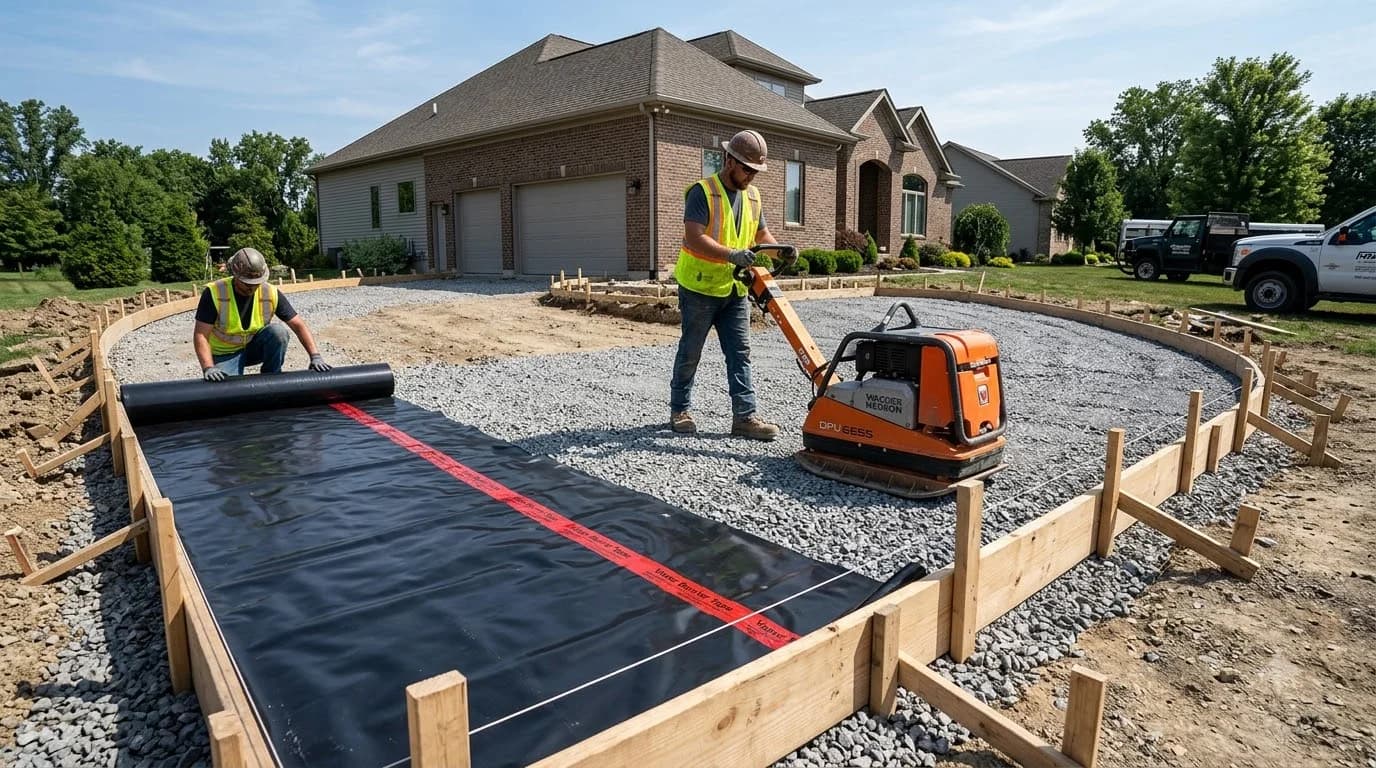
The Golden Rule: Never Bull Float or Trowel Rainwater into Fresh Paste
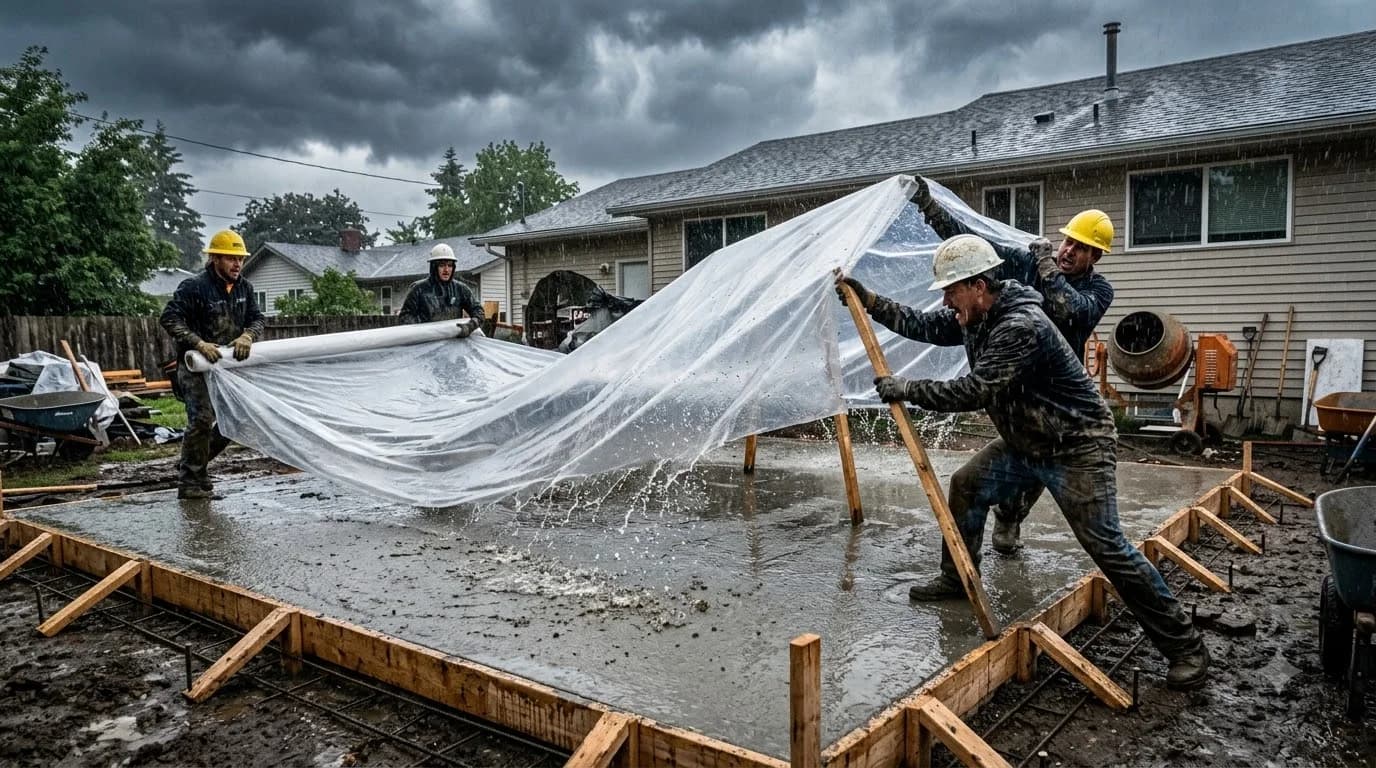
Rain during placement dilutes the surface water-to-cement ratio, drastically weakening the top 1/8" layer and causing chronic surface scaling. If rain begins, immediately cover the slab with 6-mil poly tarps. If standing rainwater pools on the plastic, squeegee or pump it off. Once concrete reaches its initial set (4 to 8 hours), light rain is no longer dangerous—it actually provides beneficial natural wet curing.
1. Hydration Science vs. Surface Water Dilution
A common homeowner misconception is that concrete “dries out” to harden, leading people to believe any rain is instantly fatal. In truth, concrete hardens through chemical hydration—the reaction between Portland cement crystals and water molecules. Concrete can cure to maximum compressive strength completely submerged in water (as in marine bridge pilings and deep caissons).
The catastrophe occurs when unconfined rainwater mixes with unhydrated, plastic surface paste. Ready-mix concrete is precisely batched under ASTM C94 with a water-to-cement (w/c) ratio between 0.40 and 0.45 to hit 4,000 PSI. When a heavy rainstorm deposits 1/4 inch of water on a fresh slab and finishers work that water into the cream with a bull float, the surface w/c ratio skyrockets above 0.70. This creates an extremely porous, brittle surface paste with a compressive strength of less than 1,200 PSI that will disintegrate during the first winter freeze.
2. Rain Exposure Risk Matrix by Curing Stage
Assess the vulnerability and necessary emergency response across the four pour stages:
| Pour Stage & Elapsed Time | Physical State of Slab | Rain Risk Level | Mandatory Jobsite Protocol |
|---|---|---|---|
| Stage 1: Discharge (0 – 1 Hour) | Plastic liquid slurry in chute | Critical (Subgrade washout) | Halt pour immediately; cover forms; pump mud out of trenches |
| Stage 2: Screeding & Floating (1 – 3 Hours) | Bleed water rising; unhardened | Severe (Surface paste dilution) | Tent 6-mil poly tarps over forms; do NOT work water into surface |
| Stage 3: Initial Stiffening (4 – 6 Hours) | Broom finished; resists shoe marks | Moderate (Droplet pitting) | Light rain harmless; deploy plastic covers if heavy rain creates craters |
| Stage 4: Post-Initial Set (8 – 24 Hours) | Hardened stone (Resists thumb dent) | Zero Risk (Highly Beneficial) | Remove tarps; natural rainwater provides free ASTM C308R wet curing |
3. Jobsite Emergency Tarping & Water Diversion Protocol
Professional masonry crews monitor weather radar continuously and maintain rolls of 6-mil polyethylene plastic on site under ACI 301:
- Tent, Do Not Drag: Never drag heavy plastic sheeting flat across unhardened plastic concrete—it will tear up the screeded finish and embed wrinkles into the surface. Elevate the plastic by resting 2x4 lumber or PVC pipes across the form boards to create an arched tent.
- Weight the Perimeter: Weight down all outer edges with concrete blocks, sandbags, or dirt backfill. High storm winds easily catch plastic tarps and turn them into giant sails that rip away formwork.
- Manage Water Pooling on Tarps: As rainwater collects in depressions on top of the plastic, the weight will sag the tarp into the soft concrete. Squeegee pooling water off the edges or use a submersible sump pump.
- Wait for the Bleed Water Window: Once the rain stops, carefully peel back the tarps. If standing water remains on the concrete, drag a clean rubber garden hose across the slab or squeegee the surface moisture off the edge. Allow natural bleed water to evaporate before running magnesium trowels or brooms.
4. Diagnosing Rain Damage: Dusting, Scaling, and Craters
If a pour was caught in a downpour, evaluate the surface condition after 28 days:
- Surface Dusting (Chalking): Sweeping the slab generates continuous gray concrete dust. This indicates the surface cement paste was over-diluted with rainwater, resulting in zero abrasion resistance.
- Surface Scaling & Delamination: During winter freeze-thaw cycles, trapped water in the weak top 1/8-inch expands, popping the cream layer off in large flaky scabs and exposing coarse aggregate beneath.
- Water Droplet Pitting: Heavy raindrops falling on unhardened concrete leave thousands of crater-like indentations that collect dirt and pool water.
5. Structural Repair for Rain-Damaged Concrete
Do not tear out a rain-damaged slab unless the subgrade washed out and the entire slab settled. The core 3.5 inches of the concrete is typically fully intact and structurally sound:
Allow the slab to cure for 28 days. Mechanically diamond-grind away the top 1/8-to-1/4-inch weakened laitance crust using an angle grinder or planetary floor grinder. Once sound, hard aggregate is exposed (ICRI CSP 2), prime with an ASTM C1059 Type II acrylic bonding agent and apply a commercial polymer-modified cementitious resurfacer. The resulting overlay delivers a 4,500+ PSI wear layer that looks brand new.
5 Critical Rain Pouring Mistakes to Avoid
Dusting Dry Cement Over Puddles
Throwing dry Portland cement onto rainwater puddles forms a brittle, unbonded surface scab with extreme shrinkage rates. The scab will spider-web crack and delaminate within months.
Bull Floating Rainwater Into Paste
Running a bull float or fresno over a rain-soaked slab forces free water down into the cream, destroying compressive strength and creating a soft, crumbly surface.
Pouring Over Saturated Mud Trenches
Pouring concrete into footings or slab trenches filled with standing mud mixes clay into the concrete core, cutting ultimate load-bearing capacity by up to 50%. Pump trenches dry first.
Dragging Tarps Flat Across Wet Paste
Dragging heavy poly tarps directly on wet concrete destroys the screeded plane and imprints permanent plastic creases that cannot be troweled out. Always tent tarps.
Planning a Concrete Pour or Resurfacing?
Calculate ready-mix yards, resurfacing overlays, moisture barriers, and 2026 material costs.
Frequently Asked Questions
Can concrete cure and set underwater?
Yes. Concrete sets and hardens through chemical hydration (crystallization between water and Portland cement), not air drying. Concrete will cure to full strength completely submerged underwater, provided the cement paste is not washed away while plastic.
What should I do if a sudden downpour hits during my pour?
Immediately suspend finishing and deploy 6-mil polyethylene plastic sheeting or heavy tarps across the forms. Tent the plastic with 2x4 lumber so it does not drag across the wet slab, weight edges with bricks, and never trowel rainwater into the paste.
How can you tell if rain ruined a cured concrete slab?
Rain damage appears as surface dusting (fine powdery residue that sweeps off), cratered droplet pitting, or surface scaling (where the top 1/8-inch paste flakes off within months under vehicle traffic and freeze-thaw cycles).
Can you sprinkle dry cement powder over wet rainwater to absorb it?
Never 'dust' dry cement onto a rain-soaked slab. While it absorbs pooling water, it creates an unhydrated, brittle, high-shrinkage surface crust that will craze-crack, blister, and peel away completely within one winter.
When is rain actually beneficial for fresh concrete?
Rain is highly beneficial once concrete achieves its initial set (typically 4 to 8 hours after pouring, when a thumb cannot leave an impression). At that point, rainfall provides free, continuous wet curing under ACI 308R guidelines.
Building Codes & Primary Standards Cited
Specifications for Structural Concrete
Defines environmental protection requirements against rain and surface dilution during placement.
Standard Specification for Ready-Mixed Concrete
Regulates maximum allowable water-cement ratios and jobsite water addition limits.
Guide to External Curing of Concrete
Establishes wet curing protocols and benefits of post-setting moisture application.
Estimations adhere to standard North American modular 3/8-inch mortar joint physics and 5% to 10% material waste factors. Local municipal building inspectors, stamped architectural blueprints, and local frost depth requirements supersede general reference guidelines.
Popular Quick Estimates
Pre-engineered takeoffs & benchmarks matched to this project
Related Calculators
Specialized tools for foundation, core fill, and budgeting
Cubic yards, bags, and slab volume for flatwork and footings
Heavyweight structural blocks and bond beam units
Core grout volume in cubic yards and 80-lb pre-mix bags
Cell fill requirements for low-lift and high-lift grouting
Blogs & Construction Guides
Technical articles, IRC code standards, rebar schedules & freight logistics
Can You Pour Concrete Over Concrete? (2" Min Guide)
Precast vs Cast-in-Place Concrete: Costs & Durability
Pouring Concrete in Cold Weather: ACI 306R (2026 Guide)