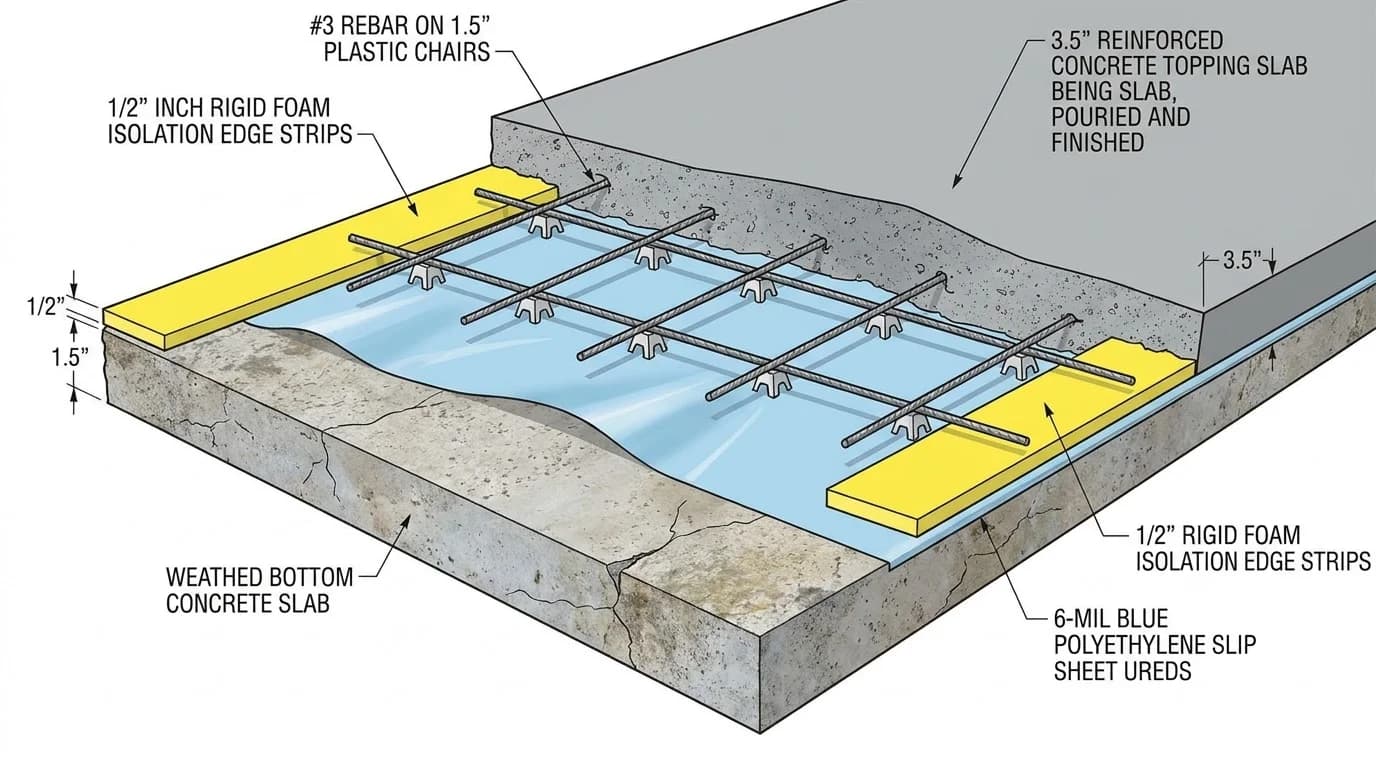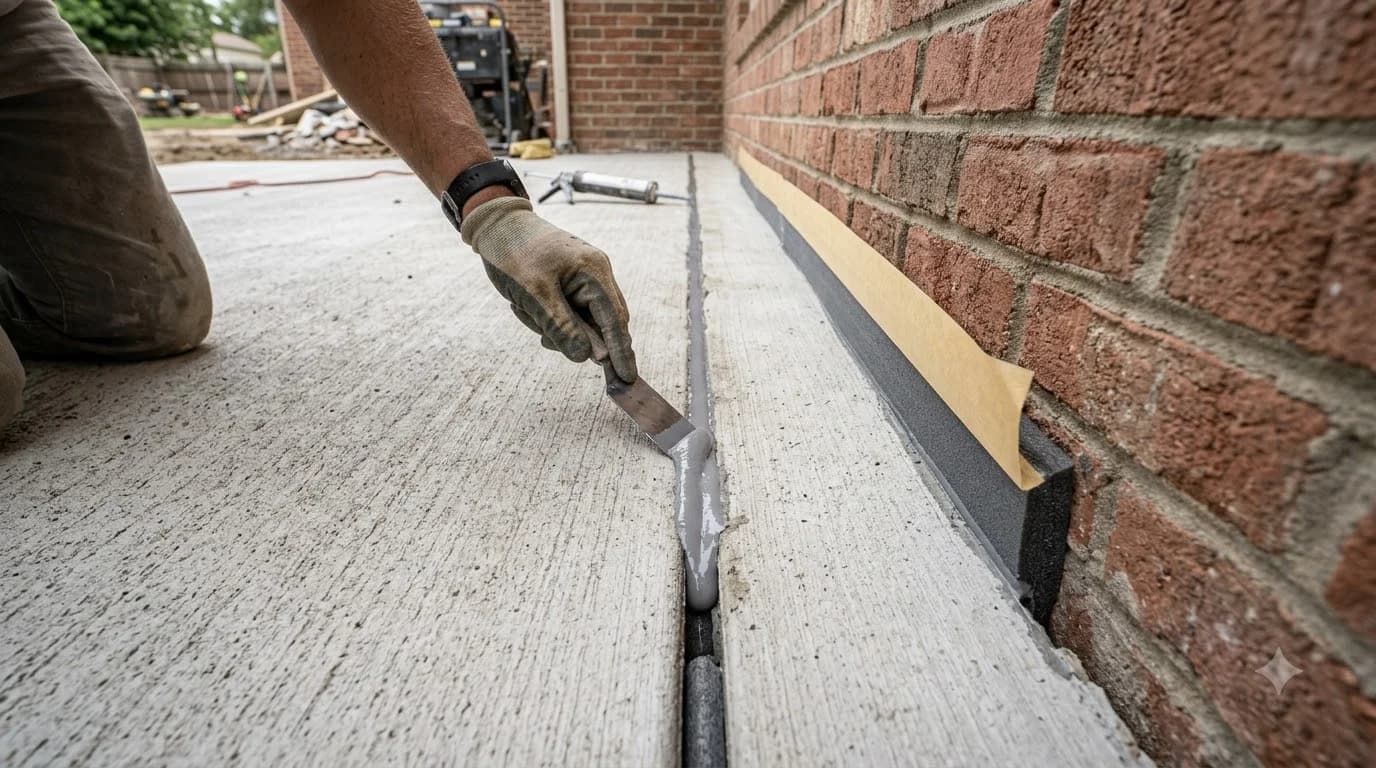
Under ACI 224.3R, true expansion and isolation joints are full-depth physical breaks (1/2-inch wide) separating flatwork slabs from fixed structures (house foundations, retaining walls, columns, curbs, and garage thresholds). Unlike partial-depth control joints (which manage shrinkage cracks), expansion joints must be filled with closed-cell polyethylene foam with a removable tear-strip, backed by closed-cell foam backer rod, and waterproofed with an ASTM C920 polyurethane elastomeric sealant to prevent water infiltration and frost heave.
1. Joint Anatomy: Expansion Joints vs. Contraction Joints vs. Isolation Joints
The American Concrete Institute (ACI 224.3R) divides concrete joints into three distinct structural categories:
Tooled or saw-cut to 1/4 slab depth (D/4). Creates a weakened plane that induces drying shrinkage cracking neatly at the bottom of the cut. Space every 24x to 30x slab thickness (8–10 ft for 4" slabs).
A 100% full-depth barrier installed prior to pouring. Separates the slab from unyielding vertical structures (walls, columns, steps, utility poles) to permit both vertical settlement and horizontal drift.
Full-depth compressible space placed in long, continuous concrete pavements (every 50 to 100 feet). Absorbs longitudinal thermal expansion during high summer heat without slab blowups.
2. Thermal Expansion Physics: Why Slabs Blow Up
Concrete is subject to thermal physics. Its linear coefficient of thermal expansion is approximately 0.0000055 inches per inch per degree Fahrenheit(5.5 × 10^-6 in/in/°F).
Consider a standard 100-foot commercial sidewalk or long residential driveway. Over the course of a year, the slab experiences a temperature swing of 90°F (from a winter low of 20°F to a summer concrete surface temperature of 110°F under direct solar radiation):
Thermal Expansion = 100 ft × 12 in/ft × 0.0000055 × 90°F = 0.594 inches (over 1/2 inch of growth)
If this 100-foot run is poured solid against rigid curbs or foundation walls without compressible expansion joints, the concrete cannot grow. Compressive stresses build until the slab buckles upward in a violent structural failure known as a "slab blowup" or shears off foundation corners.
3. Joint Filler Materials: Asphalt Fiberboard vs. Closed-Cell Foam
Selecting the correct compressible joint filler material prevents moisture infiltration and provides permanent flexibility:
- Closed-Cell Polyethylene Foam (ASTM D1752): Modern contractor standard. 100% waterproof, rot-proof, and flexible. Features a 1/2-inch tear-off top strip that leaves a perfectly recessed channel for caulking after concrete cures.
- Asphalt-Saturated Cane Fiberboard (ASTM D1751): Traditional expansion strip. Inexpensive and rigid (easy to pour against). However, after 10 to 15 years of moisture and freeze-thaw cycles, the asphalt leaches out, leaving rotten, compressed fiber that traps moisture.
- Untreated Wood / Cedar Lath (Banned Practice): Untreated 1x4 pine or redwood slats were historically placed as expansion joints. Wood rots within 5 years, leaving open 3/4-inch trenches that collect water, weed roots, and debris, causing rapid subgrade erosion.
4. Master Concrete Joint Engineering Specification Matrix
Review structural spacing standards, material specifications, and code requirements across all concrete joint categories:
| Joint Classification | Design Depth | Standard Spacing Interval | Compressible Filler / Sealant | Code / Standard Source |
|---|---|---|---|---|
| Driveway Isolation Joint | 100% Full depth (4"–6") | At garage floor, curbs, sidewalks | 1/2" Foam + Sikaflex-1c SL | ACI 302.1R / IRC R506 |
| Sidewalk Expansion Joint | 100% Full depth (4") | Every 40 to 50 linear feet | 1/2" Asphalt board or foam | ASTM D1751 / ACI 224.3R |
| Interior Slab Isolation Joint | 100% Full depth (4") | Around all steel columns & walls | 1/4"–1/2" Closed-cell foam | ACI 360R Column Details |
| Standard Contraction Joint | 1/4 Slab depth (D/4) | 8 to 10 ft (4" slab) | Tooled groove or diamond saw kerf | ACI 302.1R Table 6.1 |
| Commercial Heavy Highway Joint | 100% Full depth (8"–12") | Every 60 to 80 linear feet | 3/4" Board + Smooth steel slip dowels | AASHTO M213 / DOT Spec |
5. Sealing Protocol: Backer Rod & The 2:1 Width-to-Depth Geometry
Proper joint sealant installation requires strict adherence to elastomeric joint geometry:
- Remove Old Debris or Tear-Strip: Peel off the tear-strip on foam fillers or scrape out rotted wood. Clean concrete sidewalls with a wire wheel on an angle grinder to remove laitance, dirt, and mold. Vacuum dust thoroughly.
- Insert Closed-Cell Backer Rod: Press a closed-cell foam backer rod into the joint. Choose a backer rod diameter that is 25% larger than the joint width (use a 5/8" rod for a 1/2" joint) so it compresses tightly into place without rolling.
- The Golden 2:1 Width-to-Depth Ratio: For a 1/2-inch wide joint, the sealant depth must be exactly 1/4 inch. If the sealant is applied too thick (e.g., 1/2" deep on a 1/2" wide joint), internal cohesive stresses will cause it to tear during winter contraction.
- Dispense Self-Leveling Polyurethane Sealant: Cut the nozzle of a self-leveling polyurethane tube (such as Sikaflex-1c SL). Fill the joint flush to roughly 1/16" below the concrete surface. Self-leveling sealant will flow out smooth without tooling.
6. Five Costly Concrete Expansion Joint Mistakes to Avoid
Pouring a patio or driveway hard against a house foundation bonds the two structures together. When the patio slab moves due to frost heave or settlement, it rips masonry facing off the foundation.
If you pour caulking into an empty joint without a foam backer rod, the sealant sticks to the concrete bottom. When the slab contracts in winter, bottom-adhered sealant cannot stretch and rips apart.
Moisture inside concrete pores reacts with polyurethane isocyanate compounds, forming carbon dioxide gas bubbles that turn the sealant into a frothy, weak sponge with zero adhesion. Sidewalls must be bone-dry.
Sawing a 1-inch deep groove every 50 feet does not create an expansion joint. The bottom 3 inches of concrete remain solid; under summer heat, the bottom remains locked in compression, causing severe heaving.
If reinforcing steel rebar passes through an expansion joint without slip sleeves, it locks the two slabs together, preventing thermal movement and defeating the entire purpose of the joint.
Calculating Slab Yardage & Joint Supplies?
Get exact cubic yards, bag counts, rebar, and 2026 material costs instantly.
Frequently Asked Questions
What happens if you omit expansion joints between a driveway and garage floor?
During hot summer weather, a 50-foot outdoor driveway slab expands toward the house. Without a compressible 1/2-inch isolation joint, the slab generates thousands of pounds of compressive thrust against the garage foundation, crushing stem walls, heaving the garage slab, and causing catastrophic foundation displacement.
Why is a backer rod required before sealing expansion joints?
A backer rod prevents 'three-sided adhesion.' Elastomeric sealants (ASTM C920) must only adhere to the two opposing vertical concrete walls. If sealant bonds to the concrete floor at the bottom of the joint as well, it cannot stretch laterally and will tear down the center during winter slab contraction.
How wide should concrete expansion joints be?
Standard residential expansion and isolation joints are 1/2 inch (13 mm) wide and extend through the full depth of the slab. Large commercial parking lots and slabs exceeding 60 to 80 feet in continuous run require 3/4-inch to 1-inch engineered expansion gaps.
What is the difference between an expansion joint and a control joint?
A control joint (contraction joint) is a partial-depth groove cut one-fourth into the slab thickness (D/4) to induce controlled cracking during initial drying shrinkage. An expansion joint (isolation joint) is a 100% full-depth physical separation filled with compressible foam that allows independent movement between adjacent structures.
How often should expansion joint sealant be replaced?
High-grade commercial polyurethane joint sealants (such as Sikaflex-1c SL or MasterSeal NP 1) last 10 to 15 years. Inspect joints annually; if the sealant separates from the sidewalls or tears, water will penetrate beneath the slab, eroding subgrade soil and causing winter frost heave.
Building Codes & Primary Standards Cited
Joints in Concrete Construction
The authoritative engineering guideline for spacing, detailing, and sealing expansion and isolation joints.
Standard Specification for Elastomeric Joint Sealants
Defines class movement capabilities (Class 25 and 35) and durability standards for polyurethane sealants.
Standard Specification for Preformed Expansion Joint Filler for Concrete Paving
Governs recovery, compression, and extrusion tolerances for bituminous and non-extruding fillers.
Estimations adhere to standard North American modular 3/8-inch mortar joint physics and 5% to 10% material waste factors. Local municipal building inspectors, stamped architectural blueprints, and local frost depth requirements supersede general reference guidelines.
Popular Quick Estimates
Pre-engineered takeoffs & benchmarks matched to this project
Related Calculators
Specialized tools for foundation, core fill, and budgeting
Heavyweight structural blocks and bond beam units
Cubic yards, bags, and slab volume for flatwork and footings
Core grout volume in cubic yards and 80-lb pre-mix bags
Cell fill requirements for low-lift and high-lift grouting
Blogs & Construction Guides
Technical articles, IRC code standards, rebar schedules & freight logistics
Is Concrete Porous? Permeability & Sealing (2026 Guide)

How Much Concrete Do I Need? Complete Quantity Takeoff
How to Mix Concrete by Hand: Wheelbarrow Water Ratio