The Technical Verdict: Yes, Concrete Is Highly Porous
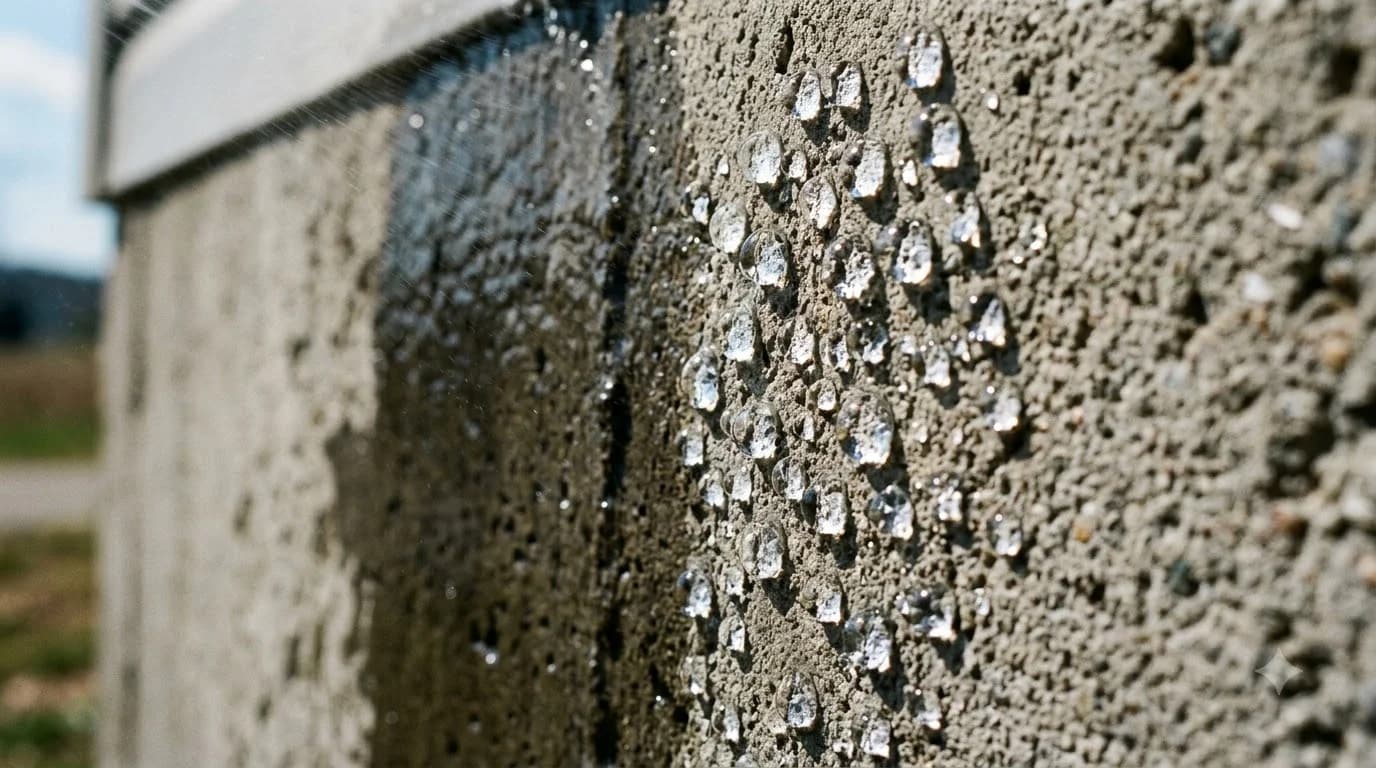
Concrete is not a solid, impermeable stone. A standard residential slab contains 12% to 18% interconnected capillary void space by volume. Chemical hydration of Portland cement requires only 0.25 to 0.28 lbs of water per pound of cement, but batch plants add 0.45 to 0.55 lbs of water for slump workability. As this unreacted excess water evaporates, it leaves behind an extensive microscopic tunnel network through which liquid water, radon gas, and water vapor travel continuously.
1. The Science of Concrete Porosity: How Capillary Tunnels Form
To understand concrete permeability, one must look at the microscopic chemistry of cement hydration (the classical Powers-Brownyard model):
As Portland cement hydrates, it forms Calcium-Silicate-Hydrate (C-S-H) gel. The minute spaces between gel crystals are called “gel pores,” measuring only 0.5 to 2.5 nanometers. Water molecules inside gel pores are held so tightly by physical adsorption that liquid water cannot flow through them. Gel pores do not cause structural leakage.
To make concrete fluid enough to pour and screed, ready-mix batchers add “water of convenience” far beyond what cement can chemically bind. As this surplus bleed water rises and evaporates over the 28-day curing period, it leaves behind open capillary tubules measuring 10 to 50 nanometers wide. These interconnected capillaries allow water to wick in via suction like water up a paper towel.
The lower your water-cement ratio (w/c), the lower the porosity. A mix with a 0.40 w/c ratio produces an almost impermeable concrete after 28 days of wet curing, whereas a sloppy 0.60 w/c mix produces a porous concrete that easily permits groundwater seepage.
2. Master Sealer & Waterproofing Matrix: Choosing the Right Chemistry
Different concrete structures require completely different sealing chemistries under ACI 515.2R (Guide to Selecting Protective Materials for Concrete):
| Sealer Technology | Type | Penetration Depth | Breathable? | Durability | Best Application | Cost / Sq Ft |
|---|---|---|---|---|---|---|
| Silane / Siloxane Blend | Penetrating | 1/4″ to 3/8″ | 100% Breathable | 7 – 10 Years | Driveways, sidewalks, patios, pool decks | $0.25 – $0.45 |
| Lithium Silicate Densifier | Penetrating Crystalline | 1/8″ to 1/4″ | 100% Breathable | Permanent | Polished commercial floors, warehouse slabs | $0.20 – $0.35 |
| Solvent-Based Acrylic | Topical Film (Wet Look) | Surface only (1-2 mils) | Semi-breathable | 2 – 3 Years | Stamped decorative concrete, colored slabs | $0.35 – $0.65 |
| 100% Solids Epoxy Primer | Topical Moisture Barrier | Surface only (10-15 mils) | Non-Breathable | 10 – 15 Years | Interior garage floors, basements (before vinyl) | $1.25 – $2.50 |
| Crystalline Admixture (Xypex) | Internal Chemical Mix | Full monolithic depth | Resists Hydrostatic | Lifetime of concrete | Foundation walls, water tanks, elevator pits | $1.50 – $3.00 |
3. The Dangers of Moisture Vapor Transmission (MVT) Indoors
When you pour concrete inside a home or commercial building without a continuous 10-mil to 15-mil polyolefin vapor retarder (ASTM E1745) beneath the slab, ground moisture constantly migrates upward into your conditioned living space:
Moisture vapor dissolves alkali hydroxides inside the concrete, creating a high-pH liquid slurry (pH 12 to 14) that emulsifies floor glues, bubbles luxury vinyl plank (LVP), and pops non-breathable epoxy coatings right off the floor.
Before installing sensitive interior flooring, professional contractors perform either an ASTM F1869 Calcium Chloride test (which measures surface vapor emission rate; flooring manufacturers require < 3.0 lbs / 1,000 sq ft / 24 hrs) or an ASTM F2170 In-Situ Relative Humidity probe test (which measures internal RH at 40% slab depth; maximum acceptable is typically 75% to 85% RH).
4. Efflorescence: Why Mineral Salts Form on Basement Walls
Many homeowners panic when they see white, fluffy crystals accumulating on their basement walls or cinder block foundation, mistaking it for toxic white mold.
The Chemical Origin of Efflorescence
During cement hydration, calcium silicates release abundant free calcium hydroxide [Ca(OH)&sub2;]. When outside rainwater soaks into unwaterproofed foundation walls, it dissolves this lime. As water reaches the drier indoor air, it evaporates. The dissolved lime reacts with atmospheric carbon dioxide, crystallizing into insoluble calcium carbonate [CaCO&sub3;]:
Ca(OH)&sub2; + CO&sub2; → CaCO&sub3; + H&sub2;OEfflorescence is not mold, but it is unmistakable proof that water is actively traveling through the porosity of your foundation wall.
5. Five Costly Concrete Waterproofing & Sealing Mistakes
Applying thick epoxy or polyurethane to an outdoor driveway or patio is a disaster. Ground moisture rising through the slab gets trapped beneath the impermeable plastic film. In freezing weather, trapped water freezes, turns white, blisters, and peels off in unsightly sheets within 6 months. Outdoor concrete must be sealed with breathable penetrating silanes.
New concrete takes 28 days to exhaust excess water and develop its internal silicate structure. Applying a penetrating or film-forming sealer before 28 days traps bleed water, blocks full hydration, and leaves a hazy white chemical film.
Brushing “waterproofing paint” on interior basement walls traps groundwater inside the block cores. Hydrostatic head pressure will eventually push the paint film off the wall. True waterproofing must occur on the positive (exterior) side using elastomeric membranes and footing perimeter drain tiles (French drains).
Smooth power-troweled concrete has closed surface pores. Applying topcoats without opening the pores via mechanical diamond grinding (CSP 2 to 3 profile) or muriatic acid etching prevents mechanical interlock, causing coatings to peel off under vehicle tires.
Penetrating sealers are engineered to soak completely into concrete pores. If sprayed on too thick and allowed to puddle, the excess silane resin dries on top as a slick, sticky white residue that must be stripped with harsh solvent strippers. Always back-roll puddles with a dry nap roller within 10 minutes.
Planning a Concrete Sealing Project?
Calculate square footage, sealer gallon requirements, and local 2026 material costs.
Frequently Asked Questions
Is cured concrete naturally porous or waterproof?
Concrete is naturally porous, behaving like a rigid microscopic stone sponge. Hardened standard concrete contains between 10% and 18% interconnected capillary void space by volume, formed as excess batch water evaporates out of the cement matrix during hydration.
Can water pass through solid concrete slabs and foundation walls?
Yes. Through capillary suction and hydrostatic groundwater head pressure, liquid water and moisture vapor migrate continuously through unsealed concrete. Standard slabs can emit 3 to 12 pounds of moisture vapor per 1,000 square feet every 24 hours without a sub-slab vapor barrier.
What is the best sealer to waterproof porous outdoor concrete?
A penetrating silane or siloxane sealer is the industry standard for outdoor driveways and patios. It penetrates 1/4 to 3/8 inch deep, chemically reacting with free silica to line pore walls with hydrophobic silicone molecules. It sheds 95% of liquid water while remaining 100% vapor permeable (breathable), preventing freeze-thaw spalling.
What causes white powdery stains on porous concrete walls?
The white powder is efflorescence. As groundwater wicks through the porous concrete, it dissolves free calcium hydroxide salts formed during cement hydration. When moisture reaches the interior air, it evaporates and leaves behind crystallized calcium carbonate on the surface.
What is the difference between penetrating sealers and topical film-forming coatings?
Penetrating sealers (silanes, siloxanes, siliconates) soak deep inside pores without creating a surface film, preserving traction and allowing moisture vapor to escape. Topical coatings (acrylics, epoxies, polyurethanes) form an impermeable plastic membrane over the surface, providing high gloss and chemical resistance but trapping sub-slab moisture that can cause bubbling if applied outdoors.
Building Codes & Primary Standards Cited
Standard Test Methods for Gravimetric Determination of Water Vapor Transmission Rate of Materials
Defines the standard laboratory measurement procedures for permeance and vapor diffusion through concrete and barrier films.
Guide to Selecting Protective Materials for Concrete
American Concrete Institute guidelines detailing the chemistry, penetration, and performance of sealers and waterproof coatings.
Standard Test Method for Density, Absorption, and Voids in Hardened Concrete
Establishes quantitative metrics for measuring permeable pore space percentage in cast-in-place concrete.
Standard Test Method for Measuring Moisture Vapor Emission Rate of Concrete Subfloor Using Anhydrous Calcium Chloride
The primary historical standard specifying acceptable vapor emissions before installing interior flooring.
Estimations adhere to standard North American modular 3/8-inch mortar joint physics and 5% to 10% material waste factors. Local municipal building inspectors, stamped architectural blueprints, and local frost depth requirements supersede general reference guidelines.
Popular Quick Estimates
Pre-engineered takeoffs & benchmarks matched to this project
Related Calculators
Specialized tools for foundation, core fill, and budgeting
Cubic yards, bags, and slab volume for flatwork and footings
Heavyweight structural blocks and bond beam units
Core grout volume in cubic yards and 80-lb pre-mix bags
Cell fill requirements for low-lift and high-lift grouting
Blogs & Construction Guides
Technical articles, IRC code standards, rebar schedules & freight logistics
How to Mix Concrete by Hand: Wheelbarrow Water Ratio
Can You Pour Concrete Over Concrete? (2" Min Guide)
How to Calculate Concrete Yards: Step-by-Step Math