Quick Contractor Verdict: Polyjacking Wins on Weight, Longevity, and Aesthetics
Mudjacking is 20% to 30% cheaper upfront ($4.50–$8.00/sq ft), but requires large 2-inch drill holes and injects heavy slurry (120 lbs/cu ft) that can re-settle weak soils. Polyjacking ($7.00–$12.00/sq ft) uses penny-sized 5/8" holes, weighs only 2 to 4 lbs/cu ft, cures in 15 minutes, and will never wash out under groundwater flow, lasting 20+ years.
1. Subgrade Settlement Mechanics: Why Concrete Slabs Sink
A standard 4-inch concrete slab weighs roughly 50 pounds per square foot. When a slab sinks, the concrete itself is rarely defective—the failure occurs in the supporting earth underneath:
- Poor Subbase Compaction: Builders backfill foundation walls, trenches, and garage approaches with loose soil. If not mechanically compacted in 6-inch lifts, gravity and foot/vehicle traffic consolidate the soil over 2 to 5 years, creating subterranean voids.
- Soil Washout from Roof Runoff: Misdirected downspouts and leaking underground drainpipes wash fine sand and aggregate out from beneath sidewalks and driveways, leaving the slab cantilevered over empty air.
- Clay Soil Shrinkage: Expansive clay soils swell during wet springs and shrink during summer droughts. As the clay desiccates and recedes, the unsupported slab fractures and drops.
2. Polyjacking vs. Mudjacking Engineering Comparison Matrix
Review the mechanical and chemical differences under ACI 546R (Concrete Repair Guide):
| Performance Metric | Polyjacking (Geotechnical Foam) | Mudjacking (Limestone / Sand Slurry) | Contractor Analysis |
|---|---|---|---|
| Drill Port Size | 5/8-inch (Dime size) | 1.5 to 2.0 inches (Soda can size) | Polyjacking leaves nearly invisible patched holes |
| Injected Mass Density | 2.0 to 4.0 lbs / cu ft | 100 to 120 lbs / cu ft | Mudjacking adds extreme dead weight to weak soils |
| Cure Time to Traffic | 15 to 30 minutes | 24 to 48 hours | Polyjacking allows same-day driveway vehicle parking |
| Groundwater Resistance | 100% Hydrophobic (Insoluble closed cell) | Water-soluble (Can wash away under flow) | Polyurethane forms a permanent subterranean dam |
| 2026 Average Pricing | $7.00 – $12.00 / sq ft | $4.50 – $8.00 / sq ft | Mudjacking is 20-30% cheaper upfront |
| Expected Durability | 20 to 30+ Years (Permanent material) | 5 to 10 Years (Often re-settles) | Polyjacking delivers higher lifetime ROI |
3. Cost & ROI Analysis: Leveling vs. Demolition and Repour
Before hiring a contractor to jackhammer and pour a new driveway, evaluate the total project cost comparison for a typical 400-square-foot sunken driveway approach:
$1,800 – $2,800
Low upfront cost; risk of re-settlement in 5–8 years.
$2,800 – $4,200
Lifetime repair; tiny holes, 15-minute cure.
$6,500 – $9,000+
Demolition, hauling, forms, 28-day cure, mismatched color.
4. The Step-by-Step Polyjacking Injection Process
Geotechnical polyjacking is a precision process executed with continuous laser monitoring under ICRI 310.1R:
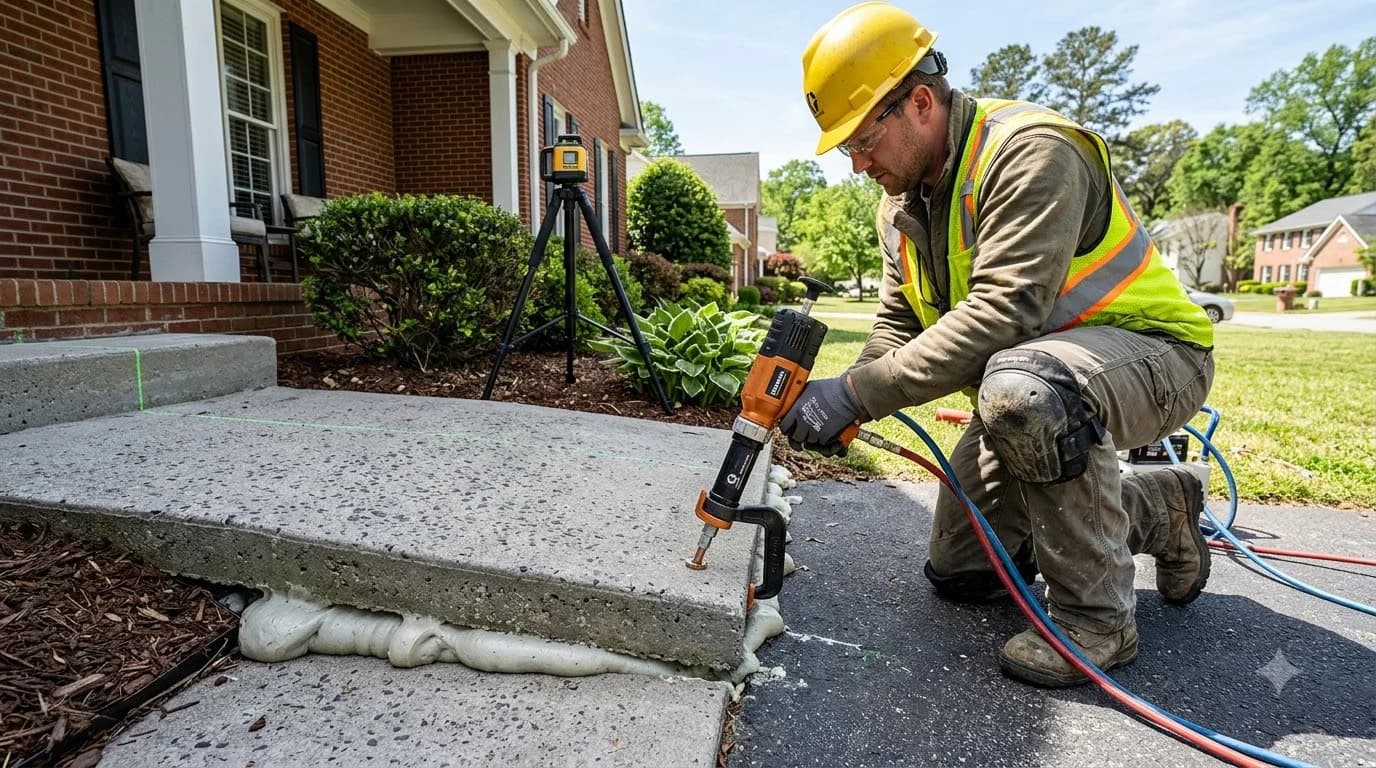
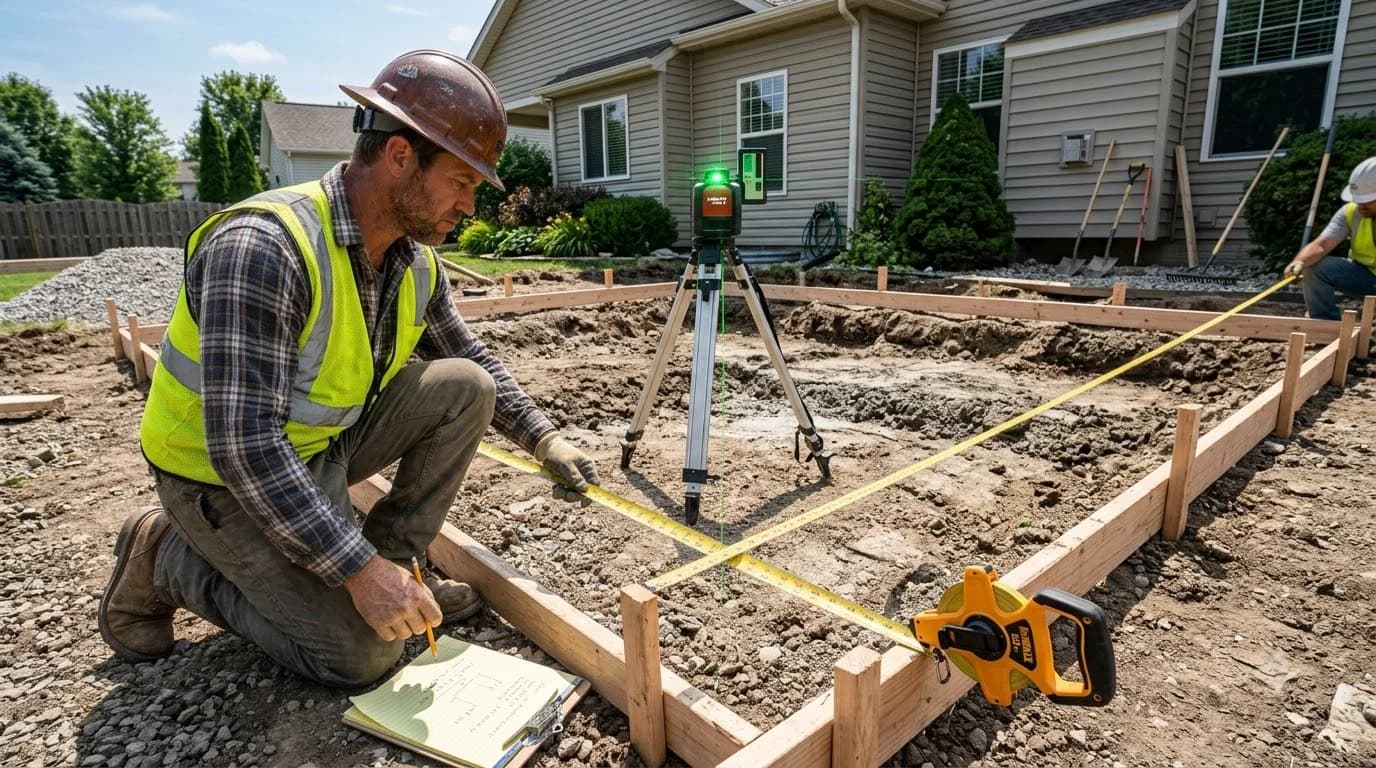
- Site Mapping & Laser Alignment:A surveyor's optical level or laser receiver is positioned on the slab to monitor elevation down to 1/16 of an inch.
- Micro-Port Drilling: Using an SDS-Plus rotary hammer drill, small 5/8-inch holes are drilled through the concrete in a staggered grid pattern.
- Injection Gun Seating: Tapered brass or steel mechanical injection ports are driven into the drill holes.
- Two-Part Polyurethane Injection: High-pressure proportioning equipment pumps isocyanate and polyol resin into the nozzle. As the components mix, an exothermic reaction expands the foam up to 25 times its liquid volume, generating up to 7,200 psf of lifting pressure under ASTM D1621.
- Void Filling & Leveling: The expanding foam first fills all subgrade air pockets, consolidating weak soil. Once confined, hydraulic pressure gently lifts the slab back to flush alignment with adjacent sidewalk panels.
- Patching: The injection ports are removed, and holes are plugged with non-shrink hydraulic cement color-matched to the surrounding concrete.
5. Feasibility: When Can a Slab Be Lifted vs. Replaced?
Not every sunken slab is a candidate for leveling. Inspect the structural integrity before committing:
- Ideal for Polyjacking: Uncracked slabs that have dropped 1/2 inch to 4 inches; slabs with one or two clean hairline control joint fractures; pool decks with trip hazards; garage approaches with settlement gaps.
- Demolition & Replacement Required:Slabs with severe “alligator cracking” (shattered into dozens of pieces smaller than 12 inches); concrete suffering from severe surface spalling, freeze-thaw crumbling, or alkali-silica reaction (ASR); slabs pushed upward by mature tree roots (leveling cannot pull a heaved slab downward).
5 Critical Concrete Leveling Mistakes to Avoid
Failing to Fix the Underlying Water Source
Leveling a walkway without redirecting an overflowing gutter or extending downspouts means water will continue washing out surrounding soil, undermining the repair.
Using Mudjacking on Highly Saturated Silt
Pumping tons of heavy wet slurry into saturated marshy or silty soil will cause the subsoil to compress further, dropping the slab below its original sunken level.
Over-Injecting Polyurethane Foam
Polyurethane foam continues to expand for 30 to 45 seconds after injection. Inexperienced operators who inject too rapidly can over-lift the slab, creating an irreversible reverse hump.
Leaving Control Joints Unsealed
After lifting, all cracked seams and expansion joints must be sealed with polyurethane caulk. Leaving joints open allows rainwater to penetrate underneath and freeze.
Planning a Concrete Repair or Slab Replacement?
Compare concrete replacement volumes, ready-mix yards, and 2026 material costs.
Frequently Asked Questions
Is concrete leveling cheaper than replacement?
Yes. Concrete leveling (polyjacking or mudjacking) costs approximately 50% to 70% less than demolishing and repouring a new slab. It also eliminates landscape damage and preserves the weathered color match of your existing driveway or walkway.
How long does polyjacking foam last?
High-density polyurethane foam is an inert, closed-cell polymer that does not rot, decompose, or dissolve in groundwater. The foam lift will last the remaining structural life of the concrete slab—typically 20 to 30+ years.
Can any sunken concrete slab be lifted?
Slabs that are intact or broken into several large sound sections can be lifted successfully. Slabs shattered into dozens of small fragments (alligator cracking) or crushed by massive tree root heave cannot be stabilized and must be demolished and replaced.
How soon can you drive on a polyjacked driveway?
Geotechnical polyurethane reaches 90% compressive strength within 15 to 30 minutes of injection. Homeowners can park passenger cars and pickup trucks on the leveled driveway the same day.
Why do mudjacked slabs often sink again after 5 years?
Traditional mudjacking injects a heavy limestone and water slurry weighing 100 to 120 lbs per cubic foot. This massive added weight further consolidates already weak, uncompacted subgrade soils, causing re-settlement over time.
Building Codes & Primary Standards Cited
Guide to Concrete Repair
American Concrete Institute guidelines for subgrade stabilization, void filling, and lifting.
Guide for Surface Preparation and Repair of Deteriorated Concrete
Establishes structural inspection standards and feasibility criteria for settled slabs.
Standard Test Method for Compressive Properties of Rigid Cellular Plastics
Measures compressive strength and lifting expansion forces of high-density geotechnical foam.
Estimations adhere to standard North American modular 3/8-inch mortar joint physics and 5% to 10% material waste factors. Local municipal building inspectors, stamped architectural blueprints, and local frost depth requirements supersede general reference guidelines.
Popular Quick Estimates
Pre-engineered takeoffs & benchmarks matched to this project
Related Calculators
Specialized tools for foundation, core fill, and budgeting
Heavyweight structural blocks and bond beam units
Cubic yards, bags, and slab volume for flatwork and footings
Core grout volume in cubic yards and 80-lb pre-mix bags
Cell fill requirements for low-lift and high-lift grouting
Blogs & Construction Guides
Technical articles, IRC code standards, rebar schedules & freight logistics
How to Level Uneven Concrete Floors: Self-Leveling Guide
Is Concrete Porous? Permeability & Sealing (2026 Guide)
How Much Concrete Do I Need? Complete Quantity Takeoff