1. Concrete vs. Mortar vs. Masonry Grout: Know the Difference
In residential construction, homeowners often confuse mortar, concrete, and grout. Each material has distinct physical properties engineered for a specific job:
Masonry Mortar
Formulated with hydrated lime for creamy plasticity. Functions exclusively as the bedding adhesive between individual blocks. Mortar lacks the aggregate strength to serve as structural core fill.
Standard Concrete
Designed for slabs and footings. Contains large 3/4" to 1" angular stone aggregates and stiff 3-to-4-inch slump. When poured into narrow block cores, large stones jam and create massive internal voids.
Masonry Core Grout
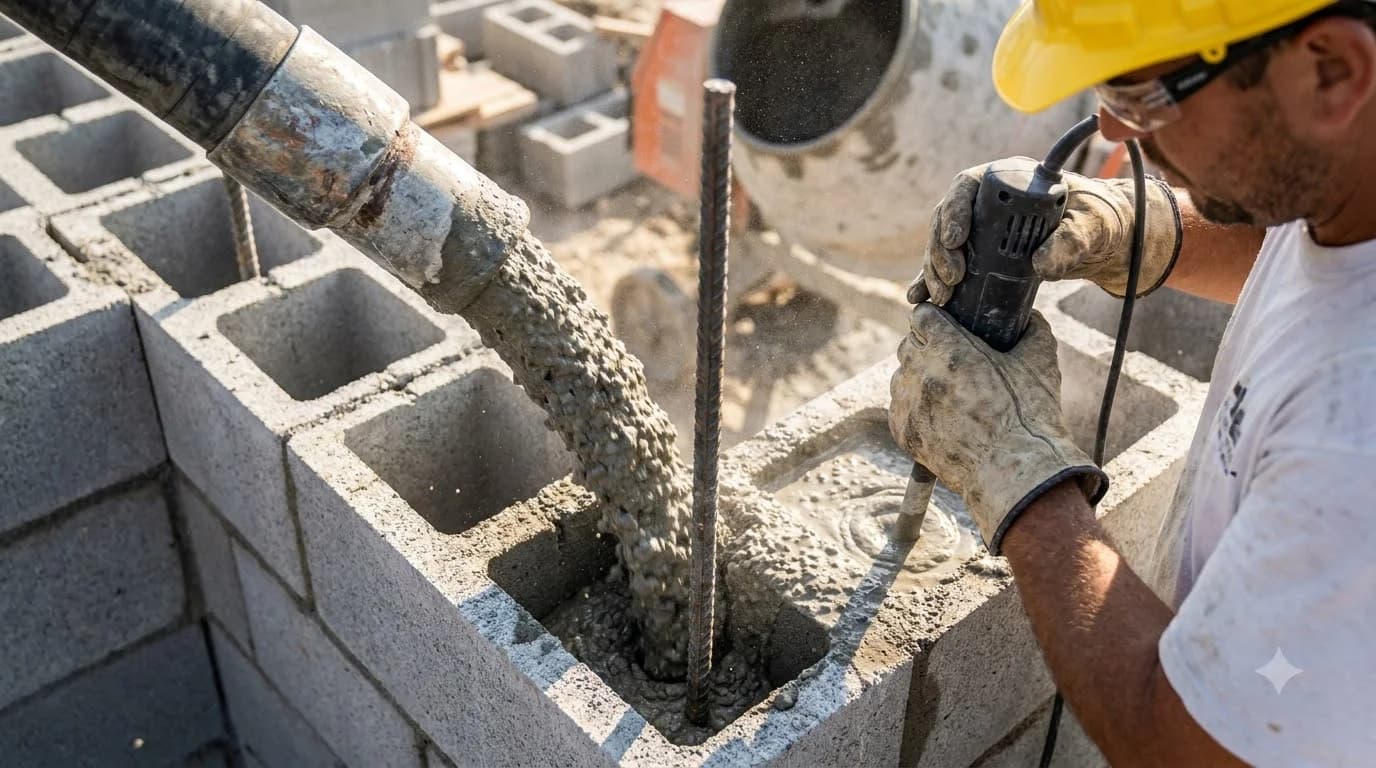
Engineered with 3/8-inch pea gravel aggregate, high cement content (2,000–3,000+ PSI), and a fluid 8-to-11-inch slump designed to flow around steel rebar and fill every crevice of hollow CMUs.
2. ASTM C476 Specifications: Fine vs. Coarse Grout
Building codes specify two classes of masonry grout based on core dimension and clearance around rebar bars:
| Grout Classification | Aggregate Sizing | Min. Clear Core Dimension | Slump Range | Recommended Use |
|---|---|---|---|---|
| Fine Grout | Mason sand only (No gravel) | 1.5 inches x 2 inches | 8 – 11 inches | Narrow collar joints, 4-inch & 6-inch CMUs, congested rebar cages |
| Coarse Grout | 3/8-inch pea gravel + sand | 2 inches x 3 inches | 8 – 11 inches | Standard 8-inch, 10-inch, & 12-inch CMU foundation and retaining walls |
3. Low-Lift vs. High-Lift Grouting Techniques
Masonry contractors choose between two execution strategies depending on wall height and site equipment:
Low-Lift Grouting (≤ 5 Feet)
Wall courses are laid up to a maximum height of 5 feet (typically 7 courses). Grout is placed into the cores using 5-gallon buckets or a grout bag before continuing to lay upper courses.
- No cleanout holes required at base.
- Minimal risk of hydrostatic wall blowout.
- Best for DIYers and small residential additions.
High-Lift Grouting (> 5 Feet up to 24 Feet)
The block wall is completely laid to its full finished height before any grout is pumped. Rebar is spliced and held with plastic positioners.
- Cleanouts mandatory: 3"x3" holes at base of every grouted cell.
- Cleanouts vacuumed, inspected, and sealed with plywood before pump.
- Poured with commercial boom pump truck in 4-to-5-ft consolidating lifts.
4. Consolidation & Rebar Encapsulation
Grout must form an unbroken mechanical lock with the deformed ribs of steel rebar (view rebar spacing guide). Simply pouring fluid grout leaves tiny air pockets along the steel surface:
1. Initial Consolidation: Immediately after pouring a lift, insert a 3/4-inch to 1-inch pencil vibrator into each cell for 3 to 5 seconds. Alternatively, puddle vigorously with a 5/8-inch rebar stick. Avoid over-vibrating, which can blow out fresh mortar joints.
2. Reconsolidation (The Secret Step): Within 10 to 20 minutes after initial placement, the porous cinder blocks will have absorbed excess water from the grout, causing the fluid mix to settle 1 to 2 inches. Re-insert the vibrator into the top 12 inches of each cell to reconsolidate and prevent shrinkage gaps beneath bond beams.
5. How Much Concrete Grout Do You Need? (Volume Table)
Use this reference table to estimate cubic yards or 80-lb pre-blended grout bags for your project:
| Block Size (Nominal) | Grout Vol / Block (Cu. Ft) | Cu. Yds per 100 Blocks | 80-lb Bags per 100 Blocks |
|---|---|---|---|
| 6x8x16 CMU | 0.18 cu ft | 0.67 cu yd | 27 bags |
| 8x8x16 CMU (Standard) | 0.26 cu ft | 0.96 – 1.0 cu yd | 38 – 40 bags |
| 10x8x16 CMU | 0.34 cu ft | 1.26 cu yd | 50 bags |
| 12x8x16 CMU | 0.42 cu ft | 1.56 cu yd | 62 bags |
Calculate Core Fill Concrete & Grout Bags
Calculate exact grout volume in cubic yards, cubic feet, and 80-lb pre-mix bags for full or partial core filling.
Frequently Asked Grouting Questions
Can you use standard bag concrete (like Quikrete) to fill cinder blocks?
Standard gravel concrete should generally NOT be used unless it is specifically pea-gravel mix. Standard bag concrete contains large 3/4-inch to 1-inch angular stone aggregates that bridge across narrow block webs and rebar, creating catastrophic internal air voids and honeycombing. You must use ASTM C476 Core-Fill Grout or pea-gravel concrete with an 8 to 11-inch fluid slump.
Why does masonry grout require such a high slump (8 to 11 inches)?
Dry cinder blocks have rapid suction that immediately pulls water out of the grout upon placement. If you pour a standard 3-inch or 4-inch slump concrete, the blocks suck it dry within minutes, causing it to freeze in place without encapsulating the steel rebar. An 8 to 11-inch slump allows the grout to flow around rebar pins and completely fill hollow cells before the block suction consolidates it.
How much concrete or grout does it take to fill a cinder block?
A standard hollow two-core 8x8x16 CMU block requires approximately 0.25 to 0.28 cubic feet of grout to fill both cores solid. To fill 100 blocks solid, you will need approximately 1.0 cubic yard of grout (or roughly thirty-five to forty 80-lb bags of pre-blended core grout).
What is the difference between low-lift and high-lift grouting?
Low-lift grouting pours wall cores in increments of 5 feet or less as the wall is built. It requires no special cleanout openings. High-lift grouting pours the full wall height (up to 12 to 24 feet) after the entire wall is laid. High-lift grouting requires 3x3-inch cleanout windows cut into the base of every vertical core to vacuum out fallen mortar droppings before pumping.
Building Codes & Primary Standards Cited
Standard Specification for Grout for Masonry
Proportion and property specifications for fine and coarse core-fill grouts, testing procedures, and 28-day compressive strengths.
Building Code Requirements and Specification for Masonry Structures
Grouting execution rules, low-lift vs high-lift thresholds, cleanout inspection openings, and consolidation vibration intervals.
Standard Test Method for Sampling and Testing Grout for Masonry
Standardized field test procedures using absorption-forming pinwheel block molds to measure in-situ grout compressive strength.
Estimations adhere to standard North American modular 3/8-inch mortar joint physics and 5% to 10% material waste factors. Local municipal building inspectors, stamped architectural blueprints, and local frost depth requirements supersede general reference guidelines.
Popular Quick Estimates
Pre-engineered takeoffs & benchmarks matched to this project
Related Calculators
Specialized tools for foundation, core fill, and budgeting
Core grout volume in cubic yards and 80-lb pre-mix bags
Step-by-step masonry formulas and corner waste rules
Direct wall dimensions with window and door deductions
Cell fill requirements for low-lift and high-lift grouting
Blogs & Construction Guides
Technical articles, IRC code standards, rebar schedules & freight logistics
How to Cut Cinder Blocks: Grinder, Saw & Chisel Guide
Where to Buy Cinder Blocks: Big Box vs Masonry Yards
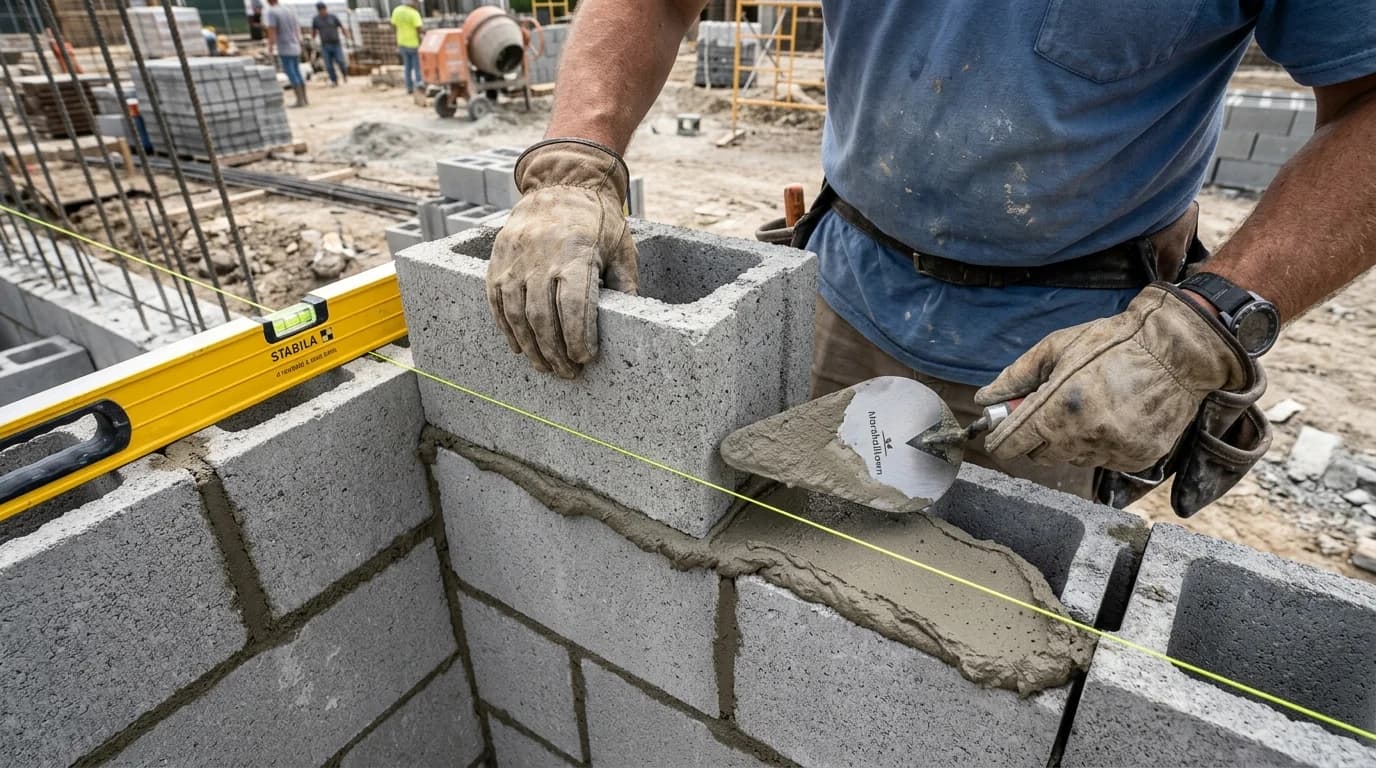
How to Lay Cinder Blocks: Masonry Guide for Beginners