1. Retail Big Box Chains: Home Depot, Lowe's & Menards Procurement
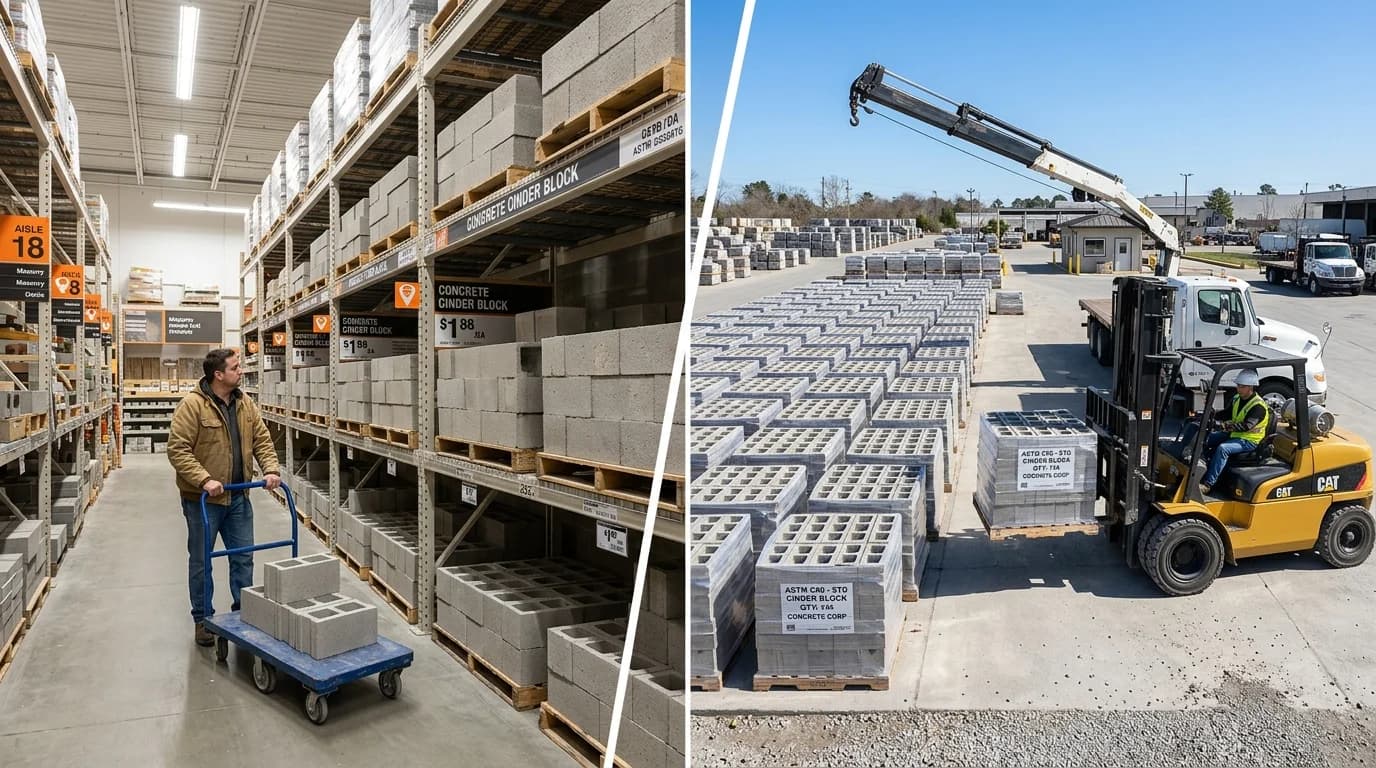
National home center retailers are the primary material source for homeowners, DIY builders, and handymen. Their dense retail presence across suburban and urban areas provides unmatched convenience:
Advantages of Big Box Retailers
- Zero Order Minimums: Buy exactly 1, 8, or 23 blocks without purchase quotas or commercial account setups.
- Extended Operating Hours: Open 7 days a week, typically 6:00 AM to 9:00 PM, allowing immediate evening and weekend pickups.
- Inexpensive Hourly Truck Rentals: Rent a flatbed pickup truck right from the parking lot for $19 for the first 75 minutes.
- Hassle-Free Surplus Returns: Return intact surplus blocks at the customer service desk without restocking fees.
Drawbacks & Hidden Costs
- Higher Unit Prices: Retail prices range from $2.25 to $2.98 per standard 8x8x16 block, even when purchasing full pallets.
- Forklift-Damaged Inventory: Retail pallets in customer aisles are frequently banged by customer carts and careless forklift operators, chipping corners.
- Curbside Drop Delivery Only: Third-party flatbed delivery drivers rarely leave the street or driveway apron.
- Missing Structural Shapes: Big box stores almost never inventory bond beam U-blocks, lintels, or corner blocks.
2. Commercial Masonry Supply Yards & Concrete Block Plants
Commercial masonry yards (such as Oldcastle APG/Belgard distributors, Basalite, Headwaters, and regional concrete block manufacturers) cater directly to professional masonry contractors. However, the vast majority of commercial yards actively sell to residential owner-builders and consumers:
Deep Pallet Volume Discounts
While big box stores charge approximately $240 to $290 for a pallet of 108 blocks ($2.40/block), commercial yards charge $160 to $200 per pallet ($1.50 to $1.85/block). On a 600-block foundation project, purchasing from a commercial yard saves $350 to $550 in raw block material costs alone.
Complete Structural & Architectural Catalogs
Commercial yards maintain extensive stock of engineered shapes mandated by IRC Section R606: open-trough bond beams for horizontal rebar placement, knockout lintel blocks for door spans, sash jamb blocks for window bucks, and decorative split-face architectural veneers in multiple color pigments.
When purchasing from a commercial yard, simply walk into the contractor sales counter. Request a quote for ASTM C90 normal-weight or medium-weight hollow load-bearing CMUs. You can pay via credit card, schedule flatbed delivery, and coordinate jobsite offloading instructions directly with the yard dispatcher.
3. Supplier Comparison Matrix: Big Box vs Commercial Masonry Yard
Evaluate retail home centers against commercial block yards across pricing, delivery equipment, and specialty catalog availability based on 2026 contractor surveys:
| Sourcing Feature | Big Box Retailers (Home Depot / Lowe's) | Commercial Masonry Supply Yards |
|---|---|---|
| Single 8×8×16 Unit Price | $2.25 – $2.98 / block | $2.10 – $2.50 / block |
| Pallet Price (108 units) | $240 – $290 | $160 – $200 (25-40% Savings) |
| Specialty Shapes (Bond Beams / Lintels) | Extremely Rare (Special Order Only) | Always In Stock (Full Catalog) |
| Pallet Core Deposit Fee | $15 – $25 (Refundable) | $15 – $25 (Refundable) |
| Delivery Fleet & Offloading | Curbside drop via contracted third party | In-house flatbed with all-terrain Moffett |
| Jobsite Placement Capability | Street, driveway apron only | Backyard, lawn, or foundation trenches |
| Delivery Cost Range | $75 – $125 flat rate | $90 – $160 (Free on 4+ pallets) |
| Store Operating Hours | Mon–Sun 6:00 AM – 9:00 PM | Mon–Fri 6:30 AM – 4:00 PM (Closed Sun) |
4. Freight Logistics, Pallet Deposits & Moffett Offloading
Concrete blocks are among the heaviest building materials transported in residential construction. Understanding hauling physics is critical for both safety and logistics:
- Pallet Weight Realities: A standard banded pallet holds 108 units of 8x8x16 CMUs. With medium-weight blocks weighing 34 to 38 lbs each, one pallet weighs 3,700 to 4,100 lbs. Cap block pallets (144 units) weigh roughly 3,600 lbs.
- Pickup Truck Payload Hazards: A standard half-ton pickup (Ford F-150, Chevy Silverado 1500) has a legal bed payload capacity of only 1,500 to 2,200 lbs. Loading a single full pallet of blocks crushes the rear suspension, blows tires, and violates DOT weight regulations. Even a 3/4-ton truck (2500 series) can haul only one pallet safely.
- All-Terrain Moffett Forklifts: Commercial supply yards equip their flatbed delivery trucks with piggyback Moffett forklifts. Featuring high-flotation knobby tires and all-wheel drive, a Moffett can drive over grass, gravel pads, and muddy terrain to set heavy pallets directly alongside your building trench, eliminating dozens of hours of back-breaking wheelbarrow transport.
- Managing Pallet Core Deposits: Both suppliers charge a refundable $15 to $25 deposit per wooden pallet. On an 8-pallet order, this represents $120 to $200 in temporary collateral. Keep pallets clean and unbroken; stack them into your truck and return them to the dispatch desk with proof of purchase for a full refund.
5. Five Costly Block Purchasing Mistakes to Avoid
1. Overloading a Half-Ton Pickup Truck
Forklift operators at big box stores will often load whatever you request. Never permit them to drop a full 3,800-lb pallet into a half-ton pickup bed. At most, a half-ton truck can safely carry 40 to 45 loose blocks per trip.
2. Buying ASTM C129 Non-Load-Bearing Units
Non-bearing cinder blocks (ASTM C129) are designed strictly for interior partition walls and lack structural compressive strength. Foundation walls, retaining walls, and garage structures legally require ASTM C90 load-bearing certified units (minimum 2,000 PSI net area strength).
3. Signing Delivery Tickets Without Pallet Inspection
Once you sign the flatbed delivery ticket, the supplier considers the shipment accepted. Inspect the steel or plastic banding immediately. If bands are loose or blocks on the bottom tier have fractured face shells from transit shifting, note the damaged unit count on the driver's bill of lading for immediate credit.
4. Discarding Wooden Pallets Instead of Claiming Deposits
Homeowners frequently burn or send heavy block pallets to the landfill, unaware they paid a $15 to $25 deposit per pallet. On a modest foundation requiring 6 pallets, throwing away pallets wastes $90 to $150 in cash refunds.
5. Assuming Big Box Stores Stock Bond Beam U-Blocks
Building a code-compliant reinforced block wall requires horizontal bond beams (U-shaped blocks) at the top course and below floor levels to encase rebar and grout. Assuming Home Depot has them in stock can stall your mason crew for days; order specialty shapes from a commercial yard a week in advance.
6. 2026 Regional Pricing Variations & Contractor Bidding Tactics
Concrete block manufacturing is hyper-localized because aggregate hauling costs restrict shipping radii to roughly 50 to 100 miles from the autoclave kiln:
Southeast / Sunbelt
$1.45 – $1.85 / block
High regional plant competition and massive residential block home volume keep unit prices low.
Midwest / Plains
$1.75 – $2.20 / block
Abundant limestone aggregates but seasonal winter plant slowdowns slightly increase freight.
Northeast / Mid-Atlantic
$2.15 – $2.75 / block
Higher regional labor costs, strict environmental aggregate zoning, and toll highway freight.
Pacific West Coast
$2.35 – $2.95 / block
High cement raw material costs and mandatory seismic ASTM testing certifications.
Pro Contractor Strategy: When ordering from a commercial yard, bundle your blocks with ASTM C270 Type S mortar bags, bulk masonry sand, #4 steel rebar, and ladder wire joint reinforcement on the same flatbed delivery. Consolidating your materials into one order eliminates multiple $125 delivery drop fees and unlocks tier-2 contractor discounts.
Frequently Asked Questions
Is it cheaper to buy cinder blocks at Home Depot or a local masonry yard?
For small quantities under 30 to 50 blocks, big box stores (Home Depot, Lowe's, Menards) are cheaper and more convenient ($2.25 to $2.98 per individual block with zero commercial minimum order fees). However, for full pallet quantities (108+ units), commercial masonry supply yards and regional concrete block plants offer volume pricing of $1.50 to $1.90 per block, delivering 25% to 40% material savings on foundation or retaining wall projects.
How much does delivery cost for a pallet of cinder blocks in 2026?
Flatbed delivery with an all-terrain Moffett piggyback forklift costs between $75 and $125 at major retail home centers and $90 to $160 at commercial masonry supply yards. The key advantage of a commercial masonry yard is that their experienced drivers can maneuver the all-terrain forklift across lawns or unpaved dirt to set heavy 3,800-lb pallets directly along foundation trenches, whereas big box subcontractors typically drop pallets exclusively at the curbside or driveway apron.
Can non-contractors buy directly from commercial masonry supply yards?
Yes. Most commercial masonry supply yards, hardscape distributors, and block manufacturing plants welcome residential homeowners and owner-builders. You do not need a commercial contractor license to purchase materials. You can walk into the sales dispatch office, pay with a standard credit card, and arrange residential jobsite flatbed delivery.
What is the wooden pallet deposit fee, and how do I get a refund?
Both big box retailers and commercial block yards assess a refundable pallet core deposit of $15.00 to $25.00 per wooden pallet to encourage recycling. When your project is complete, stack undamaged pallets in your truck bed and return them to the store customer service counter or yard dispatch desk with your original receipt to receive a 100% refund.
Why don't big box stores carry bond beam blocks or lintel blocks?
Big box stores cater primarily to DIY consumers doing light landscaping and small repairs, meaning standard hollow stretchers and solid 2-inch cap blocks account for 95% of retail turnover. Specialty architectural shapes—such as open-trough bond beams (U-blocks), sash jamb units, knockout lintels, corner returns, and split-face textured blocks—require extensive warehouse yard space and are stocked exclusively by commercial masonry suppliers.
Building Codes & Primary Standards Cited
Standard Specification for Loadbearing Concrete Masonry Units
Defines minimum compressive strength (2,000 PSI net area), moisture tolerances, and physical dimensions for structural blocks.
Structural Masonry Construction Guidelines & Procurement
National Concrete Masonry Association standard detailing unit weight classifications, pallet configurations, and jobsite handling.
Federal Cargo Securement and Axle Weight Regulations
Establishes commercial flatbed transport regulations, pallet strapping tension rules, and vehicle axle payload limits.
Estimations adhere to standard North American modular 3/8-inch mortar joint physics and 5% to 10% material waste factors. Local municipal building inspectors, stamped architectural blueprints, and local frost depth requirements supersede general reference guidelines.
Popular Quick Estimates
Pre-engineered takeoffs & benchmarks matched to this project
Related Calculators
Specialized tools for foundation, core fill, and budgeting
Step-by-step masonry formulas and corner waste rules
Direct wall dimensions with window and door deductions
Type S and M bags, cubic feet and batching sand volume
Primer, acrylic block filler and topcoat paint gallons
Blogs & Construction Guides
Technical articles, IRC code standards, rebar schedules & freight logistics
How to Lay Cinder Blocks: Masonry Guide for Beginners
How to Dispose of Cinder Blocks: Free Recycling & Waste
How to Fill Cinder Blocks with Concrete & Masonry Grout