1. Pressure Washer Nozzle Degree & Color Coding Matrix
Using the wrong colored quick-connect spray tip will instantly destroy your concrete surface:
| Tip Color & Degree | Impact Force | Min Standoff Distance | Safe on Concrete? | Recommended Application |
|---|---|---|---|---|
| Red (0-Degree Pinpoint) | 100% (Extreme) | N/A | NEVER | Acts like a water jet cutter; carves deep trenches in concrete |
| Yellow (15-Degree Chisel) | 60% – 70% | 14 – 18 inches | Caution | Spot-stripping hardened paint, heavy mastic, dried mortar splatters |
| Green (25-Degree Fan) | 35% – 45% | 10 – 14 inches | SAFE | General concrete edging, corner cutting, driveway apron perimeter |
| White (40-Degree Wide Fan) | 20% – 25% | 8 – 12 inches | SAFEST | Flushing chemical detergents, rinsing loose dirt slurry, delicate pavers |
| Black (65-Degree Brass) | < 10% (Low PSI) | Any distance | SAFE | Low-pressure chemical draw and detergent soap application |
2. Wand Sweeping vs. Rotary Surface Cleaners: Ending Zebra Striping
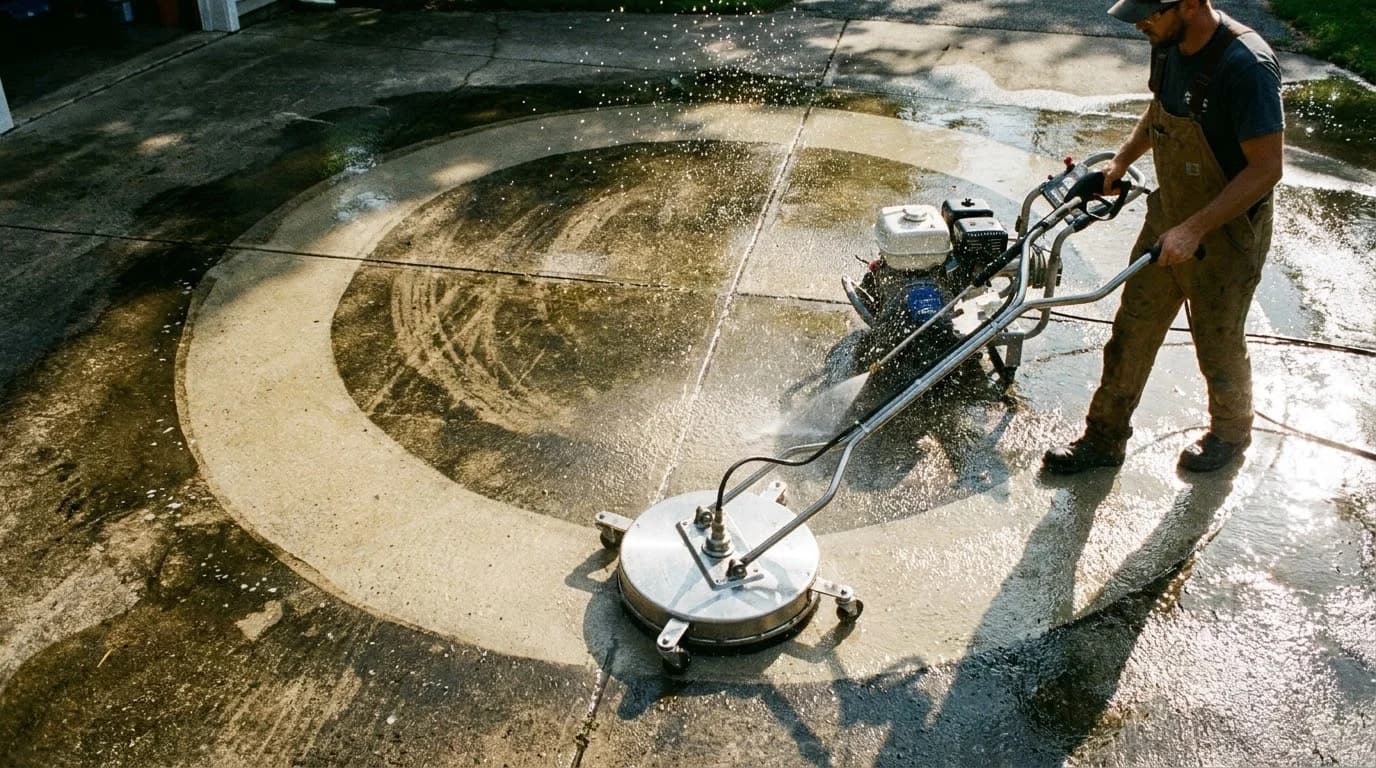
The dreaded "zebra striping" pattern seen on poorly washed residential driveways is caused by human fatigue when using an open handheld wand. As an operator swings the wand back and forth, the nozzle dips down to 6 inches at the center of the arc and rises to 14 inches at the sides. This creates uneven impact pressures that permanently etch stripes into the cement paste.
The Rotary Surface Cleaner Advantage:
A commercial surface cleaner (typically 16 to 20 inches in diameter) houses two counter-balanced 25-degree spray tips on a spray bar spinning at 2,000+ RPM. Enclosed beneath a circular hover dome, the nozzles maintain an exact 1-inch standoff distance, delivering a perfectly uniform, streak-free cross-hatch clean in one-third the time of a handheld wand.
3. The 5-Step Professional Driveway Restoration Sequence
Follow this field-proven sequence used by professional exterior cleaning contractors:
- Step 1: Dry Blow & Prep: Use a leaf blower to clear all sand, pebbles, and organic leaves off the slab. Remove any vehicle parked nearby and protect grass borders with a thorough water soaking.
- Step 2: Chemical Pre-Treatment: Apply a mild alkaline degreaser or a 2% sodium hypochlorite solution using a low-pressure black soap nozzle. Allow a 10 to 15-minute dwell time without letting the solution dry on the slab. This dissolves organic algae so high water pressure is unnecessary.
- Step 3: Perimeter Edging: Use the green 25-degree nozzle tip on your wand to cut in a 3-inch clean border along garage doors, brick foundations, and curbs where circular surface cleaners cannot reach.
- Step 4: Surface Cleaner Overlap Passes: Walk slowly and smoothly with the rotary surface cleaner in straight parallel lines, overlapping each pass by 3 to 4 inches. For heavily soiled driveways, complete a second pass in a perpendicular cross-hatch direction.
- Step 5: High-Volume Slurry Rinse: Switch to a wide white 40-degree nozzle or an unpressurized garden hose to flush the dirty suspended mud slurry down toward the street gutter.
4. Five Fatal Mistakes That Permanently Damage Concrete
1. Using the Red 0-Degree Tip
The pinpoint 0-degree nozzle concentrates 3,500 PSI onto a 1/8-inch spot. It will carve deep gouges, letters, and lines into concrete that cannot be repaired without resurfacing the entire slab.
2. Washing Concrete Under 1 Year Old
Fresh concrete lacks long-term surface density. High pressure erodes the fine paste, leaving aggregate rock exposed in rough patches. Only use soft broom washing on young concrete.
3. Forgetting Chemical Pre-Treatment
Relying solely on mechanical water pressure forces you to hold the nozzle too close to remove algae, stripping the surface paste. Chemicals do the hard work so water only rinses.
4. Stripping Paver Joint Sand Without Refilling
Pressure washing interlocking pavers washes out the structural stabilizing joint sand. If you do not sweep in fresh polymeric sand after drying, pavers will shift and sink under vehicles.
5. Post-Wash Sealing: Penetrating Silane-Siloxane
Pressure washing opens up concrete pores, leaving the slab exceptionally clean but also highly vulnerable to oil absorption, winter deicing salts, and rapid re-infestation by mold:
- Allow 48 Hours of Dry Time: Never apply sealers to damp concrete. Moisture trapped in pores will turn acrylic sealers into milky white cloudy haze.
- Apply Silane-Siloxane Penetrating Sealer: Spray a breathable silane-siloxane water repellent to saturation. The sealer chemically cross-links with the stone matrix, ensuring future rain beads up and dirt washes away easily with a simple garden hose.
6. Cold Water vs. Hot Water Commercial Washers
For standard dirt and green organic mildew, cold water pressure washers are fully effective. However, for stubborn garage oil slicks and commercial drive-thrus, hot water units are mandatory:
Cold Water Units
Standard consumer and commercial units operating at ambient tap temperature. Ideal for light mildew, dust, clay soil, and general exterior residential patios.
Hot Water Burners (190°F)
Equipped with diesel heating coils that raise water to 180°F – 200°F. High thermal energy melts engine grease, butter, and barbecue grease instantly, acting like a commercial dishwasher for concrete.
Detergent Efficiency
Using 180°F hot water doubles the chemical reaction speed of degreasers and surfactants, reducing chemical consumption by up to 50% on commercial jobsites.
Frequently Asked Questions
Can a pressure washer ruin concrete?
Yes. Using a 0-degree red tip, holding a high-pressure nozzle closer than 8 inches, or washing concrete that is less than one year old can permanently blast away the smooth top cement paste layer. This exposes the rough underlying sand and aggregate in permanent, unfixable wand streaks known as 'zebra striping.'
How many PSI do you need to safely clean a concrete driveway?
For residential concrete, 2,500 to 3,000 PSI is ideal. More importantly, high water flow rate (GPM)—between 3.0 and 4.0 Gallons Per Minute—is what truly cleans concrete by flushing heavy mud and slurry off the slab. High PSI without sufficient GPM merely etches lines without washing away debris.
How do you prevent streaks and tiger stripes when pressure washing concrete?
Use a rotary surface cleaner attachment instead of an open wand. A surface cleaner houses two spinning spray nozzles beneath a hovering circular deck, maintaining a constant 1-inch standoff distance and a uniform 360-degree overlapping clean that completely eliminates wand zebra striping.
Can you pressure wash a newly poured concrete driveway?
Never pressure wash concrete that is less than one year old. Although concrete reaches design compressive strength in 28 days, surface hydration continues to densify for 12 months. High water pressure will strip the fragile young cream layer, permanently ruining the smooth broom finish.
What chemical should you apply before pressure washing a driveway?
Apply an alkaline surfactant or a 2% sodium hypochlorite (SH) soft-wash pre-treatment using a downstream chemical injector. Allowing a 10-minute chemical dwell time dissolves organic algae, tree sap, and atmospheric grime, allowing you to clean at lower mechanical pressure without damaging the stone.
Building Codes & Primary Standards Cited
Power Washers of North America - Flatwork Pressure Washing Guidelines
Authoritative trade standard for nozzle selection, surface cleaning RPM, and GPM flow rates.
Guide to Selecting Protective Materials for Concrete
Technical standards for surface preparation, pressure limits, and post-wash protective sealers.
Standard Specification for Liquid Membrane-Forming Compounds for Curing Concrete
Governs moisture barrier retention and sealer application criteria on exterior flatwork.
Power-Operated Hand Tools - High Pressure Cleaning Equipment
Safety regulations for high-pressure fluid safety, eye protection, and safety relief devices.
Estimations adhere to standard North American modular 3/8-inch mortar joint physics and 5% to 10% material waste factors. Local municipal building inspectors, stamped architectural blueprints, and local frost depth requirements supersede general reference guidelines.
Popular Quick Estimates
Pre-engineered takeoffs & benchmarks matched to this project
Related Calculators
Specialized tools for foundation, core fill, and budgeting
Primer, acrylic block filler and topcoat paint gallons
Cubic yards, bags, and slab volume for flatwork and footings
Heavyweight structural blocks and bond beam units
Core grout volume in cubic yards and 80-lb pre-mix bags
Blogs & Construction Guides
Technical articles, IRC code standards, rebar schedules & freight logistics
How to Remove Oil Stains from Concrete: Best Methods
How to Clean Concrete Floors: Garage & Basement Guide

How to Stain Concrete: Acid Stain vs Water Dyes