Quick Contractor Takeoff: Chemical Reaction vs. Acrylic Penetration
Choose reactive acid stain when you desire permanent, variegated, marble-like earth tones (amber, walnut, terracotta, weathered bronze). Acid stains chemically fuse with free lime in the concrete matrix and can never peel. Choose water-based penetrating dyes when you require vibrant non-earth tones (cobalt blue, emerald green, slate black), consistent uniform coloration, or an indoor zero-VOC installation that skips messy acid neutralization.
1. The Chemistry: Acid Chemical Reaction vs. Micro-Pigment Dispersion
Decorative concrete staining is governed by two entirely distinct physical and chemical mechanisms outlined in ACI 310R (Guide to Decorative Concrete). Understanding these mechanisms prevents catastrophic color failure, mottling inconsistencies, or topcoat delamination.
Reactive Acid Chemical Stains: Formulated with a mild solution of hydrochloric acid, water, and inorganic metallic salts. When sprayed onto mature concrete, the acid etches the microscopic surface paste, allowing the metal salts to penetrate into the concrete pores. There, the metallic ions react with unhydrated calcium hydroxide (free lime, Ca(OH)2) generated during Portland cement hydration:
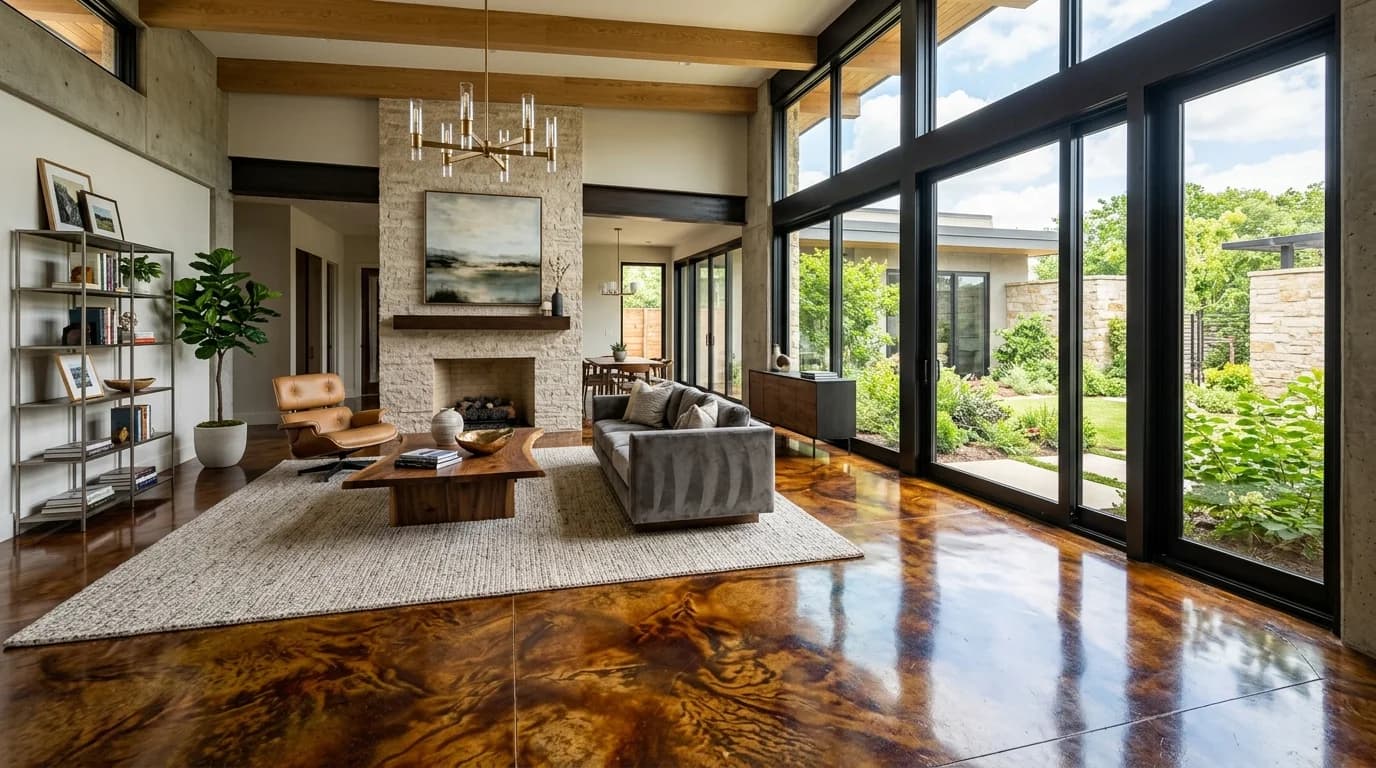
Iron salts yield warm ambers, rich tans, and deep mahogany browns. Copper salts react to produce turquoise greens and weathered bronzes. Because concrete composition, finishing trowel density, and moisture vary across every square foot, the chemical reaction produces an organic, variegated, translucent finish resembling natural marble or flagstone. The color becomes an integral part of the concrete matrix and cannot chip, peel, or fade under ultraviolet radiation.
Non-Reactive Water-Based Acrylic Dyes: Unlike acid stains, water-based stains do not undergo a chemical reaction. They consist of nano-sized pigment dispersions suspended in water-soluble polymer binders. These micro-particles measure under 5 microns, allowing them to flow deep into open capillary pores through capillary suction. Once the carrier water evaporates, the polymer locks the pigment inside the pores. This provides significant advantages: zero hazardous fumes, an extensive color palette including bright yellows, vibrant reds, and pure blacks, and the complete elimination of post-application acid neutralization.
2. Concrete Staining Chemistry & Performance Matrix
Evaluate stain chemistries based on surface reactivity, UV exterior stability, odor toxicity, and installed square-foot pricing:
| Staining Technology | Color Character | Reactivity & Bond | Neutralization | UV Stability | 2026 Material Cost |
|---|---|---|---|---|---|
| Reactive Acid Stain | Mottled, translucent marble & stone tones | Chemical fusion with calcium hydroxide | Mandatory (Ammonia / Soda) | Permanent (100% UV-stable) | $0.35 - $0.55 / sq ft |
| Water-Based Acrylic Dye | Semi-translucent, uniform, vibrant palette | Capillary pore mechanical lock | Not Required | High (UV-inhibited pigments) | $0.40 - $0.65 / sq ft |
| Acetone / Solvent Dye | Rapid-drying, monochrome, intense colors | Deep solvent flash penetration | Not Required | Interior Only (Fades in sunlight) | $0.50 - $0.75 / sq ft |
| Solid-Color Micro-Stain | Opaque, uniform matte architectural finish | Surface polymer film adhesion | Not Required | Moderate to High | $0.60 - $0.95 / sq ft |
3. Substrate Diagnosis & Preparation (The Water Drop Test)
At least 80% of all decorative concrete staining failures trace directly to inadequate surface preparation. Concrete must be bare, clean, porous, and free of all curing membranes, silicone sealers, paint, motor oil, and drywall mud.
The Water Drop Porosity Test: Drop 10 to 15 drops of clean water across various areas of the slab. If the water absorbs within 15 to 30 seconds and darkens the concrete, the capillary pores are open and ready to accept stain. If water beads up, pools indefinitely, or takes several minutes to soak in, an existing sealer or machine-troweled laitance is blocking penetration.
The Critical Golden Rule of Acid Staining: Do NOT acid-etch the slab with muriatic acid to open the pores! While acid etching is standard prior to epoxy coatings, doing so prior to acid staining prematurely destroys the calcium hydroxide (free lime) needed to trigger the color reaction. If the slab has a tight trowel burnish or old sealer, open it mechanically using a low-speed rotary floor buffer equipped with an 80-grit diamond prep pad or a coarse sanding screen.
Degreasing & Cleaning: Scrub the entire slab with an industrial alkaline cleaner or tri-sodium phosphate (TSP) mixed in hot water. Agitate vigorously with a stiff nylon deck brush, then thoroughly vacuum the dirty emulsified residue with a commercial wet-vac. Rinse with clean water until the rinse water tests neutral (pH 7.0).
4. Step-by-Step Professional Staining & Neutralization Protocol
Follow this standardized 5-step operational protocol to ensure professional-grade depth, color richness, and long-term sealer durability:
- Masking & Equipment Selection: Cover all adjacent walls, baseboards, door frames, and foliage with 4-mil plastic sheeting and high-adhesion blue tape. Use an all-plastic pump-up sprayer fitted with a conical acid-resistant nozzle. Never use sprayers with brass or stainless steel internal components; acid salts will corrode metal wands instantly, causing dangerous leaks.
- Application Technique: Hold the spray wand 12 to 18 inches above the slab. Apply the stain in continuous, random circular motions, maintaining a wet edge. Avoid straight overlapping lines or puddling. Application rates typically average 200 to 300 square feet per gallon. If deeper variegation is desired, mist a second complementary color while the first is still damp.
- Reaction Dwell Time: Allow the acid stain to react undisturbed for a minimum of 4 to 8 hours (or overnight). During this phase, the surface will fizz and gradually develop a dusty, dark powdery crust of spent metallic salts. Do not touch or walk on the wet slab during reaction.
- Neutralization & Slurry Scrubbing: This step is non-negotiable for reactive stains. Mix a neutralizing bath containing 1 cup of household ammonia or 2 cups of baking soda per 1 gallon of clean water. Flood the slab with the solution and scrub aggressively with a medium-stiff broom to loosen all chemical residues. The neutralizing wash halts acid activity and lifts spent salts. Wet-vac the slurry immediately. Continue rinsing and vacuuming until the rinse water is 100% crystal clear and a paper towel rubbed on the slab picks up zero pigment residue.
- Slab Drying & Moisture Check: Allow the slab to dry completely for at least 24 to 48 hours under continuous ventilation. Verify that moisture vapor emissions are low (relative humidity under 75% per ASTM F2170) before proceeding to the clear protective topcoat.
5. Protective Sealing & 2026 Turnkey Cost Estimates
Stained concrete without a protective sealer looks dull, chalky, and muted. The clear topcoat acts like water on a river stone, intensifying translucent undertones and locking in depth. Under ASTM C1315 (Liquid Membrane-Forming Compounds Having Special Properties for Curing and Sealing Concrete), select the appropriate sealer based on project exposure:
Solvent-Based Acrylic (Exterior Patios)
Offers the ultimate "wet look" enhancement and deep color pop. 25% solids pure acrylic resin resists freeze-thaw cracking and UV ambering. Apply 2 thin coats at 300 sq ft/gallon using a solvent-rated roller. Expect resealing every 2 to 3 years.
Water-Based Polyurethane / Epoxy (Interiors)
Zero-VOC and non-flammable for enclosed basements and living areas. Provides extreme scratch resistance against foot traffic, pet claws, and household chemicals. Often paired with a sacrificial floor wax for easy maintenance.
2026 Takeoff & Pricing Benchmarks: For a typical 400-square-foot residential patio, DIY material expenditures average $220 to $340 ($0.55 to $0.85/sq ft) including cleaner, stain, neutralizer, high-solids acrylic sealer, and roller supplies. Professional turnkey contractor installation runs between $1,800 and $3,600 ($4.50 to $9.00/sq ft) for standard single-color application, escalating to $12.00 to $16.00/sq ft for complex multi-color faux stone designs with hand-tooled score borders.
5 Costly Concrete Staining Mistakes to Avoid
1. Acid-Etching Prior to Acid Staining
Muriatic acid etching strips the calcium hydroxide (free lime) from the surface paste. Without free lime, reactive acid stains cannot chemically produce color, leaving the slab pale, patchy, or completely unchanged.
2. Skipping Neutralization & Residue Scrubbing
Failing to neutralize unreacted acid leaves low-pH salts on the slab. When clear sealer is applied, these trapped acidic salts destroy the chemical bond, resulting in peeling, micro-bubbling, and milky white haze within weeks.
3. Using Metal Sprayers for Acid Stain
Hydrochloric acid violently corrodes brass, aluminum, and steel wand components. In addition to ruining equipment and causing chemical leaks, dissolved metal ions contaminate the stain chemistry and distort final colors.
4. Applying Sealer Over a Damp Slab
Trapping moisture beneath an impermeable solvent-based sealer causes severe moisture blushing—a cloud of trapped micro-droplets turning the clear sealer chalky white. Ensure 24 to 48 hours of thorough drying before sealing.
5. Expecting Uniform Paint-Like Consistency from Acid Stains
Acid stains are inherently translucent and variegated; they highlight every aggregate variation, trowel mark, and old hairline crack. If an owner demands a uniform, solid monolithic color, specify a water-based acrylic dye or solid opaque micro-topping instead.
Planning a Concrete Slab or Patio Project?
Calculate concrete volume, surface area square footage, bagged mix, and 2026 material costs instantly.
Frequently Asked Questions
Can old, weathered concrete slabs be acid stained successfully?
Yes, but older exterior concrete often has depleted levels of free calcium hydroxide (lime) in the surface layer due to atmospheric carbonation. This results in more muted, variegated earth tones. Always execute an inconspicuous 6x6-inch test patch to evaluate actual color reactivity before coating the entire slab.
Why is chemical neutralization mandatory after acid staining?
Hydrochloric acid stains leave unreacted metallic salts and an acidic residue (pH 2 to 3) on the concrete surface. If not neutralized with a basic baking soda or ammonia wash to achieve a neutral pH of 7.0 to 8.5, the acidic salts will prevent clear sealer adhesion, resulting in bubbling, clouding, and premature flaking.
Will pressure washing or foot traffic wear off an acid-stained finish?
No. Reactive acid stains penetrate 1/16 to 1/8 inch into the concrete pores and bond chemically with the cement matrix. The color cannot chip, peel, or be washed away by high-pressure water. However, the protective clear sealer topcoat will wear over 2 to 4 years and requires routine re-application.
Should I acid-etch concrete before applying a reactive acid stain?
Never acid-etch concrete prior to acid staining. Muriatic acid etching prematurely consumes the surface calcium hydroxide (free lime) that the metallic stain salts need to produce color. Clean slabs mechanically with a rotary floor scrubber and alkaline degreaser instead.
How much does it cost to stain a concrete slab in 2026?
DIY material costs range from $0.40 to $0.85 per square foot for stain, neutralizer, and high-solids solvent acrylic sealer. Professional turnkey decorative staining contractors typically charge between $4.50 and $9.00 per square foot for single-color installations, and $8.00 to $16.00 per square foot for multi-color designs with custom saw-cut score lines.
Building Codes & Primary Standards Cited
Guide to Decorative Concrete
American Concrete Institute standards governing chemical staining, surface preparation profiles, and clear protective topcoats.
Liquid Membrane-Forming Compounds with Special Properties for Sealing Concrete
Establishes technical benchmarks for non-yellowing, UV-stable, high-durability acrylic sealers over stained concrete.
Selecting and Specifying Concrete Surface Preparation
Defines concrete surface profiles (CSP 1 through CSP 2) required for uniform stain penetration and liquid sealer adhesion.
Estimations adhere to standard North American modular 3/8-inch mortar joint physics and 5% to 10% material waste factors. Local municipal building inspectors, stamped architectural blueprints, and local frost depth requirements supersede general reference guidelines.
Popular Quick Estimates
Pre-engineered takeoffs & benchmarks matched to this project
Related Calculators
Specialized tools for foundation, core fill, and budgeting
Primer, acrylic block filler and topcoat paint gallons
Heavyweight structural blocks and bond beam units
Cubic yards, bags, and slab volume for flatwork and footings
Core grout volume in cubic yards and 80-lb pre-mix bags
Blogs & Construction Guides
Technical articles, IRC code standards, rebar schedules & freight logistics
How to Clean Concrete Floors: Garage & Basement Guide
How to Remove Rust Stains from Concrete: Best Acids
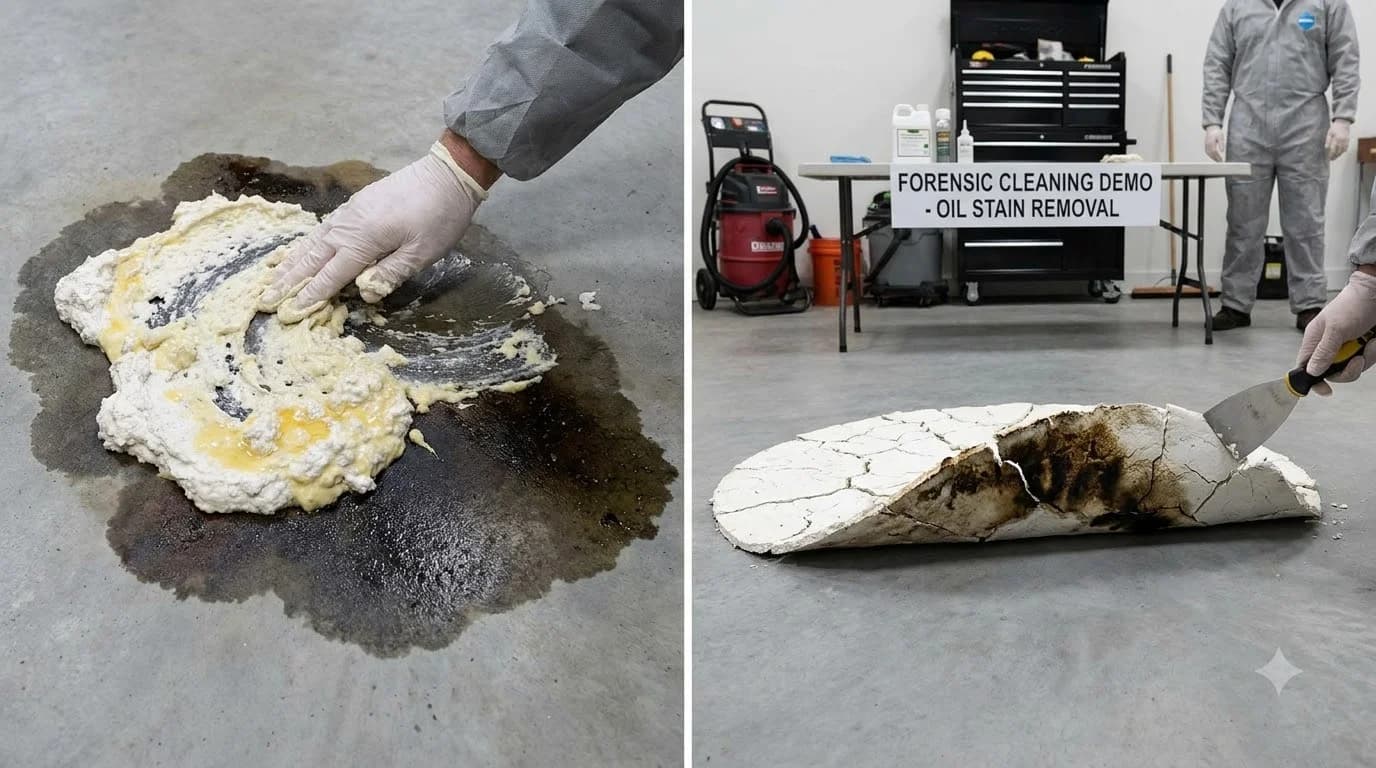
How to Remove Oil Stains from Concrete: Best Methods