Quick Contractor Answer: Absorb Fresh Spills Immediately; Poultice Deep Stains
For fresh oil spills under 2 hours old, cover with diatomaceous earth or powdered clay cat litter to wick up liquid hydrocarbons. For old, dark set-in stains, surface scrubbing with detergent will fail because oil is trapped 1/4" deep. Mix a poultice paste of acetone and bentonite clay, spread it 1/4" thick over the stain, tape plastic over it for 12 hours, then let it dry to powder. The wicking action pulls trapped oil up into the powder.
1. Capillary Mechanics: Why Motor Oil Penetrates Deeply
Concrete may look solid, but under microscopic examination, hardened cement paste is a porous sponge consisting of interconnected capillary pores ranging from 10 to 50 nanometers in diameter.
Motor oil, transmission fluid, and brake fluid are non-polar synthetic hydrocarbons with low surface tension. When oil drips onto unsealed concrete, capillary suction draws the petroleum deep into the pore structure—often penetrating 1/4 to 1/2 inch below the surface within 48 hours. Once inside, the oil forms a permanent hydrophobic barrier. Simply spraying the surface with a garden hose or cold-water pressure washer does nothing because water cannot overcome the hydrophobic barrier, leaving the dark stain locked in the stone.
2. Oil Removal Methodology Matrix by Stain Severity
Select the appropriate extraction chemistry based on stain age, size, and depth:
| Stain Category | Primary Chemical Agent | Operating Mechanism | Working Dwell Time | Removal Rate |
|---|---|---|---|---|
| Fresh Puddle (<4 Hours) | Bentonite clay cat litter or Diatomaceous earth | High surface area physical absorption | 30 to 60 minutes | 95% – 98% (Prevents staining) |
| Recent Surface Film (1-7 Days) | Trisodium Phosphate (TSP) + Hot Water (160°F) | Alkaline saponification & surfactant lift | 20 minute aggressive scrub | 80% – 90% |
| Deep Embedded Stain (Months/Years) | Acetone + Bentonite / Talc Poultice | Solvent dissolves oil; drying clay wicks it up | 24 hours (12h wet covered + 12h drying) | 85% – 95% |
| Large Driveway / Commercial Pad | Microbial Hydrocarbon Digestant (EXSOIL / Terminator) | Bio-enzymes consume oil into CO2 & water | 1 to 3 weekly mistings (No rinse needed) | 90% – 99% (Self-cleaning) |
3. The Master Solvent-Clay Poultice Protocol
A poultice is the only technique that can physically draw old, hardened motor oil out from deep concrete pores without damaging the surface cream:
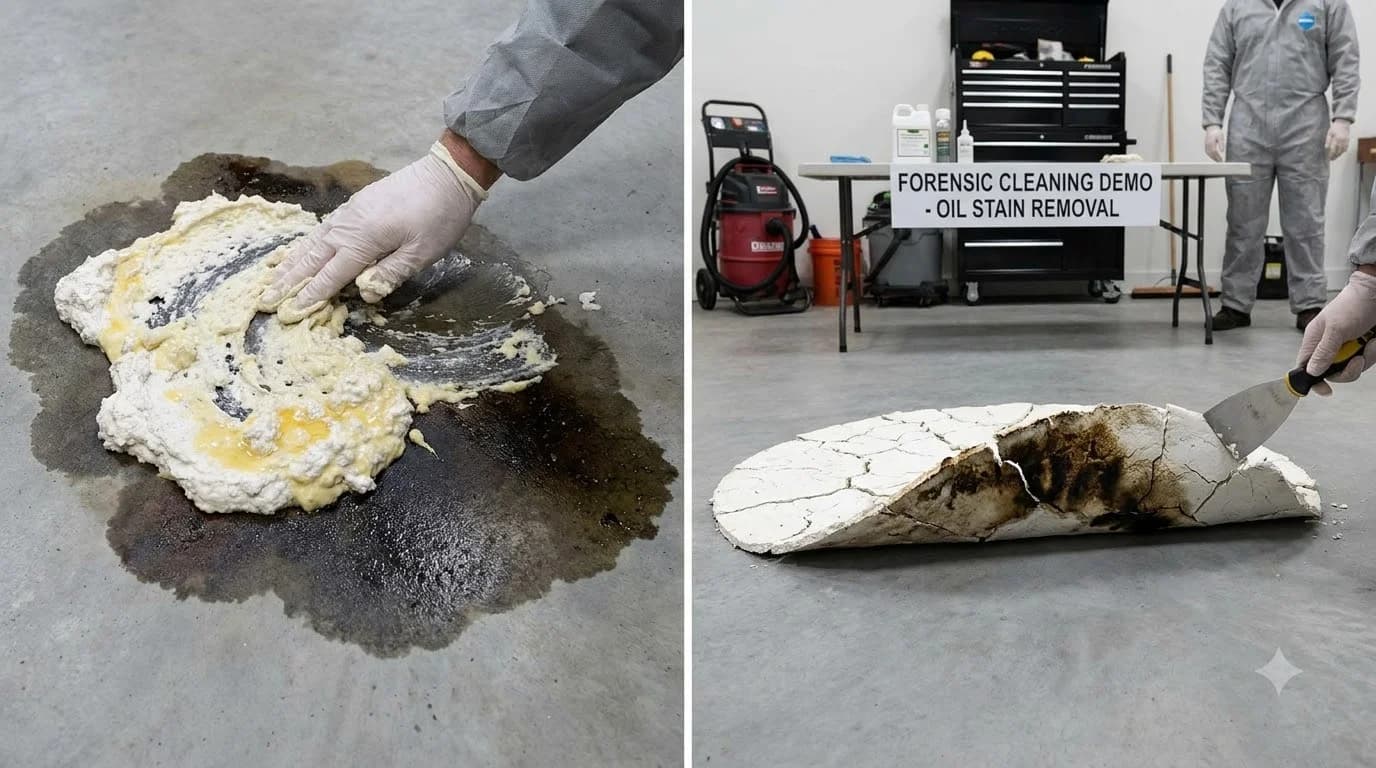
- Select the Materials: Use an absorbent powdered clay medium (unscented bentonite clay cat litter pulverized into fine dust, diatomaceous earth, or unscented baby talc). For the liquid solvent, use pure acetone, mineral spirits, or xylene.
- Mix into a Thick Paste: In a solvent-safe plastic bucket, gradually add the solvent to the clay powder, stirring until it reaches the consistency of creamy peanut butter or drywall mud.
- Trowel Over the Stain: Trowel the paste directly over the oil stain to a uniform thickness of 1/4 inch. Extend the paste 1 to 2 inches beyond the visible border of the stain.
- Cover with Plastic Wrap (12 Hours):Cover the paste with polyethylene plastic wrap and tape all four edges down tightly with painter's tape. This prevents the solvent from flashing off into the air, forcing it downward into the concrete to liquefy the embedded petroleum.
- Uncover and Air-Dry (12 Hours): Peel off the plastic wrap. As the solvent slowly evaporates into the atmosphere, reverse capillary osmosis draws the liquefied oil up into the absorbent clay powder. The clay will dry into a brittle, cracked white powder containing the extracted oil.
- Sweep and Dispose: Sweep up the dry powder and dispose of it in household trash. Scrub the remaining area with warm water and dish detergent to wash away surface residue.
4. Microbial Bioremediation for Driveways & Parking Pads
For expansive driveway oil stains where mixing gallons of clay poultice is impractical, bioremediation offers an effortless, eco-friendly solution:
- Bacterial Hydrocarbon Digestion: Products like Terminator-HSD contain billions of naturally occurring, freeze-dried microbial bacteria and enzymes.
- How It Works: Sprinkle the powder lightly over the stain and mist with water. The microbes awaken and migrate deep into concrete capillaries, using the petroleum hydrocarbons (carbon and hydrogen) as their primary food source.
- Zero Runoff / No Washing: The bacteria metabolize motor oil into harmless carbon dioxide ($CO_2$) and water. Over 2 to 4 weeks of periodic rainwater or garden hose misting, dark black oil stains fade away completely without any runoff into storm sewers.
5. Substrate Preparation & Porosity Verification (ASTM D4258)
If you are cleaning concrete prior to applying garage floor epoxy, polyaspartic coatings, or penetrating sealers, residual oil will act as a total bond breaker:
Perform the ASTM D4258 Water-Drop Porosity Test: splash clean water droplets onto the cleaned spot. If the water immediately soaks in within 10 seconds and turns the concrete dark gray, all hydrophobic oil molecules have been successfully extracted. If the water beads up, hydrocarbon residues remain and must be treated with another poultice application before coating.
5 Critical Concrete Oil Removal Mistakes to Avoid
Blasting with Cold Pressure Washers
Cold water cannot dissolve oil. Blasting with 3,500 PSI forces the liquid petroleum deeper into the capillary pores and permanently scars the soft concrete paste.
Spraying Brake Cleaner Without Absorbent
Brake cleaner liquefies oil on contact. Without an immediate clay powder blanket to wick it upward, the liquefied oil flows deep into the slab core, creating an even larger ring.
Using Muriatic Acid on Oil Stains
Acid will not react through non-polar oil. It etches the clean concrete around the stain while leaving the oil untouched, creating a discolored, cratered bullseye.
Flushing Oily Rinse Water into Storm Drains
Washing petroleum degreasers into street storm drains violates Clean Water Act regulations. Always absorb liquefied oil with clay or vacuum with a dedicated wet-vac.
Planning a Concrete Sealing or Coating Project?
Calculate cleaning chemicals, degreasers, penetrating sealers, and 2026 material costs.
Frequently Asked Questions
Does Dawn dish soap remove motor oil from concrete?
Dawn dish soap is highly effective on fresh surface spills less than 24 hours old because its concentrated surfactants emulsify unbonded oils. However, for old, darkened stains that have soaked deep into capillary pores, a solvent-clay poultice or microbial digestant is required.
Can you spray automotive brake cleaner on concrete driveways?
Brake cleaner dissolves motor oil instantly, but spraying it alone forces the dissolved liquid hydrocarbon molecules deeper into porous concrete. If using brake cleaner, immediately cover the wet spray with diatomaceous earth or clay powder to wick the dissolved oil back out.
Will cold-water pressure washing remove oil from concrete?
No. Cold water cannot overcome the hydrophobic bond of motor oil. In fact, high-pressure cold water often blasts the oil deeper into micro-fissures and permanently scars the concrete paste. Commercial contractors use 200°F hot water and industrial emulsifiers.
How does a chemical poultice pull oil out of concrete?
A poultice combines an organic solvent (like acetone) with a highly absorbent powder (like bentonite clay). The solvent dissolves the petroleum hydrocarbons deep in the pores. As the paste dries over 24 hours, reverse capillary action draws the solvent-oil mixture up into the clay powder.
How do you know if concrete is oil-free before applying epoxy?
Perform the ASTM D4258 water drop test: sprinkle clean water drops across the cleaned spot. If the water immediately soaks into the slab and darkens the concrete within 10 seconds, the oil is gone. If water beads on the surface, residual oil remains and will cause epoxy failure.
Building Codes & Primary Standards Cited
Standard Practice for Surface Cleaning Concrete for Coating
Establishes standardized procedures for removing oil, grease, and hydrocarbons before coating.
Standard for Safer Industrial Degreasers and Bioremediants
Regulates volatile organic compound (VOC) emissions and environmental runoff safety.
Hazard Communication Standard for Solvent Handling
Governs personal protective equipment (PPE) and ventilation when using volatile solvent poultices.
Estimations adhere to standard North American modular 3/8-inch mortar joint physics and 5% to 10% material waste factors. Local municipal building inspectors, stamped architectural blueprints, and local frost depth requirements supersede general reference guidelines.
Popular Quick Estimates
Pre-engineered takeoffs & benchmarks matched to this project
Related Calculators
Specialized tools for foundation, core fill, and budgeting
Primer, acrylic block filler and topcoat paint gallons
Heavyweight structural blocks and bond beam units
Cubic yards, bags, and slab volume for flatwork and footings
Core grout volume in cubic yards and 80-lb pre-mix bags
Blogs & Construction Guides
Technical articles, IRC code standards, rebar schedules & freight logistics
How to Remove Rust Stains from Concrete: Best Acids
How to Clean Concrete Floors: Garage & Basement Guide
How to Pressure Wash Concrete Patios & Driveways