1. Master Concrete Block Weight Chart by Size & Density Tier
In North American construction, loadbearing concrete masonry units conforming to ASTM C90 are manufactured in modular nominal dimensions (manufactured 3/8 inch smaller to allow for mortar joints):
| Nominal Size | Actual Dimensions | Lightweight (<105 PCF) | Medium-Weight (105-125) | Normal-Weight (>125) | Solid-Grouted Core |
|---|---|---|---|---|---|
| 4" × 8" × 16" Hollow | 3-5/8 × 7-5/8 × 15-5/8 | 18 – 20 lbs | 22 – 25 lbs | 26 – 29 lbs | 42 – 46 lbs |
| 6" × 8" × 16" Hollow | 5-5/8 × 7-5/8 × 15-5/8 | 22 – 25 lbs | 28 – 31 lbs | 33 – 36 lbs | 58 – 64 lbs |
| 8" × 8" × 16" Stretcher | 7-5/8 × 7-5/8 × 15-5/8 | 26 – 30 lbs | 34 – 38 lbs | 40 – 44 lbs | 75 – 80 lbs |
| 10" × 8" × 16" Hollow | 9-5/8 × 7-5/8 × 15-5/8 | 32 – 36 lbs | 41 – 45 lbs | 48 – 53 lbs | 95 – 105 lbs |
| 12" × 8" × 16" Hollow | 11-5/8 × 7-5/8 × 15-5/8 | 38 – 42 lbs | 48 – 53 lbs | 56 – 62 lbs | 118 – 130 lbs |
| 4" × 8" × 16" Solid Cap | 3-5/8 × 7-5/8 × 15-5/8 | 24 – 27 lbs | 29 – 32 lbs | 34 – 37 lbs | 32 lbs (Solid) |
| 8" × 8" × 8" Half-Block | 7-5/8 × 7-5/8 × 7-5/8 | 13 – 16 lbs | 17 – 20 lbs | 21 – 24 lbs | 38 – 42 lbs |
2. ASTM C90 Density Tiers: Lightweight vs Medium vs Normal
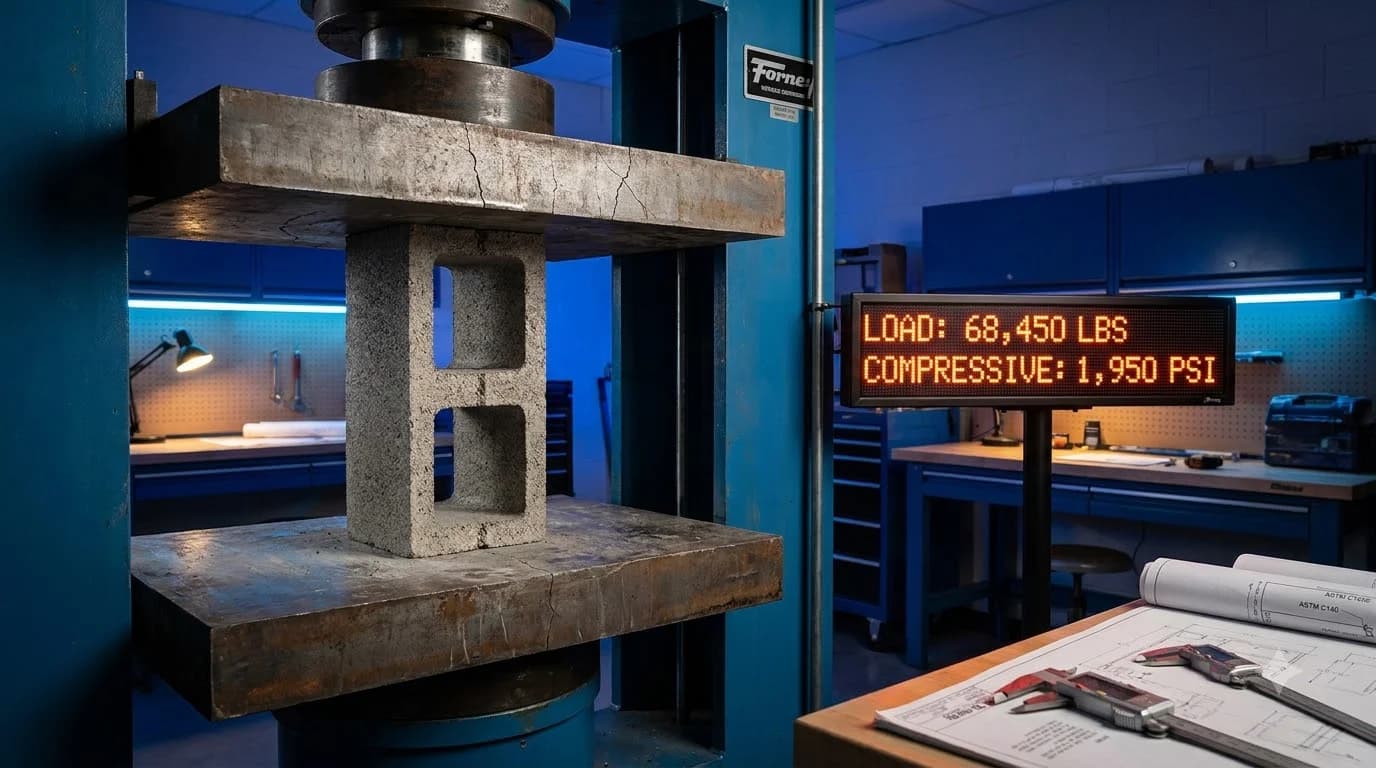
ASTM C90 defines three dry-weight density classifications. All three classes must achieve the identical minimum compressive strength of 2,000 PSI over net cross-sectional area:
Lightweight (< 105 PCF)
Manufactured with expanded shale, clay, or slate (ASTM C331). Blocks weigh under 30 lbs, significantly reducing mason fatigue and increasing daily production by 20%. Superior 4-hour fire endurance and thermal R-value.
Medium-Weight (105–125 PCF)
The workhorse of North American residential construction. Blends lightweight and natural aggregates to balance manageable unit weight (34–38 lbs) with high structural impact durability and thermal mass.
Normal-Weight (> 125 PCF)
Manufactured using dense natural sand and crushed limestone or granite. Yields maximum sound attenuation (Sound Transmission Class STC 50+), ideal for party walls, commercial security barriers, and deep basement retention.
3. Wall Dead Load Calculation (PSF) for Structural Footings
Under International Residential Code (IRC Section R403) and IBC Chapter 16, footing width is determined by total wall dead load:
A 50-foot long, 8-foot tall basement foundation wall (400 sq ft) built with solid-grouted 8-inch blocks supports 33,200 lbs (16.6 US tons) of self-weight alone, requiring a continuous 16 to 20-inch wide poured concrete footing.
4. Five Critical Mistakes in Concrete Block Hauling
1. Overloading 1/2-Ton Pickups
A pallet of 108 blocks weighs nearly 4,000 lbs. Placing an entire pallet into an F-150 bed (payload limit ~1,800 lbs) overloads the truck by more than 2,000 lbs, bending the rear axle and voiding insurance.
2. Forgetting Rain Absorption Weight
Unwrapped blocks left in a rainstorm absorb 3 to 5 lbs of water each. A pallet of wet blocks can easily exceed 4,300 lbs, causing unexpected trailer tire blowouts during transport.
3. Overloading Scaffolding Stages
OSHA Standard 1926.451 caps light-duty scaffolding at 25 lbs per square foot. Staging 20 normal-weight blocks (880 lbs) in one spot will crack scaffold planks and trigger sudden collapse.
4. Hauling Blocks Loose in a Trailer
Stacking blocks loose without ratchet strap perimeter wrapping allows individual blocks to shift and shatter when braking. Always secure loads per DOT cargo securement rules.
5. Real-World Logistics Takeoff: Hauling Blocks for a Fire Pit
A DIY homeowner is building a 4 ft × 4 ft square fire pit requiring 32 standard 8x8x16 concrete blocks plus 8 solid cap blocks:
- 32 Hollow 8" Blocks × 36 lbs = 1,152 lbs
- 8 Solid Cap Blocks × 30 lbs = 240 lbs
- 4 Bags Type S Mortar (80 lbs each) = 320 lbs
- Total Payload Weight: 1,152 + 240 + 320 = 1,712 lbs
Vehicle Safe Check: A standard midsize SUV (payload ~1,000 lbs) CANNOT haul this safely. A standard half-ton pickup (F-150 / Silverado 1500) can haul this in a single safe trip centered over the rear axle.
6. Autoclaved Aerated Concrete (AAC) vs. Standard CMU
In high-efficiency green building, Autoclaved Aerated Concrete (AAC conforming to ASTM C1693) represents the absolute lightest class of masonry block:
Ultra-Lightweight Mass
Manufactured using quartz sand, lime, cement, and aluminum powder foaming agents. An 8-inch AAC block weighs only 16 to 22 lbs—less than half the weight of traditional medium-weight CMUs.
Superior Thermal Insulation
Millions of microscopic closed-air pockets provide an integrated thermal value of R-1.25 per inch (R-10 for an 8-inch wall), eliminating thermal bridging without supplemental foam insulation.
Workability & Cutting
AAC blocks can be cut, routed, and shaped using ordinary woodworking hand saws, though they require thin-bed polymer adhesive mortar rather than traditional ASTM C270 masonry mortar.
Frequently Asked Questions
How much does a standard 8x8x16 concrete block weigh?
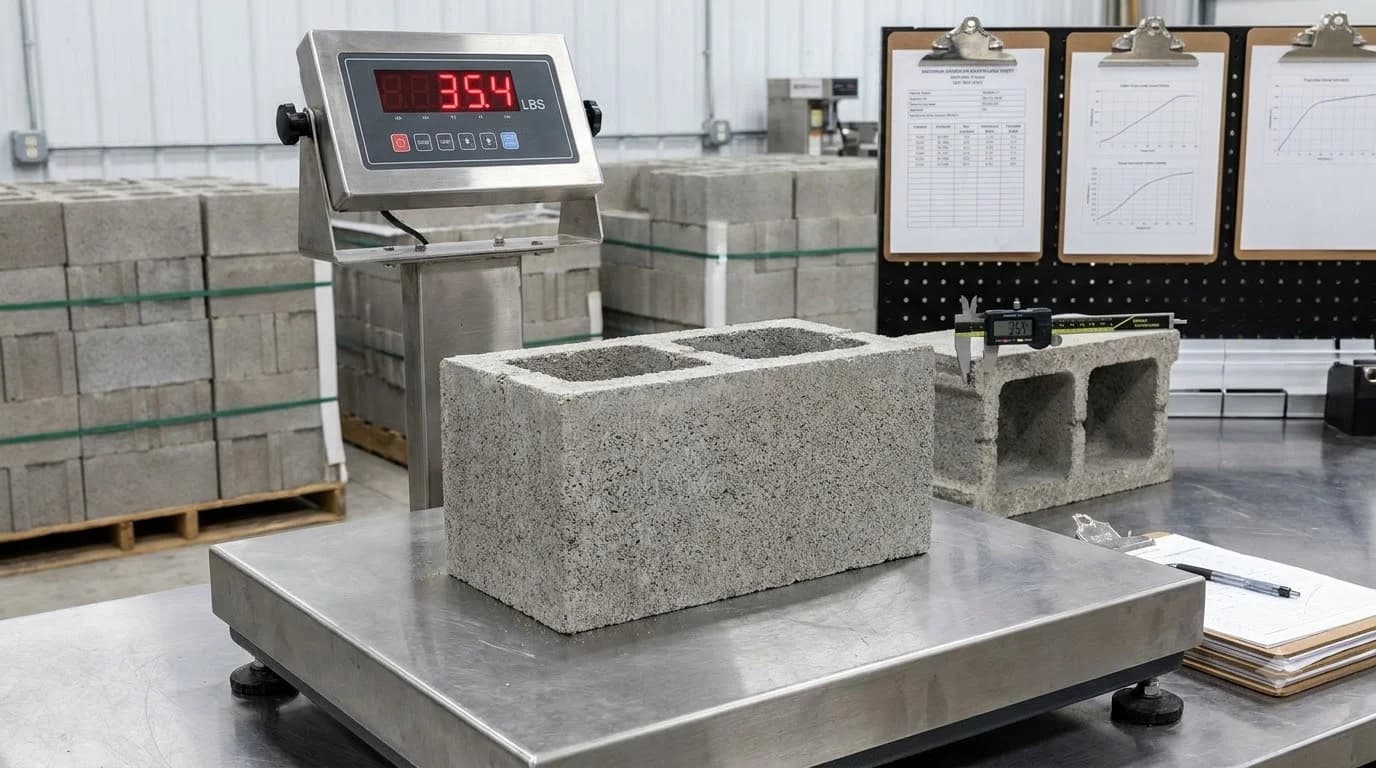
A standard 8x8x16-inch hollow concrete masonry unit (CMU) weighs between 34 and 38 pounds (15.4 to 17.2 kg) in medium-weight concrete, which is the most common grade sold at Home Depot and Lowe's. In normal-weight dense gravel concrete, it weighs 40 to 44 pounds (18.1 to 20.0 kg), while lightweight expanded shale units weigh 26 to 30 pounds (11.8 to 13.6 kg).
How much does an 8x8x16 block weigh when filled with solid concrete grout?
A standard 8x8x16 hollow block has roughly 0.28 cubic feet of internal core volume. Filled with ASTM C476 coarse pea-gravel grout (weighing roughly 145 lbs/cu ft), the internal grout adds approximately 40 to 42 pounds, bringing the total solid-grouted block weight to 75 to 80 pounds.
What are the three ASTM C90 concrete block weight density classifications?
Under ASTM C90, loadbearing CMUs are categorized into three dry aggregate density tiers: Lightweight (less than 105 lbs/cu ft), Medium-Weight (105 to 125 lbs/cu ft), and Normal-Weight (greater than 125 lbs/cu ft). All three tiers must meet the identical minimum compressive strength requirement of 2,000 PSI over net area.
How much does a full pallet of 8-inch concrete blocks weigh?
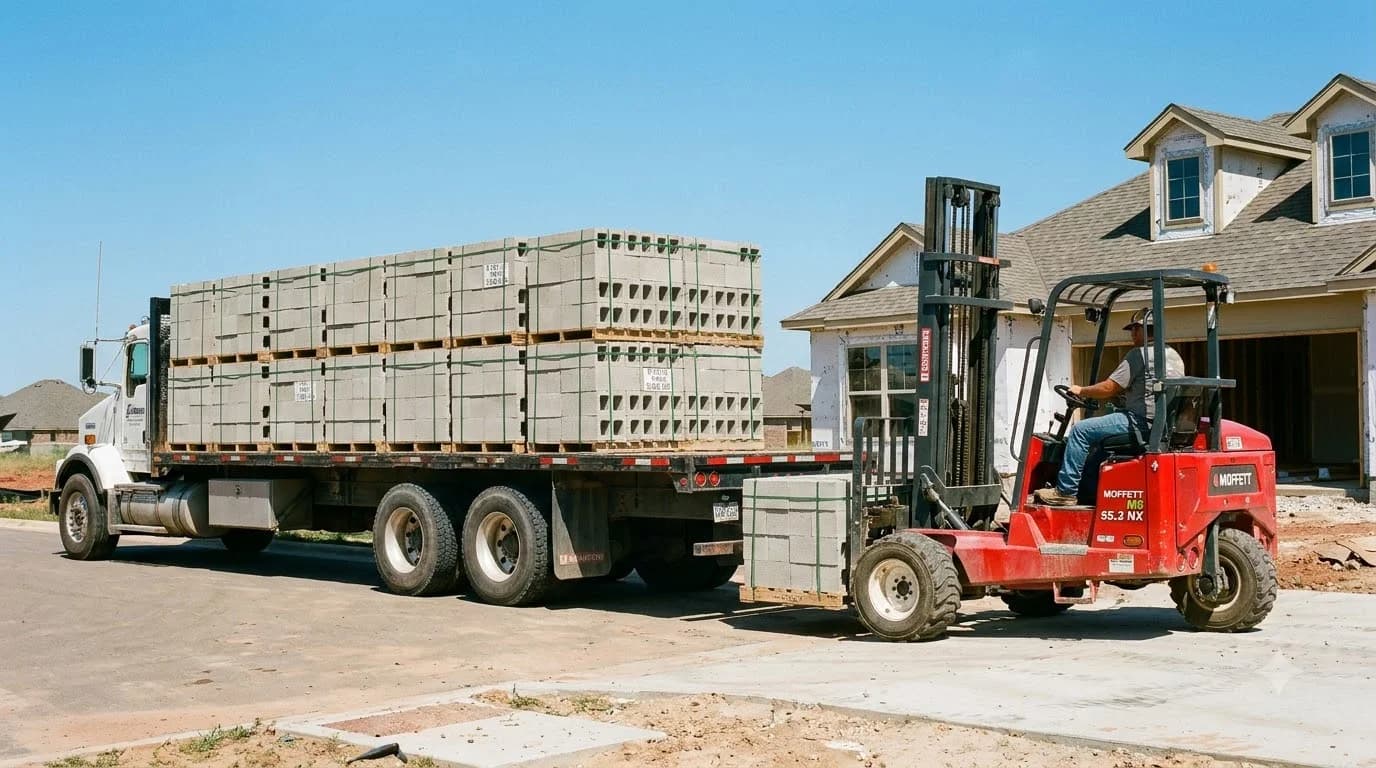
A standard commercial pallet holds exactly 108 units of 8x8x16 blocks. In medium-weight concrete, the blocks weigh roughly 3,888 lbs plus the 50-lb wooden pallet, totaling 3,938 lbs (roughly 1.97 US short tons). In normal-weight concrete, a pallet exceeds 4,400 lbs (2.2 tons).
Does rain or jobsite moisture increase concrete block weight?
Yes. Concrete masonry units are porous sponges with ASTM C90 water absorption allowances of 13 to 18 lbs per cubic foot. Uncovered pallets exposed to heavy rainfall can absorb 3 to 5 pounds of water per block, adding over 450 pounds of extra water weight to a single pallet.
Building Codes & Primary Standards Cited
Standard Specification for Loadbearing Concrete Masonry Units
Establishes density classifications, minimum compressive strength (2000 psi), and physical dimensions.
Standard Test Methods for Sampling and Testing Concrete Masonry Units
The authoritative testing standard for measuring dry unit weight, moisture absorption, and net area.
Structural Design - Dead Loads and Masonry Design
Codifies dead load weight multipliers for hollow, partially grouted, and solid grouted masonry walls.
Building Code Requirements and Specification for Masonry Structures
National standard governing structural design, grout placement, and reinforcing steel clearances.
Estimations adhere to standard North American modular 3/8-inch mortar joint physics and 5% to 10% material waste factors. Local municipal building inspectors, stamped architectural blueprints, and local frost depth requirements supersede general reference guidelines.
Popular Quick Estimates
Pre-engineered takeoffs & benchmarks matched to this project
Related Calculators
Specialized tools for foundation, core fill, and budgeting
Heavyweight structural blocks and bond beam units
Dry block weight, filled core weight and hauling loads
Cubic yards, bags, and slab volume for flatwork and footings
Core grout volume in cubic yards and 80-lb pre-mix bags
Blogs & Construction Guides
Technical articles, IRC code standards, rebar schedules & freight logistics
How Much Does a Yard of Concrete Weigh? (Full Spec)
Types of Concrete Blocks: Shapes & Uses
How Much Does a Pallet of Concrete Weigh? (2026 Guide)