Crucial Rule: Curing Is NOT Drying
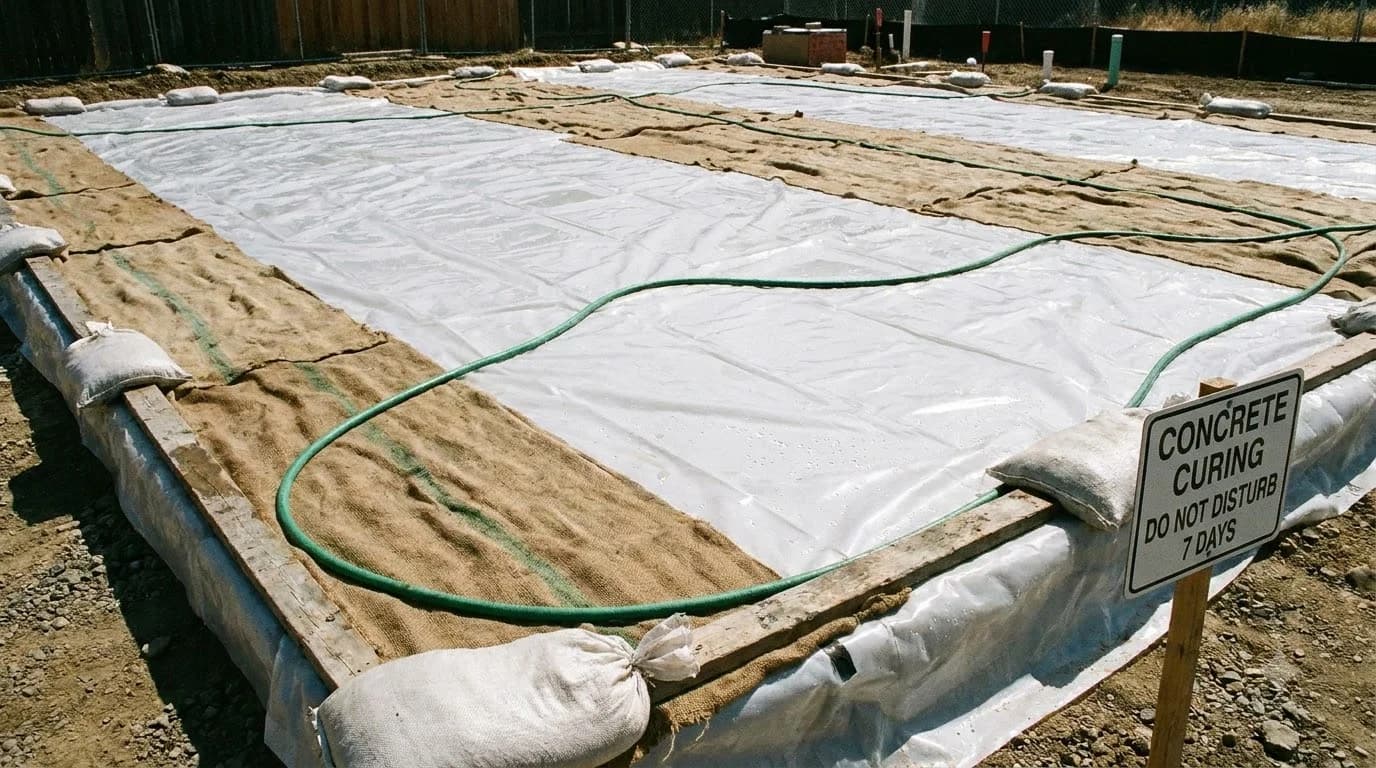
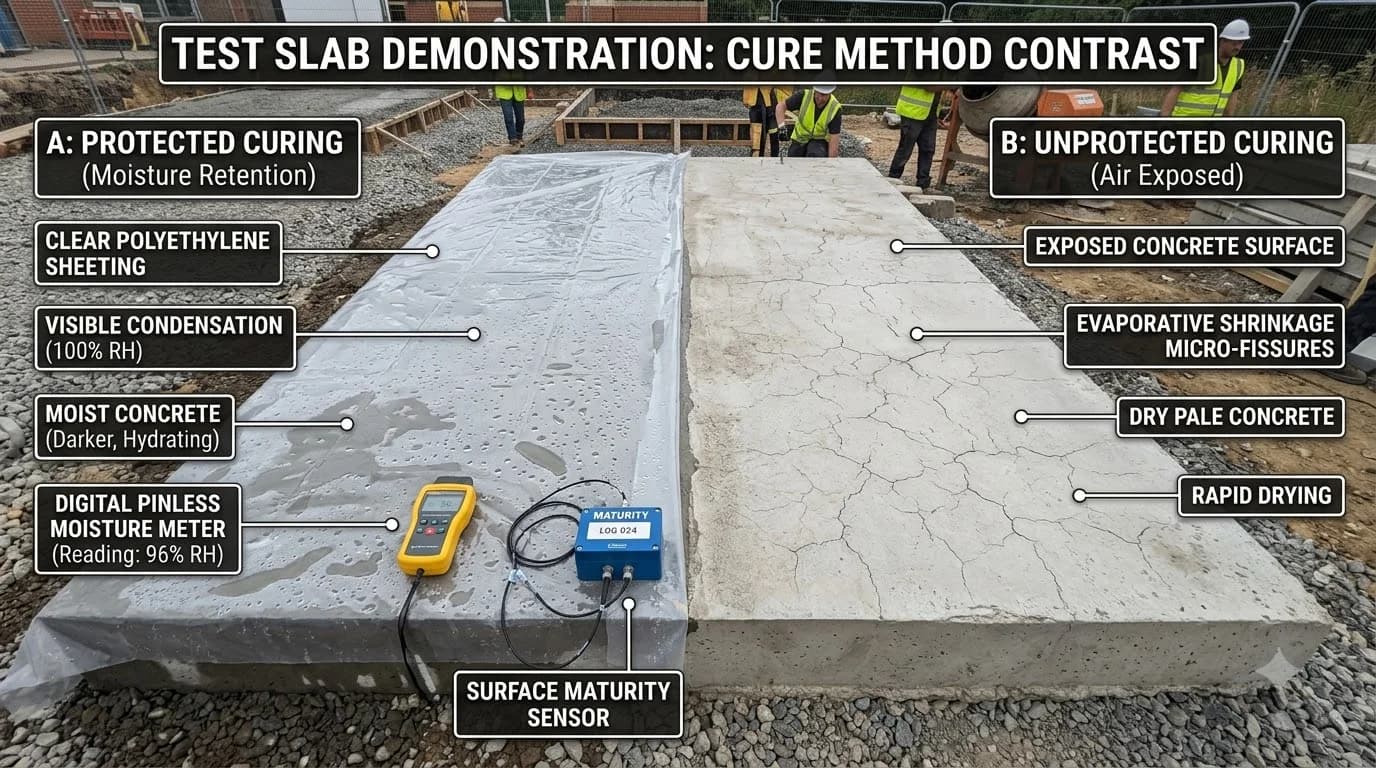
Concrete does not harden by drying out—it hardens through an irreversible chemical reaction called hydraulic hydration between Portland cement and water. If concrete dries out in the first 7 days, hydration halts permanently, robbing the slab of up to 50% of its compressive strength. Under ACI 308R, concrete must be maintained in a continuous moist state (via wet burlap, white poly sheeting, or ASTM C309 membrane compounds) for at least 7 continuous days.
1. The Science of Hydration: Why Moisture Retention Is Non-Negotiable
When Portland cement mixes with water, tricalcium silicate ($C_3S$) and dicalcium silicate ($C_2S$) react to form Calcium-Silicate-Hydrate (C-S-H) gel and calcium hydroxide. This crystalline gel grows like microscopic interlocking needles, binding the sand and aggregate together into man-made stone.
// Curing Strength vs Moisture Environment (ASTM C39 Data)
• Continuous Moist Cured (28 Days): 100% Design Strength (e.g. 4,200 PSI)
• Moist Cured 7 Days, then Air Dried: ~90% Design Strength (e.g. 3,800 PSI)
• Moist Cured 3 Days, then Air Dried: ~75% Design Strength (e.g. 3,150 PSI)
• Zero Curing (Air Dried from Day 1): ~50% Design Strength (e.g. 2,100 PSI - Severe Surface Dusting)
The critical window is the first 7 days. During this period, concrete achieves over 65% to 70% of its final strength. If wind and sun suck moisture out of the surface during this time, chemical hydration ceases permanently in the top 1/4 inch, leaving a crumbly, dusty wear surface.
2. Master Comparison Matrix: The 4 Primary Curing Methods
Under ACI 308R (Guide to External Curing of Concrete), contractors choose among four established methods based on jobsite access and budget:
| Method | Moisture Retention | Labor Effort | Risk of Discoloration | Cost / 1,000 Sq Ft | Best Application |
|---|---|---|---|---|---|
| Continuous Ponding | 100% (The Gold Standard) | High (Build sand dikes) | Zero (Uniform cure) | $25 (Water utility) | Flat roof slabs, pavements, structural decks |
| Wet Burlap & Soaker Hose | 95% – 98% | Moderate (Daily hose check) | Low (Wash burlap first) | $90 – $150 (Reusable) | Bridge decks, porch steps, columns, architectural walls |
| White Plastic Film (ASTM C171) | 90% – 95% | Low (Tape & weight edges) | Medium (If folds bridge air) | $50 – $80 | Residential driveways, sidewalks, shed slabs |
| Liquid Compound (ASTM C309) | 85% – 90% | Very Low (1-pass spray) | Low (White pigment washes off) | $65 – $110 | Large warehouse slabs, highway commercial paving |
3. The Dangers of Plastic Sheeting: Mottling & Greenhouse Overheating
While rolling out 4-mil or 6-mil plastic sheeting is the most common DIY curing method, it frequently ruins the aesthetic appearance of residential driveways and patios:
Whenever plastic film touches the concrete in some spots but bridges over wrinkles in other spots, moisture condenses unevenly. The areas where plastic touches cure differently than the air-bridged areas, leaching soluble salts non-uniformly. The result is permanent dark zebra stripes and blotches called mottling that cannot be washed or acid-etched off.
Never lay raw plastic directly on bare concrete if aesthetics matter. Place a layer of damp, washed burlap (or synthetic non-woven curing fabric) over the slab first, and then place the plastic sheet over the burlap. The fabric creates a continuous capillary moisture blanket, ensuring 100% uniform hydration with zero mottling.
4. Curing Compounds vs Cure-and-Seals: Adhesion Warnings
Spray-applied chemical curing products save immense labor, but you must select the correct product standard:
Dissipating Resin Compounds (ASTM C309 Type 1 or 2)
Formulated with wax or hydrocarbon resins that form a temporary moisture-retention film. The resin is engineered to oxidize and break down under UV sunlight within 30 to 60 days, leaving clean bare concrete. Ideal for outdoor highway paving and exterior sidewalks.
Cure & Seal Acrylics (ASTM C1315 Class A)
Formulated with non-yellowing acrylic polymers (25% solids). Serves as both a curing membrane and a permanent protective sealer that enhances color, repels water, and resists oil stains. Perfect for decorative stamped concrete and broom-finished driveways.
Critical Warning: Tile, Vinyl & Epoxy Floor Delamination
Never spray a curing compound on an interior basement or garage slab if you plan to install ceramic tile, glue-down luxury vinyl, or epoxy coatings later! The wax or acrylic membrane prevents adhesives and epoxy from penetrating concrete pores. The flooring will debond and pop off. For interior slabs scheduled for subsequent floor coverings, cure exclusively with water, poly sheeting, or wet burlap.
5. Five Costly Concrete Curing Mistakes
Spraying 50°F well water onto a 95°F concrete slab in the afternoon causes sudden differential thermal contraction. The surface shrinks instantly while the internal mass stays hot, ripping open thousands of microscopic spiderweb cracks (crazing). Water concrete early in the morning with ambient-temperature water.
Spraying curing compound onto standing bleed water traps a layer of liquid water between the concrete and the resin. The compound turns into a milky white emulsion that flakes off, leaving the concrete uncured. Wait until bleed water sheen has completely evaporated.
Burlap must be kept continuously wet. If you throw dry burlap on concrete and let it bake dry, the coarse jute fibers will act as a wick, pulling moisture out of the concrete faster than open air! Place soaker hoses over the burlap on an automated timer.
Wooden forms provide excellent curing moisture retention for the sides of footings and walls. If you strip edge forms after 24 hours, you must immediately spray the exposed vertical edges with curing compound or drape wet blankets over them. Vertical concrete edges crumble if left to air-dry.
Many DIYers stop watering after 2 days because the concrete “looks hard.” At 48 hours, concrete has only attained roughly 40% of its final strength. Terminating curing early leaves the top 1/2 inch weak and vulnerable to freeze-thaw spalling during the first winter.
Planning Your Concrete Slab Project?
Calculate total concrete volume, curing compound gallons, and 2026 local prices in seconds.
Frequently Asked Questions
How often should you water new concrete during curing?
Concrete must be kept continuously moist for a minimum of 7 full days under ACI 308R. If using open water sprinkling, wet the slab 3 to 5 times per day so the surface never dries out between applications. Allowing concrete to dry and re-wetting it with cold hose water induces thermal shock crazing cracks.
Can you use clear plastic sheeting to cure concrete?
No. Never use clear or black plastic sheeting in sunny outdoor weather. Clear plastic creates a greenhouse effect that overheats the slab, causing moisture condensation in patches that leaves permanent dark blotches called 'mottling.' Use white reflective polyethylene sheeting (ASTM C171) or wet burlap under white plastic.
What happens if you do not cure concrete at all?
Uncured concrete loses approximately 30% to 50% of its potential compressive strength. The top 1/4 inch will suffer from rapid moisture evaporation, producing a weak, dusty surface that easily scratches, cracks, and flakes under freeze-thaw cycles and car tires.
What is the difference between a curing compound and a cure-and-seal?
A standard curing compound (ASTM C309) is a temporary wax or dissipating hydrocarbon resin designed to degrade under sunlight within 30 to 60 days. A cure-and-seal (ASTM C1315) is a high-solids acrylic polymer that retains moisture during curing and remains permanently bonded as a protective, chemical-resistant glossy sealer.
How long must concrete cure before you can tile or paint over it?
Standard concrete requires at least 28 days of internal moisture equilibrium before installing tile, paint, or vinyl flooring. Furthermore, if an ASTM C309 curing compound was sprayed on the slab, it must be mechanically stripped via diamond grinding or shot blasting before adhesive installation, or the flooring will debond.
Building Codes & Primary Standards Cited
Guide to External Curing of Concrete
American Concrete Institute authoritative manual defining minimum moist curing periods, ponding techniques, and temperature controls.
Standard Specification for Liquid Membrane-Forming Compounds for Curing Concrete
Specifies moisture-loss limits (0.55 kg/m² in 72 hours) and solar reflectance benchmarks for spray-applied compounds.
Standard Specification for Sheet Materials for Curing Concrete
Governs polyethylene film, burlap-polyethylene combinations, and waterproof paper for moisture-retaining covers.
Standard Specification for Liquid Membrane-Forming Compounds Having Special Properties for Curing and Sealing Concrete
Defines non-yellowing acrylic polymers that provide both long-term sealing protection and initial curing moisture retention.
Estimations adhere to standard North American modular 3/8-inch mortar joint physics and 5% to 10% material waste factors. Local municipal building inspectors, stamped architectural blueprints, and local frost depth requirements supersede general reference guidelines.
Popular Quick Estimates
Pre-engineered takeoffs & benchmarks matched to this project
Related Calculators
Specialized tools for foundation, core fill, and budgeting
Cubic yards, bags, and slab volume for flatwork and footings
Heavyweight structural blocks and bond beam units
Core grout volume in cubic yards and 80-lb pre-mix bags
Cell fill requirements for low-lift and high-lift grouting
Blogs & Construction Guides
Technical articles, IRC code standards, rebar schedules & freight logistics
How to Mix Concrete by Hand: Wheelbarrow Water Ratio
Concrete Slump Test: ASTM C143 Procedures & Values
Concrete Drying vs Curing Time: 24h, 7-Day & 28-Day