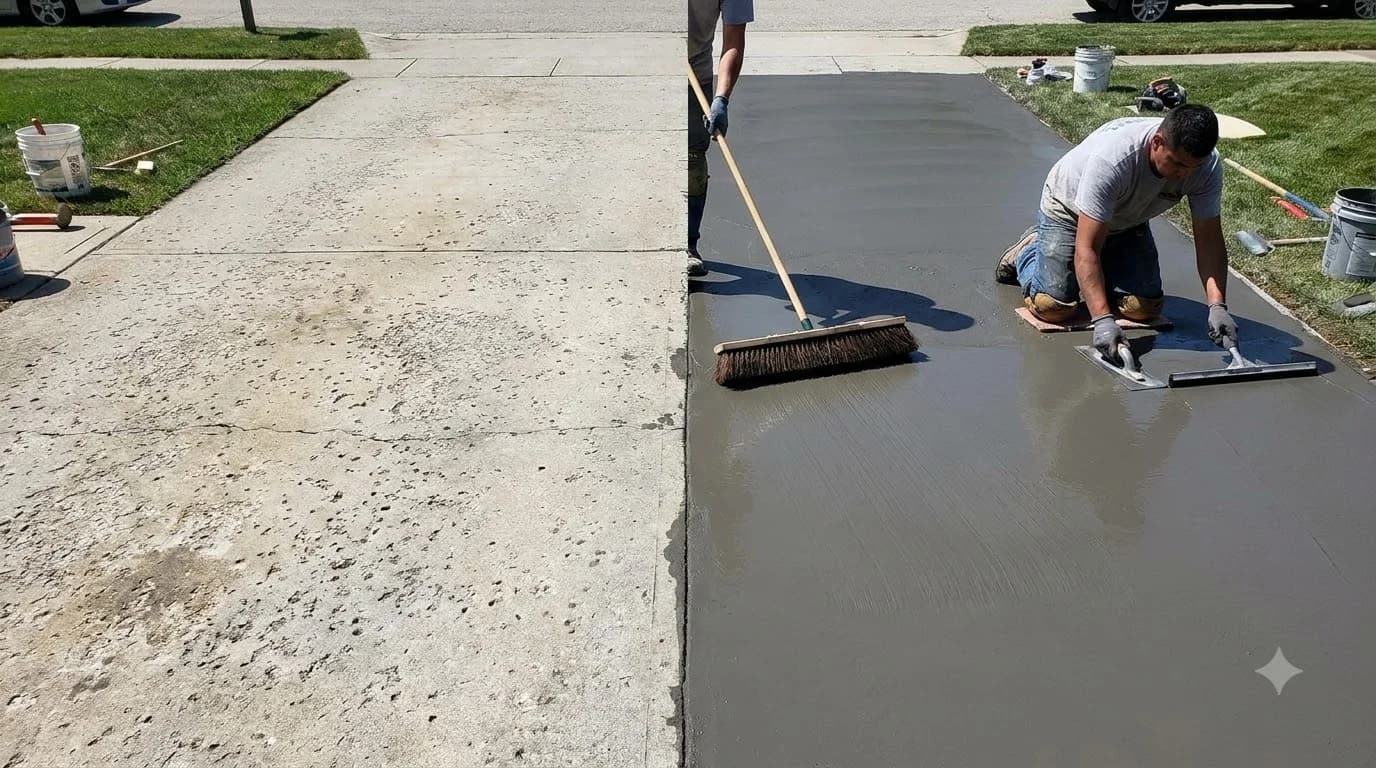
Resurface when surface degradation is cosmetic (freeze-thaw scaling, surface pitting under 1/2-inch deep, or micro-crazing) and the subgrade remains stable. If the slab exhibits differential settling, wide vertical offset cracks exceeding 1/4 inch, or severe frost heaving, the foundation has failed structurally; an overlay will simply crack along the same failure lines within months.
1. Assessment: When to Resurface vs. When to Demolish & Replace
Before spending money on resurfacing compounds, contractors perform a structural soundness audit. Use a heavy chain drag or tap the slab with a 3-lb sledgehammer. A high-pitched, solid "ping" indicates dense, bonded concrete. A dull, hollow "thud" reveals subsurface delamination where the top paste has separated from the aggregate.
- Surface scaling caused by deicer salts or winter freeze-thaw cycles.
- Shallow popouts and aggregate pitting less than 1/2-inch deep.
- Hairline shrinkage crazing cracks without vertical slab displacement.
- Cosmetic discoloration, old paint stains, or weathered surfaces.
- Uneven slab settlement with vertical lip offsets exceeding 1/4 inch.
- Tree root lifting or severe expansive clay soil movement beneath the subbase.
- Widespread structural cracking with crumbling, uncompacted subgrade.
- Severe aggregate freeze-thaw crumbling through the entire slab thickness.
2. Surface Preparation: The ICRI Concrete Surface Profile (CSP)
Over 90% of overlay delaminations occur because the base was improperly prepared. The International Concrete Repair Institute (ICRI Guideline 310.2R) establishes Concrete Surface Profile (CSP) benchmarks from 1 (nearly smooth) to 9 (very rough).
Target Profile (CSP 2 to 3): Thin resurfacers require an open, sandpaper-like pore structure (CSP 2 to 3). Pressure washing at 3,500 PSI cleans dirt but cannot remove factory machine-troweled smooth cream or old siliconate sealers.
Mechanical Grinding vs. Acid Etching: Mechanical diamond grinding with 16-to-30 grit metal-bond diamond segments is the contractor gold standard. It opens capillaries, levels minor ridges, and removes contaminants in one pass. While muriatic acid etching (1 part acid to 4 parts water per ASTM D4260) is common among DIYers, acid can be neutralized unpredictably, leave calcium chloride salt residues, and fail to penetrate oily spots.
3. Polymer Overlay Formulations & Performance Matrix
Modern resurfacing products blend Portland cement, fine graded silica sand, pozzolans, and redispersible polymers (such as ethylene-vinyl acetate or acrylic copolymers). The polymer chains cross-link within the hydrating paste, granting flexible tensile bond strengths exceeding 350 PSI:
| Overlay System Type | Standard Thickness | 28-Day Compressive PSI | Tensile Bond Strength | Return to Foot / Vehicle | 2026 Material Cost / sq ft |
|---|---|---|---|---|---|
| Broom-Finish Resurfacer | 1/8 in to 1/4 in | 4,000 – 4,500 PSI | > 300 PSI (Parent Failure) | 6 hrs foot / 24 hrs vehicle | $1.10 – $1.85 / sq ft |
| Polymer Micro-Topping | 1/16 in to 1/8 in | 4,500 – 5,500 PSI | > 350 PSI | 4 hrs foot / 48 hrs light cart | $1.75 – $3.20 / sq ft |
| Self-Leveling Wear Topping | 1/4 in to 1/2 in | 5,500 – 6,500 PSI | > 400 PSI | 4 hrs foot / 24 hrs forklift | $2.80 – $4.50 / sq ft |
| Stamped Decorative Overlay | 1/4 in to 5/8 in | 4,000 – 5,000 PSI | > 300 PSI | 12 hrs foot / 48 hrs vehicle | $2.50 – $4.00 / sq ft |
4. Step-by-Step Resurfacing Protocol: Mixing, Spreading & Brooming
Follow this professional jobsite installation sequence to ensure a permanent structural bond:
- Deep Crack Repair: Chase all cracks wider than 1/16" with a 4-inch diamond blade. Clean dust, inject high-modulus epoxy gel (ASTM C881 Type I/II), and broadcast coarse silica sand over the wet epoxy to create mechanical bite.
- Saturated Surface Dry (SSD) Saturation: Flood the slab with clean water 2 to 3 hours prior to pouring. Immediately before application, blow away all standing puddles with a leaf blower. The concrete must look dark and damp, but not wet.
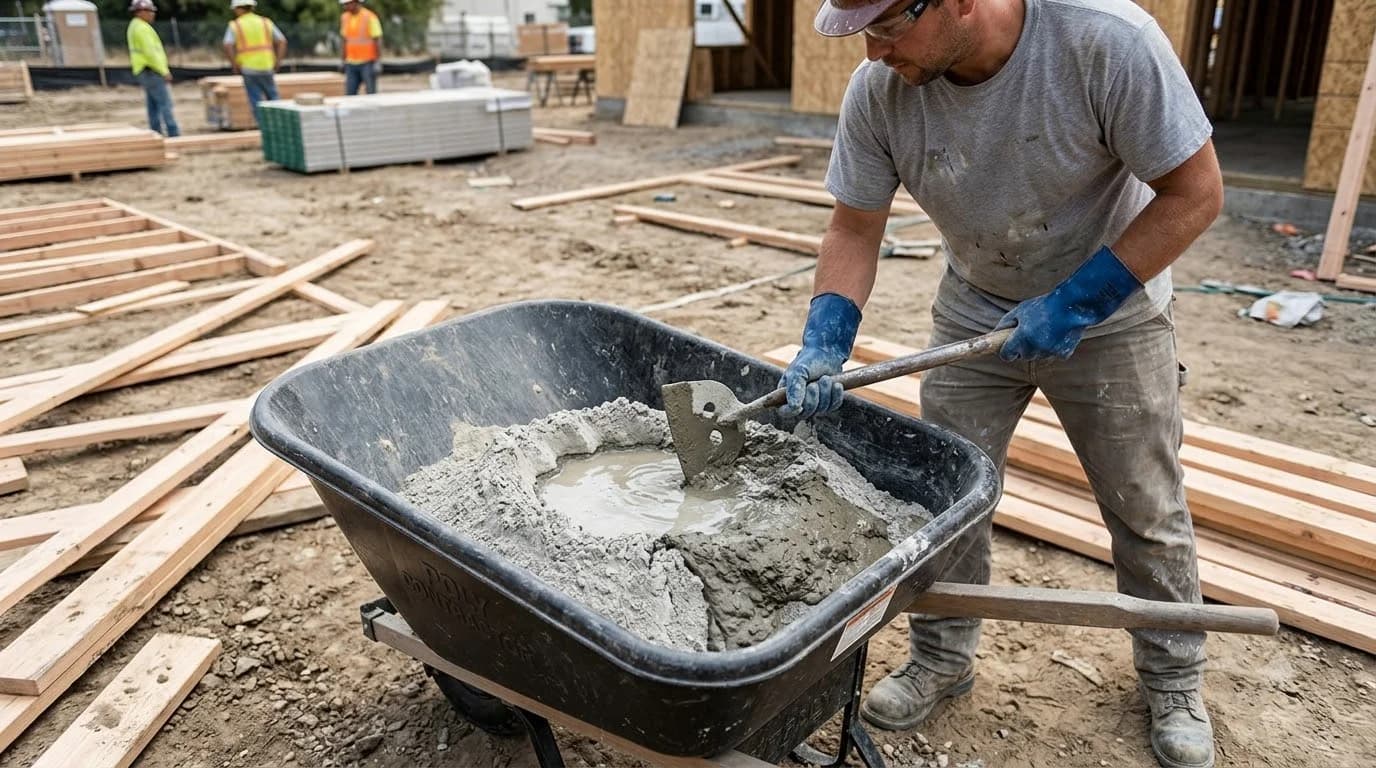
- High-Shear Paddle Mixing: Measure exact water into a 5-gallon bucket (typically 5.5 to 6.0 quarts per 40-lb bag). Add dry powder gradually while spinning a heavy-duty drill mixer with an eggbeater paddle at 650 RPM for 2 to 3 minutes. Allow the mix to "slake" for 2 minutes, then re-spin for 30 seconds.
- Placement with Squeegee: Pour the slurry in ribbons. Use a rubber squeegee or gauge rake set to 1/8" to pull the material firmly into the concrete pores. Keep a continuous wet edge across panels.
- Architectural Broom Finish: Wait 3 to 5 minutes until the material begins losing its initial glossy sheen. Pull an aluminum concrete horsehair broom cleanly in one continuous direction across the width to impart a slip-resistant micro-texture.
5. Curing & Sealing: Protecting the Fresh Overlay
Because polymer-modified overlays are placed in thin layers (1/8" to 1/4"), their high surface-area-to-volume ratio makes them vulnerable to rapid desiccation.
Do Not Cover with Plastic Sheeting: Covering fresh polymer overlays with polyethylene plastic creates condensation wrinkles that permanently discolor the cement paste with dark, marbled hydration spots.
Penetrating Sealer Application: After 48 to 72 hours of initial curing, apply a 100% breathable penetrating silane-siloxane sealer (compliant with ASTM C309). Penetrating sealers chemically react within concrete pores to form a hydrophobic barrier that repels water and deicing salts while allowing internal vapor to escape harmlessly.
6. Five Costly Concrete Resurfacing Mistakes to Avoid
Dry concrete acts like an ultra-absorbent sponge, rapidly sucking water out of the thin overlay slurry before hydration can occur. This leads to flash-drying, chalking, and catastrophic debonding.
Never squeegee resurfacer across existing control joints or perimeter expansion strips. Within months, seasonal thermal slab movement will crack the overlay directly above the buried joint. Saw-cut joints within 12 hours.
Adding even 1 extra cup of water per bag dilutes polymer resins, causes pigment segregation (tiger-striping), and weakens compressive strength by over 1,000 PSI. Strictly follow manufacturer water ratios.
Surface temperatures above 85°F cause the thin slurry to flash-set on the ground before it can be squeegeed or broomed, leaving severe lap lines and torn textures. Schedule pours for early morning.
Water-based polymer resurfacers will not bond to automotive motor oil or hydraulic fluid. Clean oil spots with emulsifying TSP degreasers or grind deep enough to reach virgin, uncontaminated stone aggregate.
Planning a Masonry or Slab Project?
Get exact concrete bag counts, ready-mix yards, and 2026 material costs instantly.
Frequently Asked Questions
How long does a polymer concrete resurfacer last?
When applied over a structurally sound substrate prepared to an ICRI CSP 2 to 3 mechanical profile, professional polymer-modified concrete resurfacers last 10 to 15+ years before requiring light cosmetic maintenance or resealing.
Can you resurface concrete in direct hot sunlight?
Never pour thin cementitious overlays in direct midday sun or windy conditions above 85°F (29°C). High temperatures trigger rapid flash-setting and surface skinning, causing severe shrinkage crazing, tearing during squeegee passes, and bond failure.
Why must existing control joints be cut back into the new overlay?
Concrete slabs expand and contract with seasonal temperature cycles. If you pour a new overlay directly across existing control joints, thermal slab movement will telegraph upward, producing an unsightly, jagged reflective crack across your finished surface within 6 to 12 months.
What is Saturated Surface Dry (SSD) condition?
SSD is a moisture state where the concrete substrate is fully saturated with water internally so it does not rob hydration water from the fresh overlay, but has zero standing water or puddles on the surface that would dilute the bonding polymer.
How thin can a polymer concrete overlay be applied?
High-grade polymer micro-toppings can be troweled as thin as 1/16 to 1/8 inch for cosmetic skim coats. Standard broom-finish resurfacers are typically applied between 1/8 inch and 3/8 inch thick, while heavy self-leveling wear toppings range from 1/4 inch to 1-1/2 inches.
Building Codes & Primary Standards Cited
Selecting and Specifying Concrete Surface Preparation
Defines CSP profile standards (1 through 9) required for high-strength polymer overlay bonding.
Standard Specification for Latex Agents for Bonding Concrete
Establishes shear bond strength minimums for polymer bonding admixtures and resurfacers.
Concrete Repair Guide
American Concrete Institute guidelines for diagnosing slab deterioration and executing surface repairs.
Estimations adhere to standard North American modular 3/8-inch mortar joint physics and 5% to 10% material waste factors. Local municipal building inspectors, stamped architectural blueprints, and local frost depth requirements supersede general reference guidelines.
Popular Quick Estimates
Pre-engineered takeoffs & benchmarks matched to this project
Related Calculators
Specialized tools for foundation, core fill, and budgeting
Heavyweight structural blocks and bond beam units
Cubic yards, bags, and slab volume for flatwork and footings
Core grout volume in cubic yards and 80-lb pre-mix bags
Cell fill requirements for low-lift and high-lift grouting
Blogs & Construction Guides
Technical articles, IRC code standards, rebar schedules & freight logistics
How to Make Concrete Molds: Melamine, Wood & Silicone
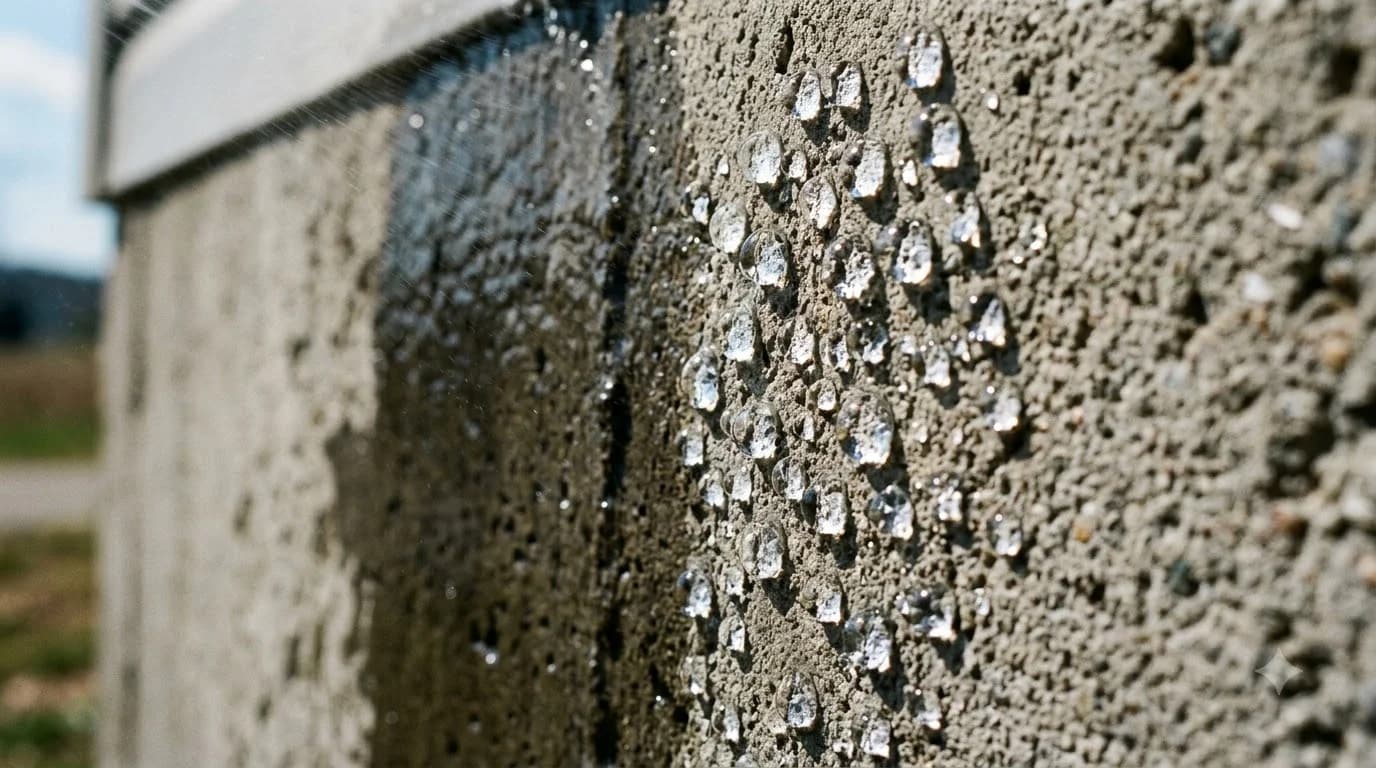
Is Concrete Porous? Permeability & Sealing (2026 Guide)
How Much Concrete Do I Need? Complete Quantity Takeoff