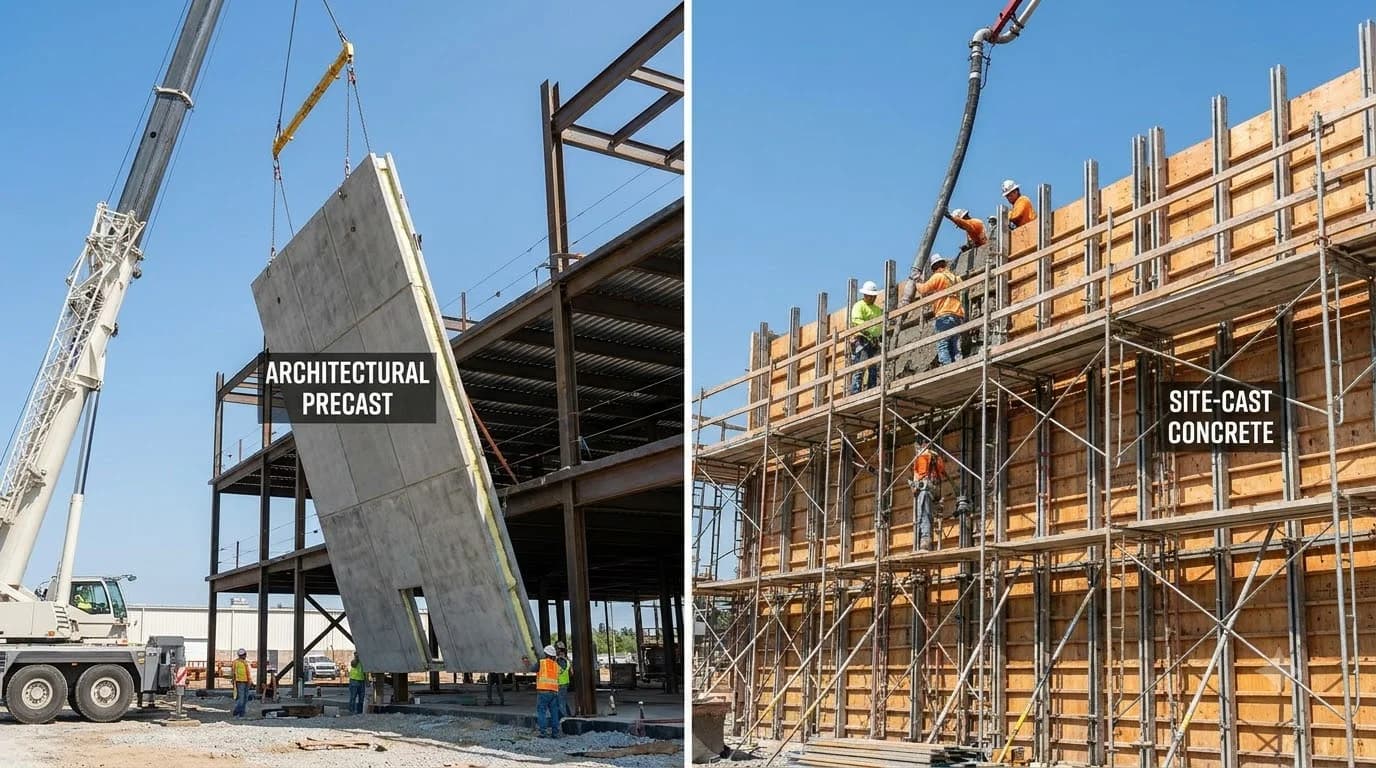
Quick Contractor Rule: Concrete Does Not Dry to Get Hard—It Hydrates
Drying is the loss of excess free water into the atmosphere. Curing is the exothermic chemical reaction (hydration) between water and Portland cement that creates calcium silicate hydrate crystals. Concrete must be kept moist during its first 7 days to reach roughly 70% of design strength, reaching 100% specified strength at 28 days under ASTM C39. Allowing concrete to dry out prematurely halts curing permanently.
1. Drying vs. Curing: The Fundamental Chemistry
One of the most widespread misconceptions in construction is that concrete sets and hardens by drying out like paint or mud. In reality, drying and curing are opposite physical processes:
- Chemical Curing (Hydration): Portland cement contains tricalcium silicate and dicalcium silicate. When mixed with water, these minerals undergo a complex exothermic reaction that produces microscopic interlocking needle-like crystals of calcium silicate hydrate (C-S-H) gel and calcium hydroxide. This crystalline network binds sand and gravel into synthetic stone. Water is a mandatory chemical reactant—without moisture, crystal growth stops permanently.
- Moisture Drying (Evaporation): Ready-mix concrete requires extra batch water for pumpability and slump workability (typically 0.45 to 0.50 water-to-cement ratio). Only about half of that water is consumed by chemical hydration. The rest is free moisture that must eventually evaporate from microscopic capillary pores over months before flooring, epoxy, or urethane can be installed.
2. The 28-Day Concrete Curing Strength Curve
Compressive strength development follows an exponential curve governed by ASTM C39(Standard Test Method for Compressive Strength of Cylindrical Concrete Specimens). The table below reflects standard 4,000 PSI ready-mix cured at 70°F (21°C):
| Elapsed Time | % of Design Strength | Estimated PSI (4,000 Mix) | Permitted Activities & Traffic | Active Curing Protocol |
|---|---|---|---|---|
| 0 – 12 Hours | 0% – 5% | 0 – 200 PSI | Keep all foot and animal traffic off completely | Apply evaporation retarder or misting if windy |
| 24 – 48 Hours | 15% – 25% | 600 – 1,000 PSI | Gentle foot traffic only; unstrip side forms | Begin wet burlap, sprinkler mist, or ASTM C309 seal |
| 3 – 5 Days | 40% – 50% | 1,600 – 2,000 PSI | Wheelbarrows on plywood runners, lawnmowers | Maintain continuous dampness beneath plastic |
| 7 Days | 65% – 75% | 2,600 – 3,000 PSI | Standard passenger sedans, crossover SUVs | Minimum ACI 308R wet curing duration fulfilled |
| 14 Days | 85% – 90% | 3,400 – 3,600 PSI | Heavy 3/4-ton pickups, small delivery vans | Plastic can be removed; allow slab to dry |
| 28 Days | 100%+ | 4,000 – 4,500+ PSI | Full design load (RVs, dump trucks, machinery) | Ready for penetrating silane/siloxane sealers |
3. Temperature Impacts & The Concrete Maturity Concept
Concrete curing speed is profoundly temperature-dependent, following ASTM C1074 (Maturity Method):
- Standard Range (60°F – 80°F): Ideal hydration window. Curing proceeds on standard 7-day and 28-day trajectories.
- Cold Weather (<50°F, ACI 306R):Chemical hydration slows dramatically. Below 40°F (4°C), strength development virtually halts. If fresh concrete freezes before reaching 500 PSI (typically 24 to 48 hours), expanding ice crystals destroy up to 50% of the ultimate structural strength. Use insulated blankets or heated enclosures.
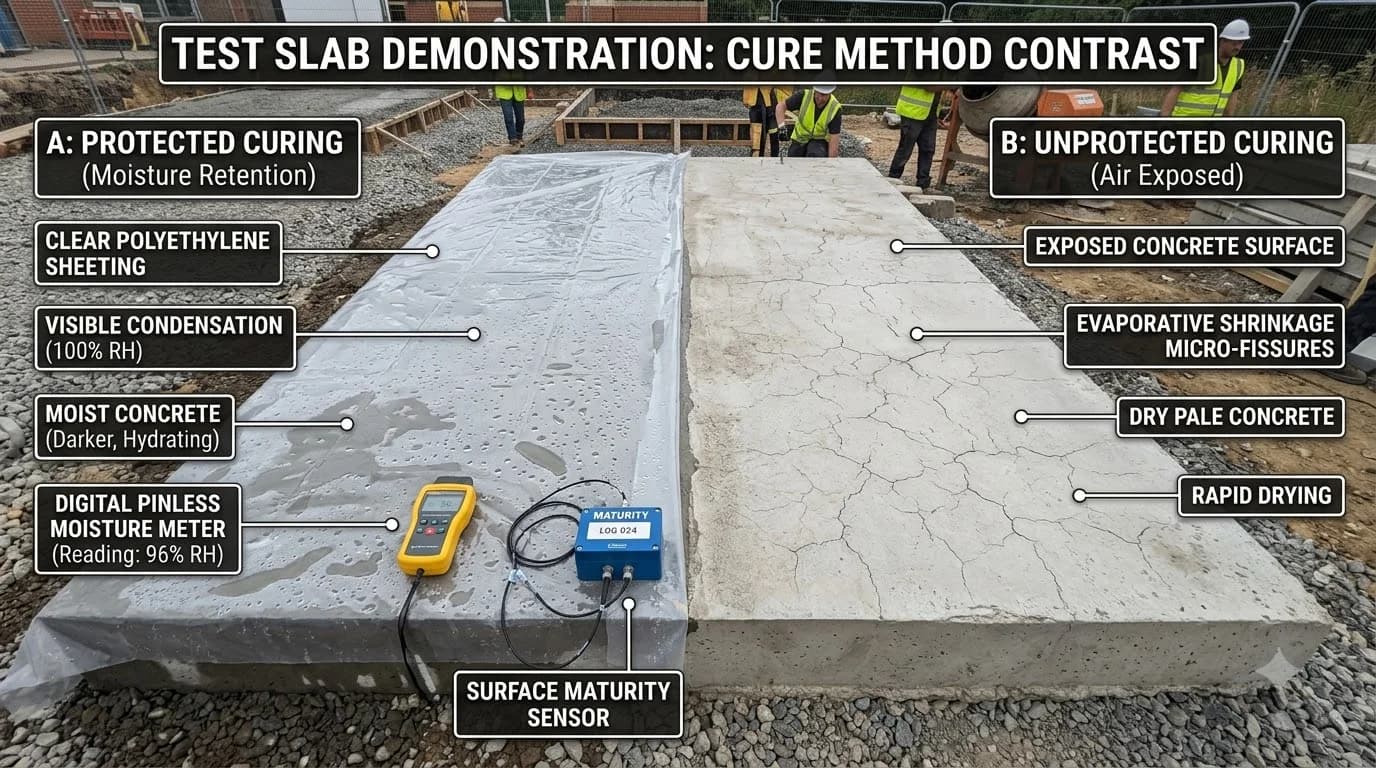
- Hot Weather (>85°F, ACI 305R): High ambient temperatures accelerate early strength but cause rapid surface moisture loss. Rapid evaporation creates high capillary tension, resulting in severe plastic shrinkage spider-cracking. Wet burlap or chemical curing compounds are mandatory.
4. Four Industry-Standard Curing Methods Compared
According to ACI 308R (Guide to External Curing of Concrete), contractors choose between several proven moisture-retention methods:
1. Water Ponding & Continuous Sprinklers
The gold standard for crack prevention. A continuous water blanket prevents any moisture loss. However, it requires constant supervision, high water volume, and dirt dikes around slab perimeters.
2. Wet Burlap & 4-Mil Polyethylene
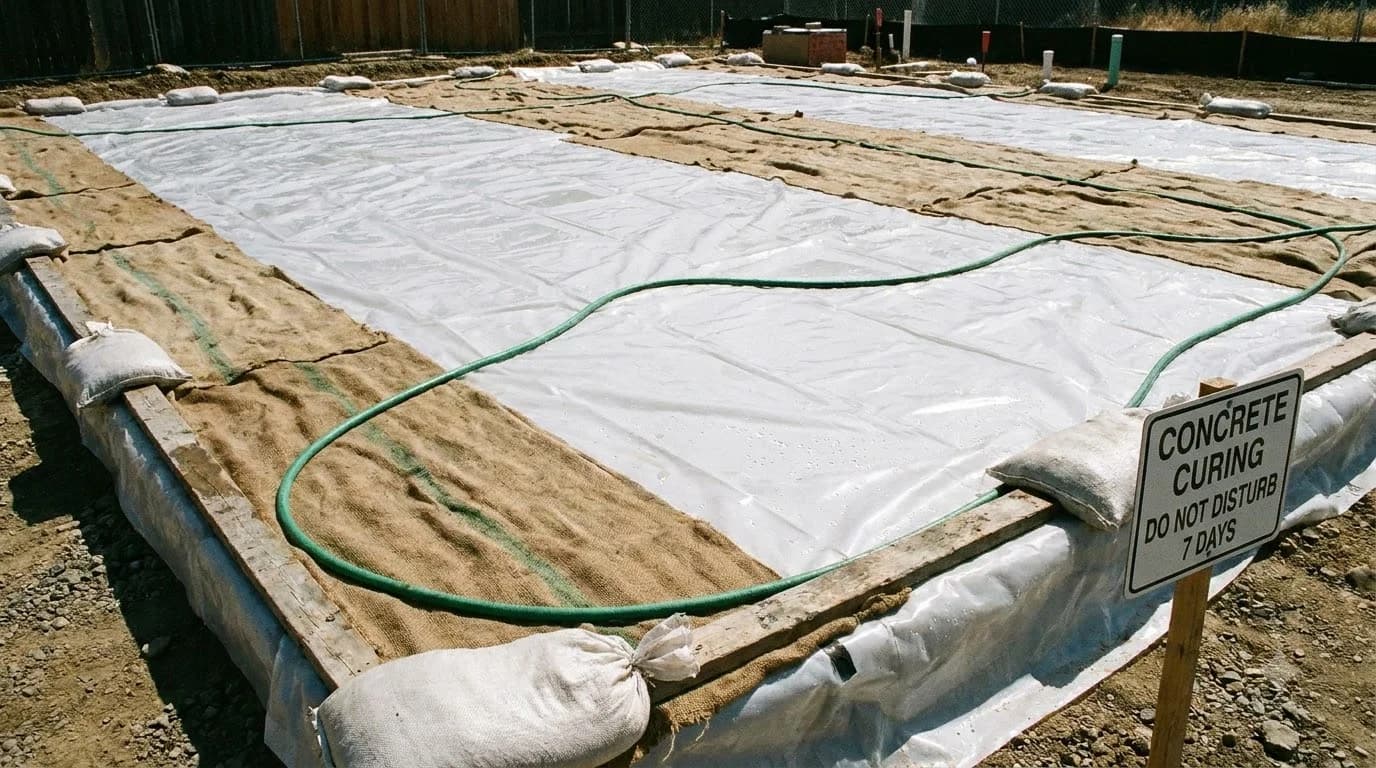
Soaked burlap blankets covered with white plastic sheeting trap 95%+ of mixing moisture. Excellent for driveways and patios, but plastic must lie flat without wrinkles to avoid mottled discoloration (“tiger striping”).
3. ASTM C309 Liquid Curing Compounds
Sprayed onto fresh concrete immediately after final troweling. Forms a thin wax or resin membrane that seals in moisture. Ideal for large parking lots and commercial slabs where water curing is impractical.
4. Leave-in-Place Insulated Forms
Leaving wooden or insulated concrete forms (ICF) on foundation walls for 5 to 7 days retains mix moisture naturally while shielding the curing mass against thermal shock.
5. Moisture Vapor Emission: When Is Concrete Dry Enough for Flooring?
While concrete is structurally cured at 28 days, it is rarely dry enough for impermeable floor coverings (epoxy, vinyl plank, rubber, or engineered hardwood). Trapped excess moisture migrating upward will delaminate adhesives and blister coatings.
- General Rule of Thumb: Standard 4-inch concrete slabs take roughly 30 days of drying time per inch of thicknessunder 70°F and 50% relative humidity (approximately 120 days for a 4-inch slab).
- ASTM F2170 (In-Situ RH Probes): Professional flooring installers drill holes and insert electronic probes. Moisture-sensitive flooring requires internal slab relative humidity below 75% to 80%.
- ASTM F1869 (Calcium Chloride Test): Measures moisture vapor emission rate (MVER). Most epoxy manufacturers require less than 3.0 lbs / 1,000 sq ft / 24 hours before application.
5 Costly Curing Mistakes to Avoid
Letting the Sun Dry Fresh Slabs
Walking away after finishing on a hot or windy day allows moisture to flash off. This permanently kills hydration in the top 1/4-inch, causing dusting, scaling, and premature surface degradation.
Driving Passenger Cars Too Early
Parking on a 3-day-old driveway concentrates 4,000 lbs of vehicle mass onto a slab that has only reached 40% strength. This fractures the subbase bond and cracks unreinforced joints.
Applying Epoxy Before Moisture Testing
Applying non-breathable 100% solids epoxy to a 28-day-old slab without testing internal RH (ASTM F2170) traps hydrostatic moisture vapor, causing catastrophic coating blisters within 6 months.
Thermal Shocking Hot Concrete with Ice-Cold Water
Spraying frigid well water onto an 85°F sun-baked slab causes extreme thermal shock contraction. The top surface contracts violently while the hot interior stays expanded, causing immediate map cracking.
Need Exact Materials For Your Project?
Get an instant takeoff with bags, ready-mix yards, sand, and 2026 pricing.
Frequently Asked Questions
How long before you can walk on fresh concrete?
You can walk on fresh concrete after 24 to 48 hours without leaving shoe impressions, provided ambient temperatures stay above 50°F. Keep pets and heavy wheelbarrows off for at least 3 to 4 days.
When can I drive my car onto a new concrete driveway?
Wait a minimum of 7 full days before parking standard passenger vehicles on new concrete, as it achieves approximately 70% of its compressive strength. Heavy pickup trucks, RVs, and delivery vans should stay off the slab for 14 to 28 days.
Does concrete ever stop curing?
Technically no. Concrete continues to gain compressive strength for decades as long as moisture and unhydrated Portland cement particles remain inside the core. Most standard engineering calculations consider 28 days as 100% design strength.
Why is rapid surface drying bad for fresh concrete?
When surface moisture evaporates faster than bleed water rises (greater than 0.2 lbs/sq ft/hr under ACI 308R), tensile stresses cause plastic shrinkage cracks. Furthermore, without water, cement particles stop hydrating, leaving a weak, powdery surface that spalls under traffic.
When can I apply epoxy or sealers to fresh concrete?
Penetrating silane/siloxane sealers can be applied after 28 days. Impervious coatings like 100% solids epoxy or urethane require the concrete to dry down to an internal relative humidity below 75-80% under ASTM F2170, which typically takes 30 to 60+ days.
Building Codes & Primary Standards Cited
Standard Test Method for Compressive Strength of Cylindrical Concrete Specimens
Establishes standardized break tests for measuring compressive strength at 7 and 28 days.
Guide to External Curing of Concrete
Defines minimum curing durations, moisture-retention methods, and ponding procedures.
Standard Specification for Liquid Membrane-Forming Compounds for Curing Concrete
Governs moisture-retention efficiency for spray-applied resin and wax curing barriers.
Estimations adhere to standard North American modular 3/8-inch mortar joint physics and 5% to 10% material waste factors. Local municipal building inspectors, stamped architectural blueprints, and local frost depth requirements supersede general reference guidelines.
Popular Quick Estimates
Pre-engineered takeoffs & benchmarks matched to this project
Related Calculators
Specialized tools for foundation, core fill, and budgeting
Cubic yards, bags, and slab volume for flatwork and footings
Heavyweight structural blocks and bond beam units
Core grout volume in cubic yards and 80-lb pre-mix bags
Cell fill requirements for low-lift and high-lift grouting
Blogs & Construction Guides
Technical articles, IRC code standards, rebar schedules & freight logistics
How to Cure Concrete: Wet Curing vs Curing Compounds
How to Mix Concrete by Hand: Wheelbarrow Water Ratio
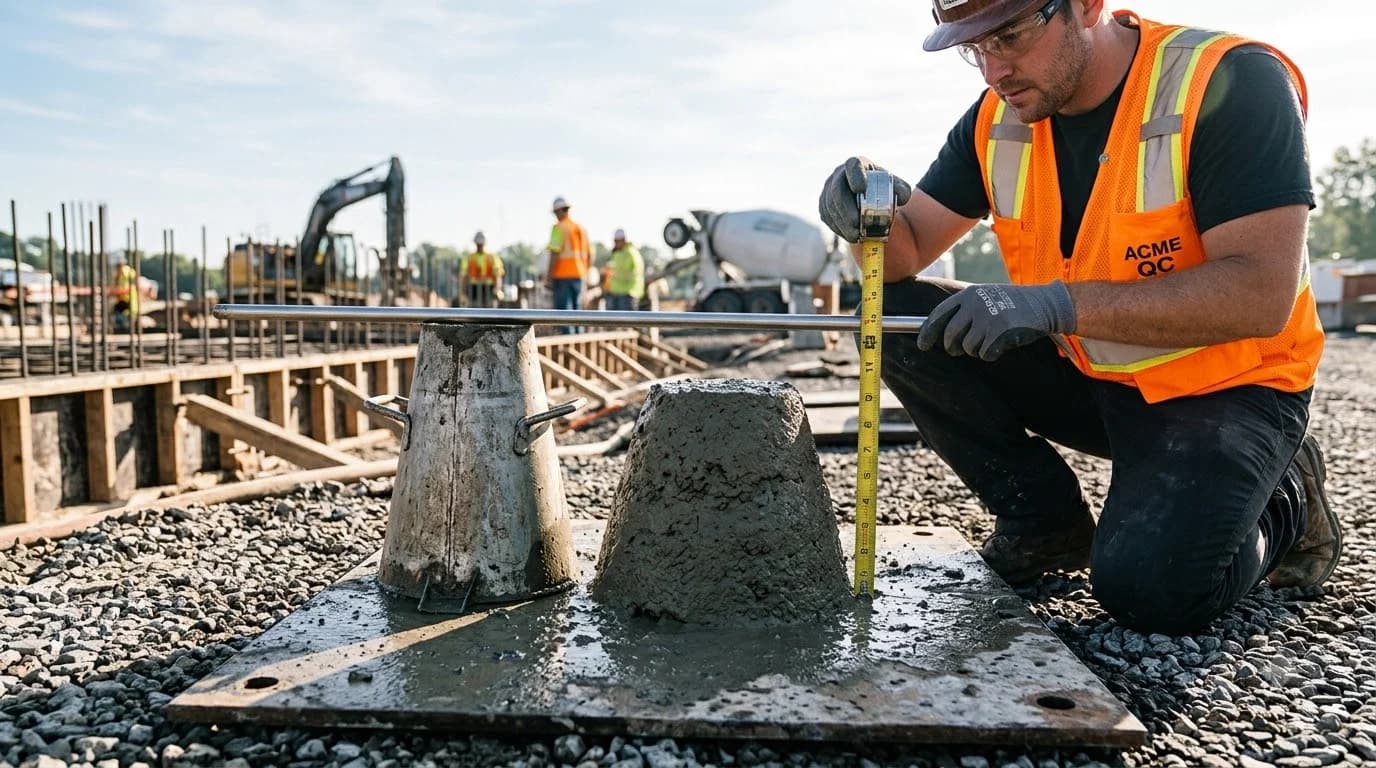
Concrete Slump Test: ASTM C143 Procedures & Values