Direct Answer: Official Cubic Foot Yields per Bag Size
The certified in-place yield for mixed, consolidated concrete according to ASTM C387 is:
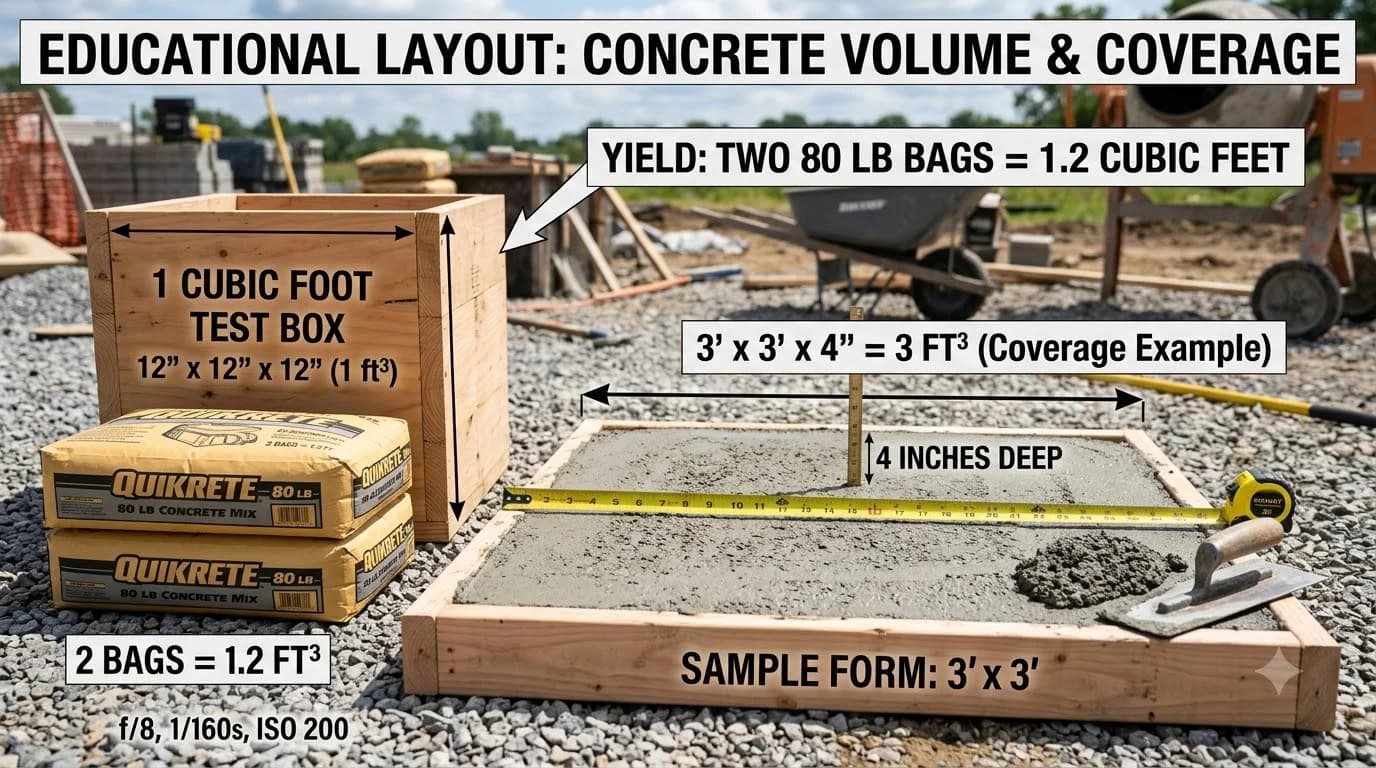
• 80-lb Bag: 0.60 cubic feet(Covers 1.80 sq ft at 4″ or 2.06 sq ft at 3.5″)
• 60-lb Bag: 0.45 cubic feet(Covers 1.35 sq ft at 4″ or 1.54 sq ft at 3.5″)
• 50-lb Bag: 0.375 cubic feet(Covers 1.13 sq ft at 4″ or 1.29 sq ft at 3.5″)
• 40-lb Bag: 0.30 cubic feet(Covers 0.90 sq ft at 4″ or 1.03 sq ft at 3.5″)
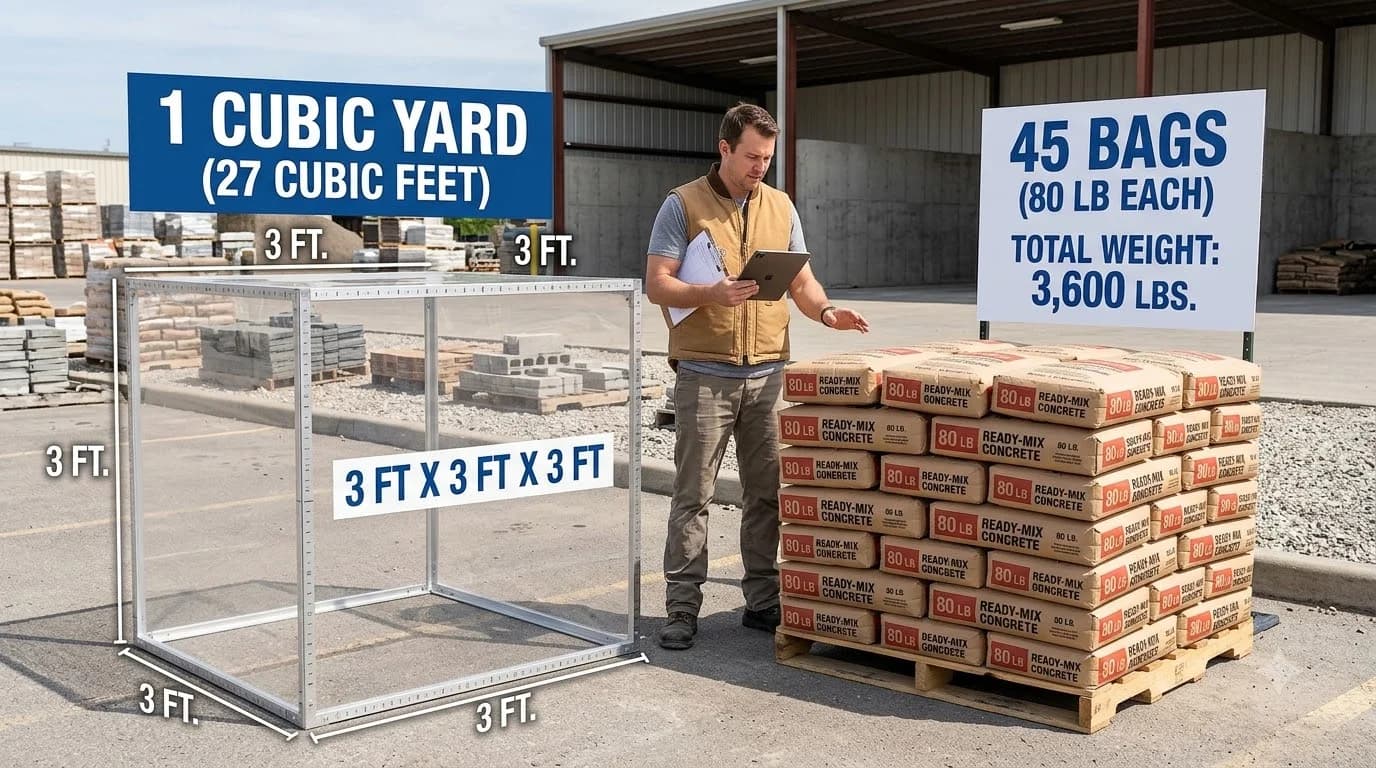
To pour 1 cubic yard (27 cu ft), you need exactly 45 bags of 80-lb or 60 bags of 60-lb concrete.
1. The Physics of Concrete Yield: Why Dry Volume Differs from Wet Volume
A frequent source of confusion on job sites is why a bag of concrete appears larger when dry in the bag than when it is mixed in a wheelbarrow. Dry sand, gravel, and cement powder contain between 30% and 35% empty void space between the uncompacted particles.
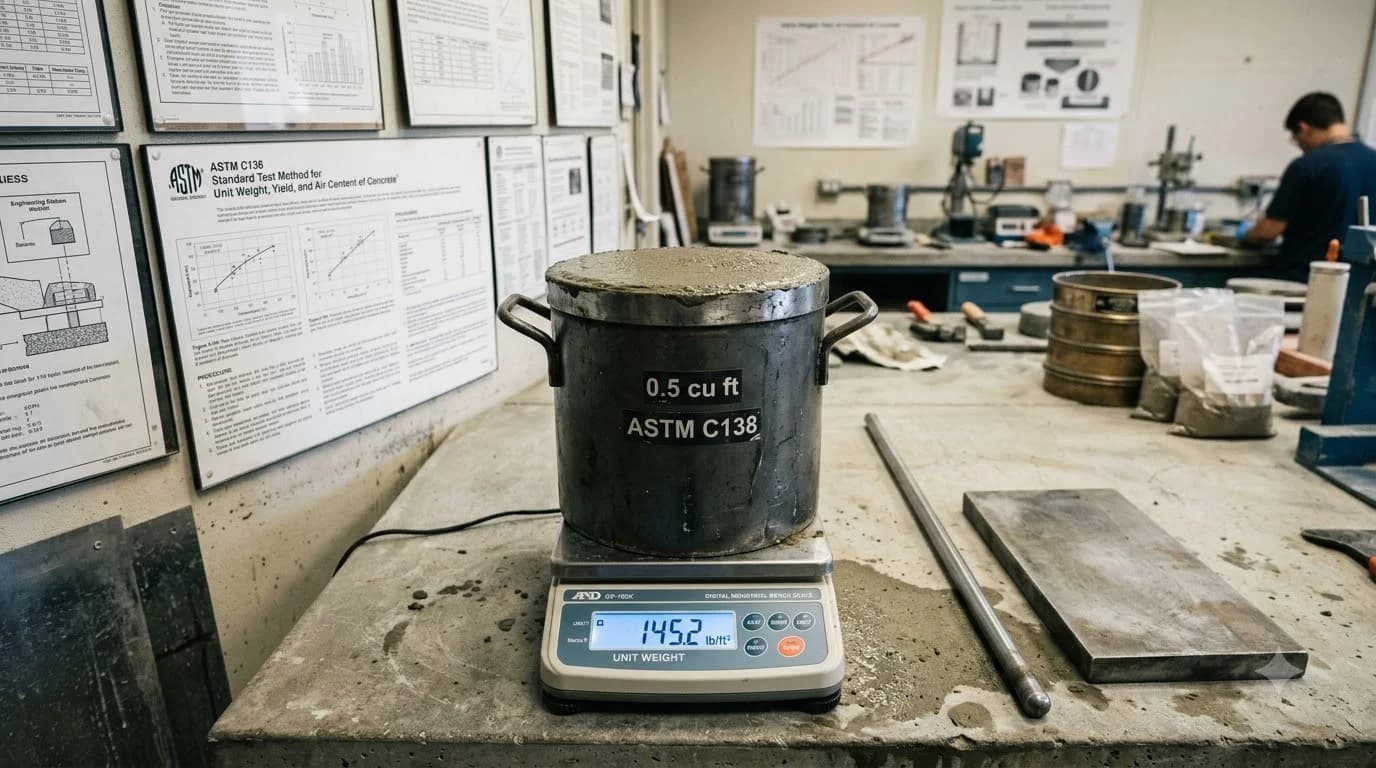
When potable water is added during batching, it activates the Portland cement grains (hydraulic hydration) and acts as a lubricant. The finer particles of cement and sand collapse into the interstitial voids between the coarse stone aggregate. Under ASTM C138 standard compaction, the wet, plastic mass consolidates down to a density of 140 to 145 pounds per cubic foot.
// Theoretical Yield Calculation
In-Place Density ≈ 133.3 lbs dry material per 1.00 cu ft consolidated wet concrete
80-lb Bag Yield = 80 lbs ÷ 133.3 lbs/cu ft = 0.600 cu ft
60-lb Bag Yield = 60 lbs ÷ 133.3 lbs/cu ft = 0.450 cu ft
50-lb Bag Yield = 50 lbs ÷ 133.3 lbs/cu ft = 0.375 cu ft
40-lb Bag Yield = 40 lbs ÷ 133.3 lbs/cu ft = 0.300 cu ft
2. Master Square Foot Coverage Matrix by Slab Thickness
To convert cubic feet into surface area coverage, divide the bag yield by the slab thickness in feet:
Square Footage = Bag Volume (cu ft) ÷ (Thickness in inches ÷ 12)
| Slab Thickness | Thickness (Ft) | 40-lb Bag (0.30 cu ft) | 50-lb Bag (0.375 cu ft) | 60-lb Bag (0.45 cu ft) | 80-lb Bag (0.60 cu ft) |
|---|---|---|---|---|---|
| 2 inches (Overlay/Resurfacing) | 0.167 ft | 1.80 sq ft | 2.25 sq ft | 2.70 sq ft | 3.60 sq ft |
| 3 inches (Light Walkway) | 0.250 ft | 1.20 sq ft | 1.50 sq ft | 1.80 sq ft | 2.40 sq ft |
| 3.5 inches (Actual 2×4 Lumber) | 0.292 ft | 1.03 sq ft | 1.29 sq ft | 1.54 sq ft | 2.06 sq ft |
| 4 inches (Nominal Standard Patio) | 0.333 ft | 0.90 sq ft | 1.13 sq ft | 1.35 sq ft | 1.80 sq ft |
| 5 inches (Heavy Vehicle/RV Pad) | 0.417 ft | 0.72 sq ft | 0.90 sq ft | 1.08 sq ft | 1.44 sq ft |
| 6 inches (Commercial Driveway) | 0.500 ft | 0.60 sq ft | 0.75 sq ft | 0.90 sq ft | 1.20 sq ft |
3. The 2×4 Lumber Formwork Reality Check (3.5″ vs 4.0″)
One of the most valuable secrets known to professional concrete finishers is the dimensional difference between nominal lumber and actual lumber.
DIY calculators assume your slab is exactly 4.00 inches deep (0.333 feet). For a 10×12 ft patio (120 sq ft), a 4-inch depth requires 40.0 cubic feet of concrete, which equals 67 bags of 80-lb mix.
Standard framing 2×4 lumber actually measures 1.5″ × 3.5″. When you screed concrete flush with the top of 2×4 form boards over a level gravel base, your slab is 3.5 inches deep (0.292 feet). That same 120 sq ft patio requires 35.0 cubic feet, or 59 bags.
Understanding this 0.5-inch difference saves you 8 heavy bags of concrete ($50+ in cash) and over 640 pounds of unnecessary mixing labor on a simple patio slab.
4. Step-by-Step Mathematical Calculation Guide
Follow this verified 4-step workflow to calculate bag requirements for any residential slab or footing:
// Step 1: Measure Dimensions in Feet
Length (ft) × Width (ft) = Square Footage
// Step 2: Convert Thickness from Inches to Feet
Thickness (ft) = Depth in inches ÷ 12
// Step 3: Compute Total Cubic Feet
Volume (cu ft) = Square Footage × Thickness (ft)
// Step 4: Divide by Bag Yield & Add 10% Waste
80-lb Bags = (Volume ÷ 0.60) × 1.10
60-lb Bags = (Volume ÷ 0.45) × 1.10
Example: 8' × 16' Walkway at 4 Inches Thick
- Surface Area: 8 ft × 16 ft = 128 sq ft
- Volume: 128 × (4 ÷ 12) = 128 × 0.333 = 42.67 cubic feet
- Base 80-lb Bags: 42.67 ÷ 0.60 = 71.1 bags
- Adding 10% Waste (Subgrade Dips & Spillage): 71.1 × 1.10 = 79 bags (80-lb)
- Or in 60-lb Bags: (42.67 ÷ 0.45) × 1.10 = 105 bags (60-lb)
5. Five Costly Bagged Concrete Yield Mistakes
Uncompacted gravel subbases compress under the weight of wet concrete, creating an effective slab depth of 4.25 to 4.5 inches instead of 4.0 inches. This subgrade compaction deficit consumes 8% to 12% more concrete volume than calculated on paper.
Adding extra gallons of water does make the slurry easier to spread and slightly increases liquid volume, but it causes severe aggregate segregation and bleeding. Once excess water evaporates, the paste shrinks dramatically, leaving weak 1,500 PSI concrete that spalls during winter freeze-thaw cycles.
Under-watering dry bagged concrete leaves large dry agglomerations and honeycomb air voids inside the slab. The concrete fails to achieve its designated 0.60 cu ft compacted density, resulting in porous, crumbling concrete with zero tensile strength.
Specialty products like lightweight structural concrete, non-shrink grouts, or polymer-modified repair mortars contain expanded shale or perlite. A 50-lb bag of lightweight concrete yields up to 0.50 cu ft, whereas standard gravel mix yields only 0.375 cu ft. Always verify the manufacturer's ASTM C387 yield statement on the bag.
Cured concrete buildup on the sides of mixing tubs and wheelbarrows robs 0.03 to 0.05 cu ft of volume from every subsequent batch, causing cumulative material shortages by the time you reach the end of the pour.
Need Exact Bag Takeoffs for Your Dimensions?
Enter your exact length, width, and depth to get instant bag counts, pallet counts, and 2026 costs.
Frequently Asked Questions
How many cubic feet does an 80-pound bag of concrete yield?
An 80-pound bag of premixed concrete yields exactly 0.60 cubic feet of wet, compacted concrete. It takes 45 bags of 80-lb concrete to equal 1 cubic yard (27 cubic feet).
How many square feet does an 80 lb bag cover at 4 inches thick?
An 80-lb bag covers exactly 1.80 square feet at a true 4-inch depth (0.60 cu ft ÷ 0.333 ft = 1.80 sq ft). If using 2x4 forms (which measure 3.5 inches actual depth), one 80-lb bag covers 2.06 square feet.
How many cubic feet in a 60 lb bag of concrete?
A 60-pound bag yields 0.45 cubic feet of consolidated concrete. It covers 1.35 square feet at 4 inches thick, and it requires 60 bags to yield 1 full cubic yard.
Why does adding water reduce the loose dry powder volume?
Dry unmixed concrete contains 30% to 35% interstitial air voids between sand and gravel aggregates. When water is added, it lubricates the particles, allowing Portland cement paste to fill the voids. This consolidates the overall loose bulk volume down by roughly 25% to reach the in-place ASTM C138 yield.
How many 80 lb bags do I need for a 10x10 slab at 4 inches?
A 10x10 foot slab is 100 square feet. At 4 inches depth (0.333 ft), the volume is 33.33 cubic feet (1.23 cubic yards). Dividing 33.33 by 0.60 cu ft gives 55.6 bags. Adding a 10% jobsite waste factor requires ordering 61 bags of 80-lb concrete.
Building Codes & Primary Standards Cited
Standard Test Method for Density (Unit Weight), Yield, and Air Content (Gravimetric) of Concrete
Defines the exact physical and mathematical laboratory formulas for determining in-place concrete yield and consolidation density.
Standard Specification for Packaged, Dry, Combined Materials for Mortar and Concrete
Standardizes volumetric yield tolerances and printed packaging guidelines for bagged concrete mixes.
Specifications for Concrete Construction - American Concrete Institute
Governs acceptable water-cement ratios, workability slump limits, and consolidation standards for structural slabs.
Estimations adhere to standard North American modular 3/8-inch mortar joint physics and 5% to 10% material waste factors. Local municipal building inspectors, stamped architectural blueprints, and local frost depth requirements supersede general reference guidelines.
Popular Quick Estimates
Pre-engineered takeoffs & benchmarks matched to this project
Related Calculators
Specialized tools for foundation, core fill, and budgeting
Installed cost per square foot and full budget forecast
Complete 4-wall structures, sheds and masonry workshops
Cell fill requirements for low-lift and high-lift grouting
Detached garage walls, vehicle doors and perimeter courses
Blogs & Construction Guides
Technical articles, IRC code standards, rebar schedules & freight logistics
Weight of Concrete per Cubic Foot: 2026 Density Specs
How Many Bags of Concrete in a Yard? (60 & 80 lb Guide)
How Much Does a Bag of Concrete Cost? (2026 Prices)