Quick Contractor Answer: Match Fastener Mechanics to Solid Poured vs Hollow Block Walls
For lightweight art (under 10 lbs), use hardwall pin hangers without drilling. For mirrors and shelves (15 to 50 lbs), use 1/4" Tapcon concrete screws in solid walls or plastic expansion plugs in mortar joints. For heavy TVs and garage storage cabinets (50 to 150+ lbs), install steel wedge anchors in solid poured concrete, or heavy-duty strap toggle bolts in hollow cinder block cores.
1. Substrate Identification: Solid Poured Concrete vs. Hollow CMU Block
Before selecting anchors, determine whether your masonry wall is solid or hollow:
- Solid Poured Concrete: Continuous, homogeneous aggregate and cement paste typically found in modern basement foundations, high-rise condos, and retaining walls. Supports all mechanical expansion anchors (wedge anchors, sleeve anchors, and self-tapping screws) under ASTM E488.
- Hollow Cinder Block (CMU): Modular concrete masonry units with 1-1/4 inch thick face shells and hollow interior air cells. Standard wedge anchors cannot be used here because the expanding collar punches through the face shell into the empty air cavity. Hollow CMU requires cavity fasteners like toggle bolts, sleeve anchors into webs, or nylon screen chemical anchors.
2. Hardware Selection & Weight Load Matrix
Select the appropriate anchor hardware based on object weight and substrate type:
| Hanging Application | Weight Class | Solid Concrete Fastener | Hollow Cinder Block Fastener | Carbide Bit Size |
|---|---|---|---|---|
| Small Framed Photos & Art | 1 – 8 lbs | Hardwall plastic pin hooks | Hardwall plastic pin hooks | No drill (Hammer only) |
| Medium Mirrors & Clocks | 10 – 30 lbs | 3/16" × 1-3/4" Tapcon screw | 1/4" Ribbed plastic anchor + screw | 5/32" or 1/4" Masonry bit |
| Floating Wood & Metal Shelves | 30 – 60 lbs | 1/4" × 2-3/4" Tapcon concrete screws | 1/4" Heavy-duty SnapToggle bolt | 3/16" or 1/2" bit (for toggle) |
| 55" – 85" Flat Screen TV Mounts | 50 – 100 lbs | Four 5/16" × 2-1/2" Tapcon or sleeve bolts | Four 3/8" SnapToggle channel bolts | 5/16" or 3/4" bit |
| Heavy Garage Storage Cabinets | 100 – 250+ lbs | 3/8" Steel wedge anchors (2.5" embed) | 1/2" Sleeve anchors into solid web | 3/8" or 1/2" Hammer bit |
3. Drilling Precision: ANSI B212.15 Tolerances & Hole Prep
A masonry anchor is only as strong as the hole it expands into. Follow these precision drilling rules:
- Use Matched ANSI Bits: Concrete screws like Tapcons have exact tolerance requirements. A 3/16" Tapcon requires a dedicated 5/32" bit, while a 1/4" Tapcon requires a 3/16" bit. Using standard fractional drill bits creates oversized or out-of-round holes that strip threads instantly.
- Depth Rule: Set the depth gauge on your rotary hammer to drill at least 1/4 to 1/2 inch deeper than the fastener embedment length. This provides empty relief space for residual pulverized silica dust so the anchor seats flush.
- The Blow-Brush-Blow Cleaning Rule: Concrete dust left in the hole acts as a dry lubricant. Blow out the hole with compressed air, scrub the interior sidewalls with a wire nylon bore brush, and vacuum clean under OSHA 1926.1153 standards.
4. Step-by-Step TV Mount Installation on Concrete
Mounting a large flat-screen TV to a concrete basement or apartment wall requires supporting both shear (downward weight) and tension (cantilever pull when the TV is extended on an articulating arm):
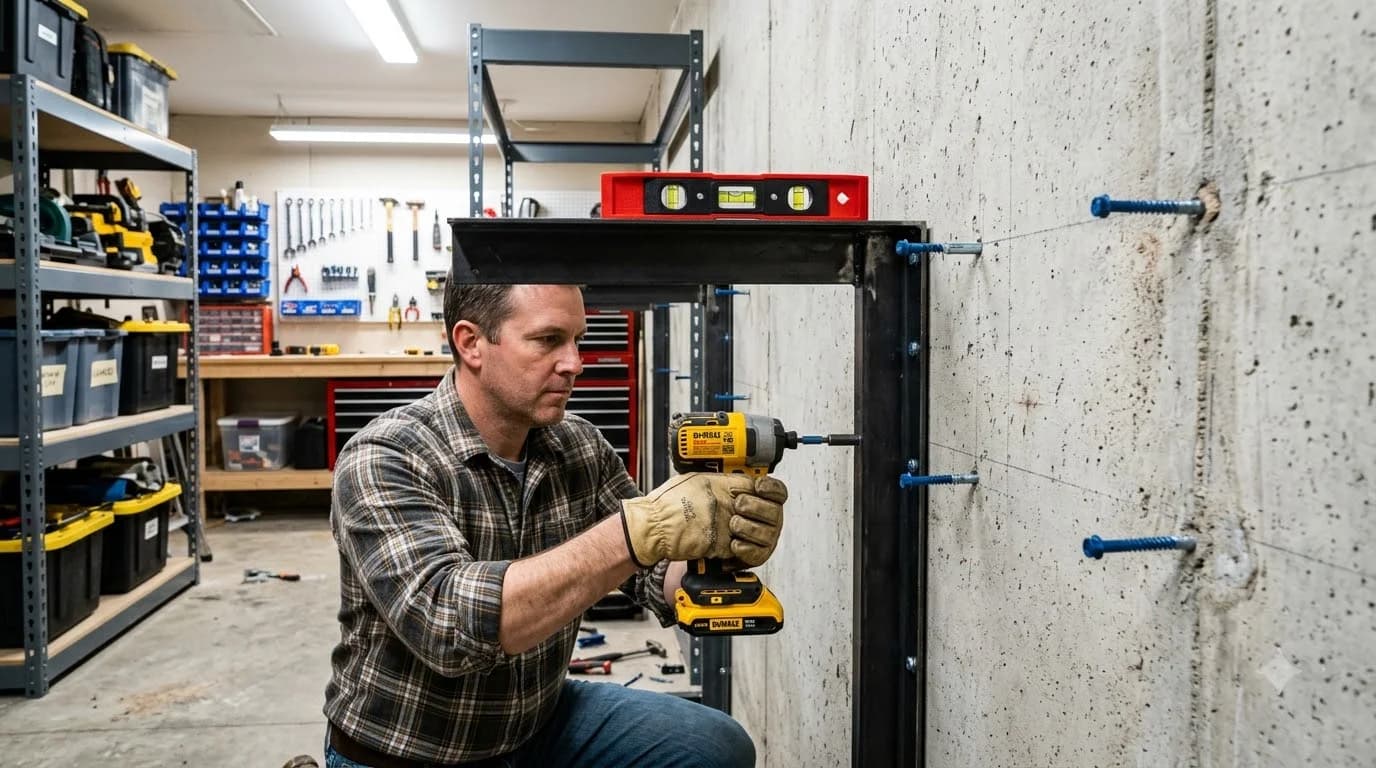
- Layout & Leveling: Hold the heavy steel TV mounting bracket against the concrete wall at viewing height. Use a torpedo level to ensure exact level alignment, and mark four corner mounting holes with a carpenter pencil.
- Drill Pilot Holes: Set an SDS-Plus rotary hammer drill to hammer mode. Drill 5/16" holes at least 3 inches deep into the solid concrete.
- Evacuate Dust: Vacuum all fine gray silica dust completely out of each hole.
- Drive Fasteners:Place heavy steel washers onto 5/16" × 2-1/2" hex-head concrete screws. Drive each screw through the bracket into the pilot holes using a socket wrench or clutch-controlled impact driver until snug against the plate.
- Stress Test: Pull firmly downward on the bracket with your full upper body weight before hanging the television. The bracket should feel as rigid as the wall itself.
5. Moisture & Vapor Barrier Protection in Basements
When drilling into below-grade exterior basement walls, puncture depth must be managed carefully:
Standard residential foundation walls are 8 to 10 inches thick. Drilling 1.5 to 2.5 inches deep for an anchor does not compromise structural integrity. However, if the home experiences high external groundwater tables, moisture vapor can migrate through anchor pilot holes. Squeeze a bead of 100% waterproof silicone sealant into the hole before inserting the screw to maintain a hermetic vapor barrier.
5 Critical Concrete Hanging Mistakes to Avoid
Using Wedge Anchors in Hollow Block
Wedge anchors require solid unyielding concrete. In hollow CMU blocks, tightening the nut punches the expander through the thin 1-1/4" face shell, destroying the block.
Using Rotary-Only Household Drills
Attempting to drill 3,500 PSI concrete without percussion hammer action burns the carbide cutting tip within 30 seconds and glazes the hole.
Over-Torquing Concrete Screws
Driving Tapcons with high-torque impact drivers can strip the concrete threads or shear the steel screw head clean off. Use a socket wrench or clutch driver.
Ignoring Cantilever Leverage on Shelves
A 12-inch deep floating shelf loaded with books exerts high outward tensile pull on the top anchor. Always use heavy-duty anchors rated for tension, not just shear.
Planning a Basement Remodel or Framing?
Calculate furring strip fasteners, wall block counts, mortar, and 2026 material costs.
Frequently Asked Questions
Can you hang pictures on concrete walls without drilling?
Yes, for frames under 5 lbs, use hardwall plastic picture hangers featuring 3 to 4 tiny tempered steel brad pins driven directly into the concrete with a hammer. Alternatively, heavy-duty outdoor mounting tape rated for masonry can hold lightweight canvas art.
Can you use plastic drywall anchors in concrete walls?
No. Self-drilling threaded drywall anchors will snap or strip out instantly against hard masonry. You must use dedicated ribbed conical masonry anchors, concrete screws (Tapcons), or steel wedge anchors drilled with a carbide hammer bit.
How do you mount heavy items to hollow cinder blocks?
In hollow CMU block walls, use heavy-duty steel strap toggle bolts (such as Toggler SnapToggles). The solid metal channel flips flat behind the 1-1/4 inch block face shell inside the hollow core cavity, distributing tension across a broad area.
What drill is required for concrete and cinder block walls?
An SDS-Plus rotary hammer drill or percussion hammer drill equipped with ANSI B212.15 carbide-tipped masonry bits is required. Standard rotary-only household drills will overheat and ruin bits in seconds.
Does drilling into basement concrete walls cause water leaks?
Drilling 1.5 to 2.5 inches into an 8-inch solid concrete basement foundation wall will not cause leaks under normal circumstances. However, if exterior hydrostatic pressure is high, inject 100% silicone sealant into the pilot hole before driving the screw to form a watertight seal.
Building Codes & Primary Standards Cited
Standard Test Methods for Strength of Anchors in Concrete Elements
Establishes standardized static tension and shear load limits for masonry anchors.
Cutting Tools - Carbide-Tipped Masonry Drills and Blanks
Defines dimensional tolerances required for proper mechanical expansion anchor fit.
Respirable Crystalline Silica Standard for Handheld Drills
Mandates dust extraction and HEPA vacuum engineering controls during concrete drilling.
Estimations adhere to standard North American modular 3/8-inch mortar joint physics and 5% to 10% material waste factors. Local municipal building inspectors, stamped architectural blueprints, and local frost depth requirements supersede general reference guidelines.
Popular Quick Estimates
Pre-engineered takeoffs & benchmarks matched to this project
Related Calculators
Specialized tools for foundation, core fill, and budgeting
Heavyweight structural blocks and bond beam units
Cubic yards, bags, and slab volume for flatwork and footings
Core grout volume in cubic yards and 80-lb pre-mix bags
Cell fill requirements for low-lift and high-lift grouting
Blogs & Construction Guides
Technical articles, IRC code standards, rebar schedules & freight logistics
When Can You Walk or Drive on Concrete? (Timeline)
How to Lay Tile on Concrete Slabs: Mortar & Prep
Can Mold Grow on Concrete? How to Kill Spores & Moss