1. The Science of Hydration: How Concrete Gains Strength Over Time
A common misconception among homeowners is that concrete "dries" to become hard. In reality, concrete does not harden by drying—it hardens through an exothermic chemical reaction called hydration, governed by American Concrete Institute guideline ACI 308R.
When Portland cement compounds (tricalcium silicate and dicalcium silicate) react with water molecules, they form calcium silicate hydrate (C-S-H) crystal needles. These microscopic interlocking crystals weave through sand and crushed stone aggregates, locking them into artificial stone. If concrete dries out prematurely before hydration is complete, crystallization stops permanently, leaving weak, dusty, friable concrete.
Under standard curing conditions (70°F / 21°C with adequate moisture), standard Type I/II Portland cement follows this exact compressive strength curve:
2. Master Concrete Loading Schedule & Activity Matrix
Refer to this contractor-verified loading schedule before allowing any people, pets, machinery, or vehicles onto newly placed concrete:
| Curing Time | % Design PSI | Permitted Activities | Strictly Prohibited |
|---|---|---|---|
| 0 to 12 Hours | 0% – 5% | None (Initial & final set phases) | All contact, footsteps, pets, rain exposure |
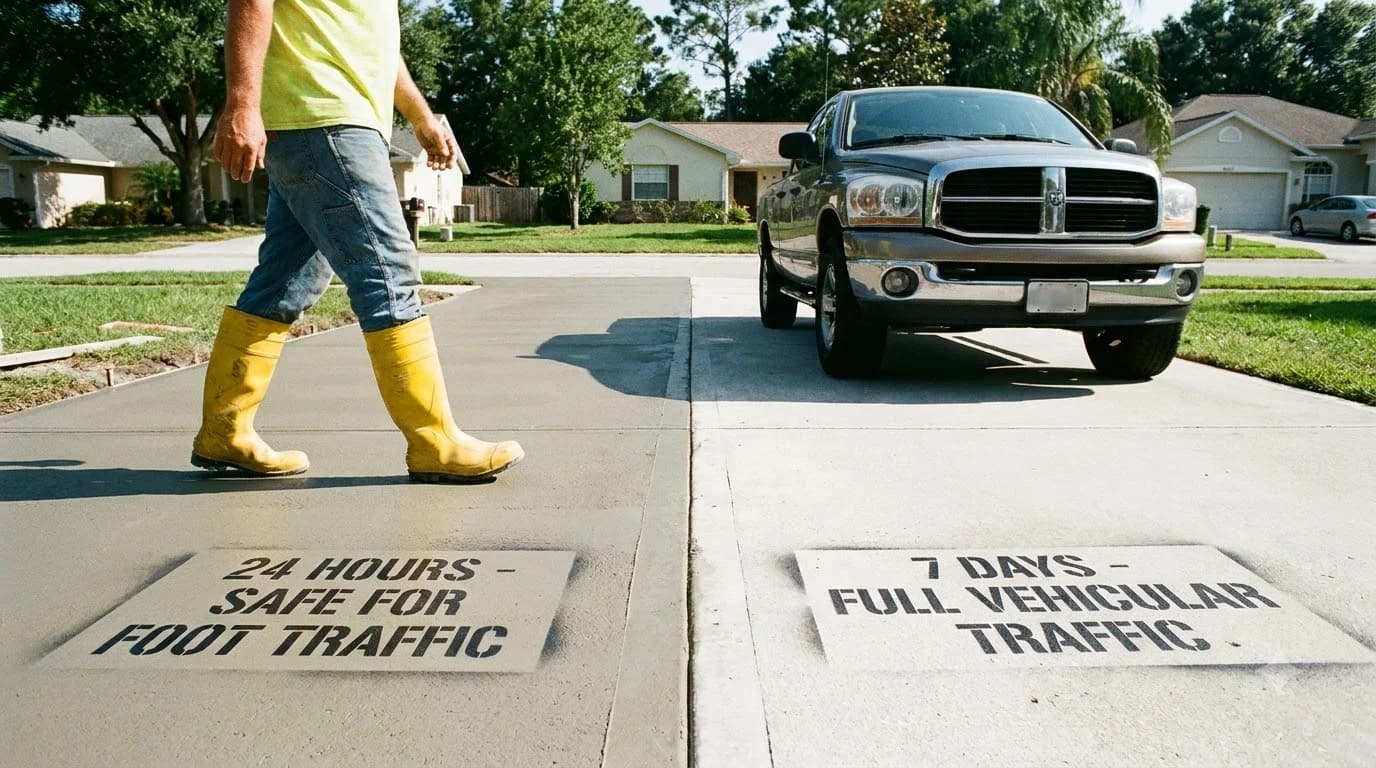
| 24 to 48 Hours | 15% – 25% | Light adult foot traffic, edge form stripping, control saw-cutting | Stilettos, twisting shoes, heavy tool drops, pets with claws |
| 3 to 5 Days | 35% – 50% | Heavy foot traffic, pushing push mowers, rubber-footed patio tables | Motorcycles, golf carts, riding mowers, trailers, vehicle tires |
| 7 Days (168 Hrs) | 65% – 75% | Sedans, crossover SUVs, 1/2-ton pickup trucks (up to 6,000 lbs curb weight) | Turning steering while stopped (dry steering), heavy delivery vans |
| 14 Days | 85% – 90% | 3/4-ton & 1-ton trucks (F-250/F-350), dual-axle boat trailers, skid steers | Concrete ready-mix trucks, tri-axle dump trucks, trash haulers |
| 28 Days (Full Spec) | 100% (3.5k-4.5k) | Full rated design loads, RVs, motorhomes, application of penetrating sealers | Overweight 30-ton commercial trucks on standard 4" slabs |
3. Climate & Temperature: How Weather Speeds Up or Halts Curing
The ASTM C1074 concrete maturity concept calculates real-world strength gain by factoring internal concrete temperature against curing elapsed time:
Hot Weather (85°F+ / 29°C+)
Higher temperatures accelerate hydration, providing rapid early strength. Concrete can often support light walking in 12 to 18 hours. However, rapid hydration without proper curing compound or misting causes excessive plastic shrinkage micro-cracking.
Ideal Range (65°F to 75°F)
Standard ACI benchmarks apply directly. Hydration proceeds at textbook velocity, producing the highest ultimate 28-day compressive durability and minimal tensile shrinkage stresses.
Cold Weather (Below 50°F / 10°C)
Hydration rate drops by over 50%. Concrete poured at 45°F may require 4 to 5 days before it is safe for foot traffic, and at least 14 to 21 days before any vehicle parking is permitted.
4. Five Costly Mistakes That Ruin Newly Poured Slabs
1. Turning Wheels While Stopped ("Dry Steering")
Power steering allows drivers to spin tires while stationary. On concrete less than 3 weeks old, the abrasive friction of grooved rubber tires grinds away the top 1/16-inch broom finish, leaving permanent discolored gouges and aggregate tear-out.
2. Driving Over Unsupported Outer Edges
A concrete slab relies on continuous subgrade support. If a car tire rolls within 3 inches of an unbackfilled edge, cantilever shear failure will snap off the corner or edge in a 45-degree diagonal fracture. Backfill edges with crushed stone before driving.
3. Permitting Heavy Commercial Delivery Vehicles
Allowing a 35,000-lb package delivery truck or a 45,000-lb garbage hauler onto a 4-inch residential driveway will crack the concrete regardless of age. Put up physical chains or cones across the apron to bar heavy trucks.
4. Parking Vehicles with Hot Tires Directly on Unsealed Paste
Tires heated from highway driving release chemical plasticizers. Placing hot tires on fresh concrete will cause chemical migration that permanently stains yellow-brown tire marks into the porous cement paste. Place corrugated cardboard beneath tires for the first month.
5. Homeowner & Contractor 7-Day Protection Checklist
Follow these proactive protection steps immediately following concrete placement:
- Day 0 to Day 3: Maintain continuous moisture. Apply an ASTM C309 membrane-forming curing compound, or water-cure with soaker hoses and poly sheeting. Keeping concrete damp increases ultimate flexural strength by over 50%.
- Install Physical Barricades: Bright yellow "Caution" barrier tape and orange safety cones at the driveway entrance prevent delivery couriers and turning delivery vehicles from driving onto the wet slab.
- Backfill Dirt or Gravel Shoulders: Before pulling passenger cars onto the driveway on Day 7, backfill and tamp topsoil or crushed gravel firmly against all exposed slab edges to eliminate unsupported edge shear risks.
- Wait 30 Days Before Applying Penetrating Silane/Siloxane Sealers: Concrete must release excess bleed water and reach 28-day hydration before breathable penetrating sealers (ASTM C309/C1315) can be applied to block winter deicing chemicals and road salts.
6. Modern In-Situ Testing: How Contractors Know It Is Safe
Commercial contractors and high-end residential builders no longer guess when concrete is ready for vehicles. Instead of relying solely on calendar days, modern jobsites utilize ASTM C1074 wireless maturity sensors (such as SmartRock or Giatec) embedded directly into the rebar cage prior to the pour.
Wireless Maturity Loggers
Sacrificial temperature probes log thermal data every 15 minutes and calculate real-time compressive strength in PSI via Bluetooth, confirming exact vehicle load readiness.
Rebound Hammer (ASTM C805)
A non-destructive Swiss rebound hammer tests surface hardness by measuring the rebound velocity of a spring-loaded mass against the slab to verify uniformity.
Field Cylinders (ASTM C31)
Standard 4x8 inch or 6x12 inch test cylinders cured alongside the driveway are crushed in a laboratory press at 7 and 28 days to verify structural compliance.
Frequently Asked Questions
Can my dog or pets walk on new concrete after 24 hours?
Yes, after 24 to 48 hours adult human footsteps and small dogs will not leave indentation footprints. However, large dog breeds with sharp unclipped claws can scratch the relatively soft micro-surface paste. For large energetic pets, keep them off the slab for at least 48 to 72 hours.
What happens if someone accidentally drives on concrete after only 3 days?
At 3 days, concrete has only attained roughly 35% to 45% of its 28-day compressive design strength. The tensile stress under heavy vehicle tire contact patches causes micro-fracturing along the bottom tensile zone of the slab. While cracks may not appear instantly, they will telegraph to the surface as unsightly spiderweb and longitudinal shear cracks within 6 to 12 months.
How does cold weather affect the driving timeline?
Hydration is an exothermic chemical reaction governed by temperature. When ambient temperatures average below 50°F (10°C), cement hydration slows dramatically; below 40°F (4°C), it virtually stops. If pouring in late autumn or winter without accelerators, extend the driving wait time from 7 days to a minimum of 10 to 14 days.
Can heavy delivery trucks or moving vans drive on my new concrete driveway after 28 days?
No. Standard residential driveways are 4 inches thick (unreinforced or light wire mesh) designed for passenger vehicles weighing up to 6,000 to 8,000 lbs. A fully loaded 3-axle concrete mixer (66,000 lbs), garbage truck (50,000 lbs), or commercial moving van will crack a 4-inch residential driveway regardless of whether it has cured for 28 days or 28 years. Keep commercial trucks on the public street.
Why shouldn't you turn car wheels while stationary on fresh concrete?
Known as 'dry steering,' turning power-steering tires while a vehicle is parked stationary exerts extreme localized torsional shear stress. On 7-to-14-day concrete where surface paste is still hardening, dry steering can grind away the broom finish, tear aggregate particles out of the surface, and leave permanent black tire rubber burns.
Building Codes & Primary Standards Cited
Guide to External Curing of Concrete
Establishes temperature, moisture duration, and strength-gain benchmarks for concrete placement.
Standard Test Method for Compressive Strength of Cylindrical Concrete Specimens
Standard testing protocol for 7-day, 14-day, and 28-day compressive break benchmarks.
Standard Practice for Estimating Concrete Strength by the Maturity Method
Governs time-temperature maturity tracking to determine in-situ load readiness.
Guide for the Design and Construction of Concrete Parking Lots
Outlines axle load distribution and slab edge protection requirements.
Estimations adhere to standard North American modular 3/8-inch mortar joint physics and 5% to 10% material waste factors. Local municipal building inspectors, stamped architectural blueprints, and local frost depth requirements supersede general reference guidelines.
Popular Quick Estimates
Pre-engineered takeoffs & benchmarks matched to this project
Related Calculators
Specialized tools for foundation, core fill, and budgeting
Heavyweight structural blocks and bond beam units
Cubic yards, bags, and slab volume for flatwork and footings
Core grout volume in cubic yards and 80-lb pre-mix bags
Cell fill requirements for low-lift and high-lift grouting
Blogs & Construction Guides
Technical articles, IRC code standards, rebar schedules & freight logistics

Asphalt vs Concrete: Cost, Lifespan & Driveway Guide
How to Lay Tile on Concrete Slabs: Mortar & Prep
Can Mold Grow on Concrete? How to Kill Spores & Moss