Quick Contractor Answer: Identify Fastener Type Before Attempting Extraction
Tapcon screws back out directly counter-clockwise with an impact driver. Wedge anchors cannot be pulled out; remove the nut, drive the stud deep into the slab with a 3-lb sledge, or cut it flush with a 4.5-inch angle grinder and patch over. Sleeve anchors can often be tapped inward to release tension before sliding the sleeve out with locking pliers.
1. Mechanical Anchor Physics: Why Concrete Anchors Resist Pullout
Concrete anchors are engineered under ASTM E488 (Standard Test Methods for Strength of Anchors in Concrete Elements) to develop immense tensile and shear resistance. When an expansion anchor is tightened, a tapered expander cone forces hardened steel collar wings outward into the concrete sidewalls, creating a localized compression zone exceeding 4,000 to 8,000 psi.
Attempting to pry out an expanded wedge anchor using a wrecking bar or automotive puller subjects the concrete around the fastener to extreme upward shear tension. Because concrete tensile strength is only roughly 10% of its compressive strength, the concrete will fail in a classic 45-degree shear cone, ripping away an unsightly 4-to-8-inch crater. Safe anchor removal requires defeating the mechanism or cutting the protruding steel flush.
2. Removal Strategy Matrix by Anchor Type
Examine the exposed head and threads of your fastener to determine the correct removal protocol:
| Fastener Category | Mechanical Locking Type | Reversible? | Best Removal Method | Required Tools |
|---|---|---|---|---|
| Tapcon / Concrete Screw | High-low thread engagement into masonry | Yes (Fully Reversible) | Back out counter-clockwise with high torque | 18V Impact driver, 5/16" or 1/4" hex bit |
| Wedge Anchor (Trubolt) | Permanent expanding split ring collar | No (Permanent) | Drive below grade OR cutoff flush & grind divot | 3-lb Hammer, angle grinder with 1/16" cutoff wheel |
| Sleeve Anchor (DynaBolt) | Tubular slotted steel casing | Partially Reversible | Back nut off, tap center stud down, pull sleeve | Wrench, pin punch, locking Vise-Grip pliers |
| Drop-In Anchor | Internal threaded sleeve with driven cone | Bolt comes out; body stays | Unscrew machine bolt; plug internal threads with epoxy | Hex socket or core drill if complete removal needed |
| Adhesive / Epoxy Rod | Chemical vinyl-ester or epoxy bond | No (Structural) | Cut flush OR heat threaded rod to 350°F with torch | Angle grinder, propane/MAPP torch, pipe wrench |
3. The Wedge Anchor Flush-Cut & Drive-Down Protocol
Wedge anchors are the most common fastener encountered when renovating commercial warehouses, removing post bases, or dismantling shelving. Follow this contractor procedure:
- Technique A: Drive Down Below Grade (Preferred for Solid Slabs): Remove the retaining nut and washer. If the original installer drilled the pilot hole deeper than the anchor length (standard commercial practice), strike the top of the threaded stud with a 3-lb drilling hammer. Driving the anchor downward forces the cone out of the expansion ring, allowing the entire stud to slide 1/2 to 1 inch below the floor line. You can then fill the opening directly.
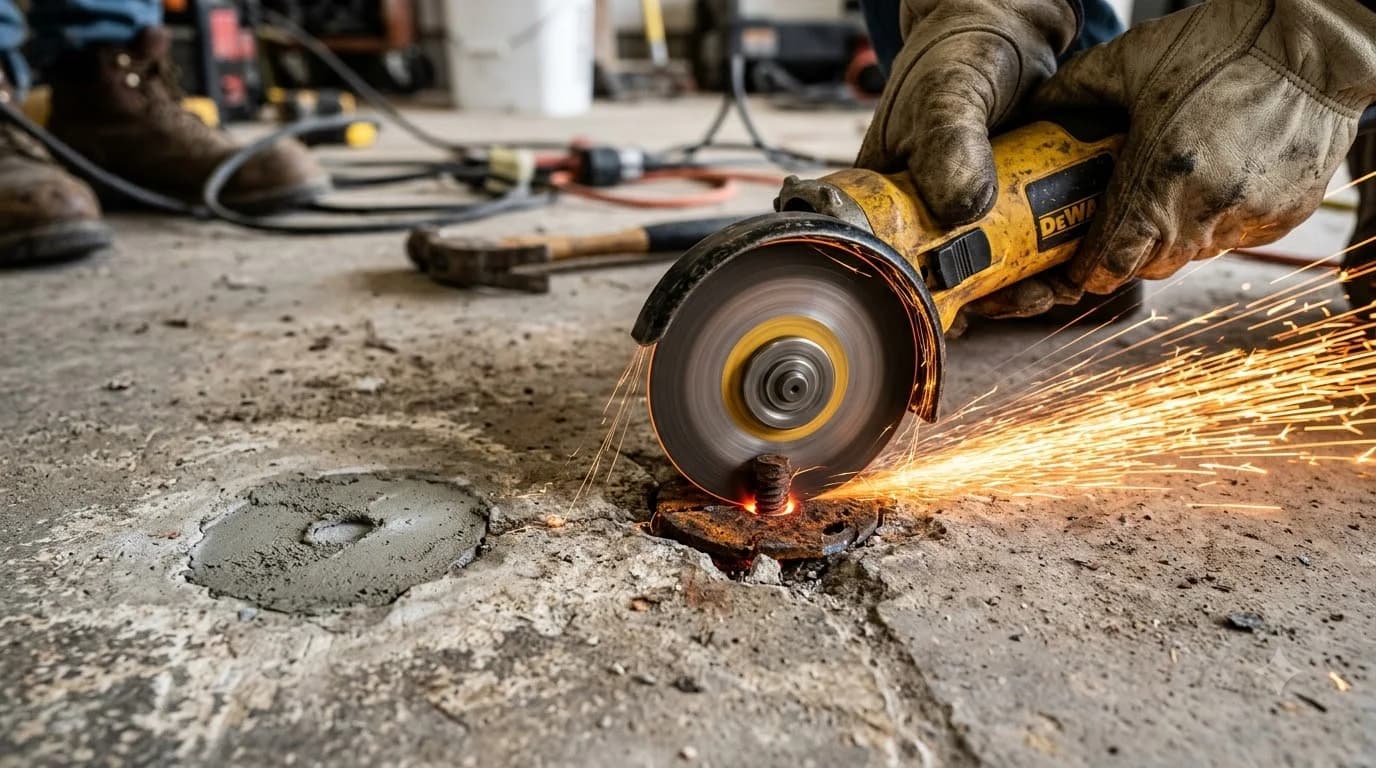
- Technique B: Flush Cutting with Angle Grinder: If the hole bottomed out and the stud will not budge, equip a 4.5-inch angle grinder with a thin (1/16-inch or 0.045-inch) metal cutoff wheel. Place the wheel flat against the concrete surface and slice through the steel stud. Wear safety glasses and a face shield under OSHA 1926.300.
- Technique C: Countersinking the Stub: After slicing the stud flush, switch to a zirconia grinding wheel or masonry grinding cup. Grind the steel stub 1/8 inch below the concrete plane to create a shallow divot. This prevents rust from bleeding through future flooring or paint.
4. Extracting Sheared, Rusted, and Stripped Fasteners
When a Tapcon screw or anchor bolt head snaps off flush with the surface, standard extraction tools often fail because the fasteners are made of case-hardened steel:
- Cobalt Bit Drilling: Standard high-speed steel (HSS) drill bits will immediately dull against hardened Tapcons. Use a heavy-duty cobalt (M42) or solid carbide drill bit running at low RPM with cutting lubricant to drill into the shank center, followed by a reverse spiral screw extractor (Easy-Out).
- Core Drilling Extraction: For critical structural repairs where all foreign metal must be removed (such as heavy machinery re-anchoring), mount a diamond wet core bit (1.5" to 2" diameter) onto a rotary hammer. Core drill around the embedded anchor, snap out the concrete cylinder containing the anchor, and patch the opening with high-strength epoxy grout.
5. Structural Hole Patching & Surface Blending
Leaving an open anchor hole allows water penetration, freeze-thaw spalling, and trip hazards. Follow this three-step repair process:
- Dust Evacuation: Concrete dust acts as a bond breaker. Blow out the hole using compressed air and a HEPA-filtered vacuum complying with OSHA 1926.1153 silica regulations. Use a wire bore brush to scrub the internal walls.
- Material Selection: For small indoor holes, use a two-part structural epoxy repair gel. For exterior driveways or industrial floors, use ASTM C1107 non-shrink hydraulic cement or rapid-setting polymer-modified repair mortar.
- Placement & Troweling: Pack the mortar firmly into the bottom of the void using a wooden dowel or rod to eliminate air pockets. Overfill slightly, allow to take an initial set for 10 minutes, and slice flush with a steel margin trowel.
5 Costly Anchor Removal Mistakes to Avoid
Prying Anchors with a Crowbar
Attempting to pry out an expanded wedge anchor tears a 4-to-8-inch conical blowout out of the slab, destroying the surrounding concrete strength and multiplying repair costs tenfold.
Leaving Metal Flush Without Countersinking
Cutting an anchor flush without grinding a 1/8-inch divot leaves raw exposed steel. Moisture in the air will cause rust blooms that discolor finished flooring or bubble epoxy topcoats.
Drilling with High Speed and Dry Bits
Attempting to drill out hardened steel anchors at high speed burns the cutting temper of your drill bit in seconds. Always use low RPM, high feed pressure, and cutting oil.
Failing to Vacuum Pulverized Concrete Dust
Packing patch mortar over fine silica drilling dust prevents adhesion. The patch will pop loose like a dry cork when driven over or exposed to winter freeze-thaw cycles.
Planning a Concrete Repair or Installation?
Calculate concrete patch volumes, slab replacement materials, and 2026 pricing in seconds.
Frequently Asked Questions
How do you remove a stripped Tapcon screw?
If the hex head strips, clamp locking Vise-Grip pliers tightly onto the screw head and turn counter-clockwise. If the head shears off flush, drill through the hardened shank with a cobalt drill bit or core-drill around it.
Can you reuse concrete wedge anchors?
No. Wedge anchors are strictly single-use fasteners. Once the expansion collar has flared against the concrete sidewall under ASTM E488 testing, it cannot be safely reset without compromising pullout holding capacity.
How do you fill the hole left by a removed anchor?
Vacuum all pulverized dust out of the hole using an OSHA-compliant HEPA filter, mist with water, and pack with non-shrink hydraulic cement or structural epoxy mortar, smoothing flush with a margin trowel.
Can you pull out a wedge anchor with a pry bar?
Never use a pry bar or claw hammer on an expanded wedge anchor. Prying will spall out a massive cone of surrounding concrete, leaving an unsightly 4 to 8-inch crater that ruins structural slab integrity.
How do you remove chemical or epoxy-bonded threaded studs?
Chemical epoxy anchors cannot be backed out mechanically. Use an angle grinder with a diamond or abrasive cutoff wheel to cut the threaded rod flush, or heat the stud with a propane torch above 300°F to soften the epoxy if extraction is essential.
Building Codes & Primary Standards Cited
Standard Test Methods for Strength of Anchors in Concrete Elements
Defines static and dynamic tension and shear test standards for mechanical concrete anchors.
Standard Specification for Packaged Dry, Hydraulic-Cement Grout (Nonshrink)
Establishes performance requirements for patching materials used in anchor hole restoration.
Respirable Crystalline Silica Standard for Construction
Regulates dust extraction and engineering controls during concrete drilling and grinding.
Estimations adhere to standard North American modular 3/8-inch mortar joint physics and 5% to 10% material waste factors. Local municipal building inspectors, stamped architectural blueprints, and local frost depth requirements supersede general reference guidelines.
Popular Quick Estimates
Pre-engineered takeoffs & benchmarks matched to this project
Related Calculators
Specialized tools for foundation, core fill, and budgeting
Heavyweight structural blocks and bond beam units
Cubic yards, bags, and slab volume for flatwork and footings
Core grout volume in cubic yards and 80-lb pre-mix bags
Cell fill requirements for low-lift and high-lift grouting
Blogs & Construction Guides
Technical articles, IRC code standards, rebar schedules & freight logistics
How Much Does Concrete Removal Cost? (2026 Price Guide)
How to Mix Concrete by Hand: Wheelbarrow Water Ratio
How to Calculate Concrete Yards: Step-by-Step Math