Pallet Ground Bearing Pressure Calculator
Calculate contact stress (psf and psi) beneath CMU pallets, evaluate concrete driveway punching shear hazards, and size plywood dunnage spreaders.
CinderCalc
Masonry Pallet Ground Bearing Pressure & Staging Report
cinderblockscalculator.com • Engineering Planning Document
Date: 10/30/2026
Surface: 4" Residential Concrete Driveway (3,500 psi)
Dunnage: 3/4" CDX Plywood (4×8)
1. Masonry Pallet Specifications
| Item Description | Unit Weight | Quantity | Gross Subtotal |
|---|---|---|---|
| Concrete Masonry Units (CMU) | 38 lbs | 108 Units | 4,104 lbs |
| GMA Wooden Pallet Tare Allowance | ~50 lbs | 1 Pallet(s) | 50 lbs |
| Total Staged Weight: | 4,154 lbs (2.08 US Tons) | ||
2. Ground Contact Stress & Dunnage Distribution
| Bearing Interface | Contact Area | Bearing Pressure (psf) | Contact Stress (psi) |
|---|---|---|---|
| 3 Bottom Runner Boards (No Dunnage) | 3.50 sq ft | 1,187 psf | 8.24 psi |
| Standard 4'×8' Sheet 3/4" CDX Plywood | 32.00 sq ft | 130 psf | 0.9 psi |
| 3/4" CDX Plywood (4×8) (Selected) | 32.00 sq ft | 130 psf | 0.9 psi |
3. Site Staging & Slab Safety Directives
- Plywood Cushioning: Always place a clean 4'×8' sheet of 3/4" CDX plywood directly under the pallet prior to forklift touchdown. This drops contact stress from 1187 psf to 130 psf (89% reduction).
- Edge Distance Rule: Maintain a strict minimum distance of 24 inches between pallet edges and concrete slab perimeter borders or un-doweled saw-cut control joints.
- Forklift Warning: Truck-mounted delivery forklifts (Moffett) weigh 6,000–8,000 lbs. Never allow forklift front wheels onto residential driveways without continuous timber tracks.
- Stacking Prohibition: Never double-stack CMU pallets on residential concrete or asphalt driveways; double-stacking generates 2374 psf of direct runner pressure.
The Engineering Physics of Pallet Ground Contact Stress
Why a 2-ton pallet creates devastating concentrated point loads on concrete flatwork when dropped without dunnage.
3 Bottom Runner Concentration (3.50 sq ft)
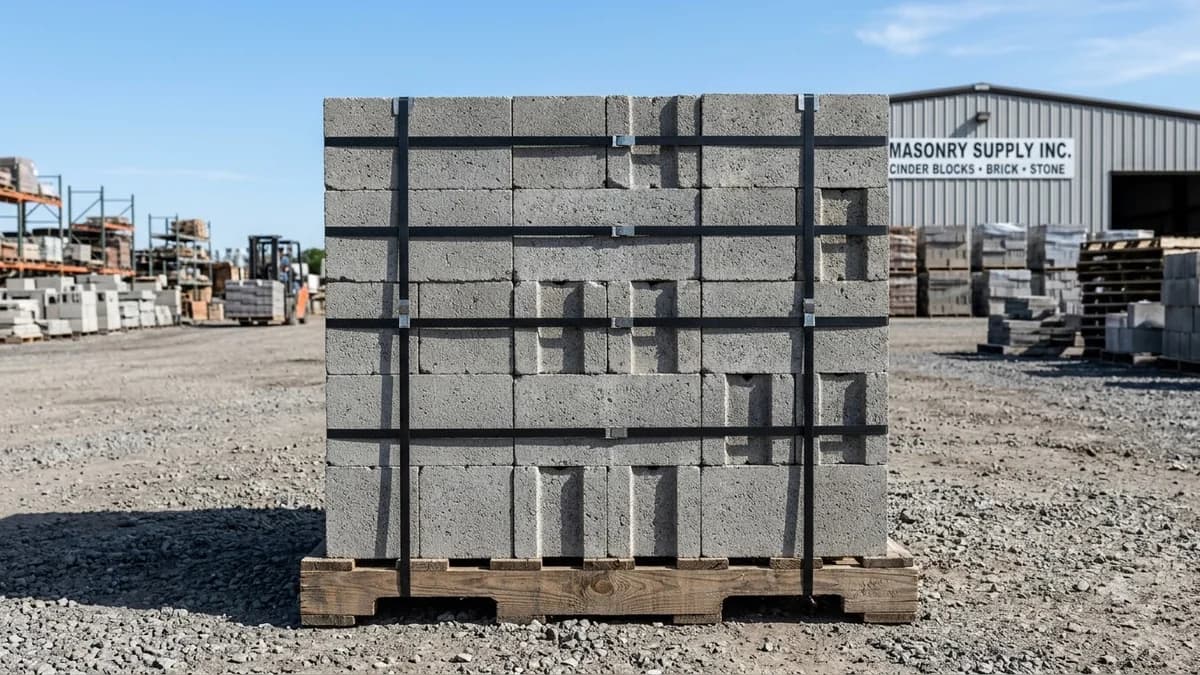
A standard industrial GMA wooden pallet measures 48 inches by 40 inches. However, the pallet does not rest flat across its 13.3 sq ft perimeter. All vertical payload weight transfers solely through three bottom wooden runner boards (stringers), each measuring approximately 3.5 inches wide by 48 inches long.
This 1,187 psf contact pressure acts as a sharp static knife edge, driving directly into concrete driveways, pavers, or subsoil.
3/4" CDX Plywood Spreader Distribution (32.0 sq ft)
Placing a full 4-foot by 8-foot sheet of 3/4-inch CDX exterior plywood underneath the pallet transforms the load from three isolated line loads into a broad, uniformly distributed slab contact area covering 32.0 square feet.
By lowering contact stress below 130 psf, the load is rendered completely harmless to cured residential concrete, compacted subgrades, and asphalt.
Concrete Driveway Failure Modes Under Heavy Pallet Staging
Residential concrete driveways are designed for rolling passenger vehicle tires, not static multi-ton masonry pallets.
Punching Shear & Core Cracking
Unreinforced 4-inch residential slabs lack tension stirrups. When an 1,180+ psf point load rests over an uncompacted subgrade void, the concrete shears around the pallet runners in a 45-degree cone punch-through crack.
Cantilever Edge Fracture
Driveway perimeter borders have no structural confinement. Setting a 4,100-lb pallet within 24 inches of a slab border turns the slab edge into an unsupported cantilever beam, snapping off large corner triangles.
Control Joint Spalling
Contraction joints are intentionally weakened plane cuts designed to control shrinkage cracks. Pallet runner point loads bridging an un-doweled control joint cause differential settlement and crushed edge spalls.
Soil & Subgrade Bearing Capacity (IBC Table 1806.2)
Presumptive load-bearing capacities for subgrade materials and staging surfaces under the International Building Code.
| Subgrade / Surface Material | Allowable Capacity | Direct Runner Status | With 3/4" CDX Plywood |
|---|---|---|---|
| Crushed Stone Base / Dense Aggregate (#57 / Roadbase) | 3,000 – 5,000 psf | Stable (1,187 psf) | 130 psf • 100% Safe |
| 4" Residential Concrete Driveway (3,500 psi Slab) | 1,000 – 1,500 psf | High Crack Risk | 130 psf • 100% Safe |
| Firm Natural Soil / Dense Sand / Stiff Clay Subgrade | 1,500 – 2,000 psf | Marginal Limit | 130 psf • 100% Safe |
| Residential Asphalt Driveway (2"–3" Hot Mix) | 800 – 1,000 psf | Severe Rutting | 130 psf • 100% Safe |
| Yard Lawn / Turf / Soft Uncompacted Topsoil | 500 – 800 psf | Stack Tip Hazard | 130 psf • Dry Turf Only |
Dunnage Material Selection: Plywood vs OSB vs Timber Sleepers
How different jobsite spreader boards perform under 4,100 lbs of static compressive loading.
3/4" CDX Plywood (Best)
Exterior-grade cross-laminated veneer provides maximum cross-grain shear modulus and flexural rigidity. It bridges minor slab imperfections without snapping and uniformly distributes 4,154 lbs over 32 square feet.
1/2" OSB Sheathing (Caution)
Oriented strand board lacks the flexural stiffness of CDX plywood. Under 4,100 lbs, 1/2-inch OSB bends severely along the runner lines, concentrating weight along the runner footprint and offering minimal actual stress dispersal.
2×10 Dimensional Lumber
Two 6-foot Douglas Fir or SYP 2×10 planks placed perpendicular underneath the pallet runners provide 10 sq ft of solid wood bearing area. Excellent on hard gravel or asphalt when full 4×8 plywood sheets are unavailable.
Moffett Forklift Delivery Wheel Point Loads
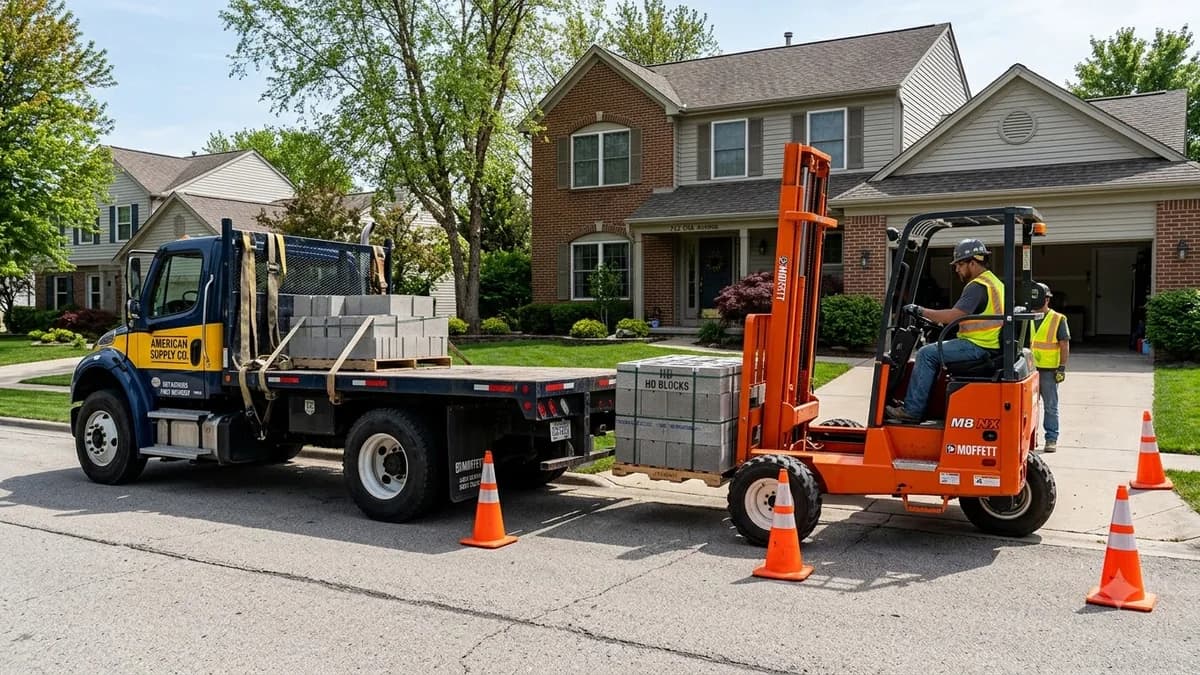
Homeowners often mistakenly assume that the pallet itself caused a driveway crack, when the damage was actually inflicted minutes earlier by the truck-mounted delivery forklift (Moffett, Princeton, or Manitou unit).
Driving a loaded Moffett onto a residential concrete driveway or sidewalk curb routinely exceeds the shear capacity of the slab, instantly snapping corners. Instruct suppliers to drop pallets directly at the street apron or lay continuous double-layer plywood tracks.
6-Step Safe Pallet Staging Protocol for Jobsite Deliveries
Follow this contractor checklist before your masonry delivery flatbed arrives on site.
Inspect Delivery Drop Zone for Slab Cracks & Utility Boxes
Walk the staging area to identify existing hairline cracks, buried irrigation lines, septic tanks, and water meter boxes. Mark high-risk subsurface utility corridors with bright spray chalk.
Lay Down Continuous 3/4-Inch CDX Plywood Dunnage
Position a clean 4×8 sheet of 3/4-inch CDX plywood flat on the surface before the forklift approaches. Sweep away loose gravel under the plywood to prevent concentrated rock puncture points.
Position Pallets Minimum 24 Inches from Slab Edges & Joints
Direct the forklift driver to place pallets centered within slab panels, keeping a strict 2-foot buffer from unreinforced slab edges, curb transitions, and saw-cut contraction joints.
Prohibit Stacking Pallets More Than 1 Tier High on Driveways
Never allow delivery drivers or crew to double-stack CMU pallets on residential flatwork. Double-stacking generates 2,374 psf of direct runner pressure and severe stack tip-over hazards.
Verify Weather & Subgrade Saturation Prior to Turf Staging
If pallets must be staged on a lawn or bare soil, verify moisture depth. Saturated topsoil has a bearing capacity under 500 psf; pallet runners will sink overnight, toppling the block stack.
Secure Pallet Plastic Wraps to Prevent Water Weight Infiltration
Cinder blocks are porous and absorb up to 15% moisture by weight during heavy rains. An unshielded 108-block pallet can absorb an additional 600 lbs of water weight, increasing ground bearing pressure.
Material estimates depend on the selected dimensions, product yields, and waste allowance.
Pallet Ground Bearing & Slab Load FAQ
Authoritative answers regarding pallet runner contact stress, driveway punching shear, dunnage sizing, and site delivery rules.
Popular Quick Estimates
Illustrative takeoffs with stated assumptions; verify project quantities
1000 Sq Ft Sizing
High-volume logistics & bulk pallet freight
Standard CMU Weight
Illustrative hollow-unit range; check supplier specs
Block Filler Gallons
Illustrative coverage; use the selected coating label
Interlocking Paver Sand
Enter area and bedding depth; verify product coverage
Related Calculators
Specialized tools for foundation, core fill, and budgeting
Dry block weight, filled core weight and hauling loads
CMU blocks, core grout, 4x rebar, tie hoops, and pad footings for columns & piers
Modular CMU courses, stepped footings, 12-inch overlaps and rebar Z-splices
Subgrade walls, soil retention, waterproofing and grout
Blogs & Construction Guides
Practical guides to block sizing, material estimates and project planning
Cinder Block Pallet Weight & Safe Truck Hauling Limits
How Much Does a Pallet of Concrete Weigh? (~3,360 lbs)
How Many Bags of Concrete on a Pallet? (Full Spec)