Quick Contractor Answer: Match Fastener Mechanics to Load Class and Base Material
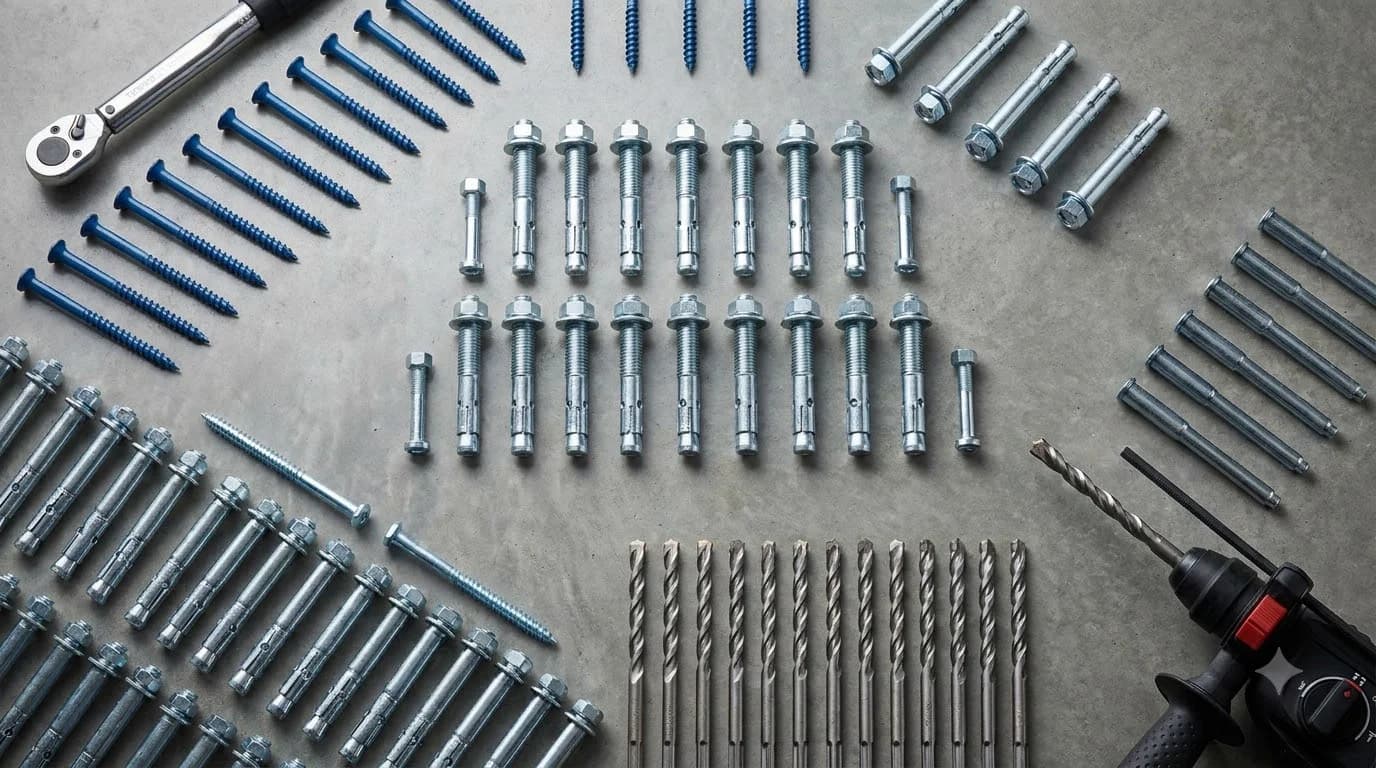
For light-to-medium loads (under 500 lbs) like furring strips and conduit, use Tapcon screws (drilled with dedicated 5/32" or 3/16" bits). For heavy structural attachments (posts, ledger boards, machinery over 1,500 lbs), use solid steel wedge anchors in poured concrete. For hollow cinder block, use sleeve anchors or toggle bolts. Always clean holes with a wire brush and vacuum before driving fasteners.
1. Four Primary Concrete Fastening Systems Explained
Securing objects to solid masonry requires overcoming the non-elastic, brittle nature of concrete. Fasteners fall into four engineering classes:
- Self-Tapping Concrete Screws (Tapcon / LDT): Case-hardened steel screws featuring alternating high-low threads. As the screw is driven into a precisely sized pilot hole, the high threads cut into the concrete paste and aggregate, creating an interlocking mechanical friction bond. They are easily removable and leave no protruding studs.
- Wedge Anchors (Trubolt / Kwik Bolt): Composed of a solid threaded steel stud with an inverted cone base wrapped in an expansion collar clip. As the nut is torqued, the cone pulls upward, expanding the steel collar radially against the concrete hole walls. They offer the highest pullout resistance in solid concrete under ASTM E488.
- Sleeve Anchors: Feature an external split steel sleeve that spans the entire shank. Tightening the bolt pulls a conical expander into the sleeve, flaring it along its full length. Ideal for soft concrete, brick, and hollow cinder block.
- Chemical Adhesive Anchors (Epoxy / Acrylic): A threaded rod or rebar placed into a hole filled with two-part structural epoxy resin. It creates zero expansion bursting stress, making it the premier choice for narrow edges and seismic zones under ACI 318 Chapter 17.
2. Anchor Capacity, Drill Bit & Embedment Matrix
Allowable design loads (using a 4:1 safety factor) in standard 3,500 to 4,000 PSI normal-weight concrete:
| Anchor Type & Size | Exact Carbide Bit Size | Min. Embedment Depth | Allowable Tension (Pullout) | Allowable Shear Load |
|---|---|---|---|---|
| 3/16" × 1-3/4" Tapcon Screw | 5/32" ANSI Carbide Bit | 1-1/4 inches | 350 lbs | 480 lbs |
| 1/4" × 2-3/4" Tapcon Screw | 3/16" ANSI Carbide Bit | 1-1/2 inches | 620 lbs | 910 lbs |
| 3/8" × 3" Wedge Anchor | 3/8" Rotary Hammer Bit | 2-1/2 inches | 1,820 lbs | 2,450 lbs |
| 1/2" × 4-1/4" Wedge Anchor | 1/2" Rotary Hammer Bit | 3-1/4 inches | 3,450 lbs | 4,300 lbs |
| 1/2" × 3" Heavy Sleeve Anchor | 1/2" Rotary Hammer Bit | 2-1/2 inches | 2,100 lbs | 2,850 lbs |
| 1/2" Epoxy Threaded Rod (B7) | 9/16" Rotary Hammer Bit | 4-1/2 inches | 6,200+ lbs | 5,800 lbs |
3. Engineering Geometry: Edge Distances & Anchor Spacing
When mechanical anchors expand, they generate intense internal radial bursting stresses in a conical shape known as the concrete breakout prism. According to ACI 318 Chapter 17 and ICC-ES AC193:
The 5d Critical Edge Rule
Always maintain a minimum edge distance equal to at least 5 anchor diameters (or manufacturer minimum). For a 1/2-inch wedge anchor, keep the hole at least 2.5 to 3 inches away from any slab edge. Drilling too close causes the edge of the concrete to blow out during nut torquing.
The 10d Minimum Spacing Rule
Separate adjacent mechanical anchors by at least 10 anchor diameters (e.g., 5 inches apart for 1/2-inch anchors). Placing anchors closer together causes their internal stress cones to overlap, reducing combined tensile pullout holding power by up to 40%.
4. Step-by-Step Installation Protocol
Follow this professional procedure to ensure maximum load capacity:
- Use an SDS-Plus Rotary Hammer: Drill using a matched ANSI carbide-tipped bit. Set the depth gauge on the tool so the hole is 1/4 to 1/2 inch deeper than the fastener embedment length.
- Execute the Blow-Brush-Blow Cleaning Routine: Under OSHA 1926.1153 silica safety standards, concrete dust left in the hole lubricates the walls and reduces pullout capacity by 50%. Use a compressed air bulb or vacuum to blow out the hole, scrub the sidewalls with a wire nylon bore brush, and vacuum a final time.
- Installing Tapcon Screws: Drive the screw with a clutch-controlled drill or light impact driver until snug against the fixture. Do not over-torque; spinning the screw once seated strips the concrete threads permanently.
- Installing Wedge Anchors: Assemble the washer and nut so the nut sits flush with the top of the threaded stud (protecting threads). Tap the anchor through the fixture into the hole with a hammer until the washer is flat. Tighten the nut with a calibrated torque wrench (typically 25 to 30 ft-lbs for 3/8", 50 to 55 ft-lbs for 1/2").
5. Solid Concrete vs. Hollow Cinder Block (CMU)
Fastening into hollow cinder blocks requires completely different hardware than solid poured slabs:
- Never Use Wedge Anchors in Hollow CMU: The face shell of an 8-inch CMU block is only 1-1/4 inches thick. The high bursting pressure of a wedge anchor will punch through the hollow core, blowing out the face shell.
- Hollow Block Solutions: For light loads, use 1/4" Tapcon screws driven with rotary-only drills (hammer action can shatter the hollow shell). For medium loads, use sleeve anchors or 1/4" toggle bolts. For heavy structural brackets, inject two-part acrylic epoxy into a fine nylon mesh screen tube that expands into the hollow cell to form a solid plug.
5 Critical Concrete Fastening Mistakes to Avoid
Using Standard Wood Bits or Drills
Attempting to drill concrete with a standard drill and metal bit burns the steel in seconds. Always use an SDS-Plus rotary hammer and ANSI-certified carbide masonry bits.
Skipping Hole Dust Cleaning
Compacted silica powder at the bottom of the hole stops anchors from reaching design embedment depth. Dust also acts as a dry lubricant, cutting pullout holding capacity in half.
Over-Torquing Tapcons with Heavy Impact Guns
High-torque 18V impact drivers easily shear the heads of 3/16" Tapcons or strip the newly cut concrete threads. Use a standard drill driver with a mechanical slip-clutch set to medium.
Violating the 5d Edge Distance Rule
Setting a 1/2-inch wedge anchor within 1 inch of a slab edge will cause the entire concrete corner to crack and shear off when the nut is torqued.
Need Exact Materials For Your Project?
Get an instant takeoff with bags, ready-mix yards, sand, and 2026 pricing.
Frequently Asked Questions
Why do Tapcon concrete screws strip out?
Tapcons strip out when the pilot hole is drilled with a standard worn bit instead of a precision matched carbide bit, when dust is left inside the hole preventing full thread engagement, or when an impact driver overtightens the screw beyond its 10-15 ft-lb torque threshold.
Can wedge anchors be used in hollow cinder block?
No. Wedge anchors require solid unyielding concrete to expand their hardened steel collar. In hollow CMU block cells, the radial expansion forces crack the thin 1-1/4 inch face shell. Use sleeve anchors, toggle bolts, or chemical screen tubes for hollow block.
How deep should a concrete anchor hole be drilled?
Always drill the hole at least 1/4 inch (and preferably 1/2 inch) deeper than the required anchor embedment depth. This provides empty relief space for residual pulverization dust so the anchor does not bottom out prematurely.
What is the difference between wedge anchors and sleeve anchors?
Wedge anchors feature a small expanding collar at the tip and only work in solid poured concrete, delivering the highest tensile pullout strength. Sleeve anchors feature an expandable steel sleeve running the entire shank length, allowing them to bridge voids in mortar, brick, and hollow block.
Do I need a hammer drill to install concrete screws?
Yes. An SDS-Plus rotary hammer or percussion hammer drill is required to pulverize hard aggregate. Standard rotary-only drills will overheat, dull carbide bits, and glaze the hole walls, resulting in undersized holes that snap screws.
Building Codes & Primary Standards Cited
Anchoring to Concrete Design Provisions
Governs concrete breakout strength, pullout capacity, and edge distance factors.
Acceptance Criteria for Mechanical Anchors in Concrete Elements
Establishes testing criteria for cracked and uncracked concrete anchor certification.
Standard Test Methods for Strength of Anchors in Concrete Elements
Sets protocols for measuring static tension and shear load capacities.
Estimations adhere to standard North American modular 3/8-inch mortar joint physics and 5% to 10% material waste factors. Local municipal building inspectors, stamped architectural blueprints, and local frost depth requirements supersede general reference guidelines.
Popular Quick Estimates
Pre-engineered takeoffs & benchmarks matched to this project
Related Calculators
Specialized tools for foundation, core fill, and budgeting
Heavyweight structural blocks and bond beam units
Cubic yards, bags, and slab volume for flatwork and footings
Core grout volume in cubic yards and 80-lb pre-mix bags
Cell fill requirements for low-lift and high-lift grouting
Blogs & Construction Guides
Technical articles, IRC code standards, rebar schedules & freight logistics
Precast vs Cast-in-Place Concrete: Costs & Durability
How to Remove Concrete Anchors: Extraction & Cutting
How Many Bags of Concrete in a Yard? (60 & 80 lb Guide)