Concrete does not harden by drying. It cures through an exothermic chemical reaction called hydration, where Portland cement crystals react with water molecules to form calcium-silicate-hydrate (C-S-H) gel needles that permanently bind sand and gravel aggregates into artificial stone. If concrete dries out before hydration completes, it loses up to 50% of its compressive strength.
1. The Four Essential Ingredients of Concrete
A standard volumetric cubic yard of structural concrete consists of four primary components carefully proportioned according to ACI 211.1:
Manufactured by heating limestone, clay, shale, and iron ore in a rotary kiln to 2,700°F (1,482°C) to form clinker, then grinding it with 5% gypsum into micro-fine powder (ASTM C150 Type I/II). It serves as the hydraulic glue of the matrix.
Must be potable and free of dissolved oils, acids, alkalis, salts, and organic materials (ASTM C1602). Water triggers chemical hydration and provides physical lubricity to place the mix.
Clean washed natural quartz sand or manufactured stone sand passing through a #4 sieve (particles under 4.75 mm per ASTM C33). Fills voids between large coarse aggregates.
Crushed limestone, granite, or washed river gravel ranging from 3/8-inch to 1-1/2 inches in size. Acts as the primary unyielding structural backbone that bears compressive loads.
2. The Chemistry of Hydration: C-S-H Gel Formation
When water is introduced to Portland cement powder, an exothermic chemical reaction begins immediately. The main chemical compounds in Portland cement drive this transformation:
- Tricalcium Silicate (C3S): Hydrates rapidly over the first 7 days, releasing significant heat and producing early compressive strength and initial set.
- Dicalcium Silicate (C2S): Hydrates slowly over weeks and months, contributing to long-term strength gain from day 28 through day 365.
- Tricalcium Aluminate (C3A): Reacts violently within minutes; gypsum is added during cement milling to control C3A and prevent instantaneous flash setting.
The principal product of silicate hydration is Calcium Silicate Hydrate (C-S-H). Under an electron microscope, C-S-H forms billions of rigid, microscopic crystalline needles that radiate outward from cement grains, interlocking with adjacent grains and adhering tenaciously to sand and stone surfaces. A byproduct, Calcium Hydroxide (Ca(OH)2), provides a high alkaline environment (pH 12.5 to 13.5) that protects embedded steel rebar from corrosion.
3. Abram's Law & The Water-to-Cement Ratio (w/c)
Formulated by Duff Abram in 1918, Abram's Law states that the compressive strength of fully compacted concrete is inversely related to its water-to-cement ratio by weight:
Complete chemical hydration requires only about 0.25 to 0.28 lbs of water per 1.0 lb of cement. However, additional water is required to give the paste physical fluidity to flow around rebar and fill forms.
A water-to-cement ratio of 0.40 to 0.45 produces high-performance 4,000 to 5,000 PSI concrete with tightly packed capillary pores, providing superior freeze-thaw durability and deicer salt resistance. If uneducated crews add hose water on-site to push the ratio to 0.60 or higher, the unreacted water evaporates after placement, leaving an interconnected network of microscopic capillary voids. This reduces compressive strength by up to 40% and invites moisture freeze-thaw spalling.
4. Master Engineering Concrete Mix & Specification Matrix
Standard ready-mix designs specified for residential and commercial construction in 2026:
| Mix Classification | w/c Ratio | Cement Sacks / yd³ | 28-Day Target PSI | Air Entrainment | Primary Structural Use |
|---|---|---|---|---|---|
| Standard Footing Mix | 0.50 – 0.55 | 5.0 sacks (470 lbs) | 2,500 – 3,000 PSI | Non-air-entrained | Sub-grade spread footings, post pads |
| Interior Slab / Basement | 0.48 – 0.52 | 5.5 sacks (517 lbs) | 3,000 – 3,500 PSI | Optional (under 3%) | Basement floors, garage slabs (conditioned) |
| Exterior Driveway / Patio | 0.42 – 0.45 | 6.0 sacks (564 lbs) | 4,000 – 4,500 PSI | 5.5% – 7.5% (ASTM C260) | Driveways, sidewalks, pool decks in freeze zones |
| Heavy Commercial Pavement | 0.38 – 0.42 | 6.5 sacks (611 lbs) | 4,500 – 5,500 PSI | 6.0% (Mandatory) | Heavy truck loading docks, parking structures |
| High-Strength Post-Tensioned | 0.32 – 0.36 | 7.5 sacks (705 lbs + silica fume) | 6,000 – 8,000+ PSI | Tailored per spec | Precast girders, multi-story structural columns |
5. Batch Plant Processing vs. Transit Mixer Delivery (ASTM C94)
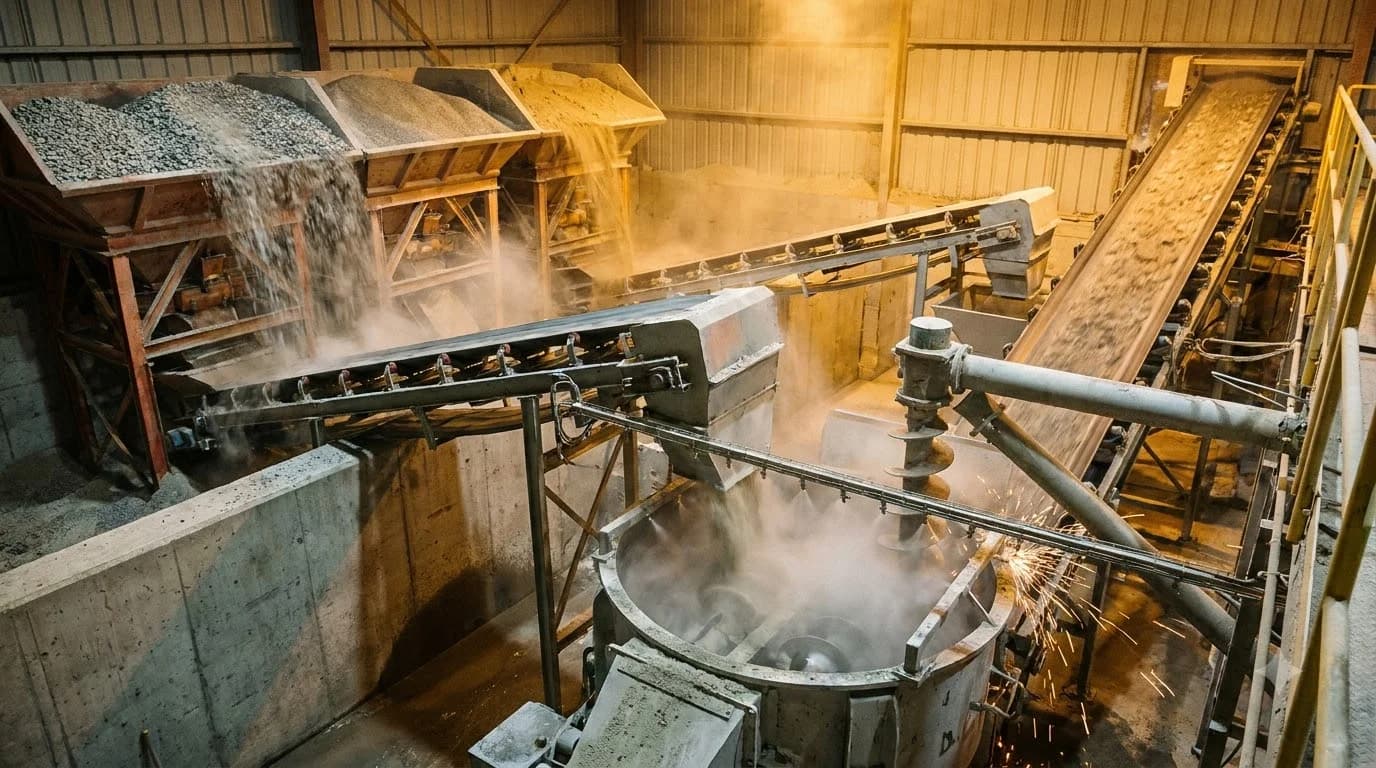
Modern concrete is batched in computer-automated industrial plants. Aggregate moisture sensors measure internal sand dampness and automatically adjust batch water volumes by weight to avoid skewing water-to-cement ratios.
The 90-Minute Delivery Clock (ASTM C94): Once water contacts Portland cement inside the batch plant, a 90-minute or 300-drum-revolution countdown begins. If transit delays exceed 90 minutes in warm weather (above 85°F), early hydration products begin linking within the revolving drum, generating excessive heat. Re-tempering old concrete with water upon arrival will break apart early C-S-H crystals and permanently ruin compressive strength.
Air Entrainment Admixtures (ASTM C260): In freeze-thaw climates, batch plants add synthetic surfactants that generate billions of microscopic microscopic air bubbles (10 to 500 microns in diameter) spaced less than 0.2 mm apart throughout the cement paste. When absorbed water in concrete freezes and expands by 9%, these microscopic voids act as expansion relief chambers, preventing concrete from shattering.
6. Five Critical Concrete Chemistry Mistakes to Avoid
Adding 1 gallon of water per cubic yard increases slump by 1 inch but destroys 200 PSI of compressive strength and increases drying shrinkage cracking. Use superplasticizers (water-reducing admixtures) to increase fluidity without adding water.
If surface water evaporates faster than bleed water rises (greater than 0.2 lbs/sq ft/hr per ACI 308R), plastic shrinkage cracks will split the top 1 inch within 2 hours. Apply evaporative retarders or moist burlap immediately.
Sand containing clay or silt coats aggregate surfaces, preventing cement paste from bonding. Beach sand contains chlorides that cause rapid catastrophic galvanic corrosion of embedded steel rebar.
Freezing water expands, physically shearing newly formed C-S-H crystal bonds. If concrete freezes before achieving 500 PSI, the matrix is permanently crippled and must be torn out.
Applying impermeable topical film-forming sealers or epoxies before 28 days traps moisture and alkaline salts, causing severe white efflorescence, moisture blushing, and coating delamination.
Need Exact Yardage & Mix Takeoffs?
Calculate ready-mix cubic yards, dry bag counts, and 2026 material costs in seconds.
Frequently Asked Questions
Can concrete harden underwater?
Yes. Portland cement is a hydraulic cement, meaning its hardening mechanism relies on an exothermic chemical reaction with water molecules, not air exposure. Curing concrete fully submerged in water prevents moisture loss, producing higher compressive strength and fewer microscopic shrinkage cracks than air-cured concrete.
Why does concrete crack as it cures?
Concrete shrinks approximately 1/16 inch per 10 linear feet during curing. As water is consumed by hydration and excess unreacted water evaporates from capillary pores, internal tensile stresses develop. Because concrete has high compressive strength but weak tensile strength, relief contraction joints (ACI 302.1R) must be tooled every 8 to 10 feet.
What happens if fresh concrete freezes during the first 24 hours?
If ice crystals form in fresh concrete before it reaches 500 PSI compressive strength, the expanding ice disrupts the developing calcium-silicate-hydrate (C-S-H) crystal matrix. This causes permanent structural damage, reducing the ultimate 28-day strength by up to 50% and causing severe surface scaling.
What is the difference between cement and concrete?
Cement is a fine gray binding powder manufactured from calcined limestone and clay (accounting for 10% to 15% of a mix). Concrete is the finished synthetic rock created when cement powder is mixed with water, sand, and coarse stone gravel aggregate.
Why is excess water harmful to concrete strength?
Under Abram's Law, concrete strength is inversely proportional to the water-to-cement ratio. Adding extra water increases workability but creates extensive microscopic capillary voids as unreacted water evaporates, drastically lowering compressive strength, abrasion resistance, and freeze-thaw durability.
Building Codes & Primary Standards Cited
Standard Specification for Portland Cement
Defines chemical and physical requirements for Portland cement types I through V.
Standard Specification for Concrete Aggregates
Sets grading requirements and soundness standards for fine and coarse concrete aggregates.
Standard Practice for Selecting Proportions for Normal Concrete
The structural engineering standard for calculating mix proportions, w/c ratios, and aggregate volumes.
Estimations adhere to standard North American modular 3/8-inch mortar joint physics and 5% to 10% material waste factors. Local municipal building inspectors, stamped architectural blueprints, and local frost depth requirements supersede general reference guidelines.
Popular Quick Estimates
Pre-engineered takeoffs & benchmarks matched to this project
Related Calculators
Specialized tools for foundation, core fill, and budgeting
Cubic yards, bags, and slab volume for flatwork and footings
Heavyweight structural blocks and bond beam units
Core grout volume in cubic yards and 80-lb pre-mix bags
Cell fill requirements for low-lift and high-lift grouting
Blogs & Construction Guides
Technical articles, IRC code standards, rebar schedules & freight logistics
Is Concrete Porous? Permeability & Sealing (2026 Guide)
How to Resurface Concrete: Overlays & Micro-Toppings
How to Seal Concrete: Siloxane vs Acrylic Sealers