Sonotube Concrete Calculator
Calculate exact cylindrical pier concrete volume, 80-lb and 60-lb concrete bag counts, 4-ft form sections, and flared bell-base footing allowances for decks, porches, and pergolas.
Sonotube Cylindrical Pier & Footing Concrete Takeoff
cinderblockscalculator.com/sonotube-concrete-calculator
Date: 11/13/2026
Reference: IRC R403.1.4 / ACI 332
| Material Item | Basis / Yield | Quantity |
|---|---|---|
| Total Concrete Volume | 18.84 net cu ft + 10% waste | 0.77 yd³ (20.72 cu ft) |
| 80-lb Concrete Bags | 0.60 cu ft / bag | 35 bags |
| 60-lb Concrete Bags | 0.45 cu ft / bag | 47 bags |
| 50-lb Concrete Bags | 0.375 cu ft / bag | 56 bags |
| 4-ft Form Tube Sections | Rounded up per pier depth | 6 sections |
| Estimated Concrete Weight | ~145 lb / cu ft normal-weight | 3,004 lbs |
Cylindrical Pier Volume Formula (V = π × r² × h) & Worked Takeoff
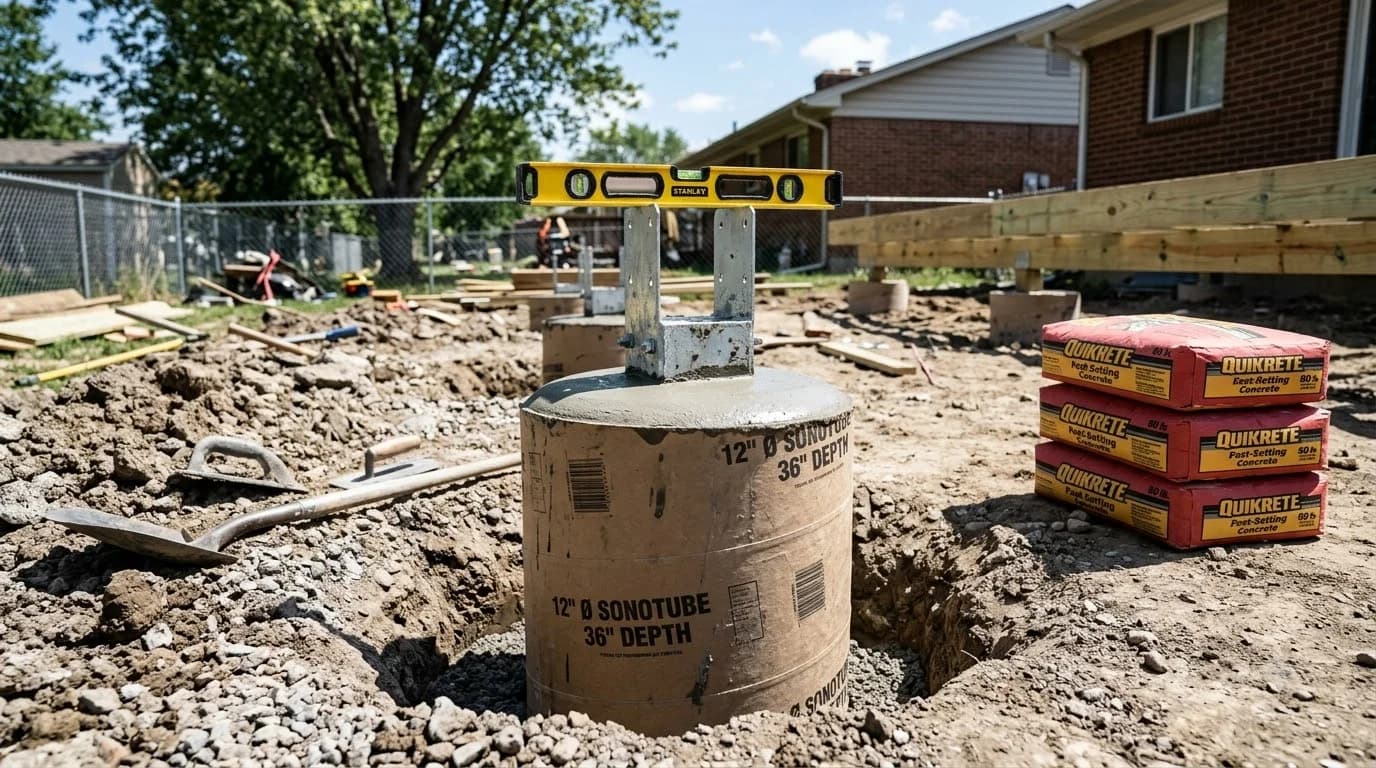
Every cylindrical concrete form tube behaves mathematically as a right circular cylinder. Converting the tube's inside diameter from inches to feet gives the radius r = (D ÷ 2) ÷ 12, and converting embedment depth gives height h = Depth_in ÷ 12. Multiplying cross-sectional area by height yields exact net concrete volume in cubic feet:
Worked Example: Six 12" × 48" Straight Deck Piers (+10% Waste)
1. Radius (r) = 12" ÷ 2 ÷ 12 = 0.50 ft | Height (h) = 48" ÷ 12 = 4.00 ft
2. Single Pier Volume = 3.14159 × (0.50)² × 4.00 = 3.14 cu ft
3. Six-Pier Net Volume = 6 × 3.14 = 18.84 cu ft (0.70 yd³)
4. Order Volume (+10% field margin) = 18.84 × 1.10 = 20.72 cu ft (0.77 yd³)
5. Bagged Concrete: ceil(20.72 ÷ 0.60) = 35 × 80-lb bags | ceil(20.72 ÷ 0.45) = 47 × 60-lb bags | 6 × 4-ft tubes | 3,004 lb
Adding a 10% waste allowance is essential even with smooth waxed cardboard tubes. Real jobsites lose small quantities of wet mix around uneven auger bottoms, inside mixer chutes, and at the top crown finish. Running two bags short mid-pour creates a cold joint that compromises pier integrity.
IRC R403.1.4 Frost-Depth Rules & Flared Bell Footing Bases
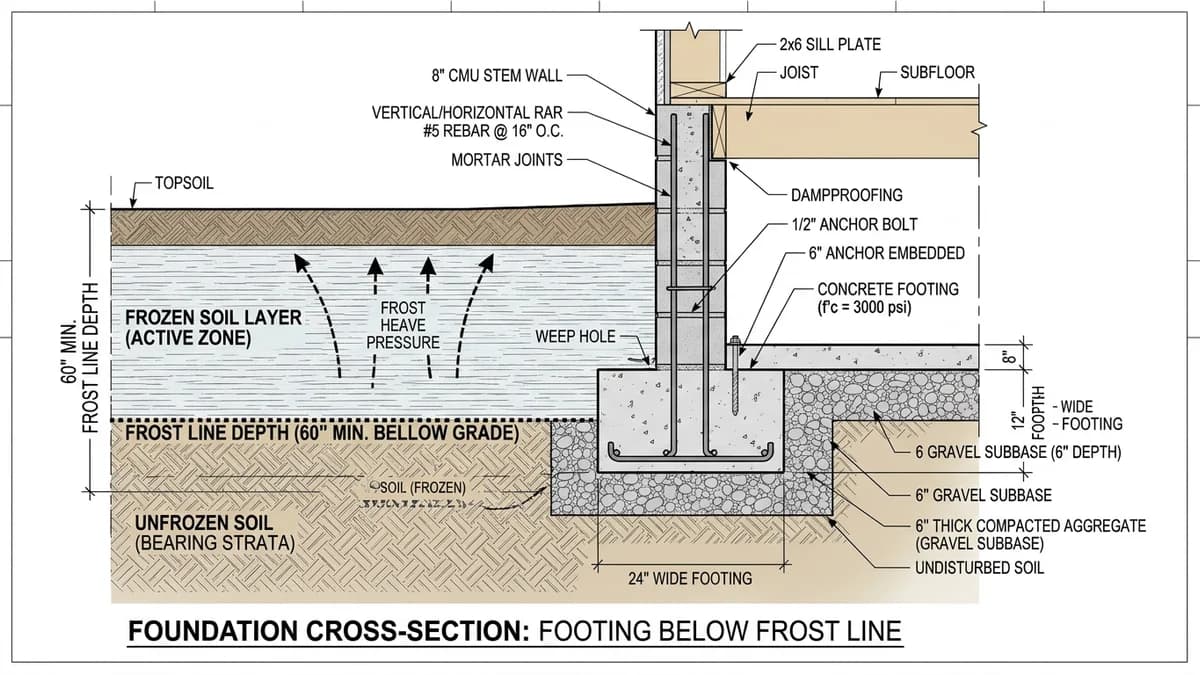
Under IRC Section R403.1.4, exterior deck, sunroom, and porch footings must extend below the local frost line—or utilize an engineered frost-protected design—to prevent seasonal soil freezing from lifting posts out of level. When wet silt or clay freezes downward, ice lenses expand and grip the sides of shallow piers (adfreezing), jacking the footing upward over successive winters.
Why Use a Flared Bell Base (Bigfoot Style)?
A flared plastic bell base attaches to the bottom of a standard cardboard tube and widens the footing footprint by 1.5× the shaft diameter over the bottom 8 inches. Because bearing area scales with the square of diameter, a 1.5× wider base delivers 2.25× more soil bearing area while locking the pier under undisturbed backfill like an inverted anchor to counter frost uplift.
Frustum Volume Math for Bell Footings
When the calculator's bell-base toggle is active, the bottom 8 inches is computed as a conical frustum using V = (π × h / 3) × (r₁² + r₁r₂ + r₂²) where r₂ = 1.5 × r₁. On a 12" × 48" pier, flaring to an 18" base adds 0.31 cu ft per pier (total 3.45 cu ft), typically adding roughly 1 extra 80-lb bag per two piers.
Table 1: Sonotube Volume & Bag Chart per 4-ft (48") Tube
The net planning matrix below shows exact single-tube quantities for standard 4-ft (48-inch) forms from 6" to 24" diameter, matching the calculator engine before adding your project waste allowance.
| Tube Dia. | Net Vol (cu ft) | Net Vol (yd³) | 80-lb Bags | 60-lb Bags | 50-lb Bags | With 1.5× Bell | Net Weight |
|---|---|---|---|---|---|---|---|
| 6" | 0.79 cu ft | 0.03 yd³ | 2 | 2 | 3 | 0.86 cu ft | 115 lb |
| 8" | 1.40 cu ft | 0.05 yd³ | 3 | 4 | 4 | 1.53 cu ft | 203 lb |
| 10" | 2.18 cu ft | 0.08 yd³ | 4 | 5 | 6 | 2.39 cu ft | 316 lb |
| 12" | 3.14 cu ft | 0.12 yd³ | 6 | 7 | 9 | 3.45 cu ft | 455 lb |
| 14" | 4.28 cu ft | 0.16 yd³ | 8 | 10 | 12 | 4.69 cu ft | 621 lb |
| 16" | 5.59 cu ft | 0.21 yd³ | 10 | 13 | 15 | 6.13 cu ft | 811 lb |
| 18" | 7.07 cu ft | 0.26 yd³ | 12 | 16 | 19 | 7.76 cu ft | 1,025 lb |
| 24" | 12.57 cu ft | 0.47 yd³ | 21 | 28 | 34 | 13.79 cu ft | 1,823 lb |
Table 2: Frost Depth Footing Takeoff Matrix (36" to 60")
Each cell displays the net single-pier concrete volume followed in parentheses by the illustrative 6-pier project order (80-lb bags and cubic yards including 10% waste).
| Diameter | 36" Frost Depth | 42" Frost Depth | 48" Frost Depth | 60" Frost Depth |
|---|---|---|---|---|
| 8" Tube | 1.05 cu ft (12 bags / 0.26 yd³) | 1.22 cu ft (14 bags / 0.30 yd³) | 1.40 cu ft (16 bags / 0.34 yd³) | 1.75 cu ft (20 bags / 0.43 yd³) |
| 10" Tube | 1.64 cu ft (19 bags / 0.40 yd³) | 1.91 cu ft (22 bags / 0.47 yd³) | 2.18 cu ft (24 bags / 0.53 yd³) | 2.73 cu ft (31 bags / 0.67 yd³) |
| 12" Tube | 2.36 cu ft (26 bags / 0.58 yd³) | 2.75 cu ft (31 bags / 0.67 yd³) | 3.14 cu ft (35 bags / 0.77 yd³) | 3.93 cu ft (44 bags / 0.96 yd³) |
| 16" Tube | 4.19 cu ft (47 bags / 1.02 yd³) | 4.89 cu ft (54 bags / 1.20 yd³) | 5.59 cu ft (62 bags / 1.37 yd³) | 6.98 cu ft (77 bags / 1.71 yd³) |
Backfill, Tube Bracing & J-Bolt / Post-Base Anchor Placement
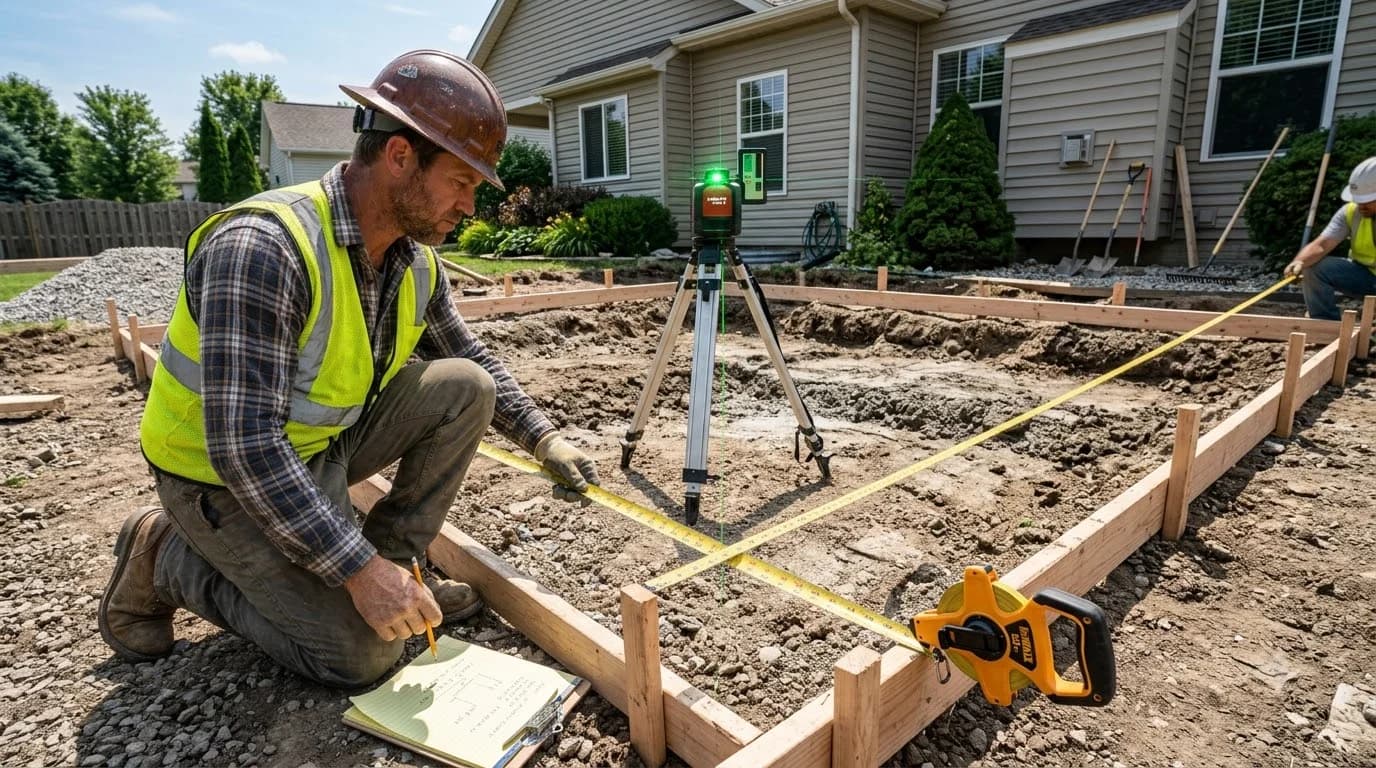
Accurate concrete volume is only half the pier installation. Cardboard form tubes are lightweight and easily knocked out of plumb or floated upward by fluid concrete head pressure if installed improperly. Follow these field checks before mixing:
- Clean Undisturbed Bearing Bottom: Remove all loose soil crumbs, standing groundwater, and mud from the bottom of the augered hole before dropping the tube. Pouring over loose spoil leads to post settlement once deck framing loads arrive.
- Plumb Bracing & Partial Backfill: Align every tube to your batter-board strings, drive two angled 2×4 stakes per pier, and screw bracing cleats near the top rim. Tamp 12 to 18 inches of dry backfill around the lower collar so wet concrete cannot push out beneath the bottom edge.
- Vertical Rebar & Concrete Consolidation: Where local codes or uplift zones require reinforcement, suspend vertical #4 rebar sticks with a minimum 3-inch side clearance from soil/tube walls and consolidate each lift with a rod or pencil vibrator to eliminate air pockets.
- J-Bolt & Post-Base Embedment: Screed the top concrete crown 2 to 6 inches above grade, trowel a gentle drainage bevel away from the center, and wet-set galvanized 1/2-inch J-bolts or standoff post-base anchors on exact beam centerlines while the mix remains plastic.
Material estimates depend on the selected dimensions, product yields, and waste allowance.
Sonotube Concrete & Pier Footing FAQs
Code-grounded answers on cylindrical volume formulas, frost depth embedment, bell footings, and bagged vs. ready-mix orders.
Popular Quick Estimates
Illustrative takeoffs with stated assumptions; verify project quantities
Crawlspace Stem Wall
Course-height example; footing design is site-specific
4-in Patio Slab Takeoff
Ready-mix yardage with 10% subgrade allowance
24x24 Garage Slab
576 ft² × 5/12 ft ÷ 27; excludes waste and design
Block Material Cost
Editable block prices; add delivery and installation
Related Calculators
Specialized tools for foundation, core fill, and budgeting
Cubic yards, bags, and slab volume for flatwork and footings
Concrete cubic yards, premix bags, and rebar for CMU strip footings
Crawlspace piers, deck posts, solid cap blocks, and isolated pad footings
Spanning grade beams over drilled piers, rebar cages, and shear stirrups
Blogs & Construction Guides
Practical guides to block sizing, material estimates and project planning
How Many Bags of Concrete for Fence Posts & Footings
US Frost Line Depth by State: Footing Building Codes
Concrete Bag Prices: Compare Bag Sizes, Yield & Cost