Quick Contractor Benchmark: Concrete Bags per Fence Post
For a standard 6-foot privacy fence with a **4×4 wood post** (3.5″ actual) set in a **10-inch diameter hole 30 inches deep**, you need **2.8 bags of 60-lb concrete** (or **2.1 bags of 80-lb concrete**). If building in frost country requiring a 36-inch hole, order **3.5 bags (60-lb)** per post. For heavy **6×6 gate posts** in a 12-inch hole at 36-inch depth, budget **5.0 bags (60-lb)** or **3.8 bags (80-lb)** per post.
1. The Engineering Rules: Post Hole Diameter and Depth
A fence post fails not because the concrete breaks, but because the soil yields under lateral wind load or frost pushes the post out of alignment. Two strict geometric rules govern professional fence installation:
Excavate the post hole diameter to three times the nominal post width. A nominal 4×4 post (actual 3.5″) requires a 10″ to 12″ hole. A nominal 6×6 post (actual 5.5″) requires a 16″ to 18″ diameter hole. Narrower holes fail to provide enough concrete collar mass to resist high wind shears.
At least one-third (and ideally one-half) of the post's above-ground height must be buried underground. For a 6-foot fence, embed at least 24 to 36 inches into undisturbed soil. In regions subject to freezing ground, IRC Section R403.1.4 requires digging below your municipal frost line.
In frost-prone regions (USDA Zones 3–6), frost depth ranges from 30 inches in the Mid-Atlantic to 48 or 60 inches across the Upper Midwest and New England. If your concrete footing sits above the frost line, freezing water trapped beneath it expands by 9% and jacks the post upward every winter (frost heaving).
2. Master Concrete Bag Takeoff Matrix (4×4, 6×6, and Sonotubes)
The table below calculates exact net concrete volume by taking the gross cylindrical volume of the hole and subtracting the displaced displacement of the embedded wood post (3.5″×3.5″ for 4×4; 5.5″×5.5″ for 6×6):
| Hole Diameter × Depth | Post / Pier Type | Net Volume (Cu Ft) | 50-lb Bags (0.375 cu ft) | 60-lb Bags (0.45 cu ft) | 80-lb Bags (0.60 cu ft) |
|---|---|---|---|---|---|
| 8″ dia × 24″ deep | 4×4 Line Post | 0.53 cu ft | 1.5 bags | 1.2 bags | 0.9 bags |
| 10″ dia × 30″ deep (Standard) | 4×4 Line Post | 1.15 cu ft | 3.1 bags | 2.8 bags | 2.1 bags |
| 10″ dia × 36″ deep (Frost) | 4×4 Corner/End Post | 1.41 cu ft | 3.8 bags | 3.5 bags | 2.6 bags |
| 12″ dia × 36″ deep | 6×6 Gate Post | 2.20 cu ft | 5.9 bags | 5.0 bags | 3.8 bags |
| 12″ dia × 48″ deep (Deep Frost) | 6×6 Heavy Gate | 2.93 cu ft | 7.8 bags | 6.8 bags | 5.1 bags |
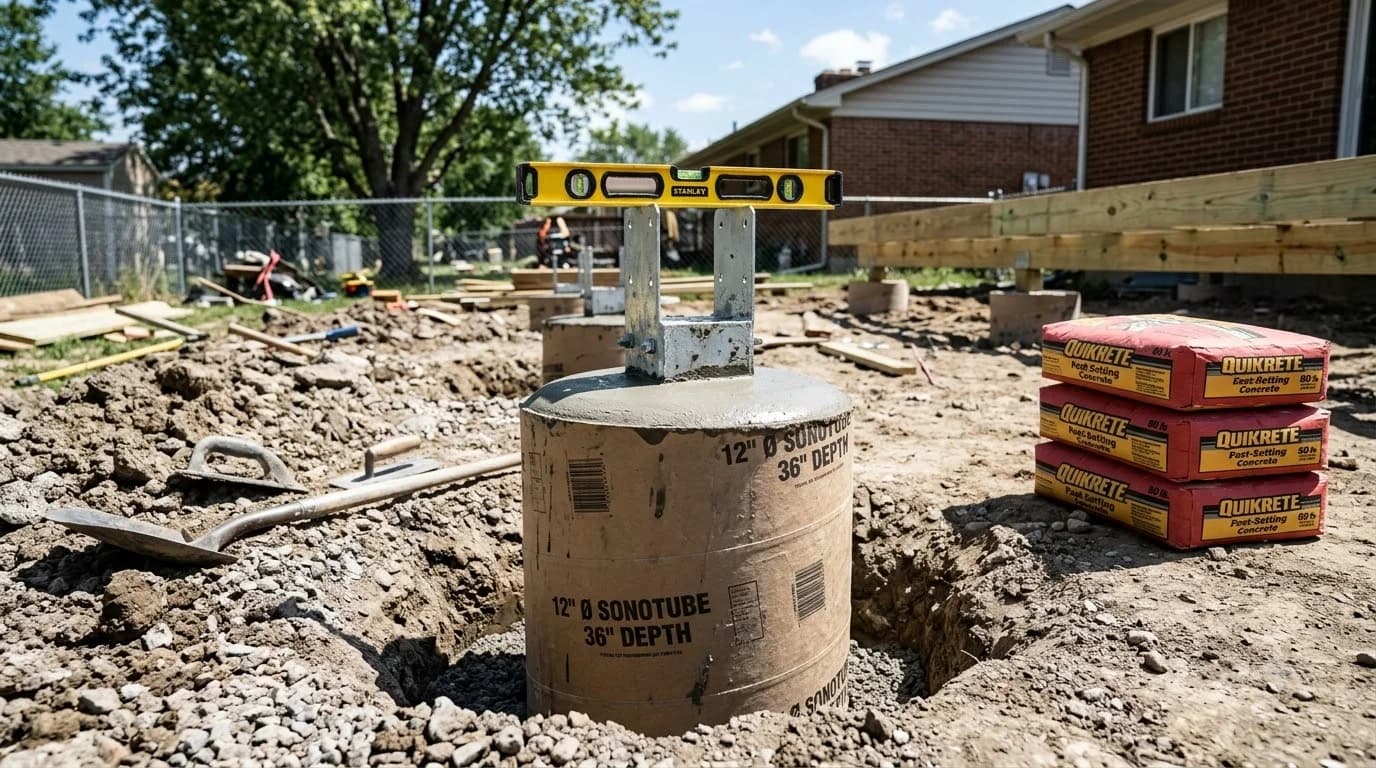
| 8″ Sonotube × 48″ deep | Deck Pier (No Wood Displ.) | 1.39 cu ft | 3.7 bags | 3.1 bags | 2.4 bags |
| 10″ Sonotube × 48″ deep | Deck Pier (No Wood Displ.) | 2.18 cu ft | 5.8 bags | 4.9 bags | 3.7 bags |
| 12″ Sonotube × 48″ deep | Heavy Deck / Porch Pier | 3.14 cu ft | 8.4 bags | 7.0 bags | 5.3 bags |
3. The Exact Mathematical Takeoff Formula
To calculate bagged concrete needs on any irregular hole or pier diameter, use cylinder volume minus rectangular post displacement:
// Step 1: Gross Hole Volume (Cylinder)
Hole Volume (cu ft) = π × (Radius in feet)² × Depth in feet
Radius in feet = (Diameter in inches ÷ 2) ÷ 12
// Step 2: Wood Post Displacement
4×4 Wood Volume = (3.5 ÷ 12) × (3.5 ÷ 12) × Depth in feet = 0.085 × Depth
6×6 Wood Volume = (5.5 ÷ 12) × (5.5 ÷ 12) × Depth in feet = 0.210 × Depth
// Step 3: Net Bags Required
60-lb Bags = (Gross Volume - Wood Volume) ÷ 0.45 cu ft
80-lb Bags = (Gross Volume - Wood Volume) ÷ 0.60 cu ft
Real-World Contractor Example: 150-Foot Privacy Fence
You are setting twenty (20) 4×4 wood posts on 8-foot centers in 10-inch diameter holes dug 30 inches deep (2.5 feet):
- Gross Hole Volume: 3.1416 × (0.4167)² × 2.5 = 1.363 cu ft per hole
- Wood Displacement: 0.2917 × 0.2917 × 2.5 = 0.213 cu ft
- Net Concrete per Hole: 1.363 - 0.213 = 1.15 cu ft
- Bags per Hole (60-lb): 1.15 ÷ 0.45 = 2.56 bags → round to 2.8 with 10% bottom waste
- Total Fence Order: 20 posts × 2.8 bags = 56 bags (60-lb), or 42 bags (80-lb)
- Total Material Cost (at $5.50/bag 60-lb): $308.00
4. Why You Must Never Cup the Post Bottom in Concrete
The most pervasive DIY mistake is placing a wooden post at the bottom of a raw dirt hole and pouring concrete all the way underneath and around it.
Concrete is porous and shrinks microscopically away from wood as it cures, creating a capillary slit. When rain runs down the post, water enters this hairline gap and drains to the bottom. If concrete is underneath the wood, it creates a sealed bathtub. Even pressure-treated lumber (AWPA UC4A Ground Contact) submerged in standing water will rot and snap at the ground line within 4 to 7 years.
The Contractor-Approved Method: Dig 6 inches deeper than your target post depth. Fill the bottom 6 inches with clean, angular crushed stone (#57 gravel). Tamp the stone firmly, then set the wood post directly on top of the stone. Pour concrete around the sides of the post only. Any water entering the joint drains harmlessly down through the gravel into the subsoil.
5. Fast-Setting vs Standard Concrete: When Can You Dry Pour?
Contractors frequently ask whether they can dump dry bagged concrete directly into the hole and soak it with a garden hose:
Fast-Setting Concrete (Red Bag)
- Chemistry: Calcium aluminate cement reacts rapidly with standing moisture.
- Installation: Pour dry powder into hole with post braced, pour 1 gallon of clean water per 50-lb bag on top.
- Set Time: Sets rigid in 20 to 40 minutes; remove braces after 2 hours.
- Strength: Reaches ~4,000 PSI at 28 days (ASTM C387). Ideal for non-structural fences.
Standard Concrete Mix (Yellow Bag)
- Chemistry: Standard Portland Type I/II cement requires thorough mechanical agitation.
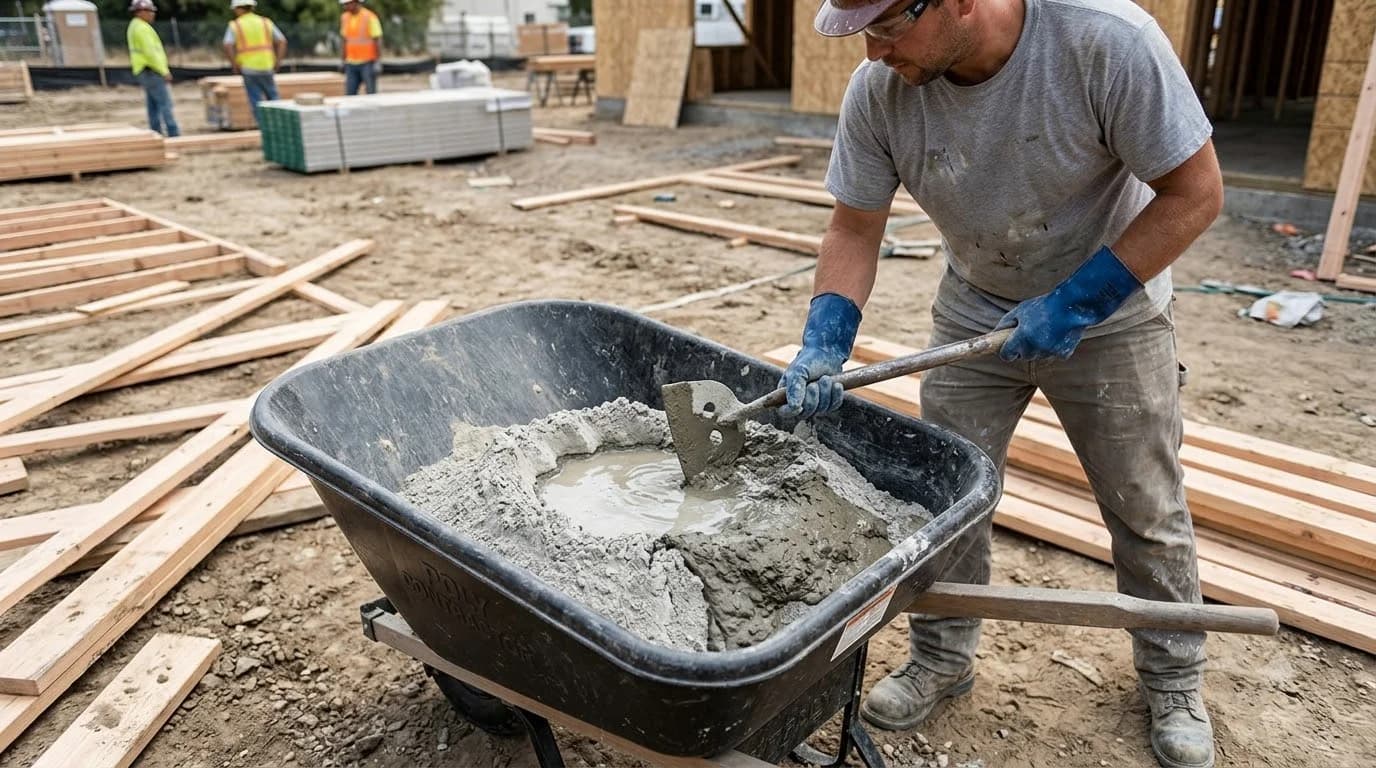
- Installation: MUST be mixed in a wheelbarrow or mixer with water prior to placing.
- Dry Pour Danger: Dry pouring standard mix leaves large unhydrated dry powder pockets and brittle voids.
- Strength: Reaches 4,000 to 5,000 PSI; mandatory for structural deck footings and retaining walls.
6. Five Costly Jobsite Mistakes When Concreting Posts
Stopping concrete 3 inches below the surface and throwing lawn soil over top allows wet mulch and dirt to stay in constant contact with the wood. Always crown the concrete 1 to 2 inches above the finished grade and slope the top surface away from the post with a margin trowel so rain sheds outward.
Using manual clamshell post-hole diggers often creates a funnel that is wide at the top (14″) and narrow at the bottom (8″). This inverted wedge allows frost to grab the concrete collar and push the post out of the ground. The hole must have straight vertical walls or be flared out (belled) at the bottom.
Line posts experience balanced tension from fence pickets on both sides. Gate posts and 90-degree corner posts endure severe unilateral cantilever torque. Gate posts should always use 6×6 lumber, be dug 12 inches deeper than line posts, and be anchored with at least 5 to 6 bags of concrete.
Pouring an uncontrolled stream from a garden hose washes the cement paste out of the coarse aggregate, dropping concrete strength from 4,000 PSI down to under 1,500 PSI. Measure water in a 5-gallon bucket: precisely 1.0 gallon per 50-lb bag.
While fast-setting concrete feels hard in 30 minutes, it has only reached roughly 20% of its ultimate design strength. Hanging heavy 60-lb gate panels within the first 24 hours induces lateral creep that permanently pulls the post out of plumb. Allow 24 to 48 hours before hanging gates.
Need Exact Material Quantities for Your Job?
Calculate total bags, ready-mix cubic yards, gravel base, and 2026 local prices in seconds.
Frequently Asked Questions
How many bags of concrete do I need for a 4x4 fence post?
For a standard 10-inch diameter hole dug 30 inches deep, you need 2.8 bags of 60-lb concrete or 2.1 bags of 80-lb concrete per post. In colder climates with a 36-inch frost depth, plan on 3.5 bags of 60-lb or 2.6 bags of 80-lb mix per hole.
How many bags of concrete do I need for a 6x6 post or deck pier?
A 6x6 post set in a 12-inch diameter hole at 36 inches deep requires 5.0 bags of 60-lb concrete or 3.8 bags of 80-lb concrete. For a 48-inch deep frost footing, you will need 6.8 bags of 60-lb or 5.1 bags of 80-lb concrete.
Can you pour dry fast-setting concrete into a post hole and add water?
Yes, but strictly with specially formulated fast-setting concrete (such as Quikrete Fast-Setting in the red bag). Fast-setting mixes use accelerated calcium aluminate cements that pull water downward through capillary action. Never dry-pour standard 4,000 PSI concrete mixes; they require premixing in a tub or wheelbarrow.
Should concrete go underneath the bottom of a wooden fence post?
No. Never encase the bottom butt of a wooden post in concrete. Concrete forms an impermeable cup that traps rainwater, causing rot within 3 to 5 years. Always add 4 to 6 inches of crushed #57 gravel at the bottom of the hole for drainage, set the post on the gravel, and pour concrete collar around the sides.
How deep should a fence post hole be dug?
The minimum depth is one-third (1/3) to one-half (1/2) of the post height above ground. For a standard 6-foot privacy fence, holes must be at least 24 to 30 inches deep. In northern zones subject to freezing, IRC Section R403.1.4 requires footing depths to extend at least 6 inches below the local frost line (often 36 to 48 inches).
Building Codes & Primary Standards Cited
Standard Specification for Packaged, Dry, Combined Materials for Mortar and Concrete
Governs compressive strength benchmarks for packaged regular and rapid-hardening post concrete.
Minimum Depth of Exterior Footings
Mandates that structural posts and deck footings extend below the frost line specified by the local building official.
American Wood Protection Association - Ground Contact General Use
Specifies chemical preservative retention levels for wooden fence posts and structural columns in concrete contact.
Estimations adhere to standard North American modular 3/8-inch mortar joint physics and 5% to 10% material waste factors. Local municipal building inspectors, stamped architectural blueprints, and local frost depth requirements supersede general reference guidelines.
Popular Quick Estimates
Pre-engineered takeoffs & benchmarks matched to this project
Related Calculators
Specialized tools for foundation, core fill, and budgeting
Heavyweight structural blocks and bond beam units
Cubic yards, bags, and slab volume for flatwork and footings
Property line privacy fences, pilasters and wind bracing
Core grout volume in cubic yards and 80-lb pre-mix bags
Blogs & Construction Guides
Technical articles, IRC code standards, rebar schedules & freight logistics
Is Concrete Porous? Permeability & Sealing (2026 Guide)
How Much Concrete Do I Need? Complete Quantity Takeoff
How to Mix Concrete by Hand: Wheelbarrow Water Ratio