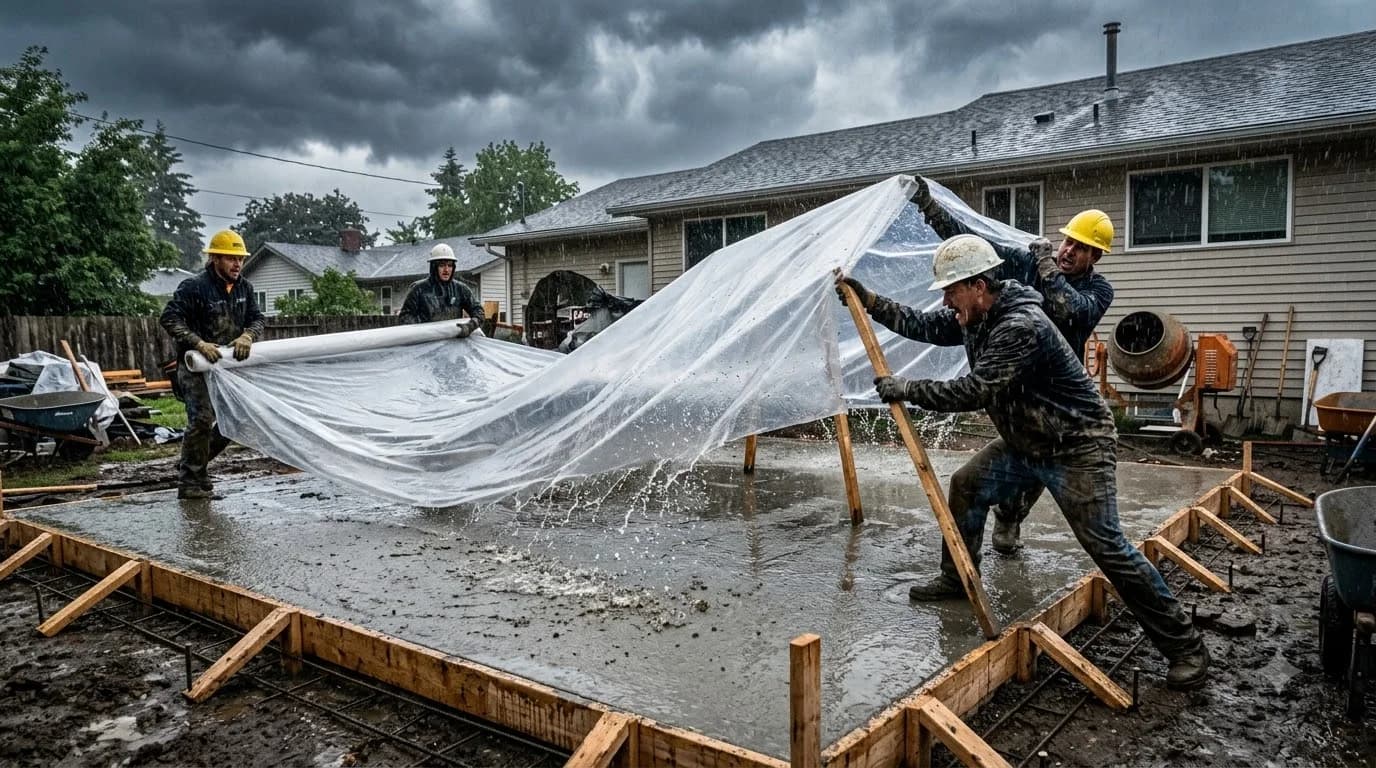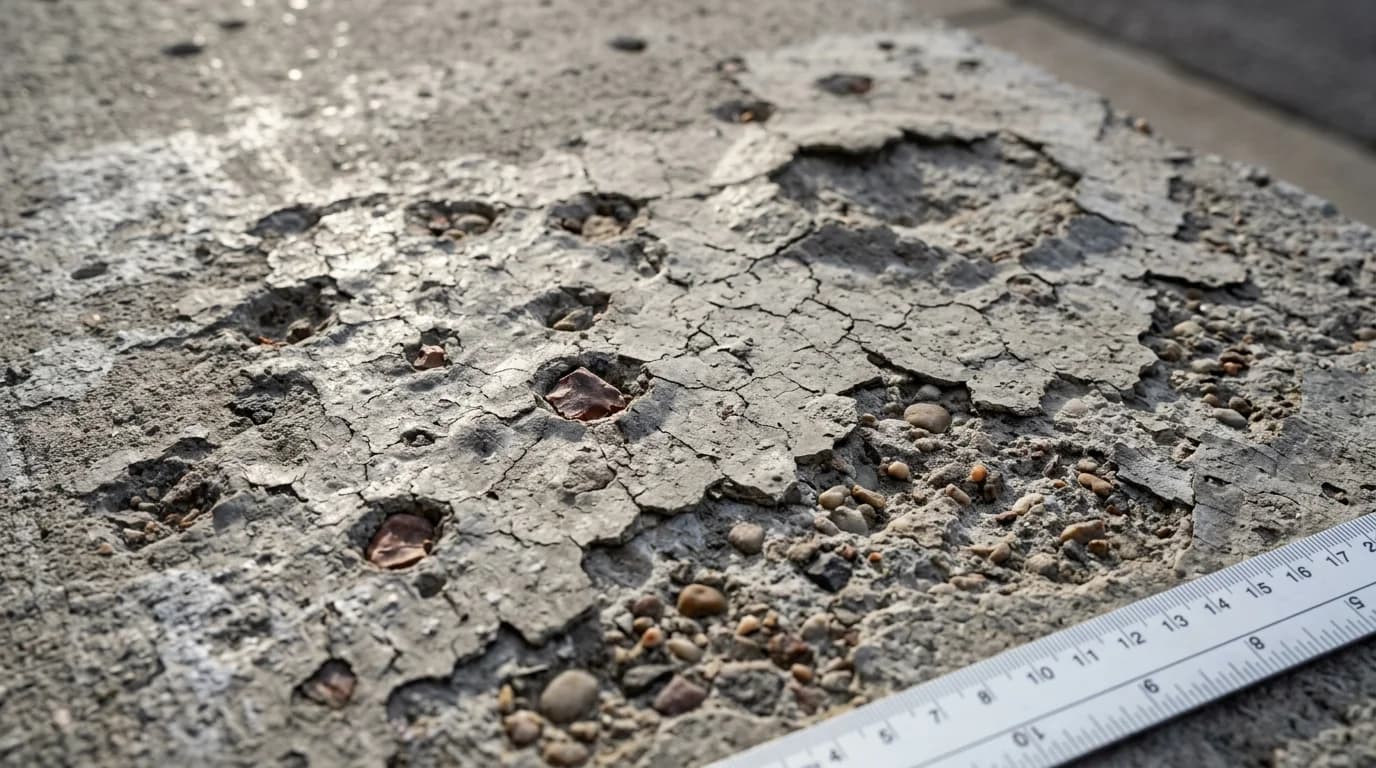
Under ACI 302.1R, concrete surface delaminations and blisters occur when finishing operations (power floating or hard steel troweling) are performed prematurely while bleed water and entrained air are still rising through the setting matrix. Troweling compacts and seals a dense 1/8-inch surface skin; rising water and air become trapped beneath it, creating unbonded hollow subsurface planes that peel away under vehicular traffic. In contrast, surface scaling is caused by cyclic freeze-thaw expansion of water inside non-air-entrained pastes or young concrete subjected to aggressive deicer salts, while popouts stem from moisture expansion within porous chert and shale aggregates (ASTM C33).
1. Concrete Delamination vs. Blistering: Mechanics of Premature Finishing
Concrete is a complex suspension of aggregates, cement grains, and water. Immediately following placement, screeding, and bull floating, the heaviest particles (gravel and coarse sand) settle downward under gravity. This sedimentation displaces excess mixing water upward toward the surface—a natural physical phenomenon known as bleeding. Concurrently, microscopic air bubbles entrapped during mixing rise toward the atmospheric boundary.
Surface delamination occurs when finishing crews begin floating or hard steel troweling while this bleeding process is actively underway. When a power trowel with tilted steel blades passes across the surface, it densifies and consolidates the top 1/8 to 1/4 inch of cement paste, creating an impermeable, airtight surface crust.
Blistering vs. Delamination: The underlying physics of blistering and delamination are identical, but their morphology differs:
- Blisters: Form when trapped air and water exert localized upward hydraulic pressure under a pliable, still-elastic surface skin, creating round, hollow bumps between 1/4 inch and 4 inches across. They are especially prevalent on slabs cast over impermeable vapor barriers, where bleed water cannot drain into the subgrade.
- Delaminations: Form when the surface crust has achieved higher stiffness before separation occurs. Instead of individual circular blisters, delaminations encompass massive continuous planes ranging from several square inches to dozens of square feet. The defect is often invisible to the naked eye until heavy forklift or vehicle wheels drive over the slab, cracking and dislodging the unsupported shell.
2. Surface Scaling & Spalling: Freeze-Thaw & Air-Entrainment Failure
Scaling is the progressive flaking, peeling, and detachment of the hardened cement paste and fine mortar at the surface of an exterior slab, exposing the coarse gravel aggregate beneath. Under ACI 201.2R (Guide to Durable Concrete), scaling is classified from Light (loss of surface mortar up to 1/4 inch deep with no aggregate exposure) to Severe (complete loss of mortar over 1/2 inch deep with aggregate completely dislodged).
The primary driver of scaling is the 9% volumetric expansion of water as it changes phase from liquid to ice:
Hydrated Portland cement paste contains microscopic capillary pores. When moisture enters these capillary pores and freezes, the volumetric expansion forces unfrozen capillary water to migrate away from the freezing front. If the distance to an open relief cavity is too large, immense internal hydraulic pressures exceeding the tensile strength of the concrete paste (typically 400 to 600 PSI) build up instantly, rupturing the paste matrix.
To prevent this hydraulic rupture, exterior concrete exposed to freezing temperatures must be specified with an air-entraining admixture meeting ASTM C260. Air-entraining agents generate billions of microscopic, spherical air voids distributed evenly throughout the cement paste. These entrained bubbles act as expansion relief reservoirs into which freezing capillary water can safely escape without fracturing the solid paste.
3. Forensic Diagnosis Matrix: Surface Defects & Test Methods
Accurately diagnosing concrete surface distress is critical to selecting the proper repair protocol versus unnecessary full-slab demolition:
| Defect Type | Visual Morphology & Depth | Root Causative Mechanism | Diagnostic Test Standard | Recommended Remediation |
|---|---|---|---|---|
| Delamination | Large flat sheets (1/8" to 3/8" thick) unbonded from slab | Premature power troweling sealing bleed water/air | ASTM D4580 (Chain Drag Sounding) | Shotblast to CSP 3 + Polymer micro-topping |
| Surface Blisters | Isolated hollow bumps 1/4" to 3" in diameter | Trapped air under early-troweled elastic surface film | Visual inspection & hammer tap sounding | Grind flush + Polymer patch repair |
| Freeze-Thaw Scaling | Rough, flaking mortar exposing coarse stone | Lack of ASTM C260 air entrainment; deicer thermal shock | ASTM C672 (Scaling Resistance Test) | Diamond mill + High-strength cementitious overlay |
| Aggregate Popouts | Conical craters (1/2" to 2" wide) with fractured stone center | Porous chert or shale aggregate moisture expansion | ASTM C33 / Petrographic Examination | Drill out aggregate + Epoxy mortar plug |
| Surface Dusting | Fine chalky powder brushing off hard concrete | High water-cement ratio; finishing bleed water into paste | Mohs scratch test / Tape adhesion test | Lithium silicate densifier hardening |
4. Deicer Chemical Attack & Aggregate Popouts
Two common real-world conditions accelerate surface deterioration even when initial finishing execution was competent:
The Chemistry of Deicing Salt Destruction
Homeowners frequently ruin new driveways by spreading bag salt during the first winter. Chemical deicers—including sodium chloride (NaCl), calcium chloride (CaCl2), and magnesium chloride (MgCl2)—cause damage through three separate mechanisms:
- Severe Thermal Shock: The rapid endothermic dissolution of salt on snow drops surface concrete temperatures by 15°F to 30°F in minutes, producing extreme differential thermal contractions between the frozen surface and warm interior core.
- Increased Freeze-Thaw Cycling: By lowering the freezing point of water, salts dramatically increase the frequency of freeze-thaw cycles. In a typical winter, a treated driveway may experience 100+ freeze-thaw transitions compared to 30 cycles on an untreated slab.
- Chemical Leaching of Calcium Hydroxide: Magnesium and calcium chlorides chemically react with calcium hydroxide in the concrete matrix, forming calcium oxychloride and magnesium silicate hydrate. These reaction products undergo destructive crystallization expansion that disintegrates the paste bond from within.
Aggregate Popouts and Unsound Materials
An aggregate popout is a shallow, conical depression formed when an unsound particle of gravel or stone fractures near the surface, blowing away the concrete mortar covering it. The culprit is almost always low-density, porous sedimentary stones:
Under ASTM C33 (Standard Specification for Concrete Aggregates), chert with a relative density below 2.40, porous shales, weathered ironstones, and soft lignite coal particles have high absorption rates and low permeability. During rainy autumns, these stones become 100% water-saturated. When freezing occurs, the expanding water cannot escape the dense stone, fracturing the particle along internal bedding planes. The explosive pressure blows out a cone-shaped plug of concrete. Popouts are purely cosmetic and do not compromise structural slab capacity, but they create unsightly craters that collect dirt and pool water.
5. Prevention Rules: The Golden Rules of ACI 302 Finishing
Contractors can eliminate virtually all finishing-related surface failures by enforcing strict job-site compliance with ACI 302.1R:
- Never Finish Over Bleed Water: The cardinal rule of flatwork. All surface water sheen must evaporate or be dragged off with a rubber hose before floating or troweling. Finishing with bleed water on the surface works excess water into the top 1/16 inch, skyrocketing the local water-cement ratio and guaranteeing a dusting, scaling surface.
- Avoid Steel Trowels on Air-Entrained Exterior Concrete: Air-entrained exterior concrete should be bull-floated and given a non-slip broom finish. Hard power troweling with steel blades seals air voids near the top, producing a dense crust over air-rich matrix—the exact recipe for delamination.
- Control Evaporation Rate with Windbreaks: When hot sun, low humidity, and high winds cause surface drying rates to exceed 0.20 lbs/sq ft/hour (ACI 305R), the surface will crust over while the underlying slab remains wet and soft. Spray an ASTM C171 monomolecular evaporative retardant immediately after screeding to preserve surface workability.
- Enforce a 30-Day Air-Drying Period Before Frost: Exterior slabs must cure under wet burlap or curing compound for 7 days, followed by at least 30 continuous days of warm air-drying before experiencing freezing weather or deicer exposure. This allows internal capillary water to evaporate, keeping moisture saturation below the critical 91.7% threshold.
6. Forensic Repair Protocol: Scarification, Overlays & Hydrophobic Sealers
When faced with delaminated or scaled concrete, total slab demolition is rarely necessary unless full-depth structural cracking has occurred. Follow the industry-standard multi-step remediation workflow:
Step 1: Acoustic Chain Drag Mapping (ASTM D4580)
Walk the entire slab dragging a 20-pound steel link chain or tapping with a masonry hammer. Mark all hollow, dull-sounding delaminated boundaries with bright spray paint. Extend your repair perimeter at least 6 inches beyond the sounding line to ensure you reach sound, fully bonded concrete.
Step 2: Perimeter Saw-Cutting and Mechanical Surface Profiling
Saw-cut the marked perimeter lines to a depth of 1/4 inch using a diamond blade. Never feather-edge a patch—feathered edges invariably crack and chip away within months. Use a pneumatic bush hammer, mechanical scarifier, or shotblaster to chip away the entire delaminated skin down to sound aggregate, achieving a Concrete Surface Profile of CSP 3 to 5 (similar in texture to medium-coarse sandpaper).
Step 3: High-Performance Polymer-Modified Overlay
Thoroughly vacuum all micro-dust. Bring the concrete substrate to a Saturated Surface Dry (SSD) condition with clean water. Apply a structural epoxy or polymer bonding slurry (ASTM C881). While the primer is tacky, apply a polymer-modified cementitious resurfacing mortar (such as CTS Rapid Set NewCrete or MAPEI Planitop 18) at 1/4-inch to 1/2-inch thickness, finished with a textured broom pattern.
Step 4: Hydrophobic Silane/Siloxane Penetrating Sealant
After 28 days of curing, saturate the restored slab with a 100% active solids penetrating alkyl-alkoxysilane sealer. Unlike topical clear coats that peel, silane molecules penetrate 1/4 inch deep into the concrete micro-pores, chemically bonding with silicate structures to create an invisible hydrophobic barrier that repels water and prevents deicer salt penetration forever.
5 Costly Mistakes to Avoid When Dealing with Surface Defects
When concrete begins to stiffen on a windy day, inexperienced finishers often flick water from a bucket or brush onto the slab to lubricate their trowel. This catastrophic shortcut dilutes the surface paste, increases the local water-cement ratio to over 0.70, and guarantees severe dusting, micro-crazing, and surface scaling during the first winter freeze.
Concrete requires up to 12 months to reach complete chemical maturity and maximum resistance to salt attack. Throwing rock salt, calcium chloride, or magnesium chloride pellets on a driveway poured less than one year ago will strip the surface paste right down to the aggregate. Use clean traction sand or cat litter during the first winter instead.
Finishing crews trained in commercial interior warehouse flatwork sometimes mistakenly run high-speed power trowels with steel blades over exterior air-entrained concrete. Steel troweling creates a dense, non-air-entrained crust over an air-rich body, causing extensive blistering and delamination sheets. Exterior slabs should always receive a wood/magnesium float finish followed by a broom texture.
Troweling cosmetic thin patch mortar directly over smooth, unprofiled delaminations without a saw-cut edge is guaranteed to fail. Without at least a 1/4-inch square edge and a mechanically roughened substrate (CSP 3), the thin feathered edge loses its moisture into the air, shrinks, and shears off within weeks under traffic.
Rolling cheap exterior latex deck paint or high-build acrylic sealers over a scaling patio locks sub-slab vapor inside. As hydrostatic vapor pressure drives upward from the earth, moisture accumulates behind the impermeable film, freezing in winter and peeling the paint off in huge ugly flakes along with another layer of concrete paste. Always specify breathable, penetrating silane sealers.
Calculating Concrete Slab Yardage or Replacement Volume?
Accurately compute ready-mix yardage, sub-base gravel tonnage, and rebar takeoffs with our free engineering calculators.
Frequently Asked Questions
What is the primary difference between concrete delamination and surface blistering?
Delamination and blistering share the same core root cause—trapping bleed water and air under a prematurely sealed surface crust—but differ in scale. Blisters are localized, raised circular bumps (1/4 inch to 4 inches in diameter) that form when trapped air and water push up the still-flexible mortar skin. Delamination affects much larger, continuous zones (often several square feet or square yards) where an entire 1/8-inch to 3/8-inch mortar layer separates horizontally from the underlying slab.
How do you test a concrete slab for hidden subsurface delaminations?
Subsurface delaminations are detected non-destructively using the ASTM D4580 chain-drag method or acoustic hammer sounding. By dragging a heavy link steel chain across the slab or tapping with a masonry hammer, sound concrete produces a crisp, high-pitched ringing frequency, whereas delaminated hollow voids emit a distinctive dull, hollow 'clacking' or drumming sound. Infrared thermography can also map delaminations on outdoor slabs warmed by the sun.
Why do deicing chemicals cause new concrete driveways to scale and flake?
Deicing salts (especially calcium chloride and magnesium chloride) trigger severe thermal shock by melting ice rapidly, which draws heat out of the upper concrete surface and causes sudden temperature drops. Furthermore, deicers increase the degree of water saturation in micro-pores, causing intense osmotic and hydraulic pressures when freezing occurs. On concrete less than one year old or lacking ASTM C260 air entrainment, this hydraulic pressure fractures the fragile cement paste.
What causes small conical popouts on concrete driveways and patios?
Popouts are caused by low-density, porous, or unsound coarse aggregates located within 1/2 inch to 1 inch of the finished surface. Aggregates such as porous chert, soft shale, mudstone, or ironstone absorb groundwater from the fresh concrete or soil. When frozen during winter, the trapped water inside the stone expands by 9%, fracturing the stone and blowing off the conical concrete mortar cap directly above it.
Can scaled or delaminated concrete be repaired without ripping out the entire slab?
Yes. If the underlying base slab remains structurally sound without full-depth settlement fractures, the delaminated or scaled surface layer can be repaired. Contractors mechanically scarify or shotblast the slab to Concrete Surface Profile CSP 3 to 5, remove all fractured paste, apply an epoxy bonding primer, and install a 1/4-inch to 1/2-inch polymer-modified or micro-topping cementitious overlay followed by a penetrating silane-siloxane water repellent.
Building Codes & Primary Standards Cited
Guide to Concrete Floor and Slab Construction
American Concrete Institute guidelines establishing timing windows for floating, troweling, and bleed-water management.
Guide to Durable Concrete
Defines standards for freeze-thaw durability, chemical deicer attack thresholds, and entrained air void spacing.
Standard Specification for Concrete Aggregates
Sets quality, grading, and soundness limits for deleterious substances, porous chert, and popout-prone rock fractions.
Estimations adhere to standard North American modular 3/8-inch mortar joint physics and 5% to 10% material waste factors. Local municipal building inspectors, stamped architectural blueprints, and local frost depth requirements supersede general reference guidelines.
Popular Quick Estimates
Pre-engineered takeoffs & benchmarks matched to this project
Related Calculators
Specialized tools for foundation, core fill, and budgeting
Cubic yards, bags, and slab volume for flatwork and footings
Heavyweight structural blocks and bond beam units
Core grout volume in cubic yards and 80-lb pre-mix bags
Subgrade walls, soil retention, waterproofing and grout
Blogs & Construction Guides
Technical articles, IRC code standards, rebar schedules & freight logistics
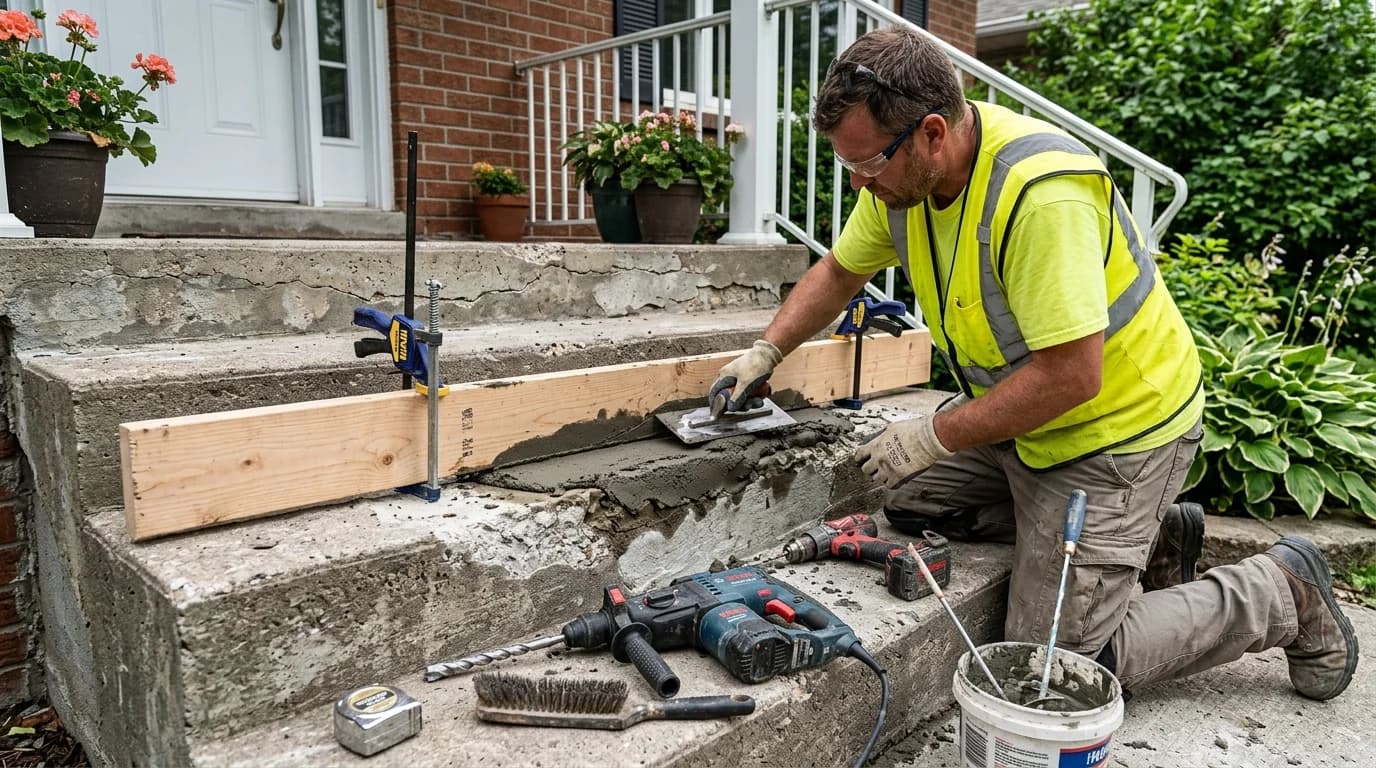
How to Repair Damaged Concrete Steps: Rebuild Broken Edges
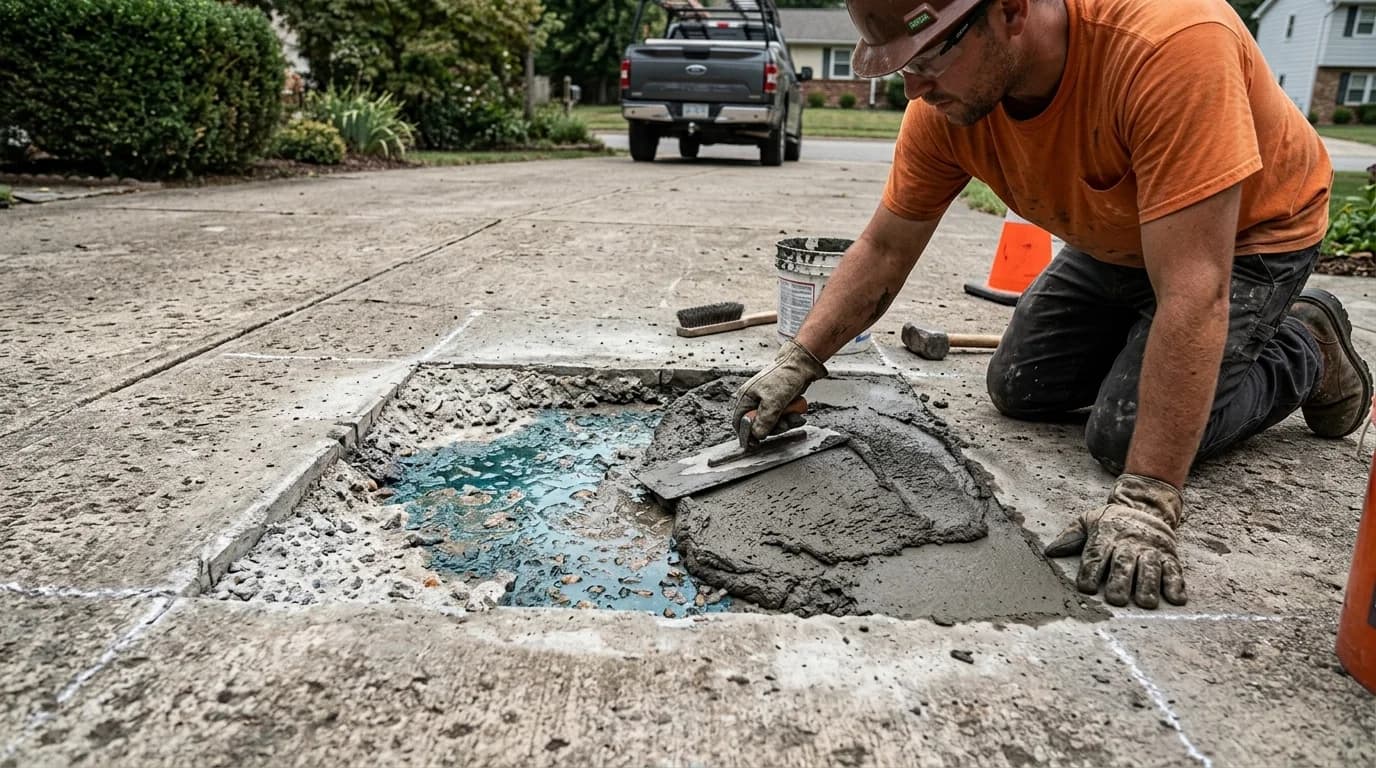
How to Repair Spalled Concrete: Pitted & Flaking Slabs
How to Repair Cracks in Cinder Block Foundation Walls