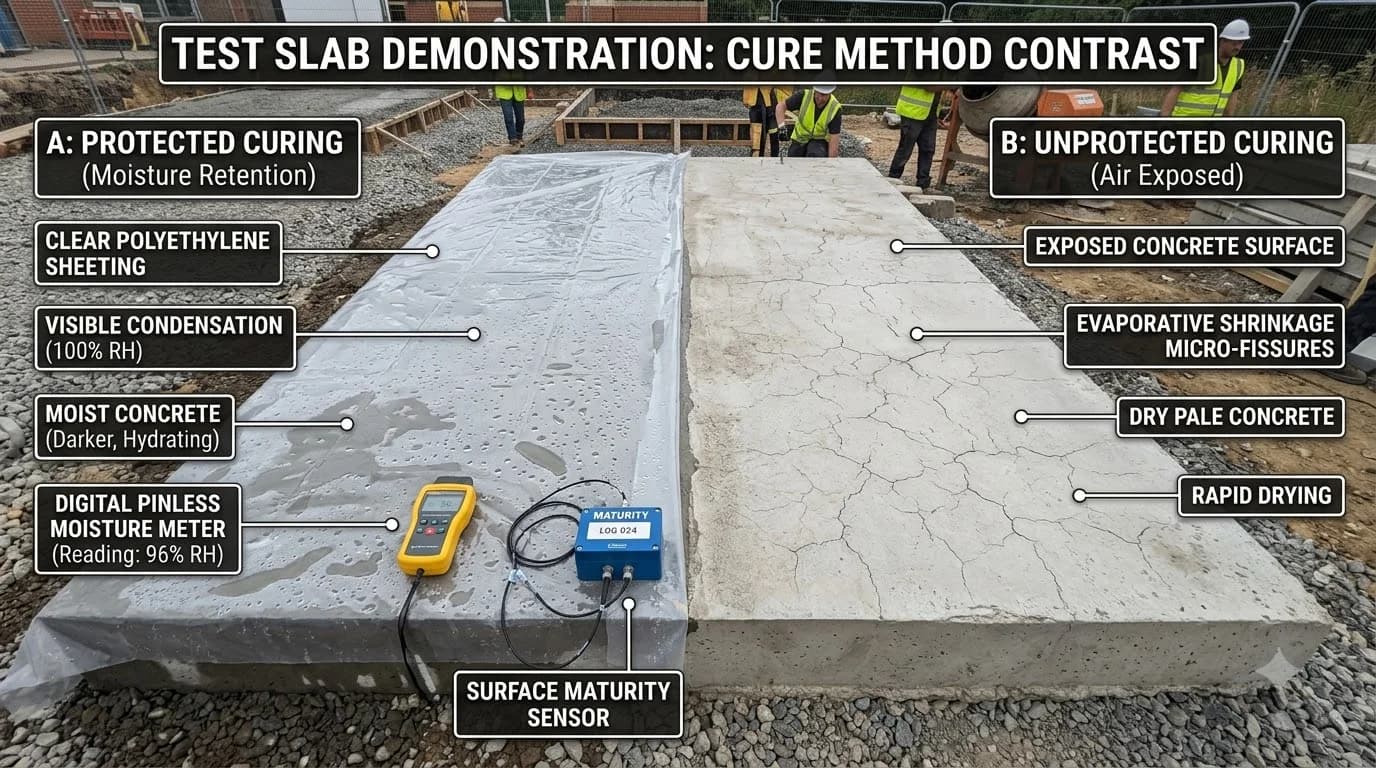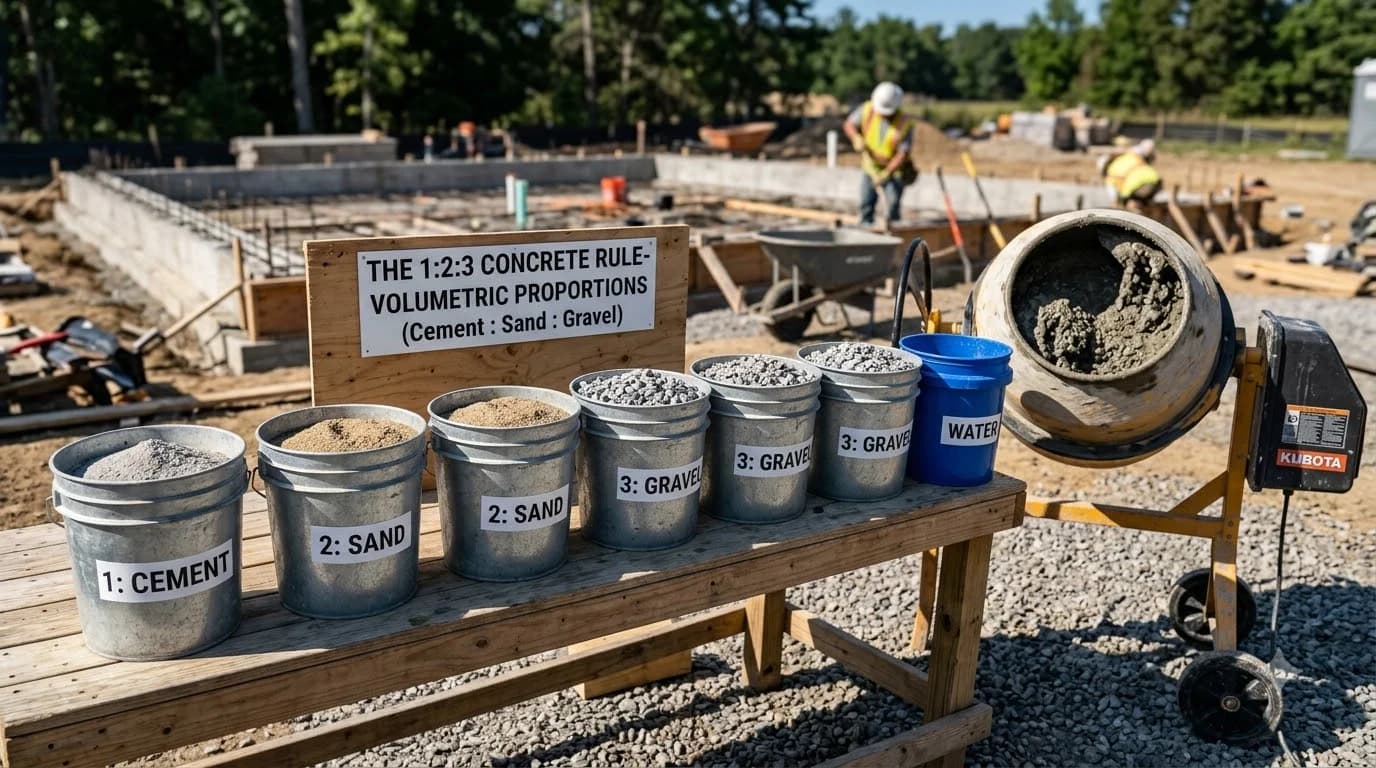
Quick Answer: The standard rule of thumb for 3,000 to 3,500 PSI structural concrete is the 1:2:3 volumetric ratio—1 part Type I/II Portland cement, 2 parts clean concrete sand, and 3 parts 3/4-inch crushed gravel, mixed with approximately 0.45 to 0.50 parts water by weight. One 94-lb bag of cement mixed with 2 cu ft sand and 3 cu ft stone yields 4.5 cubic feet of concrete.
1. The Volumetric Chemistry of Concrete Proportions
Concrete is not a chemical compound; it is a composite artificial stone where coarse and fine mineral aggregates are permanently bound together by a hardened paste of hydrated Portland cement. In a properly proportioned mix, every grain of sand and piece of coarse stone is completely coated with cement paste, and all void spaces between larger aggregate particles are fully occupied by smaller particles and paste:
Portland Cement (The Binder): Comprising approximately 10 to 15 percent of total volume, Portland cement (ASTM C150 Type I/II) reacts exothermically with water to form calcium silicate hydrate (C-S-H) gel. This microscopic crystalline needle matrix interlocks across aggregate boundaries, creating compressive load capacity.
Fine Aggregate (Masonry / Concrete Sand): Making up 25 to 30 percent of total volume, clean washed concrete sand conforming to ASTM C33 fills the large void spaces between coarse gravel stones. If too little sand is used, the mix becomes harsh, unworkable, and prone to honeycomb voids; if too much sand is used, the mix requires excessive water and cement paste to achieve workability, increasing drying shrinkage.
Coarse Aggregate (Crushed Stone / Gravel): Representing 35 to 45 percent of total mix volume, graded 3/8-inch to 1-inch crushed limestone or granite provides the heavy compressive mass, abrasion resistance, and volumetric stability. Coarse stones prevent the cement paste from shrinking excessively during hydration.
2. Standard Concrete Mix Proportions Matrix
Depending on the structural application, volumetric mix proportions must be adjusted to deliver specific compressive strengths, slump workability, and durability performance. The matrix below details the five most common field mixes based on ACI 211.1 guidelines:
| Mix Ratio (C : S : G) | 28-Day Strength | Water Ratio (w/c) | Slump Range | Best Structural Application |
|---|---|---|---|---|
| 1 : 2 : 3 (Standard) | 3,000–3,500 PSI | 0.45–0.50 | 3–4 inches | Driveways, sidewalks, patio slabs, standard footings |
| 1 : 2 : 2 (High-Strength) | 4,000–4,500 PSI | 0.40–0.45 | 2–3 inches | Heavy equipment pads, garage floors, columns, beams |
| 1 : 1.5 : 2.5 (Dense Mix) | 3,500–4,000 PSI | 0.42–0.47 | 3–4 inches | Water-retaining structures, chemical-resistant slabs |
| 1 : 3 : 3 (Foundation Mix) | 2,500–3,000 PSI | 0.50–0.55 | 4–5 inches | Fence post footings, mass gravity retaining walls |
| 1 : 3 : 0 (Sand / Mortar) | 2,500 PSI (Shear) | 0.45–0.50 | 3 inches | Flagstone bedding, shower pans, thin surface topping |
3. The Water-to-Cement Ratio and Abrams’ Law
In 1918, Duff Abrams formulated the foundational law of concrete technology: for any given set of materials, the compressive strength of fully compacted concrete is inversely proportional to its water-cement ratio by weight. This principle remains the single most critical rule governing concrete performance today.
The minimum theoretical water-cement ratio needed for complete chemical hydration of Portland cement is approximately 0.25 to 0.28. However, a mix with this little water would be completely dry, uncompactable, and impossible to place. In practice, extra water is added to provide physical lubrication and workability, bringing the target water-cement ratio to 0.40 to 0.50 for standard structural applications.
Every drop of water added beyond the hydration requirement occupies physical space within the plastic concrete matrix. As the concrete cures and dries, this excess water evaporates, leaving behind a network of microscopic capillary pores. A mix with a high water-cement ratio (such as 0.65) will possess up to three times the porosity of a dense 0.42 mix, resulting in:
- Dramatic drop in 28-day compressive strength (from 4,500 PSI down to under 2,500 PSI).
- Increased drying shrinkage cracking and curling along slab perimeter edges.
- Higher permeability, allowing water, chlorides, and deicing salts to reach reinforcing steel.
- Weak surface skin (laitance) that dusts, powders, and spalls under vehicular traffic.
4. Step-by-Step Batching by Volume Protocol
On job sites without access to ready-mix transit trucks, batching by volume using standard 5-gallon plastic buckets provides accurate, repeatable proportion control. Follow this contractor-grade batching procedure:
Calibrate the Measure: A standard 5-gallon bucket filled level to the brim contains approximately 0.67 cubic feet of material. One 94-lb bag of dry Portland cement equals approximately 1.0 loose cubic foot (equivalent to 1.5 level five-gallon buckets).
Loading Sequence: Always add materials to the drum or wheelbarrow in the following order to ensure complete mixing without cement balling:
- Pour approximately 80 percent of the required batch water into the vessel first.
- Add all coarse gravel aggregate (3 parts). The tumbling stone scours previous residue off the mixer drum walls.
- Add all Portland cement (1 part). The water and stone immediately disperse the cement powder into a rich slurry.
- Add all concrete sand (2 parts) incrementally while the mixer rotates.
- Add remaining water slowly in small splashes until the desired slump of 3 to 4 inches is achieved.
- Mix continuously for 3 full minutes, rest for 2 minutes, then finish with a 2-minute final mix per ASTM C94 guidelines.
5. Calculating Sacks of Cement per Cubic Yard
One cubic yard contains 27 cubic feet of volume. Due to aggregate packing—where fine sand grains fill the void spaces between gravel stones—the total volume of loose ingredients shrinks by approximately 30 to 35 percent when mixed with water. This volumetric shrinkage factor must be accounted for when ordering raw materials:
To produce 1 cubic yard (27 cu ft) of compacted 1:2:3 concrete, you will need approximately:
- 6.0 sacks (94 lbs each) of Portland cement (approx 564 lbs total binder).
- 12 cubic feet (0.44 cu yd) of clean concrete sand (approx 1,200 to 1,350 lbs).
- 18 cubic feet (0.67 cu yd) of 3/4-inch crushed gravel (approx 1,800 to 2,000 lbs).
- 32 to 36 gallons of clean potable water (approx 270 lbs, yielding w/c ~ 0.48).
Total wet weight of one cubic yard of standard normal-weight concrete is approximately 3,900 to 4,100 lbs (roughly 145 to 150 lbs per cubic foot).
5 Costly Proportioning Mistakes to Avoid
Adding excess water for easier shoveling
Every extra gallon of water drops compressive strength by 200 to 300 PSI and causes severe drying shrinkage cracks.
Using unwashed pit-run or beach sand
Unwashed sand contains clay, silt, and organic matter that coat cement particles, preventing proper hydration bonding.
Ignoring aggregate moisture content
Wet outdoor sand contains 4 to 8% surface water. Failing to reduce mixing water accordingly leads to an excessively wet, weak batch.
Omitting coarse aggregate for thick slabs
Using sand-only mortar for a 4-inch slab results in extreme volumetric shrinkage, severe curling, and structural failure.
Under-mixing or over-mixing in the drum
Under-mixing leaves unhydrated cement clumps; over-mixing (past 15 minutes) grinds soft aggregate, increases temperature, and accelerates flash setting.
Calculate Exact Concrete Materials
Use our Concrete Slab Calculator to compute cubic yards, cement bag counts, sand tonnage, and gravel requirements for any project dimensions.
Frequently Asked Questions
Can you make concrete using only cement and water?
No. Pure cement mixed with water is neat cement paste. Without fine and coarse aggregates to resist volumetric drying shrinkage, the paste shrinks drastically by 1 to 2 percent, cracks into severe spiderweb fissures, and possesses negligible tensile or compressive strength.
What is the difference between concrete mix and mortar mix?
Concrete mix contains coarse stone or gravel aggregate (typically 3/8-inch to 3/4-inch crushed rock) and is designed for thick structural slabs (2 to 6+ inches). Mortar contains only fine masonry sand and hydrated lime, engineered for thin 3/8-inch bonding joints between masonry units.
How much concrete does one 94-lb bag of Portland cement yield?
Using the standard 1:2:3 volumetric mix ratio, one 94-lb bag (1 loose cubic foot) of Portland cement combined with 2 cubic feet of sand and 3 cubic feet of gravel yields approximately 4.5 cubic feet (0.17 cubic yards) of placed and consolidated concrete.
What happens if you add too much water to the concrete mix?
Adding excess water drastically increases the water-cement ratio. Every extra gallon of water added per cubic yard reduces compressive strength by approximately 200 to 300 PSI, increases drying shrinkage cracking, causes bleed water channels, and creates a dusty, low-abrasion surface layer.
What mix ratio is needed to achieve 4,000 PSI concrete?
To achieve 4,000 PSI at 28 days, use a richer 1:2:2 volumetric proportion (1 part cement, 2 parts sand, 2 parts coarse aggregate) with a strictly controlled water-cement ratio between 0.40 and 0.45. This requires approximately 6 to 7 sacks of cement per cubic yard of placed concrete.
Building Codes & Primary Standards Cited
Standard Practice for Selecting Proportions for Normal, Heavyweight, and Mass Concrete
Authoritative American Concrete Institute methodology for volumetric aggregate sizing, cementitious content, and water-cement ratios.
Standard Specification for Portland Cement
Governs chemical and physical requirements for Type I (general purpose), Type II (moderate sulfate), and Type III (high early strength) cements.
Standard Specification for Concrete Aggregates
Establishes grading sieve analysis, cleanliness limits, and soundness tolerances for fine concrete sand and coarse stone.
Estimations adhere to standard North American modular 3/8-inch mortar joint physics and 5% to 10% material waste factors. Local municipal building inspectors, stamped architectural blueprints, and local frost depth requirements supersede general reference guidelines.
Popular Quick Estimates
Pre-engineered takeoffs & benchmarks matched to this project
Related Calculators
Specialized tools for foundation, core fill, and budgeting
Cubic yards, bags, and slab volume for flatwork and footings
Heavyweight structural blocks and bond beam units
Core grout volume in cubic yards and 80-lb pre-mix bags
Cell fill requirements for low-lift and high-lift grouting
Blogs & Construction Guides
Technical articles, IRC code standards, rebar schedules & freight logistics
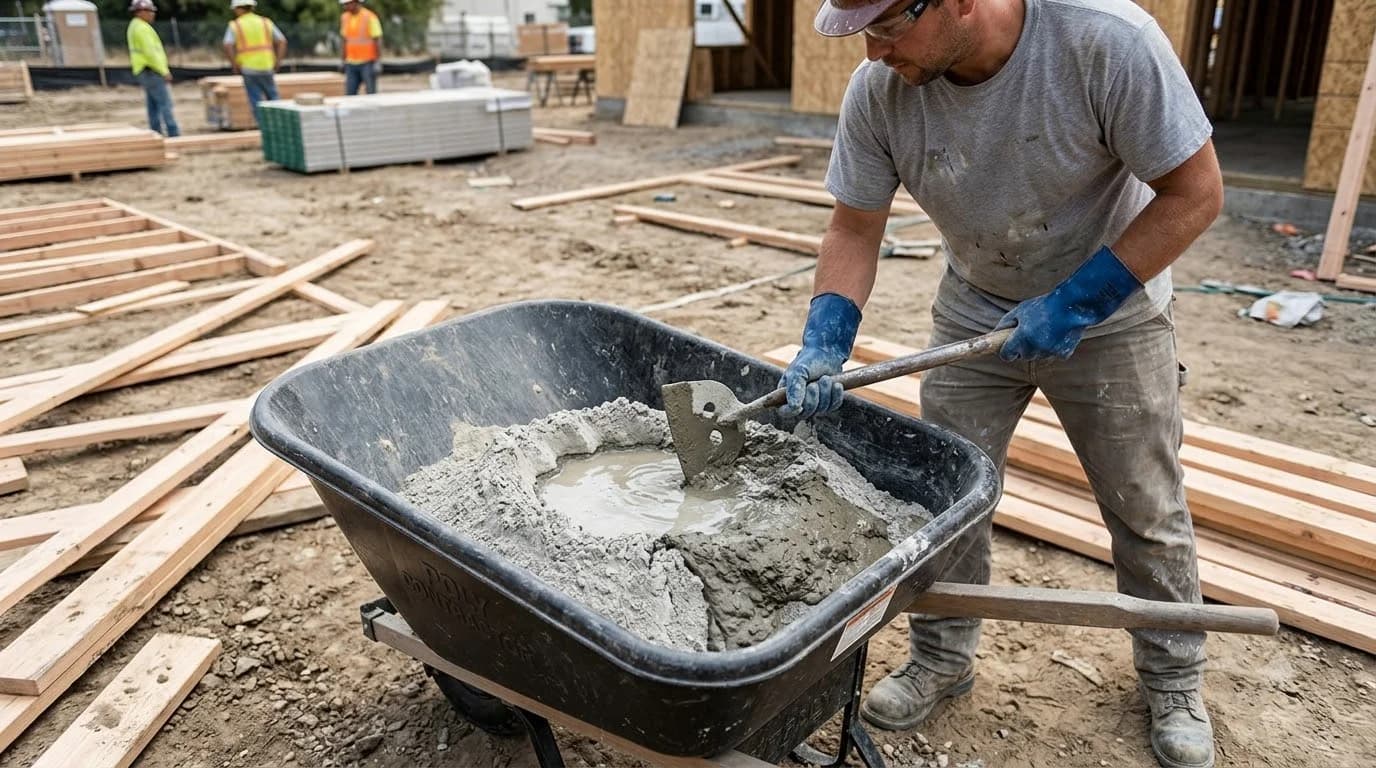
How to Mix Concrete by Hand: Wheelbarrow Water Ratio
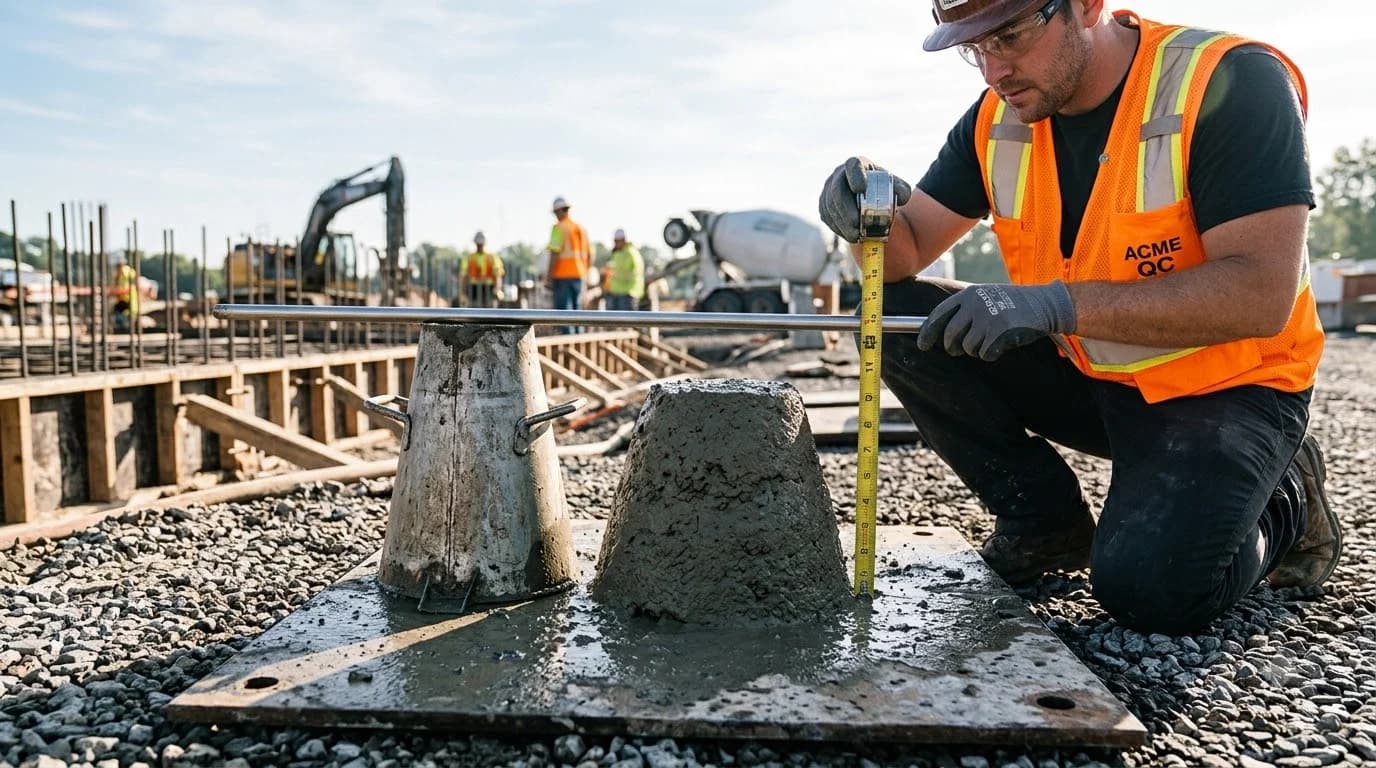
Concrete Slump Test: ASTM C143 Procedures & Values
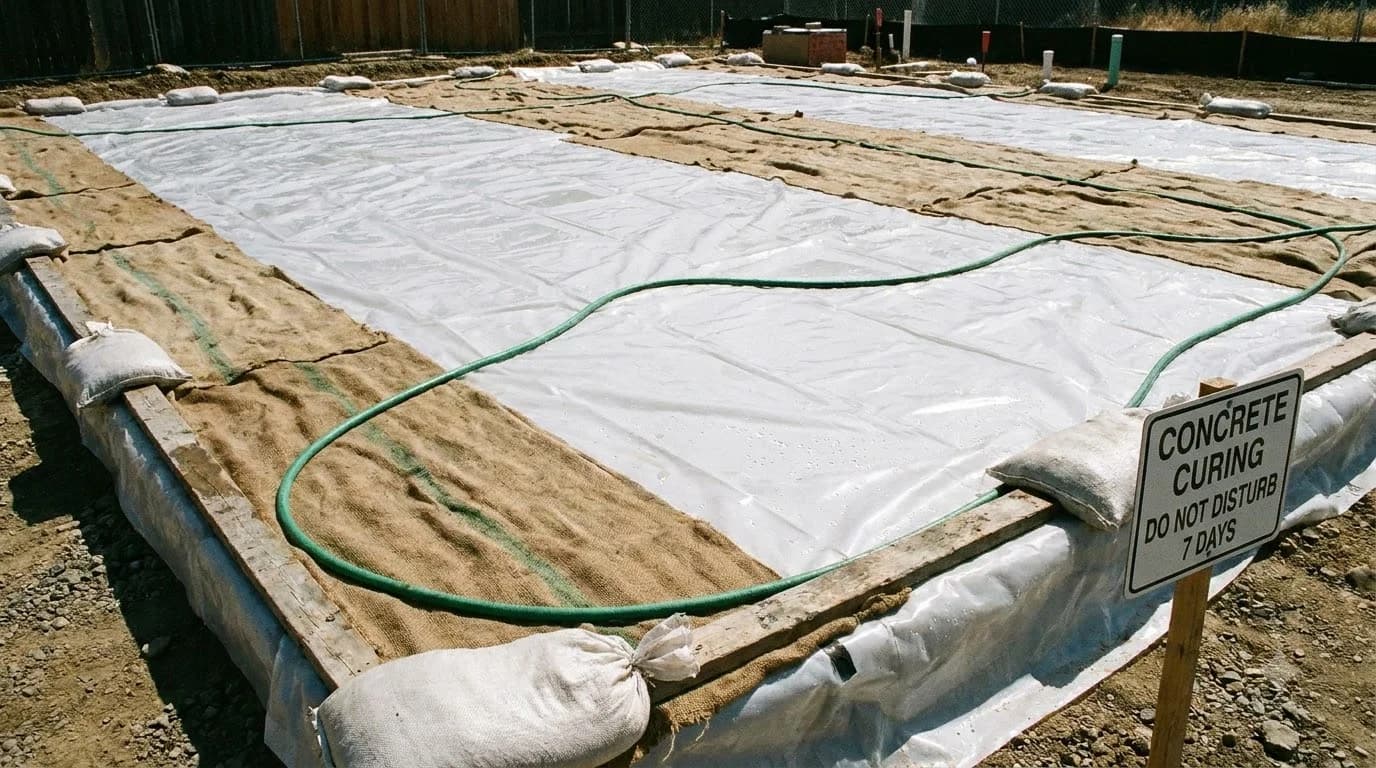
How to Cure Concrete: Wet Curing vs Curing Compounds