1. Master Concrete Demolition Tool Comparison Table
Match your physical stamina, project square footage, and slab thickness against available demolition tools:
| Demolition Tool | Daily Rental Cost | Production Rate | Max Slab Thickness | Physical Effort |
|---|---|---|---|---|
| 12-lb Sledge + 5-ft Digging Bar | $35 (Purchase) | 15 – 25 sq ft / hr | 3.5" (Unreinforced) | Extreme (Heavy cardio & back strain) |
| 35-lb Medium Breaker (SDS-Max) | $60 – $80 / day | 30 – 45 sq ft / hr | 4.0" | Moderate |
| 60-lb Heavy Electric Breaker (Bosch Brute) | $85 – $115 / day | 50 – 85 sq ft / hr | 6.0" | Low (Machine weight does the work) |
| Non-Explosive Expanding Grout (Dexpan) | $65 per 44-lb box | Variable (24-hr soak) | 12.0"+ (Deep walls) | Zero (Silent chemical cracking) |
| Mini-Excavator Hydraulic Breaker | $350 – $550 / day | 200 – 400 sq ft / hr | 12.0"+ Heavy rebar | Zero (Operator seated in cab) |
2. The Physics of Concrete Fracture: Creating the Air Gap
Concrete is artificial rock. It possesses immense compressive strength (3,000 to 4,500 PSI), designed specifically to resist downward crushing forces. However, its tensile strength is remarkably weak—only about 10% of compressive capacity (roughly 350 to 450 PSI).
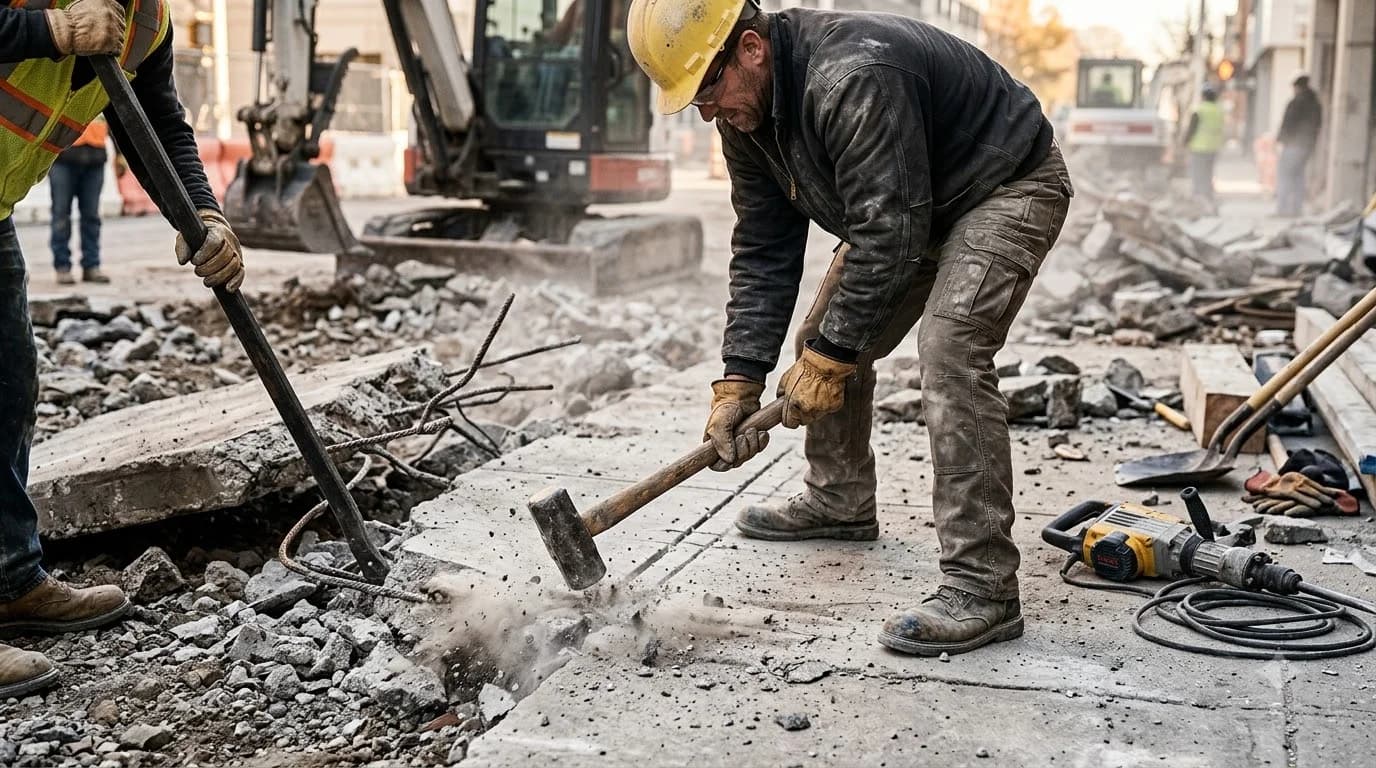
When a novice swings a sledgehammer at the center of a flat slab, the compacted subgrade gravel beneath the concrete acts like a blacksmith's anvil. The blow is resisted entirely in compression; the hammer bounces off, vibrating the worker's wrists and elbows while barely chipping the concrete.
The Cantilever Air-Gap Principle:
Have a partner slide a 5-foot steel pinch-point digging bar beneath the slab edge and pry upward 1 to 2 inches. This introduces a hollow air pocket below. When you strike the edge 6 inches inward, the cantilevered slab is placed into extreme bending tension. Because concrete cannot withstand 400 PSI of tensile stress, a single solid hammer blow snaps off a clean chunk immediately.
3. The 6-Step Concrete Breaking Sequence
Follow this professional demolition field sequence:
- Call 811 Before Striking: Dial 811 (free nationwide utility locate) to mark underground electrical conduit, gas pipes, and telecommunications cables that may run directly underneath or alongside the slab.
- Cut Clean Relief Borders: If breaking out a section of patio adjacent to your home foundation or garage door, rent a 14-inch handheld cut-off saw with a diamond blade. Score a 2-inch deep cut to isolate vibrations and prevent cracking the adjoining foundation.
- Establish an Outside Free Edge: Dig away 6 inches of topsoil along the perimeter border to expose the bottom edge of the slab.
- Work in 6 to 8-Inch Bites: Strike or position your jackhammer point 6 to 8 inches inward from the open edge. Breaking in small bites shears off manageable 20 to 30-lb chunks.
- Cut Steel Mesh and Rebar: When chunks break loose, embedded welded wire mesh will hold them together. Keep a pair of 24-inch bolt cutters or a cordless angle grinder with a metal cut-off wheel nearby to snip the steel grid immediately.
- Stage Chunks for Removal: Load chunks directly into a heavy contractor wheelbarrow. Never pile broken concrete in the center of your work zone where it blocks foot movement.
4. Five Fatal Mistakes in DIY Concrete Demolition
1. Striking in the Center of a Slab
Hitting the center of a slab without a free edge or air gap wastes 90% of your energy. The concrete is trapped under equal compressive resistance, resulting in exhaustion within 15 minutes.
2. Breaking Chunks Too Large to Lift
Shattering the slab into massive 150-lb boulders requires you to re-break them later or risk severe back disc herniation trying to load them into a truck. Aim for 25-lb "two-hand" pieces.
3. Inadequate Eye & Metatarsal Protection
Sledgehammer blows launch jagged concrete projectiles. Regular sunglasses shatter on impact; wear ANSI Z87.1 wrap-around goggles and steel-toe boots to protect metatarsal bones.
4. Forgetting Rebar Snapping Tools
Attempting to wrench broken concrete free from 3/8-inch steel rebar with your bare hands causes wrist sprains. Snip steel with bolt cutters as you advance.
5. Chemical Demolition: The Silent Expanding Grout Alternative
If you need to break up concrete inside a finished basement, near swimming pool glass, or adjacent to delicate historic brickwork where jackhammer noise and vibrations are prohibited, use chemical expanding grout (Dexpan):
- Drill 1.5-inch Holes: Use a rotary hammer to drill holes 1.5 inches in diameter at 8 to 12-inch grid spacing, drilled to 85% of slab depth.
- Mix & Pour: Mix Dexpan powder with cold water into a pourable slurry and fill the holes.
- 18,000 PSI Silent Expansion: Over the next 12 to 24 hours, the mineral compound expands slowly, exerting 18,000 PSI of lateral pressure. The slab fractures along the drill lines with zero sound, zero dust, and zero vibration.
Frequently Asked Questions
What size sledgehammer is best for breaking up concrete slabs?
A 10-lb to 12-lb double-faced sledgehammer with a 36-inch fiberglass or hickory handle is ideal. An 8-lb hammer lacks sufficient kinetic momentum to shatter 4-inch concrete, while a 16-lb hammer causes rapid fatigue to the lower back and shoulders within 20 minutes.
How does chemical expanding demolition grout work?
Non-explosive chemical demolition grout (such as Dexpan or Ecobust) consists of specially processed calcium oxide. When mixed with water and poured into pre-drilled 1.5-inch holes, the slurry hydrates and expands with over 18,000 PSI of silent lateral expansive force. Within 12 to 24 hours, it cleanly shears reinforced concrete without noise, flying debris, or ground vibration.
What is the secret trick to breaking concrete with a sledgehammer?
The secret is creating an 'air gap' beneath the slab. Concrete has massive compressive strength (4,000 PSI) but weak tensile strength (400 PSI). If concrete rests flat on solid subgrade dirt, the ground acts as an anvil, absorbing hammer blow energy. By digging out dirt beneath an edge or prying the slab up 1 inch with a heavy steel digging bar, striking creates a bending moment that instantly snaps the slab.
Is it worth renting an electric demolition jackhammer?
Yes, absolutely for any project over 100 square feet. A 60-lb electric breaker hammer (such as a Bosch Brute) plugs into a standard 120V 15-amp household outlet, delivers 35 to 42 ft-lbs of impact energy at 1,000 blows per minute, and breaks up concrete four times faster than manual sledgehammers with minimal physical strain.
What personal protective equipment is mandatory when demolishing concrete?
Under OSHA standards, you must wear ANSI Z87.1 high-impact safety glasses or full-face shield (shattered concrete shards travel at over 100 mph), steel-toed work boots with metatarsal protection, heavy leather gloves, hearing protection rated for 90+ dBA, and an N95 or P100 respirator to block respirable crystalline silica dust.
Building Codes & Primary Standards Cited
Respirable Crystalline Silica Standard in Construction
Mandates dust control and respiratory protection protocols during mechanical concrete demolition.
Occupational and Educational Personal Eye and Face Protection Devices
High-velocity projectile impact standards for eye safety during chisel and hammer operations.
Guide for the Demolition of Concrete and Masonry Structures
Establishes structural isolation, vibration limits, and rebar severance standards.
Sustainable Management of Construction and Demolition Materials
Guidelines for recycling broken concrete rubble into crushed base material.
Estimations adhere to standard North American modular 3/8-inch mortar joint physics and 5% to 10% material waste factors. Local municipal building inspectors, stamped architectural blueprints, and local frost depth requirements supersede general reference guidelines.
Popular Quick Estimates
Pre-engineered takeoffs & benchmarks matched to this project
Related Calculators
Specialized tools for foundation, core fill, and budgeting
Heavyweight structural blocks and bond beam units
Cubic yards, bags, and slab volume for flatwork and footings
Core grout volume in cubic yards and 80-lb pre-mix bags
Cell fill requirements for low-lift and high-lift grouting
Blogs & Construction Guides
Technical articles, IRC code standards, rebar schedules & freight logistics
How to Mix Concrete by Hand: Wheelbarrow Water Ratio
How to Calculate Concrete Yards: Step-by-Step Math
How to Seal Concrete: Siloxane vs Acrylic Sealers