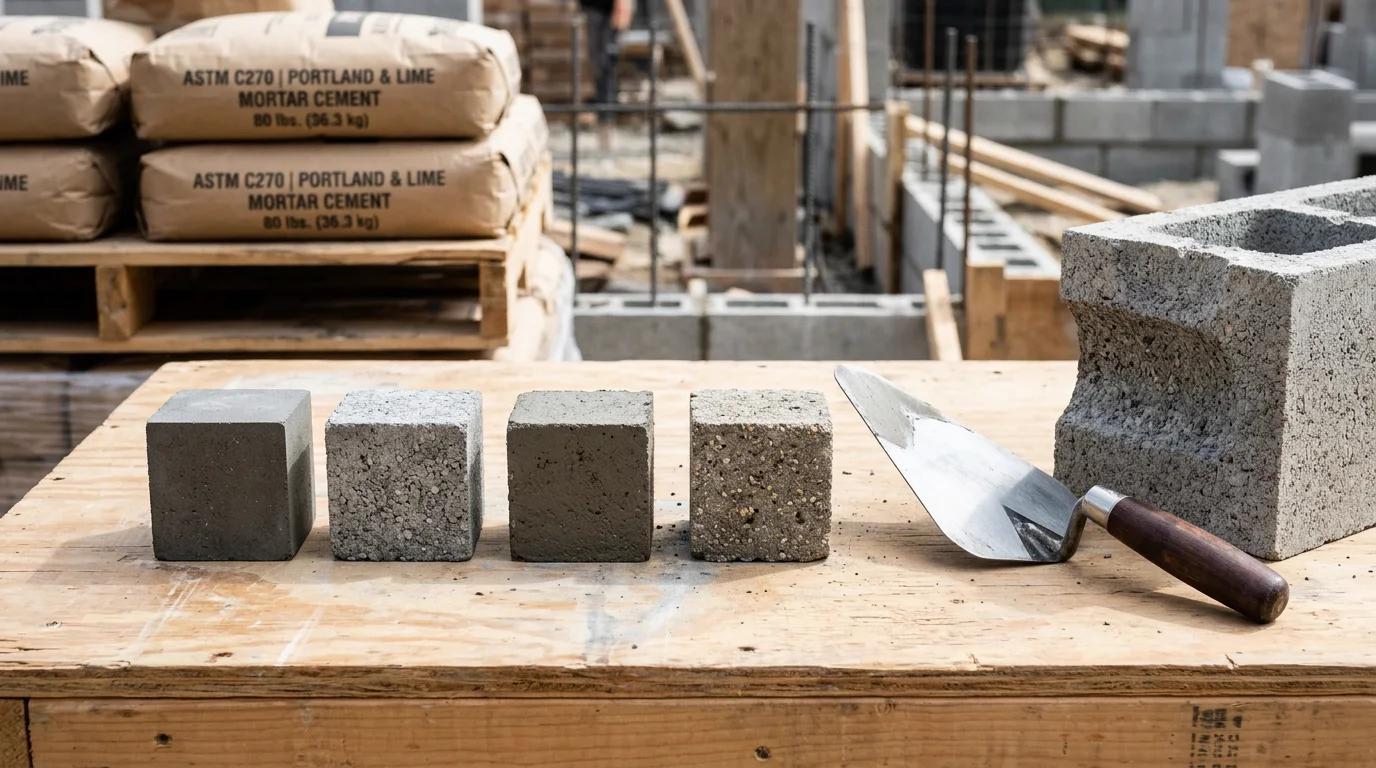
ASTM C270 Mortar Type Selector & Bag Takeoff Estimator
Match Type M, S, N, or O compressive strength and Portland-lime-sand ratios to your structural or veneer masonry application and size pre-blended bags.
1. Decoding MaSoN wOrK: Why Four Mortar Types Exist
The letters M, S, N, and O come from every second letter in the classic masonry phrase MaSoN wOrK (Type K, at 75 PSI, was historically reserved for fragile heritage preservation and is largely omitted from modern structural tables). Rather than representing a ladder from “worst” to “best,” ASTM C270 classifies mortar along a calibrated engineering trade-off between compressive stiffness and elasticity, bond adhesion, and vapor permeability.
Every mortar batch balances three primary ingredients: Portland cement (early strength and hydraulic set), Type S hydrated lime (plasticity, water retention, and elasticity), and washed masonry sand conforming to ASTM C144 (aggregate skeleton that controls drying shrinkage). Increasing Portland cement pushes 28-day compressive strength upward, while increasing hydrated lime softens the hardened joint so a wall can absorb thermal expansion and minor foundation settling without fracturing the masonry units themselves.
2. ASTM C270 Type M, S, N, and O Engineering Comparison Matrix
The matrix below summarizes ASTM C270 laboratory minimum 28-day compressive strength (Property standard) alongside standard volumetric Proportion recipes (by volume of cementitious material to damp, loose masonry sand).
| Mortar Type | Min 28-Day PSI | Portland : Lime : Sand | Masonry Cement Ratio | Water Retention & Bond | Best Masonry Application |
|---|---|---|---|---|---|
| Type M | 2,500 PSI | 1 : 1/4 : 3 to 3-3/4 | 1 Type M : 2-1/4–3 sand | ≥ 75% retention; low elasticity, stiffest joint | Below-grade retaining walls, footings, heavy stone paving, driveways |
| Type S | 1,800 PSI | 1 : 1/2 : 4 to 4-1/2 | 1 Type S : 2-1/4–3 sand | ≥ 75% retention; highest tensile bond against lateral loads | Exterior loadbearing CMU walls, basements, foundations, high-wind zones |
| Type N | 750 PSI | 1 : 1 : 4-1/2 to 6 | 1 Type N : 2-1/4–3 sand | ≥ 75% retention; good workability, vapor permeability & healing | Above-grade clay brick veneer, chimneys, soft stone, non-load partitions |
| Type O | 350 PSI | 1 : 2 : 6-3/4 to 9 | 1 Type N + lime (or specialty) | ≥ 75% retention; very soft, breathable, sacrificial joint | Interior non-loadbearing walls, historic soft-brick repointing (non-freeze) |
Proportion Rule Note: Under ASTM C270, total damp, loose sand volume must always equal 2.25 to 3 times the sum of the separate volumes of cementitious materials (Portland cement + hydrated lime). Need custom site-batched volumes? Run exact shovel and cubic-foot ratios in our Portland-lime mortar calculator.
3. Proportion vs. Property Spec & Portland-Lime vs. Masonry Cement
ASTM C270 provides two mutually exclusive compliance pathways. Under the Proportion specification, engineers rely on time-tested volumetric recipes (Table 1 of ASTM C270); no compressive cylinder testing is required on-site as long as the constituent Portland cement (ASTM C150), hydrated lime (ASTM C207), and sand (ASTM C144) are measured cleanly by volume. Under the Property specification, a testing laboratory designs a custom mix to verify three lab metrics: minimum 28-day compressive strength, minimum 75% water retention, and maximum entrained air content. A project specification must select one pathway or the other—never blend a lab strength target with a rigid field recipe.
Portland Cement + Hydrated Lime + Sand
Blending Type I/II Portland cement with Type S hydrated lime produces a denser, low-air mortar matrix (typically under 12% entrained air). Because high entrained air reduces microscopic mechanical keying inside brick and CMU pores, Portland-lime mortar achieves higher flexural tensile bond under TMS 402 structural tables and is often required in Seismic Design Categories D–F.
Pre-Blended Masonry Cement Bags (ASTM C91)
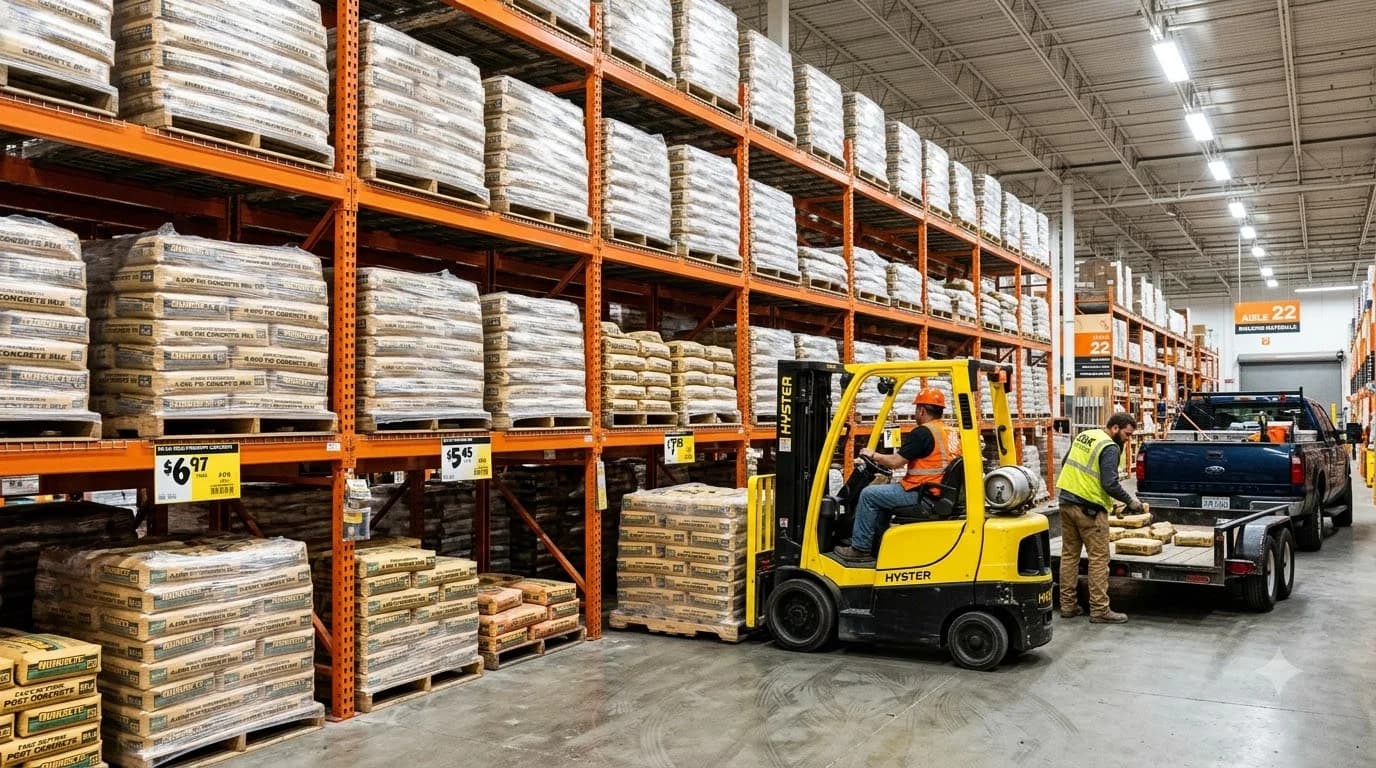
Masonry cement bags combine Portland clinker with ground limestone plasticizers and air-entraining admixtures. Masons prize masonry cement for consistent color and buttery trowelability, and 80-lb pre-blended bags simplify small concrete block wall builds. Just note that higher air content (12%–19%) yields lower allowable flexural tension than Portland-lime or ASTM C1329 mortar cement.
4. Why Compressive PSI Is Not Enough: Bond, Breathability & The Golden Rule
Even a 750 PSI Type N mortar carries far more vertical dead load than a two-story residential masonry wall ever experiences. In real-world masonry failures, walls rarely crush downward; instead, they leak, crack horizontally from wind or earth pressure, or lose unit faces to freeze-thaw spalling. Four non-compressive metrics govern field durability:
- Tensile Bond & Flexural Strength: Mortar must glue adjacent courses tightly enough to resist lateral wind suction and backfill bending. Type S Portland-lime mortar generally achieves the highest bond intimacy with dense concrete masonry units.
- Water Retention (≥ 75%): Dry clay bricks and hollow CMU face shells act like sponges. High-lime mortars hold mixing water against suction long enough for cement crystals to hydrate completely at the unit interface.
- Vapor Permeability & Autogenous Healing: Hydrated lime leaves microscopic vapor pathways that let trapped wall moisture escape through the joints. Uncarbonated calcium hydroxide also migrates into hairline shrinkage cracks and recrystallizes upon contact with rainwater and carbon dioxide, sealing micro-voids over time.
The Golden Rule of Masonry: Mortar Must Stay Softer Than the Unit
Think of mortar as a sacrificial cushion. When temperatures swing or moisture freezes inside a wall, the mortar joint must yield or crack first because repointing a mortar joint costs a fraction of replacing shattered brick. If you pack 2,500 PSI Type M mortar against 100-year-old low-fired clay brick, the rigid mortar locks the brick edges in compression and blocks vapor drying—forcing the brick face itself to pop off (spall). Always match soft or historic brick with Type N or Type O mortar via a tuckpointing mortar calculator.
5. Worked Bag Takeoff Example & Pre-Blended Yield Table
CinderCalc's masonry takeoff engine uses a verified planning benchmark of 30 standard 8×8×16 concrete masonry units per 80-lb pre-blended mortar bag (assuming standard 3/8-inch face-shell and end-web bedding), which converts to ~3.33 bags per 100 blocks (rounded up to 4 bags per 100 blocks when ordering). Because thicker walls have wider face shells and deeper webs, adjust your bag count by unit width: 0.6× for 4-inch CMU, 0.8× for 6-inch CMU, 1.0× for 8-inch CMU, and 1.4× for 12-inch CMU.
Worked Example: 300-Block 8-Inch CMU Foundation Wall (Type S)
- Standard 8-in CMU bag count:
300 blocks ÷ 30 blocks/bag = 10 bags(80-lb pre-blended Type S mortar, yielding ~0.60 cu ft per bag). - 100-block benchmark check:
(100 ÷ 30) = 3.33 bagsper 100 blocks; orderingceil(100 ÷ 30) = 4 bagscovers hawk drop and cutoff waste on small 100-block runs. - Wall-width adjustment check: If the same 300 units were 6-inch partition CMU (
0.8×), you would needceil(10 × 0.8) = 8 bags; for 12-inch retaining CMU (1.4×), planceil(10 × 1.4) = 14 bags; for 4-inch veneer CMU (0.6×), planceil(10 × 0.6) = 6 bags. - Illustrative planning budget: At an illustrative retail planning example of ~$8–$13 per 80-lb pre-blended bag, 10 bags run roughly $80–$130 before regional taxes or pallet delivery.
| Masonry Unit Size | Width Multiplier | Units / 80-lb Bag | Bags / 100 Units | Bags for 300 Units | Illustrative Bag Budget ($8–$13/bag) |
|---|---|---|---|---|---|
| Standard Modular Clay Brick (3/8" joint) | Full bed | ~36–40 bricks | 3 bags | 8–9 bags | $64 – $117 |
| 4-inch CMU (4×8×16) | 0.6× | ~50 blocks | 2–3 bags | 6 bags | $48 – $78 |
| 6-inch CMU (6×8×16) | 0.8× | ~37.5 blocks | 3 bags | 8 bags | $64 – $104 |
| 8-inch CMU (8×8×16 Standard) | 1.0× | 30 blocks | 4 bags (3.33 exact) | 10 bags | $80 – $130 |
| 12-inch CMU (12×8×16) | 1.4× | ~21.4 blocks | 5 bags | 14 bags | $112 – $182 |
Need full-bedding calculations or 60-lb bag equivalents? Run your exact block count and joint width through our dedicated masonry mortar calculator.
6. Field Mixing, Board Life & Retempering Rules (TMS 602)
Even the cleanest ASTM C270 mix ratio fails if over-watered or held too long on the mortar board. Mechanical batch mixers should run for 3 to 5 minutes after all dry materials and water are added; hand-mixing in a tub rarely disperses hydrated lime uniformly. Hold back roughly 10% of the mixing water at first, then adjust until the mortar clings cleanly to a vertical trowel blade at a 45-degree tilt.
The 2 to 2.5 Hour Board-Life Rule
Under moderate temperatures, place mortar within 2 to 2.5 hours of first adding water. When ambient air exceeds 90°F (or in dry, windy conditions), TMS 602 shortens usable board life to 1.5 hours and requires shading sand piles and mixing water.
Safe Retempering vs. Discarding
Adding small splashes of clean water to replace sun/wind evaporation (retempering) is valid only before initial cement hydration set begins. Once a batch turns gritty, stiff, or lumpy from chemical hydration—especially above 90°F— discard it immediately; re-wetting set mortar slashes bond strength by over 50%.
7. Common Mortar Selection Mistakes & Failure Modes
Most masonry defects trace back to picking a mix solely by compressive PSI or cutting lime out of the recipe. Review these four recurring jobsite failures before ordering pallets:
| Common Selection Mistake | Wrong Mix Used | Field Failure Mode | Correct ASTM C270 Spec |
|---|---|---|---|
| Repointing soft historic brick with high-PSI mortar | Type M (2,500 PSI) | Brick face spalling, trapped moisture, freeze-thaw shear fractures | Type N (750 PSI) or Type O (350 PSI) |
| Building exterior CMU foundation with veneer mortar | Type N or Type O | Horizontal bed-joint cracking under backfill lateral earth pressure | Type S (1,800 PSI) or Type M (2,500 PSI) |
| Batching lime-free Portland + sand “brick mix” | 1:3 Portland:Sand (no lime) | Harsh trowelability, rapid water loss, shrinkage hairline cracks & leaks | ASTM C270 Portland + Type S Hydrated Lime |
| Retempering stiffened mortar after 3 hours or above 90°F | Expired Type S/N batch | Chalky, weak joints that crumble under fingernail scraping and fail bond | Fresh batch every 2–2.5 hrs (1.5 hrs > 90°F) |
Calculate Exact Mortar Bags & Mix Volumes
Ready to order pre-blended pallets or bulk Portland cement, hydrated lime, and masonry sand? Run your wall dimensions or repointing area through our dedicated masonry tools.
Frequently Asked Questions
Which mortar type is best for concrete block (CMU) foundation walls?
ASTM C270 Type S mortar (1,800 PSI minimum 28-day compressive strength) is the standard choice for above- and below-grade CMU foundation walls because it balances high flexural bond strength against lateral soil pressure with workable water retention. Type M (2,500 PSI) is reserved for heavy retaining walls, below-grade footings, and driveways subjected to severe freeze-thaw saturation.
Why shouldn't I always use the strongest mortar (Type M) for every project?
Mortar must remain softer and more vapor-permeable than the masonry unit it bonds. Using rigid 2,500 PSI Type M mortar with soft clay brick or historic stone traps moisture and transfers thermal expansion stress directly into the masonry units, causing brick face spalling and structural cracking instead of sacrificial joint wear.
How many 80-lb bags of pre-blended mortar do I need for 100 concrete blocks?
As a standard planning rule for 8-inch nominal (8×8×16) concrete masonry units with 3/8-inch face-shell mortar joints, one 80-lb pre-blended mortar bag lays approximately 30 blocks. That equals 3.33 bags per 100 blocks, which builders round up to 4 bags per 100 blocks to cover hawk waste and partial end joints.
What is the difference between Portland-lime mortar and masonry cement mortar?
Portland-lime mortar blends Type I/II Portland cement, Type S hydrated lime, and masonry sand, producing lower entrained air, higher tensile bond strength, and autogenous crack healing. Masonry cement bags contain pre-blended limestone fillers and air-entraining admixtures for creamy trowelability, though higher air content (12%–19%) typically yields lower flexural bond strength.
Can you mix ASTM C270 Proportion and Property specifications on the same job?
No. ASTM C270 explicitly prohibits combining the Proportion specification and Property specification on a single project. You either follow the volumetric recipe tables (Portland:Lime:Sand parts by volume) using compliant raw materials, or you batch to lab-verified performance targets (PSI, water retention, and air content) certified by pre-construction testing.
How long can mixed mortar sit on the mortar board, and can it be retempered?
Under normal ambient conditions, masonry mortar should be used within 2 to 2.5 hours of initial mixing. You may retemper mortar with small splashes of clean water to replace evaporation loss during that window, but discard any batch once cement hydration stiffening begins or after 1.5 hours when temperatures exceed 90°F.
Reference Standards & Source Catalogs
Standard Specification for Mortar for Unit Masonry
Governs Proportion and Property specifications, compressive strengths (M 2,500; S 1,800; N 750; O 350 psi), water retention, and air limits.
Read sourceStandard Specification for Loadbearing Concrete Masonry Units
Establishes minimum net-area compressive strength (2,000 psi) and dimensional tolerances for modular concrete masonry units.
Read sourceHydrated Lime for Masonry Purposes & Aggregate for Masonry Mortar
Defines Type S hydrated lime plasticity/water retention and well-graded masonry sand gradation limits for workability.
Read sourceBuilding Code Requirements and Specification for Masonry Structures
Establishes structural flexural bond design values, mortar board-life rules, hot/cold weather limits, and inspection protocols.
Read sourceInternational Residential Code: General Masonry Construction
Specifies allowable mortar types by wall exposure and reinforcement rules; always verify your locally adopted edition.
Read sourcePublisher links identify where to find the applicable standard; they do not establish certification or confirm every statement on this page. Check the edition, manufacturer data, and local adoption. Material takeoffs are planning estimates, and structural dimensions and reinforcement must come from the project design.
Popular Quick Estimates
Illustrative takeoffs with stated assumptions; verify project quantities
Type S Mortar Bags
Example 30 blocks per 80-lb bag; check product yield
10x10 Wall Estimate
Standard residential yard & garden wall run
100 Sq Ft Sizing
Standard 8x8x16 nominal coverage benchmark
Standard CMU Weight
Illustrative hollow-unit range; check supplier specs
Related Calculators
Specialized tools for foundation, core fill, and budgeting
Brick, block, and stone joint mortar bags and masonry sand
ASTM C270 Type M, S, N site-mix Portland cement, hydrated lime, and sand batches
Repointing mortar bags, raked joint linear feet, diamond grinding blades, and labor
Heavyweight structural blocks and bond beam units
Blogs & Construction Guides
Practical guides to block sizing, material estimates and project planning
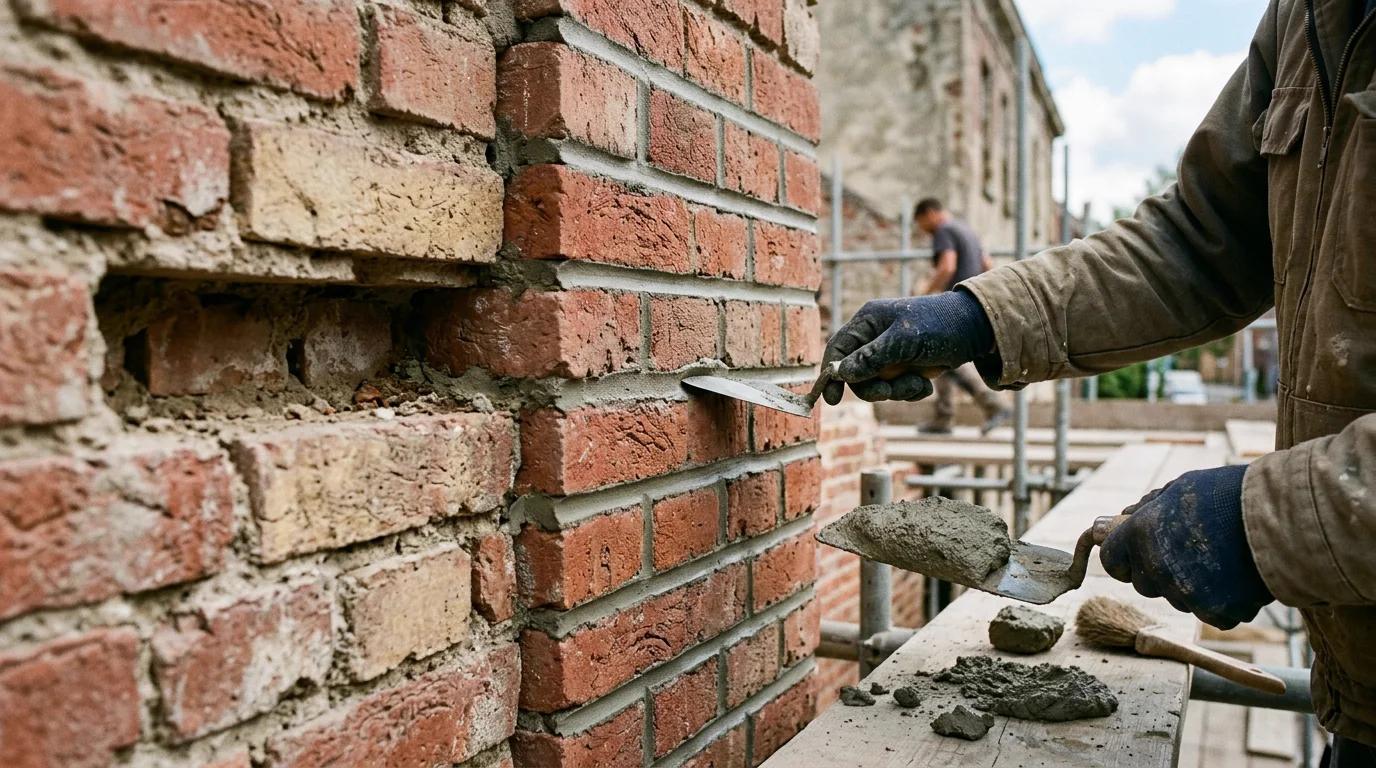
How to Tuckpoint and Repoint Mortar Joints (Step-by-Step)
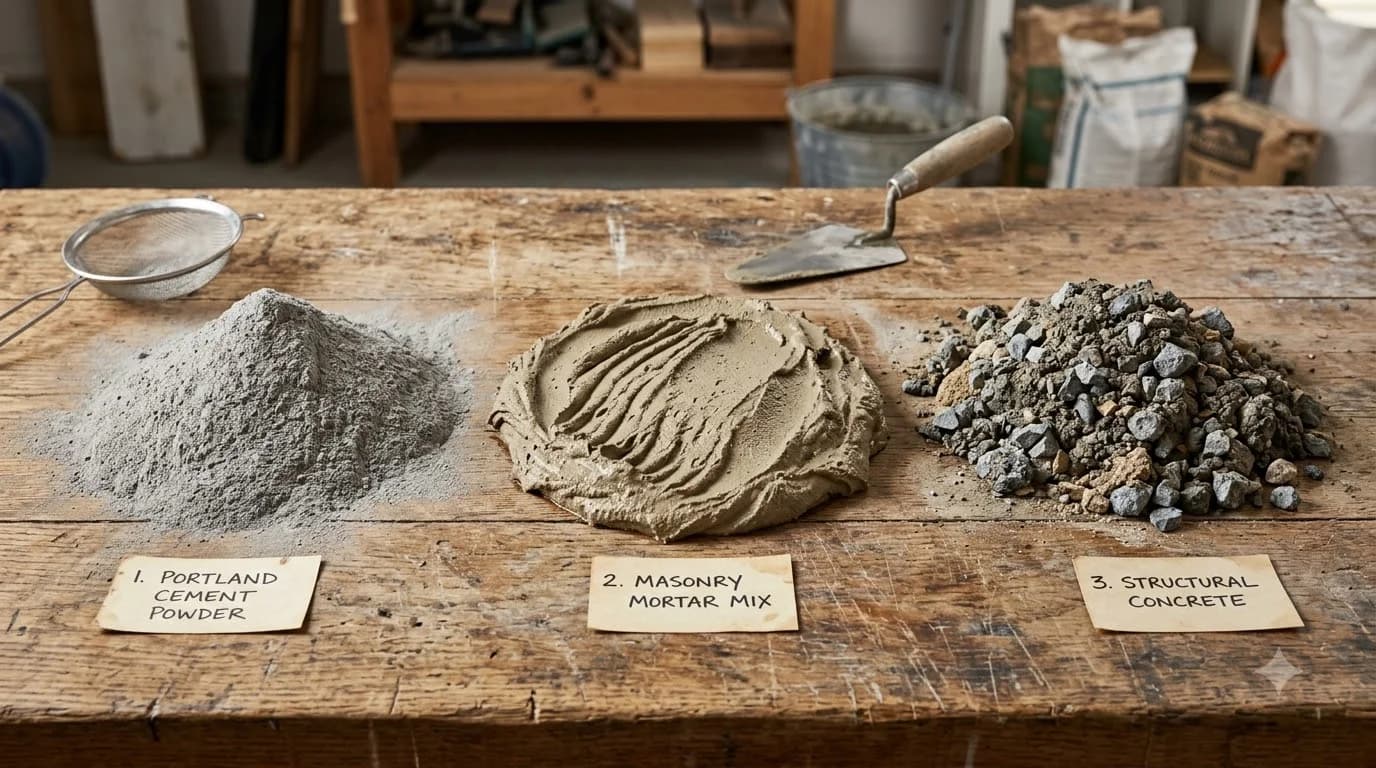
Concrete vs Cement vs Mortar: Key Differences & Mixes
How Many Cubic Feet in a Bag of Concrete? (Bag Yields)