Full-Pallet Order & Shipment Weight Calculator
Example defaults: 108 blocks per pallet, 36 lb per block and 40 lb per empty pallet. Replace these with your supplier's figures. This estimates complete pallets; it does not add waste to the blocks you enter.
1 pallets · 108 blocks delivered · Details
- Pallets to order
- 1
- Blocks delivered
- 108
- Extra blocks
- 0
- Shipment weight (lb)
- 3,928
Shipment weight includes every block on the ordered pallets and the empty pallets. Moisture, wrap and other cargo can increase the actual load. Check the specific vehicle's payload label, axle/tire ratings, trailer and hitch limits, passengers and other cargo; this estimate does not determine whether transport is safe.
Calculate the wall's block requirement1. Pallet Stacking Geometry & Cube Footprints
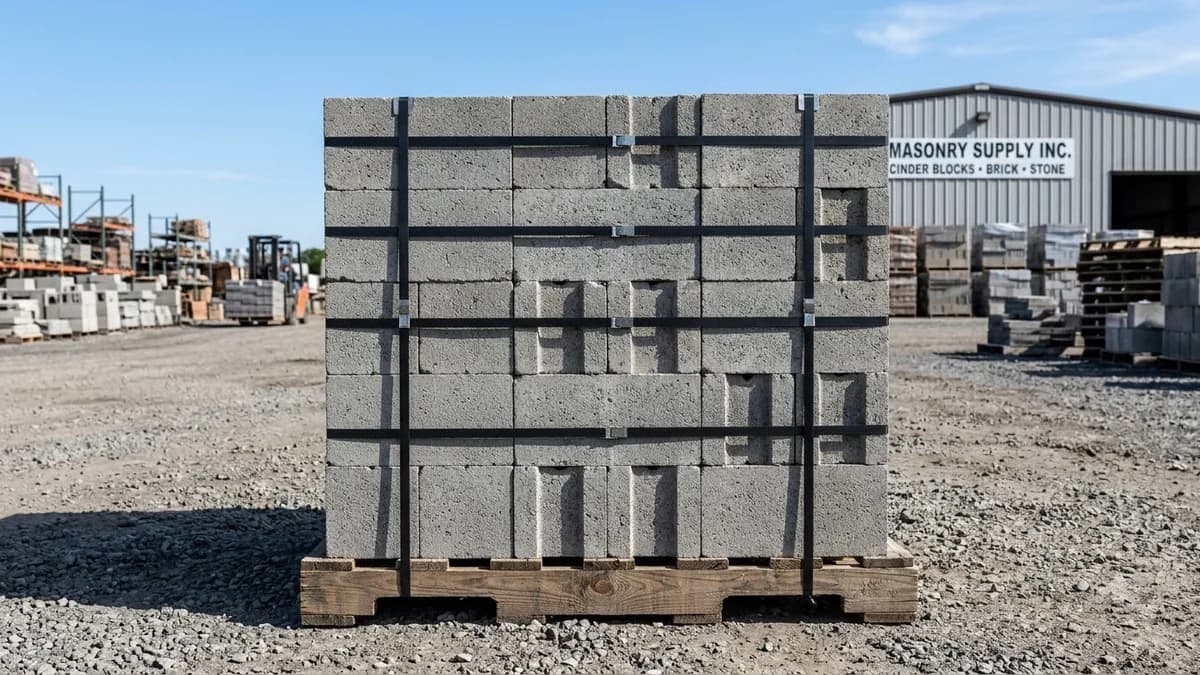
Concrete masonry plants bundle blocks on automated cubers rather than hand-stacking them. That is why two supply yards in the same city can quote either 108 blocks or 120 blocks for an 8×8×16 pallet: each plant configures its cuber pattern around its wood skid size, strapping machine, and forklift fleet.
- • 3 tiers × 36: Lower ~28–29 in. overall height (~23 in. block + ~5.5 in. pallet); wide, stable center of gravity on 40″×48″ or 48″×48″ skids.
- • 4 tiers × 27: Narrower footprint (~36 in. tall including skid) with interlocking 90°-rotated layers for banding tension.
- • Wall yield: 108 ÷ 1.125 blocks/sq ft = 96.0 sq ft net wall area (~87 sq ft after 10% cutting waste).
- • 4 tiers × 30 or 5 tiers × 24: Common commercial masonry cubes (~36–44 in. tall); heavier per lift (~4,360 lb at 36 lb/block).
- • 40″×48″ GMA vs 32″×48″ cube: Standard 4-way hardwood pallets measure 40″×48″, while many block plants strap 32″×48″ or 36″×48″ cubes (including palletless core-slot cubes) to fit two wide on a flatbed.
- • Wall yield: 120 ÷ 1.125 blocks/sq ft = 106.7 sq ft net wall area (~97 sq ft after 10% waste).
Always confirm whether your supplier ships on a wood skid or as a strapped cube with bottom forklift tine slots—and measure between wheel wells (~48 in. on many full-size trucks) before assuming a 40″×48″ pallet can slide flat inside a vehicle bed.
2. Pallet Pack Counts, Wall Coverage & Weight by Block Size
The table below applies palletOrder() math across standard nominal CMU widths from 4×8×16 to 12×8×16 using illustrative normal-weight hollow unit weights and a 40-lb empty wood pallet. Supplier pack counts and unit weights vary by plant, core geometry, and aggregate density—replace these defaults with your supplier's SKU sheet.
| Nominal size | Blocks / pallet | Net area / pallet | Est. unit wt | Loaded skid (+40 lb) | 200-block order (pallets · delivered / extra) |
|---|---|---|---|---|---|
4×8×16 Partition / veneer cube | 144 | 162.0 sq ft | 20 lb | 2,920 lb | 2 pallets · 288 / 88 extra |
6×8×16 Screen / shed wall cube | 120 | 135.0 sq ft | 28 lb | 3,400 lb | 2 pallets · 240 / 40 extra |
8×8×16 Standard yard skid (3×36 or 4×27) | 108 | 121.5 sq ft | 36 lb | 3,928 lb | 2 pallets · 216 / 16 extra |
8×8×16 Commercial yard cube (4×30 / 5×24) | 120 | 135.0 sq ft | 36 lb | 4,360 lb | 2 pallets · 240 / 40 extra |
10×8×16 Wide stem-wall cube | 90 | 101.3 sq ft | 43 lb | 3,910 lb | 3 pallets · 270 / 70 extra |
12×8×16 Heavy foundation cube | 72 | 81.0 sq ft | 50 lb | 3,640 lb | 3 pallets · 216 / 16 extra |
How Block Density Changes 8×8×16 Pallet Weight
Under ASTM C90, concrete masonry units are produced in lightweight (<105 pcf), medium-weight (105–125 pcf), and normal-weight (≥125 pcf) concrete mixes. Even at the exact same 108-block pack count, aggregate density swings a skid by more than 1,000+ pounds.
| ASTM C90 density class | Typical unit range | 108-block skid (+40 lb) | 120-block skid (+40 lb) |
|---|---|---|---|
| Lightweight (<105 pcf) | 25–28 lb/unit (26 lb ex.) | 2,848 lb | 3,160 lb |
| Medium-Weight (105–125 pcf) | 30–33 lb/unit (32 lb ex.) | 3,496 lb | 3,880 lb |
| Normal-Weight (≥125 pcf) | 35–40 lb/unit (36 lb ex.) | 3,928 lb | 4,360 lb |
| Heavy / Damp Normal-Weight | 38–42 lb/unit (39 lb ex.) | 4,252 lb | 4,720 lb |
Need wall quantities first? Estimate net blocks and cutting waste with our cinder block calculator or cinder block wall calculator, then enter the waste-adjusted block total into the pallet tool above (it does not add a second waste allowance).
3. Full-Pallet Ordering & Shipment Weight Formula
Full-pallet math rounds up to whole cubes and accounts for the empty skid weight on every pallet:
Pallets = ceil(Required Blocks ÷ Blocks per Pallet)
Delivered Blocks = Pallets × Blocks per Pallet
Shipment Weight (lb) = (Delivered Blocks × Unit Weight) + (Pallets × Empty Pallet Weight)
Worked example: 200 required blocks ÷ 108 per pallet = 1.85 → rounds up to 2 pallets. You receive 216 blocks (16 extra blocks). At 36 lb per block and 40 lb per empty pallet, shipment weight is (216 × 36) + (2 × 40) = 7,856 lb before shrink-wrap or rain moisture.
For hollow versus solid or grouted unit weights, check our CMU block weight guide and pallet weight and truck hauling guide.
4. Pickup Truck & Trailer Hauling Safety Check
A single full pallet of normal-weight 8×8×16 blocks weighs 3,928 to 4,360 lb—nearly two short tons concentrated on a 40″×48″ footprint. No generic pickup class name (“half-ton”, “three-quarter-ton”, or “one-ton”) guarantees safe hauling capacity. Cab size, 4WD hardware, bed length, and trim options all reduce remaining payload.
- • Door-jamb payload sticker: Check the yellow/white Tire and Loading Information label (“combined weight of occupants and cargo”) and subtract driver, passengers, tools, and racks.
- • GVWR & Rear GAWR: A pallet sits over or behind the rear axle, so rear axle rating (GAWR) and tire load index often max out before total GVWR.
- • Trailer & hitch ratings: Verify trailer axle rating minus empty trailer curb weight, plus 10–15% tongue weight against receiver limits and tow-vehicle payload.
- • Partial bed loads: For example, if a pickup's remaining payload after driver and gear is 1,400–1,600 lb, a safe partial load of 36-lb blocks is roughly 38–44 loose blocks (~1/3 pallet), not a full 108-unit skid.
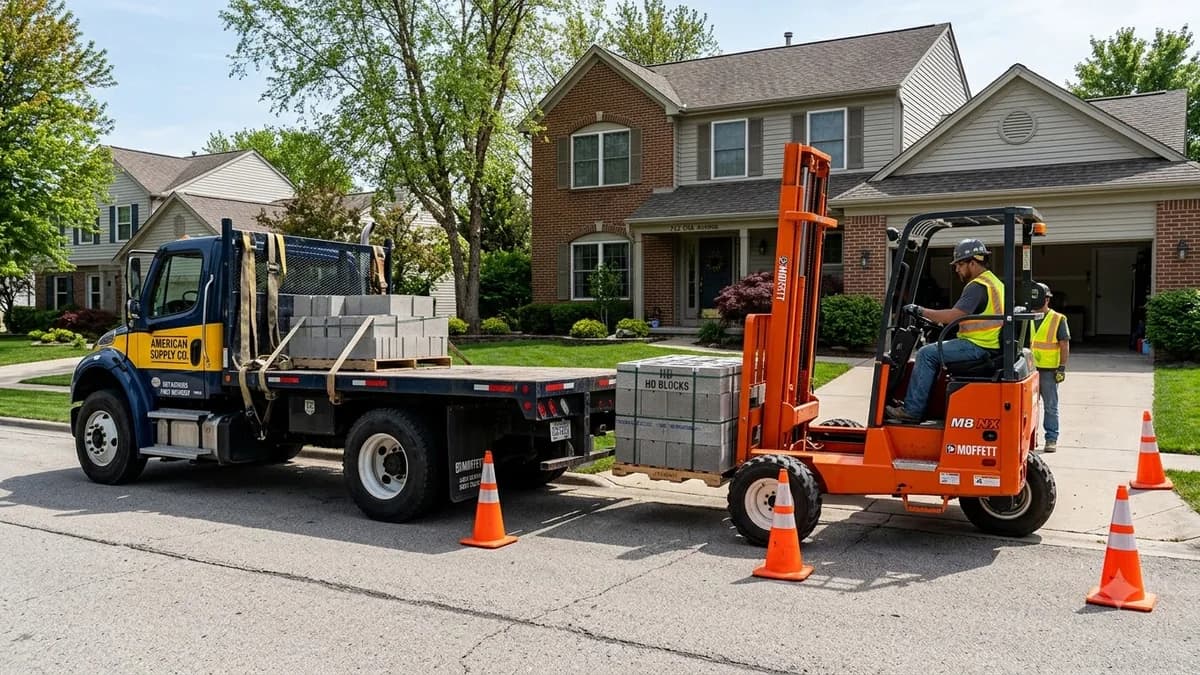
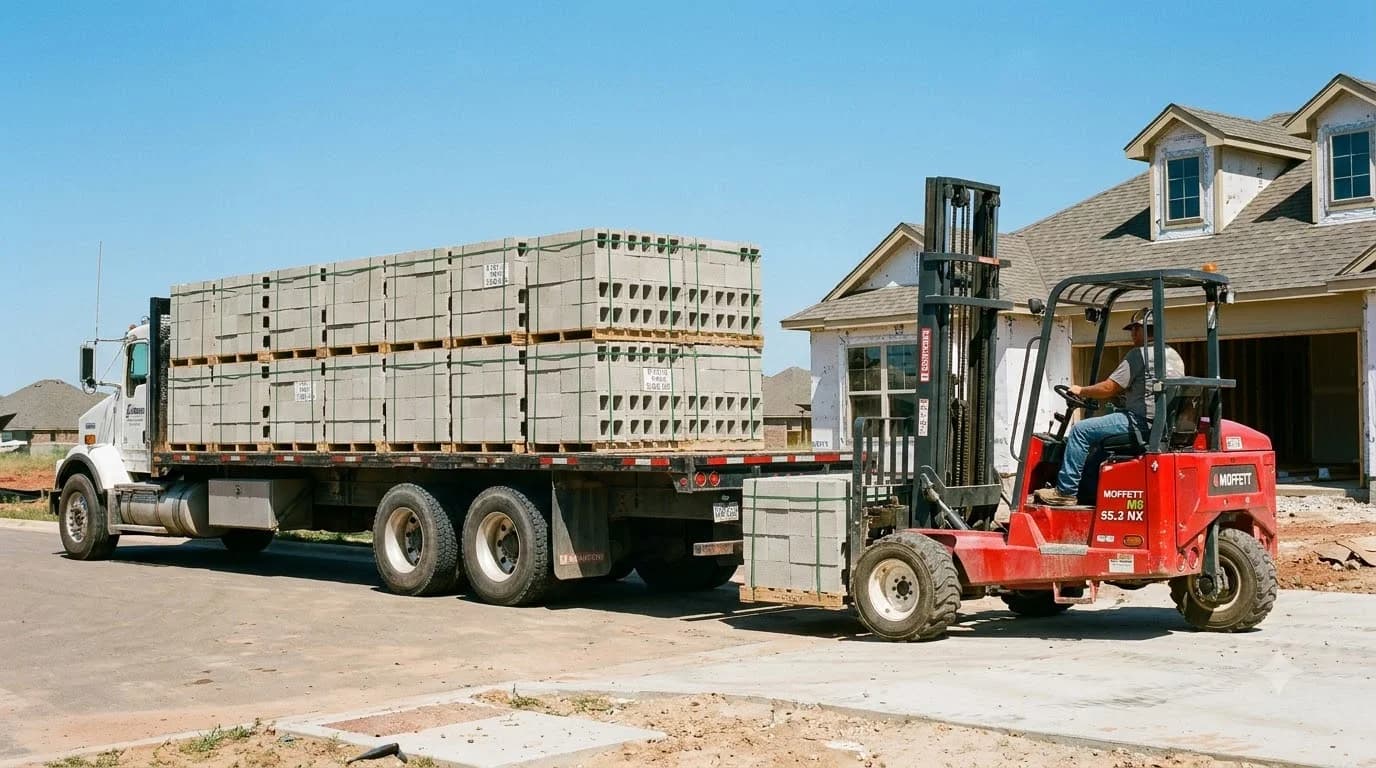
- • Use yard delivery for ≥1 full skid: Flatbed Moffett (piggyback forklift) or boom-truck delivery typically beats multiple risky pickup trips in time, suspension wear, and tire safety.
- • Load forward & strap down: When hauling partial loads on a trailer or bed, center weight slightly ahead of the axle(s), keep height below bed rails, and secure with rated ratchet straps.
- • Account for wet blocks: Uncovered pallets exposed to yard rain hold extra water weight beyond dry catalog specs.
5. Cost per Pallet vs Loose Blocks & Offloading Checklist
Pallet material cost follows simple multiplication: Delivered Quantity × Quoted Unit Price. As an illustrative planning example (not a live retailer quote), 108 blocks at $2.50 each equals $270 (and 120 blocks equals $300) before sales tax, pallet deposits, and delivery charges. Across typical illustrative unit prices of $1.50 to $3.00 per 8×8×16 block, a 108-unit skid ranges from $162 to $324 in block cost alone.
Full cubes are best when your requirement is close to a pallet multiple (e.g., 100–108 or 195–216 blocks), your supplier offers a lower bundled unit price or charges a cube-breaking fee on partial orders, and a forklift or boom truck can set the skid near your work zone.
If you need 120 blocks and the yard sells 108-unit skids without a split-pack penalty, ordering 1 full pallet + 12 loose blocks avoids paying for 96 surplus blocks on a second pallet. Always compare the cost of leftover blocks against any per-piece upcharge.
Pre-Delivery Deposit & Offloading Checklist
- Confirm pallet deposit & return window: Many masonry yards charge a refundable deposit (often $15–$30+ per heavy hardwood skid as an illustrative yard example) refunded when the undamaged pallet is returned with your invoice.
- Verify offloading equipment: Confirm whether the delivery truck carries a Moffett piggyback forklift or boom crane; standard flatbeds require your own telehandler or skid-steer rated ≥ 4,500 lb.
- Check access, slope & overhead lines: 26-ton delivery trucks need firm driveway or compacted gravel bearing, sufficient gate width (~10–12 ft), and clearance from low tree branches or power lines for booms.
- Stage on level ground & cover from rain: Set pallets on firm, flat cribbing away from trench edges and keep blocks wrapped or tarped so moisture does not add weight or cause premature efflorescence.
Also review actual versus nominal block height (7-5/8 in.) before laying out course elevations.
Frequently Asked Questions
How many cinder blocks are on a pallet?
A standard 8×8×16 pallet typically holds 108 blocks (3 tiers of 36 or 4 tiers of 27) or 120 blocks in commercial yard cubes, though there is no universal industry count. Confirm the exact packaged quantity for your manufacturer, block shape, and supplier SKU before ordering.
How many 4-inch, 6-inch, 10-inch, or 12-inch blocks are on a pallet?
Illustrative supplier pack counts by nominal width are 144 blocks per pallet for 4×8×16 units, 120 blocks for 6×8×16 units, 108 blocks (or 120) for 8×8×16 units, 90 blocks for 10×8×16 units, and 72 blocks for 12×8×16 units. Actual cube counts depend on plant packaging and pallet footprint.
How much does a full pallet of cinder blocks weigh?
Multiply every delivered block by the supplier's unit weight and add the empty pallet and packaging. Using normal-weight 8×8×16 planning examples (36 lb per block and a 40-lb skid), a 108-block pallet weighs 3,928 lb and a 120-block pallet weighs 4,360 lb before moisture or wrap.
Can I carry a full pallet of cinder blocks in a pickup truck?
Most standard pickup beds cannot safely haul a full 3,600 to 4,360 lb pallet. Do not rely on a half-ton or three-quarter-ton class label; check your door-jamb payload sticker, GVWR, rear axle GAWR, tire ratings, and trailer hitch limits after subtracting passengers and gear, or schedule supplier delivery.
How much does a pallet of cinder blocks cost, and are deposits refundable?
Multiply the quoted unit price by the full pallet quantity, then add applicable taxes, pallet deposits, and delivery fees. For planning arithmetic, 108 blocks at an illustrative $2.50 each equals $270 before fees. Many yards charge a refundable pallet deposit when the intact skid is returned with a receipt.
Should I order loose blocks or a full pallet?
Order full pallets when your requirement approaches or exceeds a full cube and your site can offload 2-ton skids, because bundled cubes speed handling and may avoid split-pack fees. Order loose units for small repairs or when leftover blocks from rounding up to another pallet would cost more than paying per-piece pricing.
Does the pallet calculator estimate loose blocks or full pallets?
It estimates full-pallet orders. For 200 required blocks at 108 blocks per pallet, 36 lb per block, and a 40-lb empty pallet, it returns 2 pallets, 216 delivered blocks, 16 extra blocks, and 7,856 lb total shipment weight.
Reference Standards & Source Catalogs
Loadbearing concrete masonry units
Specification context for density classifications and net compressive strength, not a fixed block weight or pallet count. Consult the applicable edition and selected manufacturer's product data.
Read sourceConcrete masonry technical resources
Industry guidance on unit properties and masonry construction. Numeric order examples on this page are declared planning assumptions, not sourced packaging specifications.
Read sourceSelected product and delivery quote
Confirm SKU, pack quantity, unit and loaded pallet weights, skid dimensions, deposit terms, pricing, and delivery access directly with your supplier.
Publisher links identify where to find the applicable standard; they do not establish certification or confirm every statement on this page. Check the edition, manufacturer data, and local adoption. Material takeoffs are planning estimates, and structural dimensions and reinforcement must come from the project design.
Popular Quick Estimates
Illustrative takeoffs with stated assumptions; verify project quantities
1000 Sq Ft Sizing
High-volume logistics & bulk pallet freight
Standard CMU Weight
Illustrative hollow-unit range; check supplier specs
Masonry Steps Riser
Check local stair rules and project-specific design
Block Filler Gallons
Illustrative coverage; use the selected coating label
Related Calculators
Specialized tools for foundation, core fill, and budgeting
Calculate runner contact pressure and plywood dunnage distribution
Commercial 1,125 net block takeoff, 12 pallets, and bulk mortar estimates
Exact block, mortar bag, and pallet count for a 10×10 ft (100 sq ft) masonry wall
Step-by-step masonry formulas and corner waste rules
Blogs & Construction Guides
Practical guides to block sizing, material estimates and project planning
How Much Does a Pallet of Concrete Weigh? (~3,360 lbs)
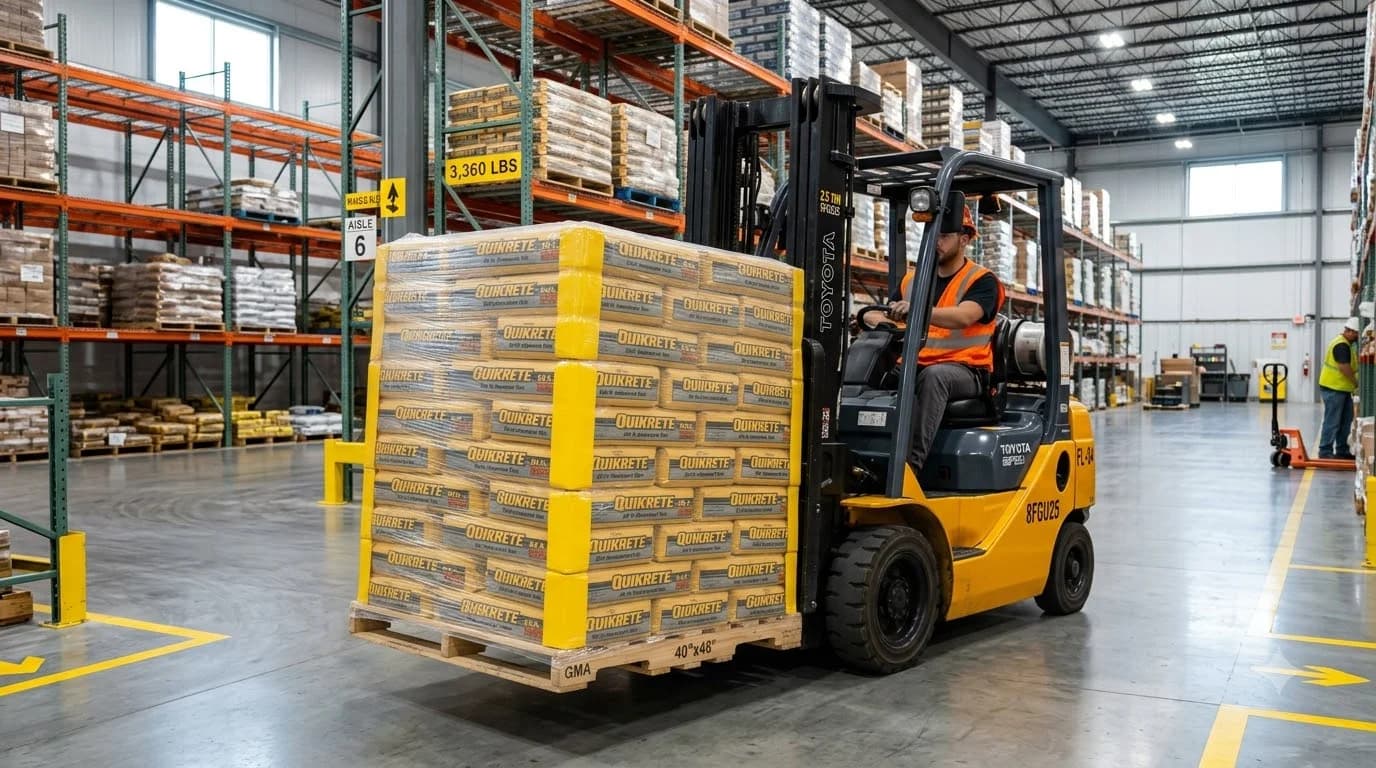
How Many Bags of Concrete on a Pallet? (Full Spec)
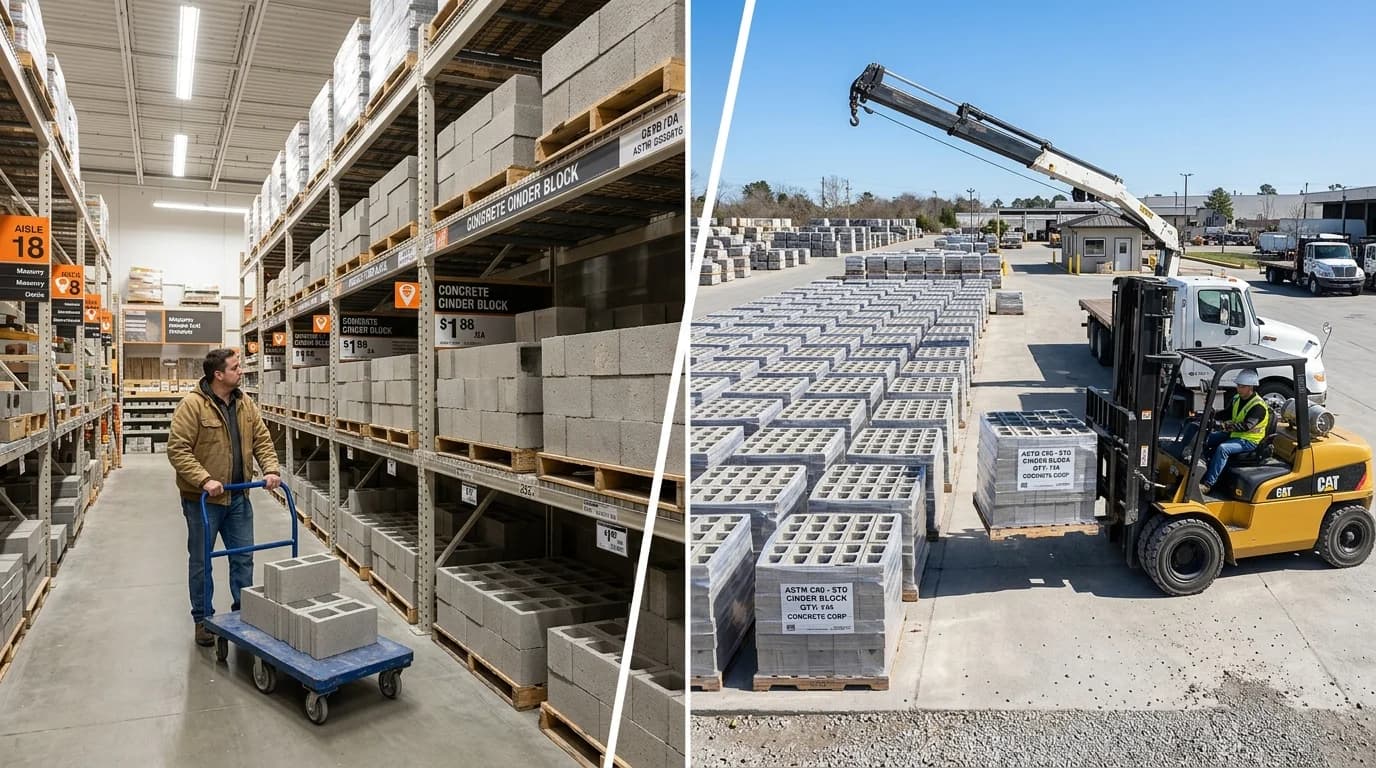
Where to Buy Cinder Blocks: Big Box vs Masonry Supply