Executive Structural Summary
In everyday language across America, homeowners, contractors, and retail clerks say "cinder block" when referring to almost any hollow gray masonry unit. However, on architectural blueprints, municipal permits, and structural engineering calculations, CMU (Concrete Masonry Unit) is the only code-approved specification.
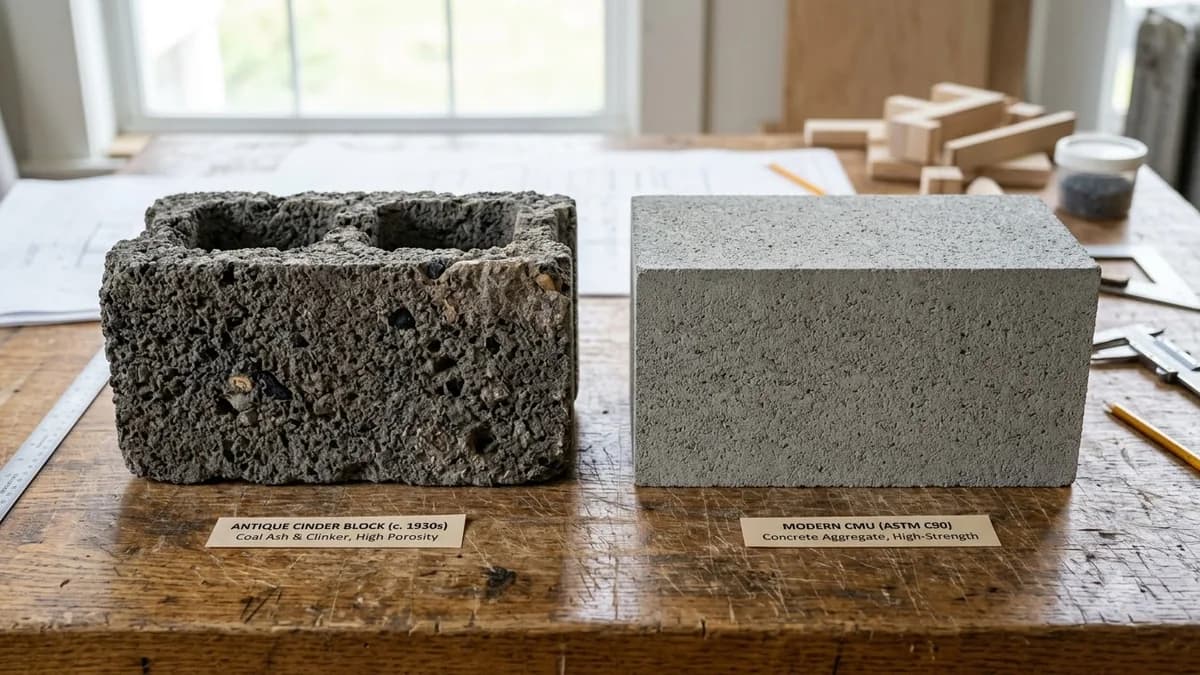
True cinder blocks are historic relics manufactured from industrial coal ash between 1900 and 1965. Modern concrete blocks are high-strength structural units manufactured with Portland cement and aggregate under strict ASTM C90 quality standards.
1. Master Comparison Matrix: CMU vs Concrete Block vs Cinder Block
| Characteristic | CMU (ASTM C90 Standard) | Concrete Block (General Term) | Historic Cinder Block |
|---|---|---|---|
| Primary Ingredients | Portland cement, graded sand, crushed gravel, limestone | Portland cement, crushed stone, sand, water | Coal cinders, combustion fly ash, weak cement slurry |
| Compressive Strength | 1,900 to 3,000+ psi (ASTM C90) | 1,800 to 2,500 psi | 400 to 800 psi (Structurally Fragile) |
| Typical Weight (8x8x16) | 34 to 42 lbs (Medium / Normal-weight) | 35 to 40 lbs | 24 to 28 lbs (Very light) |
| Water Absorption Limit | Dense, low absorption (≤ 13 to 17 lb/cu ft) | Low absorption, moisture resistant | Extremely porous (> 22 lb/cu ft); sponge-like |
| Building Code Approval | Approved for all loadbearing foundations | Approved when stamped ASTM C90 | Prohibited for loadbearing foundations |
2. The Chemistry of Coal Cinders: Why Historic Blocks Deteriorate
Between the 1910s and 1950s, manufacturers turned to industrial coal ash—a waste byproduct from coal-fired locomotives and municipal power plants—to produce cheap, lightweight building blocks. However, chemical instabilities caused significant long-term failures:
Coal cinders contain unburned sulfur compounds and iron pyrites. When groundwater penetrates the block, sulfur reacts with moisture to form weak sulfuric acid. This acid leaches the calcium hydroxide out of the cement binder, causing the block to powder, spall, and flake over decades.
Because coal-cinder blocks have very high porosity, they act like a sponge against saturated soil. During winter freeze-thaw cycles in northern states, expanding water crystals burst the delicate cellular walls of the block, creating horizontal hairline cracks and inward foundation bowing.
3. Jobsite Field Identification: 4 Tests for Contractors & Homeowners
If you are inspecting an older home built before 1970, how can you tell whether your basement foundation is built with antique coal-cinder blocks or modern concrete CMUs? Perform these 4 quick field tests:
Test 1: The Screwdriver Scratch Test
Firmly scrape a flathead screwdriver across an unfinished corner. Real cinder blocks are soft and will easily flake off dark crumbly gray powder. A modern ASTM C90 concrete block is rock-hard and will resist gouging or leave only a faint white scrape line.
Test 2: Visual Aggregate & Color
Examine the surface with a flashlight. Antique cinder blocks are dark charcoal or brownish-gray with visible shiny black glassy clinker flecks. Modern CMUs are uniform light gray with visible quartz sand and crushed limestone aggregate.
Test 3: Water Droplet Absorption
Splash a few drops of water onto bare block. Antique coal-cinder blocks absorb water almost instantaneously due to unsealed cellular pore structures. On modern dense CMUs, water beads temporarily on the surface before slowly soaking in.
Test 4: Weight & Heft Comparison
A salvaged 8x8x16 cinder block weighs approximately 24 to 28 lbs. A standard modern normal-weight 8x8x16 concrete masonry unit weighs 38 to 42 lbs (and medium-weight CMUs weigh 31 to 35 lbs).
4. Home Inspection Flags & Structural Retrofit Solutions
When buying or selling a home with an antique block basement, home inspectors and mortgage underwriters (especially FHA and VA loans) scrutinize foundation integrity:
The Inward Deflection Flag:If unbalanced soil pressure causes an old cinder block foundation wall to deflect inward by more than 1/2 inch across its height, it is flagged as a structural defect. Horizontal cracks along the 3rd or 4th mortar course indicate soil shear pressure exceeding the unreinforced wall's lateral capacity.
Modern Foundation Retrofitting: Foundation repair contractors stabilize compromised cinder block walls using two primary engineered methods:
High-tensile carbon fiber straps epoxied vertically every 4 feet prevent inward wall deflection without consuming basement floor space.
Heavy-duty structural steel columns anchored to the concrete basement slab and bolted to top floor joists to mechanically brace severely bowed walls.
Calculate CMU Blocks & Mortar for Your Project
Estimate block quantities, mortar bags, and core fill in seconds.
Frequently Asked Questions (CMU vs Cinder Block)
Are cinder blocks and concrete blocks the same thing?
No. While people colloquially use the terms interchangeably, true cinder blocks were historically manufactured with coal cinders and industrial fly ash, making them lighter but structurally weaker. Modern concrete blocks (CMUs) are engineered with Portland cement, sand, and crushed gravel under strict ASTM C90 specifications.
What does CMU stand for in construction?
CMU stands for Concrete Masonry Unit. It is the standardized architectural and engineering designation for modular concrete structural blocks manufactured to ASTM standards.
Can you use antique cinder blocks for load-bearing foundation walls?
No. Antique cinder blocks lack the compressive strength (minimum 1,900 psi net area required by ASTM C90) and moisture resistance needed for load-bearing foundations or retaining walls. Modern ASTM C90 CMUs must always be specified.
How do I know if my basement is built with real cinder blocks or concrete blocks?
You can identify them using three quick field tests: 1) Color: Cinder blocks are dark gray to charcoal with visible black coal specks, while concrete blocks are light gray. 2) Scratch test: Scraping a coal-cinder block with a screwdriver easily flakes powder off; modern concrete blocks resist scratching. 3) Home age: If your house was built before 1965, it may contain historic coal-ash cinder blocks.
Are true cinder blocks still manufactured or sold in the United States today?
No. True coal-ash cinder blocks are no longer commercially manufactured in the United States. Modern masonry plants produce 100% concrete masonry units (CMUs) conforming to ASTM C90 (for loadbearing walls) or ASTM C129 (for non-loadbearing interior partitions).
Building Codes & Primary Standards Cited
Standard Specification for Loadbearing Concrete Masonry Units
Specifies compressive strength (1,900 psi net area min), aggregate density tiers, and dimensional tolerances for CMUs.
Standard Specification for Mortar for Unit Masonry
Specifies cement-to-lime-to-sand proportioning and compressive strengths for Type M (2,500 psi) and Type S (1,800 psi) structural mortars.
International Residential Code: General Masonry Construction
Governs empirical and engineered design rules for masonry wall thickness, vertical rebar spacing, and lintel support spans.
Estimations adhere to standard North American modular 3/8-inch mortar joint physics and 5% to 10% material waste factors. Local municipal building inspectors, stamped architectural blueprints, and local frost depth requirements supersede general reference guidelines.
Popular Quick Estimates
Pre-engineered takeoffs & benchmarks matched to this project
Related Calculators
Specialized tools for foundation, core fill, and budgeting
Commercial load-bearing concrete masonry units
Straight and multi-wall runs with mortar and waste allowances
Standard 8-inch series wall and reinforcement estimates
Standard nominal 8x8x16 block takeoff with mortar joints
Blogs & Construction Guides
Technical articles, IRC code standards, rebar schedules & freight logistics
How Wide and Long is a Cinder Block?
How Tall is a Cinder Block? (Actual vs. Nominal Height)
Home Depot vs Lowe's Cinder Block Prices (2026 Guide)