Concrete Mix Ratio Calculator
Calculate exact 94-lb Type I/II Portland cement bags, concrete sand, #57 coarse gravel, clean mixing water, and 5-gallon bucket counts for 1:2:3, 1:1.5:3, 1:2:4, and 1:3:3 concrete mixes.
Concrete Mix Ratio & Volumetric Batching Takeoff
cinderblockscalculator.com/concrete-mix-ratio-calculator
Date: 11/13/2026
Reference: ACI 211.1 / ASTM C150 / ASTM C33
| Batch Ingredient | Basis / Density / Yield | Quantity |
|---|---|---|
| Total Placed Concrete | 27 net cu ft + 10% field allowance | 29.7 cu ft (1.1 yd³) |
| Type I/II Portland Cement (94-lb bags) | 1.0 cu ft per 94-lb bag (ASTM C150) | 8 bags (7.6 cu ft) |
| Dry Concrete Sand | ~100 lb / cu ft (ASTM C33) | 15.2 cu ft (1,520 lb) |
| #57 Coarse Gravel | ~105 lb / cu ft (ASTM C33 3/4") | 22.9 cu ft (2,405 lb) |
| Clean Mixing Water | ~5.2 gal per 94-lb bag (adjust for damp sand) | 41.6 gal |
| 5-Gallon Utility Bucket Total | 0.67 cu ft dry volume per bucket | 69 buckets |
Volumetric Batching Math (1.54 Bulking Factor) & Worked 1-Yard Example
Mixing raw concrete by volume does not follow a 1-to-1 ratio between dry stockpiles and finished concrete. Loose #57 crushed stone and concrete sand contain roughly 35% open air space between particles. When water and Type I/II Portland cement paste coat the stones inside a rotating drum mixer, fine sand packs around the gravel and paste fills remaining pores. To end up with V_wet cubic feet of solid concrete, you must batch V_dry = V_wet × 1.54 cubic feet of loose dry materials.
Worked Example: 1 Cubic Yard (27 cu ft) of 1:2:3 Concrete (+10% Waste)
1. Order Wet Volume = 27.00 × 1.10 = 29.70 cu ft (1.10 yd³)
2. Loose Dry Batch Volume = 29.70 × 1.54 = 45.74 cu ft across 1 + 2 + 3 = 6 parts
3. Type I/II Portland Cement = 45.74 × (1 ÷ 6) = 7.6 cu ft → ceil(7.6) = 8 × 94-lb bags (1.0 cu ft/bag)
4. Dry Concrete Sand = 45.74 × (2 ÷ 6) = 15.2 cu ft × 100 lb/cu ft = 1,520 lb
5. #57 Coarse Gravel = 45.74 × (3 ÷ 6) = 22.9 cu ft × 105 lb/cu ft = 2,405 lb
6. Water & Buckets: 8 × 5.2 = 41.6 gal water | ceil((7.6 + 15.2 + 22.9) ÷ 0.67) = 69 × 5-gal buckets
If you are still measuring a slab, footing, or cylindrical pier before mixing, first size your geometry in our Concrete Slab & Footing Calculator, Sonotube Pier Calculator, or Concrete Steps Calculator, then bring the exact cubic-foot total back here.
Table 1: ASTM Volumetric Concrete Mix Ratio Chart (Per 1 Net Cubic Yard)
The net batching matrix below shows exact material requirements for 27.0 cu ft (1.00 yd³) of placed concrete at 0% waste using ASTM C150 Type I/II Portland cement (94 lb = 1.0 cu ft), ASTM C33 concrete sand (~100 lb/cu ft), and #57 stone (~105 lb/cu ft). Add 10% in the calculator above for jobsite spillage.
| Mix Ratio | Target PSI | 94-lb Portland | Concrete Sand | #57 Gravel | Water | 5-Gal Buckets | Best Structural Use |
|---|---|---|---|---|---|---|---|
| 1 : 1.5 : 3 | ~4,000 PSI | 8 bags (7.6 cu ft) | 11.3 cu ft (1,130 lb) | 22.7 cu ft (2,384 lb) | 41.6 gal | 63 buckets | Cold-climate slabs, driveways & structural piers |
| 1 : 2 : 3 | ~3,500 PSI | 7 bags (6.9 cu ft) | 13.9 cu ft (1,390 lb) | 20.8 cu ft (2,184 lb) | 36.4 gal | 63 buckets | Patios, sidewalks, garage pads & general flatwork |
| 1 : 2 : 4 | ~2,500–3,000 PSI | 6 bags (5.9 cu ft) | 11.9 cu ft (1,190 lb) | 23.8 cu ft (2,499 lb) | 31.2 gal | 63 buckets | Trench footings, mass fill & post encasement |
| 1 : 3 : 3 | ~3,000 PSI | 6 bags (5.9 cu ft) | 17.8 cu ft (1,780 lb) | 17.8 cu ft (1,869 lb) | 31.2 gal | 62 buckets | Smooth broom-finish pads, curbing & pumpable fill |
Water-to-Portland Ratio & Damp Sand Moisture Corrections
The single most common mistake when mixing concrete from raw stockpiles is over-watering. Every extra gallon of water per 94-lb Portland cement bag increases the water-to-Portland ratio, dilutes the paste, slows surface hardening, and drops finished 28-day compressive strength while raising freeze-thaw scaling risk. Because outdoor sand piles almost always hold trapped surface water, start with 80%–85% of the calculated 5.2 gallons per 94-lb bag and adjust based on sand feel below.
| Sand Condition | Free Moisture | Water in Sand | Batch Water Adjustment | Jobsite Squeeze Test |
|---|---|---|---|---|
| Oven / Kiln-Dry Sand | 0% | 0.00 gal/cu ft | Add full ~5.2 gal per 94-lb bag | Sand pours freely like dust; no clumping in hand |
| Damp Stockpile Sand | 2%–3% | ~0.25 gal/cu ft | Reduce added water by ~0.5 gal/bag (use ~4.7 gal) | Feels cool; barely holds shape when squeezed |
| Moist / Rain-Exposed Sand | 5%–6% | ~0.50 gal/cu ft | Reduce added water by ~1.0 gal/bag (use ~4.2 gal) | Forms a cohesive ball in hand and leaves slight moisture |
| Wet / Dripping Sand | 8%+ | ~0.75 gal/cu ft | Reduce added water by ~1.5 gal/bag (use ~3.7 gal) | Squeezing sand leaves wet sheen or drips on palm |
5-Gallon Bucket Calibration & Drum Mixer Loading Sequence
1-Bag 1:2:3 Mini-Batch in 5-Gallon Buckets
One 94-lb bag of Type I/II Portland cement occupies exactly 1.0 cu ft (~1.5 level 5-gallon buckets at 0.67 cu ft each). For repeatable 1-bag drum batches at a 1:2:3 ratio, load 1 × 94-lb Portland bag, 3 level buckets of concrete sand (2.0 cu ft), and 4.5 level buckets of #57 gravel (3.0 cu ft)—yielding roughly 3.9 cu ft of placed wet concrete per drum cycle.
Correct Drum Loading Order
Never dump dry Portland powder into a dry drum first—it cakes onto the paddles. Pour half of your water and all #57 gravel first so the tumbling stones scrub the blades, add the Portland cement, add concrete sand, and trickle the remaining water while spinning for 3 to 5 minutes until uniform. See our hand & drum concrete mixing guide and concrete mix ratios formula breakdown for full curing checklists.
Illustrative Cost Comparison: Raw Batching vs. Premix Bags vs. Ready-Mix
As an illustrative planning example for a 1.0 cubic yard (27 cu ft) net pour plus 10% waste (29.7 cu ft total): batching raw 1:2:3 materials at illustrative benchmarks of $14.50 per 94-lb Portland bag (8 bags = $116.00), $55/ton bulk concrete sand (1,520 lb = $41.80), and $60/ton #57 gravel (2,405 lb = $72.15) totals roughly $229.95—compared with 50 × 80-lb pre-blended concrete bags at $6.50 each ($325.00). For continuous pours above 2.5 to 3.0 cubic yards, a ready-mix truck typically becomes more practical once short-load fees are cleared. Always confirm local quarry delivery fees and dated supplier quotes.
Material estimates depend on the selected dimensions, product yields, and waste allowance.
Concrete Mix Ratio & Volumetric Batching FAQs
Engineering answers on 1:2:3 vs. 1:1.5:3 proportions, the 1.54 bulking factor, 5-gallon bucket counts, and slump water control.
Popular Quick Estimates
Illustrative takeoffs with stated assumptions; verify project quantities
4-in Patio Slab Takeoff
Ready-mix yardage with 10% subgrade allowance
24x24 Garage Slab
576 ft² × 5/12 ft ÷ 27; excludes waste and design
Masonry Steps Riser
Check local stair rules and project-specific design
Core Grout Cell Volume
Example: 0.22 ft³ cores × 1/6 fill; excludes waste
Related Calculators
Specialized tools for foundation, core fill, and budgeting
Cubic yards, bags, and slab volume for flatwork and footings
Cylindrical form tube pier concrete volume, 80-lb/60-lb bags, and bell bases
Poured concrete stairs & porch stoop yards, bags, and IRC R311.7 riser/tread compliance
ACI 302.1R saw-cut spacing grid, blade depth, linear feet, and 29-oz sealant tubes
Blogs & Construction Guides
Practical guides to block sizing, material estimates and project planning
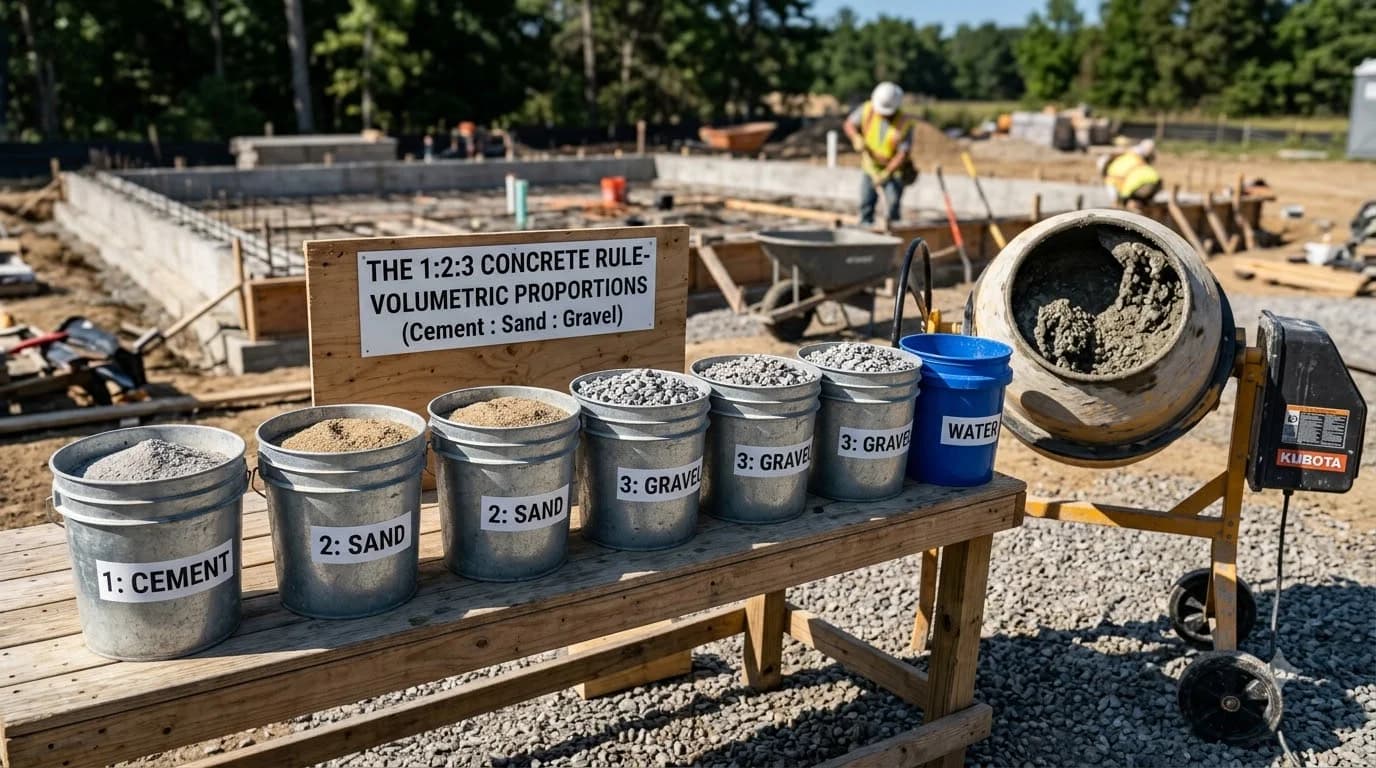
Concrete Mix Ratios: The 1-2-3 Rule for 3,000 & 4,000 PSI
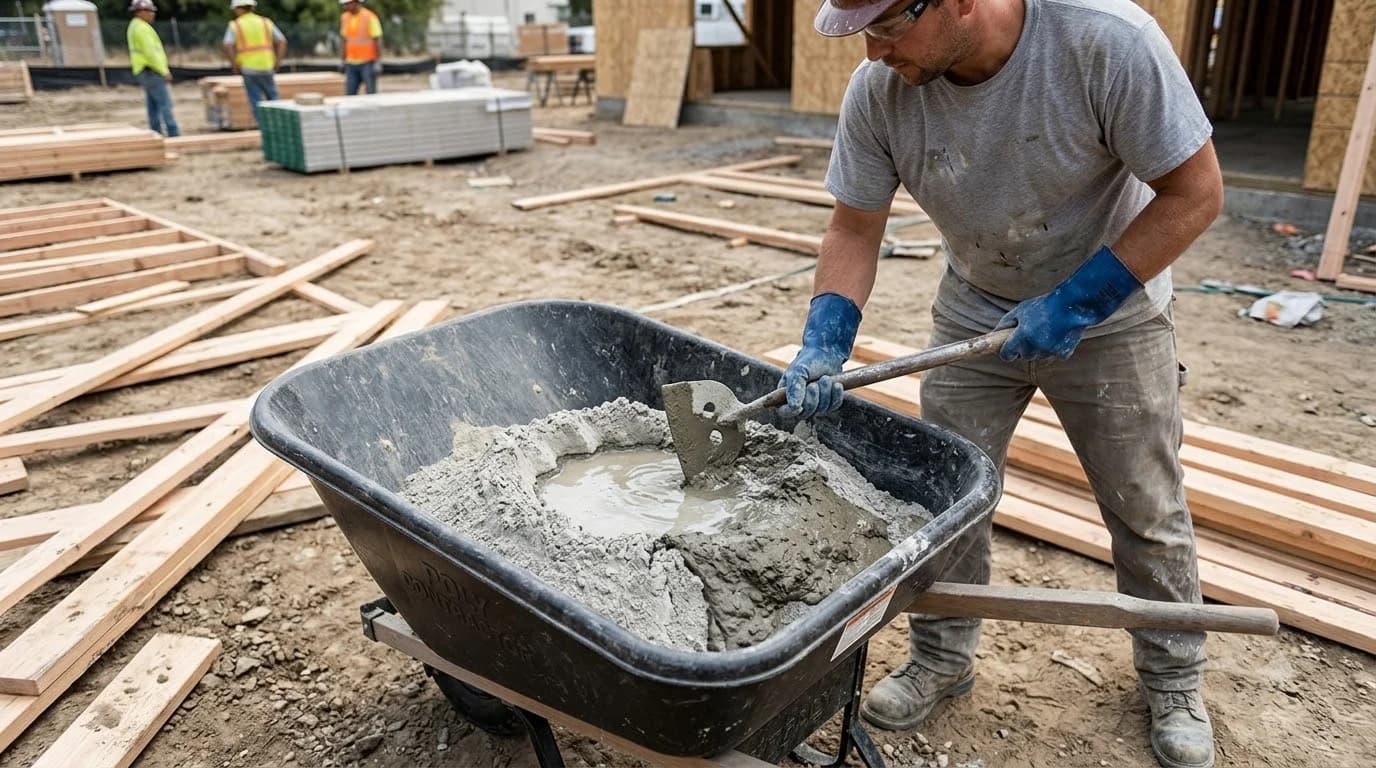
How to Mix Concrete by Hand: Wheelbarrow & Trough Math
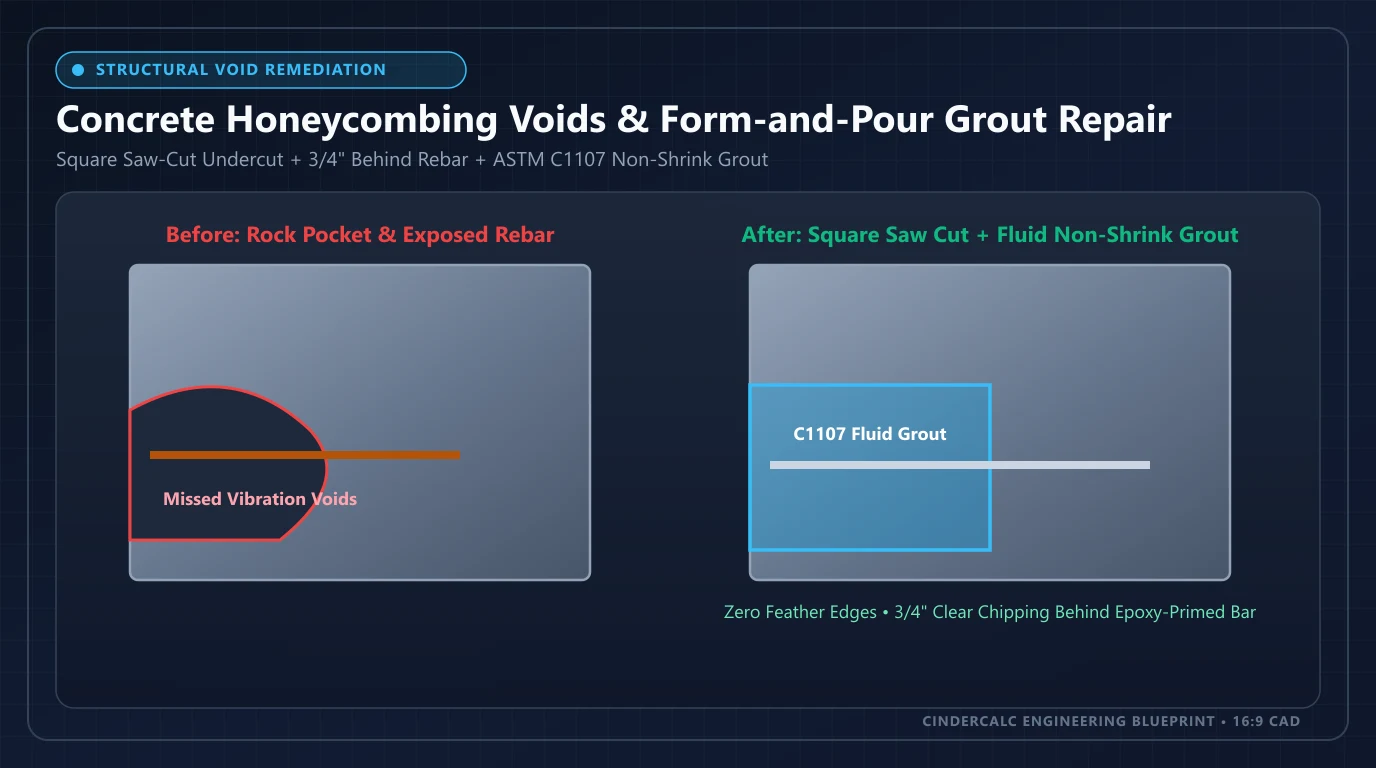
Concrete Honeycombing: Causes, Severity & Repair Guide