Exposed Aggregate Patio Concrete, Surface Retarder & Pea Gravel Seeding Estimator
Estimate ready-mix concrete yardage, 5-gallon surface-retarder sprayer pails, seeded decorative stone bags, and acrylic wet-look sealer.
1. Integral Ready-Mix vs. Hand-Seeded Aggregate: Mix Design & Stone Specs
An exposed aggregate surface is only as durable as the stone locked inside its top 3/8 inch and the paste matrix holding those pebbles in place. Contractors create exposed aggregate slabs using one of two distinct material strategies: an integral full-depth mix batched at the ready-mix plant, or a broadcast seeded surface pressed into a standard structural slab right after screeding.
Full-Depth Integral Exposed Aggregate Mix
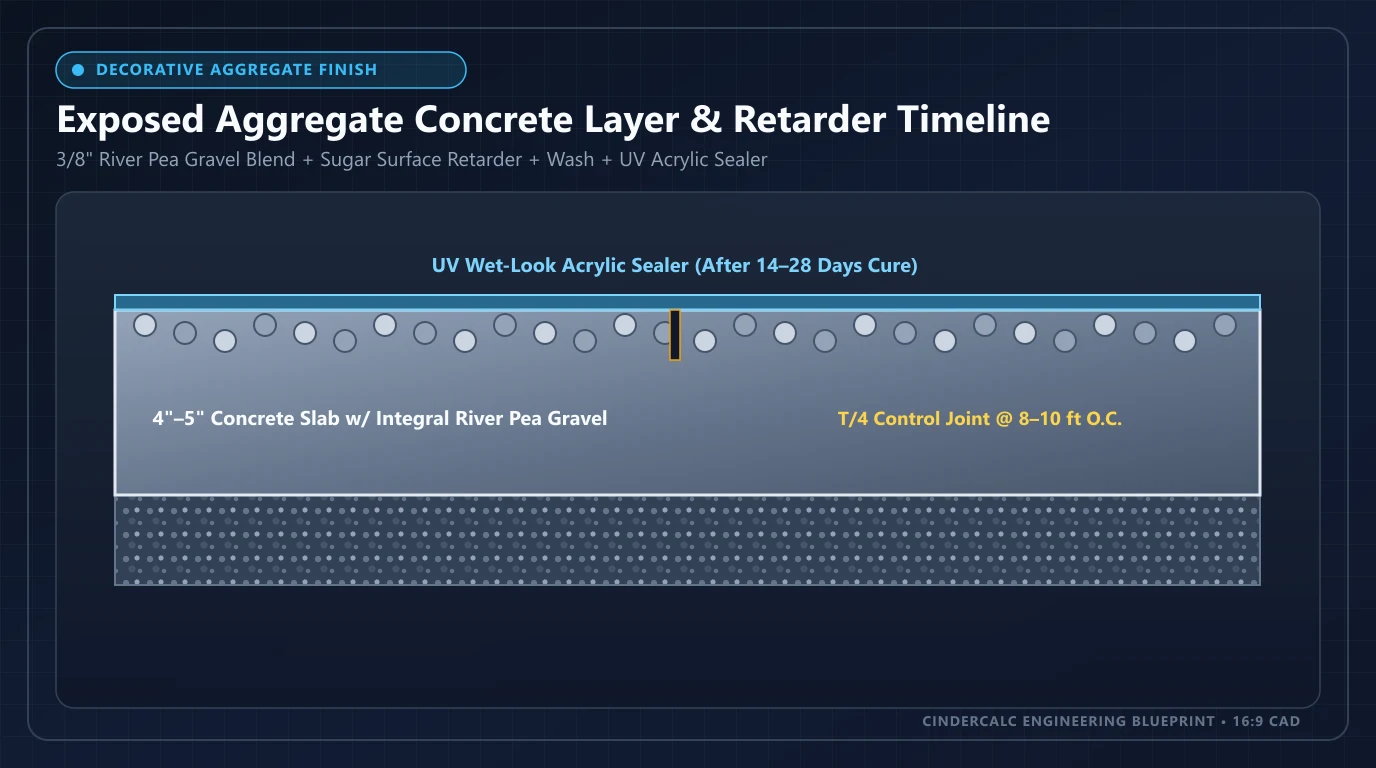
For driveways, walkways, and large patios, order an exterior 4,000+ PSI concrete mix with 5% to 7% entrained air (essential in freeze-thaw climates per ACI 332) and a maximum 0.42–0.45 water-to-binder ratio. Ask the batch plant for a higher coarse-to-fine ratio loaded with hard, non-reactive #8 (3/8-inch) rounded river pea gravel, crushed granite, or dark basalt.
Hold slump to 4 to 5 inches. Over-watered 7-inch slump mixes allow heavy pebbles to sink below a thick watery mortar layer, leaving bald spots after washing. Avoid soft porous limestone or low-density chert gravel that absorbs water and pops out during winter freezes.
Hand-Seeded Broadcast Aggregate Method
When architectural specs call for expensive imported stones—such as crushed quartz, black basalt, or colored river pebbles—pouring them throughout a 4- to 6-inch structural slab is wasteful. Instead, pour a standard 4,000 PSI air-entrained ready-mix base, screed and bull-float, then broadcast clean, pre-washed 1/4- to 3/8-inch stone across the surface.
Dense full-coverage seeding requires 300 to 400 lb per 100 sq ft (3 to 4 lb/sq ft), while lighter accent spacing uses around 200 lb per 100 sq ft (matching the 50-lb bag per 25 sq ft baseline in the estimator above). Tamp seeded stone flush into the top 3/8 inch with a darby or magnesium float until paste completely encapsulates every pebble before spraying retarder.
Need exact ready-mix volume before calling your local batch plant? Run your slab length, width, and thickness through our concrete slab yardage calculator with a 10% waste allowance so you avoid short-load fees or cold joints mid-pour.
2. Chemical Surface Retarder vs. Hose-and-Broom Wash Timing
The single most common failure on exposed aggregate slabs is mistimed washing. Historically, crews tried to time an unretarded slab using only a garden hose and stiff street broom—an unforgiving 1- to 3-hour window where washing 30 minutes too early scours out sand and rolls loose pebbles across the slab, while washing 30 minutes too late permanently locks gray paste halos onto the aggregate crowns.
Modern flatwork crews prevent that gamble with a water-based chemical surface retarder. Sprayed uniformly at ~200 to 250 sq ft per gallon immediately after bull-floating and edging (as soon as surface bleed water sheen evaporates), the retarder forms a shallow sacrificial membrane that pauses hydration in only the top 1/8 to 3/16 inch of paste while the concrete underneath cures normally. You then return 4 to 18 hours later—after the bulk slab is hard enough to walk on with kneeboards—and pressure-wash the soft top film away cleanly.
| Exposure Method & Condition | Application / Target Depth | Typical Wash Window | Job-Site Timing Risk |
|---|---|---|---|
| Chemical Retarder (Hot: 80°F–95°F) | 200–250 sq ft/gal spray; 1/8"–3/16" micro-etch | 4 – 8 hours | Low if covered with poly sheet or sprayed early; sun accelerates underlying set. |
| Chemical Retarder (Mild: 65°F–75°F) | 200–250 sq ft/gal spray; 1/8"–3/16" micro-etch | 8 – 14 hours | Ideal overnight wash schedule; test edge hardness before full pressure-washing. |
| Chemical Retarder (Cool: 50°F–60°F) | 200–250 sq ft/gal spray; shallow-etch formula | 12 – 18+ hours | Slow hydration; washing too early risks popping stone sockets along shaded edges. |
| Old-School Hose & Broom (No Retarder) | Water mist + stiff bristle scrub; variable depth | 1 – 3 hours (critical) | Very high: too early dislodges aggregate; too late locks hardened paste permanently. |
3. Worked Material Example: 400 sq ft Pool Deck / Patio (4" Slab)
Use these exact planning formulas—matching the default preset in the interactive estimator above—for a 20 × 20 ft patio (400 sq ft, 4 inches thick) with a 10% ready-mix waste factor:
Concrete, Retarder & Sealer Quantities
- 1. Ready-Mix Concrete: 400 sq ft × (4 ÷ 12 ft) × 1.10 ÷ 27 = 5.43 cu yd (order 5.5 to 6.0 yd³ 4,000 PSI air-entrained mix).
- 2. Chemical Surface Retarder: 400 sq ft ÷ 200 sq ft/gal = 2 gallons (field range: 1.6 to 2.0 gal at 200–250 sq ft/gal).
- 3. Penetrating Silane-Siloxane (1 Coat): 400 sq ft ÷ 250 sq ft/gal = 2 gallons rounded up.
- 4. UV Acrylic Sealer (2 Thin Coats): (400 × 2) ÷ 225 sq ft/gal = 4 gallons total.
Optional Broadcast Stone & Control Joints
- Dense Broadcast (300–400 lb / 100 sq ft): 4 × 350 lb = 1,400 lb (28 × 50-lb bags) of pre-washed 3/8" decorative gravel.
- Light Accent Broadcast (200 lb / 100 sq ft): 400 sq ft ÷ 25 sq ft/bag = 16 × 50-lb bags (800 lb).
- Control Joint Spacing: Saw-cut or tool at 8 to 10 ft intervals (a 20×20 ft patio splits into four 10×10 ft panels totaling 40 LF of cuts).
Do not skip contraction joints on exposed aggregate slabs. Because jagged random shrinkage cracks look conspicuous across pebbled textures, plan your panel layout in our concrete slab joint spacing calculator and review concrete expansion and control joint placement rules before placing formwork.
4. Slip Resistance (SCOF), Barefoot Comfort & Steep Driveway Traction
Texture and stone shape control how safe your slab feels under wet bare feet or heavy vehicle tires. Industry slip-testing standards evaluate Static Coefficient of Friction (SCOF) and dynamic wet traction across smooth versus textured mineral surfaces:
Pool Decks & Barefoot Walkways
Specify rounded 3/8-inch (#8) river pea gravel with a light-to-medium etch depth (about 1/8 inch). Smooth-crowned river pebbles deliver strong wet SCOF traction (typically well above the 0.60 wet threshold) while remaining comfortable on bare feet—unlike sharp crushed rock or deep 1/4-inch washes that snag toes and collect leaf debris.
Steep Driveways (> 8% Grade)
On sloped driveways in rainy or icy regions, angular crushed granite or crushed basalt provides mechanical bite for rubber tires and winter boots that outperforms slick steel troweling and glossy stamped patterns. Avoid overloading high-build glossy acrylic sealers on steep slopes unless you mix a fine polymer non-slip additive into the topcoat.
5. Illustrative Cost vs. Other Finishes & Sealer Chemistry
The planning ranges below compare illustrative installed flatwork budgets and maintenance profiles across standard broom-finish, integral exposed, hand-seeded specialty stone, and stamped decorative concrete. Use our concrete driveway cost calculator to model your local square footage and slab thickness.
| Decorative Slab Finish | Illustrative Installed Cost | Wet Slip Traction | Patching & Wear Durability |
|---|---|---|---|
| Standard Broom-Finish Concrete | $6 – $10 / sq ft | Moderate–High when fresh; broom ridges wear down over 5–10 yrs | Easiest to place; surface paste scaling shows quickly under road de-icers. |
| Integral Exposed Aggregate (3/8" Gravel) | $10 – $16 / sq ft | High permanent mineral traction (SCOF friendly around pools) | Hard stones resist abrasion and hide minor salt wear; patching requires matching stone batch. |
| Hand-Seeded Specialty Stone | $13 – $20 / sq ft | High traction; adjustable stone density and custom color palettes | Higher labor for even broadcast and tamping; visually forgiving on long walks. |
| Multi-Color Stamped Concrete | $14 – $24 / sq ft | Low–Moderate when wet & sealed unless grit additive is mixed in | Relies on film-forming sealer for color protection; very hard to blend repairs. |
Acid-Wash Cleanup & Choosing Between Silane-Siloxane vs. Acrylic Sealers
Even well-washed exposed aggregate can retain a faint milky residue on top of rounded river stones. Once the slab cures for 7 to 14 days, pre-wet the concrete, scrub lightly with a 10:1 to 20:1 diluted muriatic or sulfamic acid wash, neutralize with water and baking soda, and flush completely clean. Wait 14 to 28 days total so internal slab moisture evaporates before applying sealer, as detailed in our concrete driveway and patio sealing guide.
| Sealer Property | Breathable Penetrating Silane-Siloxane | Film-Forming Acrylic (Solvent or Waterborne) |
|---|---|---|
| Visual Appearance | Natural dry matte look; stone color remains true without glare. | Satin to high-gloss wet look; intensifies river pebble and granite hues. |
| Illustrative Coverage Rate | ~250 – 300 sq ft / gallon (flood coat wet-on-wet per manufacturer) | ~250 – 300 sq ft / gallon (1 coat) or ~225 sq ft / gal per coat for 2 thin coats |
| Moisture Vapor & Freeze-Thaw | Chemically bonds inside pores while letting sub-slab vapor escape; zero peeling or blushing. | Forms a surface membrane; trapping groundwater vapor can cause whitish blushing or flaking. |
| Wet Slip Resistance (SCOF) | Preserves full bare stone micro-texture; best default for pool decks. | Reduces micro-grip when wet unless non-slip grit is broadcast into coat 2. |
| Re-Seal Maintenance Cycle | Typically 5–7+ years; clean and re-spray without stripping old film. | Every 2 – 4 years under UV sun and tire traffic; requires thin re-coats to prevent buildup. |
Planning Estimate Notice & Field Mockup Guidance
All installed square-foot prices ($6–$24/sq ft), retarder yields (200–250 sq ft/gal), stone seeding rates (300–400 lb/100 sq ft), and sealer cycles (2–4 years) in this guide are illustrative planning examples only. Regional aggregate availability, ready-mix short-load charges, ambient humidity, and site access change actual project quotes and wash windows. Always pour a small mock-up panel and verify mix air content and locally adopted ACI/IRC provisions before placing structural driveways or pool decks.
Calculate Slab Yardage, Control Joints & Installed Cost
Lock in exact ready-mix concrete volume, saw-cut joint spacing, and driveway budget estimates before scheduling your pour:
Frequently Asked Questions
Should I use an integral exposed aggregate mix or hand-seed stone on top?
An integral plant-batched mix distributes 3/8-inch river pea gravel or granite uniformly through the entire slab depth, making large driveways and patios faster and more consistent to place. Hand-seeding—broadcasting 300 to 400 lb per 100 sq ft for dense coverage (or ~200 lb per 100 sq ft for lighter accents) and floating it into the top 3/8 inch—costs less in expensive specialty stones such as quartz or basalt and keeps standard structural aggregate underneath.
When do you spray surface retarder and how long until you wash it off?
Spray chemical surface retarder at 200 to 250 sq ft per gallon immediately after bull-floating and edging once surface bleed water disappears. The safe wash window is typically 4 to 18 hours later: around 4 to 8 hours in 80°F–95°F summer sun, 8 to 14 hours in 65°F–75°F mild weather, and 12 to 18+ hours in cool 50°F–60°F conditions.
Why is chemical surface retarder safer than the old hose-and-broom water wash?
Old-school hose-and-broom exposure relies on a razor-thin 1- to 3-hour window before initial set. Washing 30 minutes too early scours out the matrix and dislodges stones, while washing 30 minutes too late leaves hardened mortar halos locked onto pebble crowns. A surface retarder keeps only the top 1/8 to 3/16 inch unhydrated while the structural slab cures solid underneath.
How much does exposed aggregate concrete cost compared to broom-finish or stamped concrete?
As an illustrative planning example, broom-finish flatwork often runs $6 to $10 per sq ft installed, integral exposed aggregate runs $10 to $16 per sq ft, hand-seeded specialty stone runs $13 to $20 per sq ft, and multi-color stamped concrete runs $14 to $24 per sq ft. Final bids depend on slab thickness, regional stone hauling, saw-cut joints, and sealer selection.
Is exposed aggregate concrete slip-resistant around pools and on steep driveways?
Yes. Rounded 3/8-inch (#8) river pea gravel delivers high wet Static Coefficient of Friction (SCOF) traction without sharp edges, making it comfortable for bare feet on pool decks. For steep driveways over 8% grade, angular crushed granite or basalt offers superior tire bite, and adding a fine non-slip grit or choosing a penetrating silane-siloxane sealer preserves wet traction.
Should I seal exposed aggregate with penetrating silane-siloxane or glossy acrylic?
Choose a breathable penetrating silane-siloxane sealer in freeze-thaw climates or around pool decks where moisture vapor transmission and natural matte slip resistance matter most. Choose a film-forming UV-resistant acrylic sealer if you want a wet-look color pop that deepens stone tones, applying two thin coats and re-sealing every 2 to 4 years.
Reference Standards & Source Catalogs
Guide to Concrete Floor and Slab Construction
Covers slab-on-ground mix proportioning, bleed-water timing before finishing, curing practices, and surface durability for exterior concrete flatwork.
ACI publicationsResidential Code Requirements for Structural Concrete
Establishes minimum 4,000+ PSI compressive strength and 5%–7% air entrainment thresholds for exterior driveways, patios, and walks exposed to freeze-thaw cycles.
ACI publicationsConcrete Aggregates & Ready-Mixed Concrete Specifications
Defines aggregate gradation (#8 / 3/8-in. stone), deleterious chert/shale limits to prevent popouts, and ready-mixed batching tolerances; confirm locally adopted specifications.
ASTM standards catalogPublisher links identify where to find the applicable standard; they do not establish certification or confirm every statement on this page. Check the edition, manufacturer data, and local adoption. Material takeoffs are planning estimates, and structural dimensions and reinforcement must come from the project design.
Popular Quick Estimates
Illustrative takeoffs with stated assumptions; verify project quantities
4-in Patio Slab Takeoff
Ready-mix yardage with 10% subgrade allowance
24x24 Garage Slab
576 ft² × 5/12 ft ÷ 27; excludes waste and design
Interlocking Paver Sand
Enter area and bedding depth; verify product coverage
Masonry Steps Riser
Check local stair rules and project-specific design
Related Calculators
Specialized tools for foundation, core fill, and budgeting
Cubic yards, bags, and slab volume for flatwork and footings
Ready-mix slab yardage, gravel base tons, #4 rebar grid, and finish labor budget tiers
ACI 302.1R saw-cut spacing grid, blade depth, linear feet, and 29-oz sealant tubes
Volumetric 1:2:3 and 1:1.5:3 Portland cement, sand, #57 gravel, water, and 5-gal buckets
Blogs & Construction Guides
Practical guides to block sizing, material estimates and project planning
Concrete Patio & Driveway Drainage Slope Guide (1%–2%)
How to Seal a Concrete Driveway: Acrylic vs Silane Sealers
How Much Does a Concrete Driveway Cost? (2026 Price Guide)