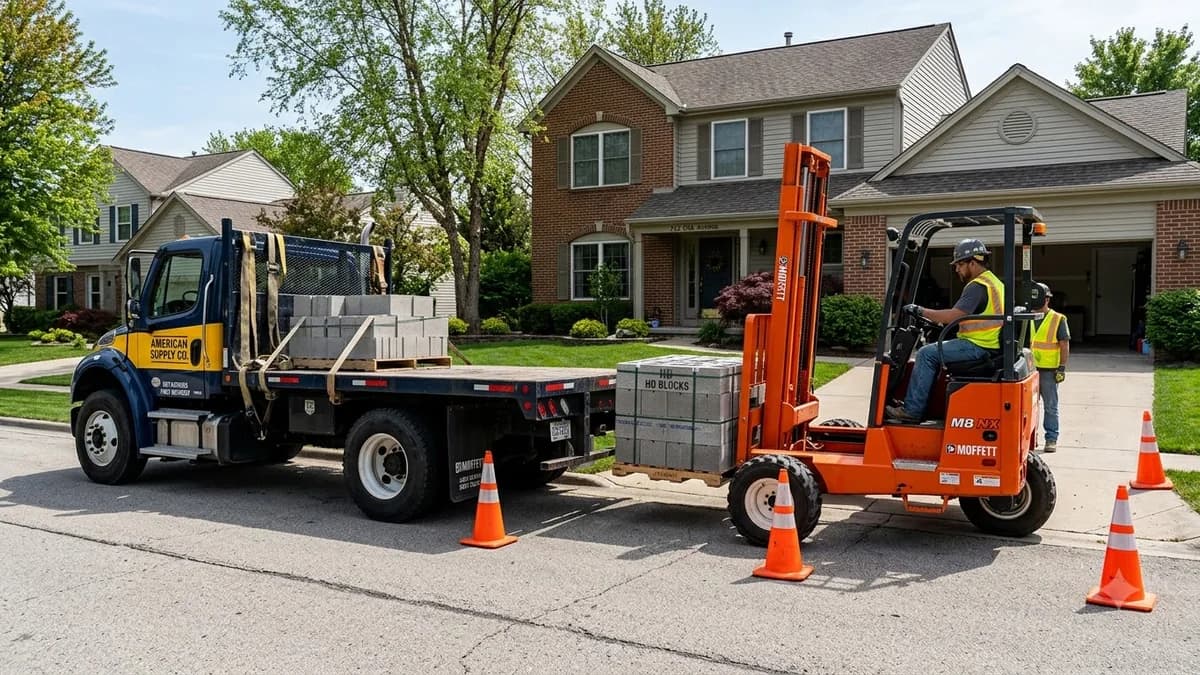
Payload Warning: Do Not Forklift a Full Pallet Into a 1/2-Ton Bed
Towing capacity is NOT payload capacity. A truck rated to tow 10,000 lbs on a trailer can typically only carry 1,600 to 2,100 lbs in its cargo bed (Gross Vehicle Weight Rating minus curb weight). Loading a 3,600 lb pallet into a half-ton truck causes immediate suspension bottoming, cracked leaf springs, brake fade, and severe rollover risks.
Pallet Weight & Capacity Specifications by CMU Size
| Block Nominal Size | Blocks / Pallet | Pallet Dimensions | Total Pallet Weight (Medium Wt) | Total Pallet Weight (Normal Wt) |
|---|---|---|---|---|
| 4" x 8" x 16" Partition | 144 units | 40" x 48" x 36" | ~3,100 lbs (1.55 tons) | ~3,600 lbs (1.80 tons) |
| 6" x 8" x 16" Slim CMU | 120 units | 40" x 48" x 38" | ~3,350 lbs (1.68 tons) | ~3,950 lbs (1.98 tons) |
| 8" x 8" x 16" Standard | 90 – 108 units | 40" x 48" x 40" | ~3,400 lbs (1.70 tons) | ~4,050 lbs (2.03 tons) |
| 12" x 8" x 16" Commercial | 60 units | 40" x 48" x 38" | ~3,300 lbs (1.65 tons) | ~3,900 lbs (1.95 tons) |
Truck Class Safe Payload Guide (F-150 vs F-250 vs F-350)
Real payload capacity: 1,600 – 2,100 lbs. Safe limit: 35 to 45 standard 8-inch blocks hand-stacked over the rear axle. Never load a full pallet.
Real payload capacity: 3,300 – 4,200 lbs (gas engines). Safely carries 1 pallet of lightweight/medium blocks. Check tire door jamb sticker before loading normal-weight blocks.
Real payload capacity: 4,500 – 7,500 lbs. A dually 1-ton truck easily handles one full pallet centered with plenty of safety margin, or two pallets on long-bed dual-rear-wheel models.
DOT Safe Hauling Protocols for Concrete Masonry
Concrete blocks have high mass and low friction against steel and composite truck bed liners. Under sudden highway braking, unsecured blocks become deadly airborne projectiles. Follow these DOT safety rules:
- Position Load Over Axle: Place loose blocks or pallets directly over or slightly in front of the rear axle. Never stack heavy blocks behind the rear axle against the tailgate, which lifts front steering wheels off the road.
- 2-Inch Heavy Ratchet Straps: Secure pallets with at least two 2-inch commercial ratchet straps rated for at least 3,333 lbs Working Load Limit (WLL) hooked into structural chassis frame anchor points.
- Max Tire Cold Inflation PSI: Check the sidewall maximum cold PSI on your truck tires. Hauling near max payload on soft, underinflated tires generates extreme tire heat and highway tread separation blowouts.
Explore Related CMU Calculators & Guides
Frequently Asked Questions About Pallet Weights & Hauling
How much does a full pallet of cinder blocks weigh?
A standard pallet of 8x8x16 cinder blocks contains 90 to 108 blocks and weighs between 3,100 and 4,100 pounds (1.55 to 2.05 tons) depending on whether the units are lightweight expanded shale or normal weight gravel concrete.
Can a half-ton pickup truck (F-150, Silverado 1500) haul a pallet of concrete blocks?
No. Standard half-ton pickup trucks have a maximum cargo bed payload capacity of 1,600 to 2,300 pounds. A full pallet of concrete blocks weighs over 3,200 pounds, which will overload the suspension, bottom out springs, destroy wheel bearings, and violate federal highway GVWR safety limits.
How many cinder blocks can I safely haul in an F-150 bed?
Depending on cab and bed options, an F-150 or 1500-series truck can safely carry approximately 35 to 45 standard 8-inch blocks (weighing 1,400 to 1,800 lbs) distributed evenly over the rear axle, leaving safe margin for the driver and passenger.
What are the physical dimensions of a concrete block pallet?
Concrete masonry units are stacked on heavy-duty 40-inch wide by 48-inch deep wooden pallets (or 48x48-inch square pallets) and wrapped in heavy plastic stretch film, standing approximately 36 to 42 inches tall.
What size truck or trailer is required to haul 1 full pallet of blocks?
To safely haul 1 full pallet (up to 4,000 lbs), you need a 3/4-ton heavy duty pickup (such as a Ford F-250 or Silverado 2500HD with proper payload rating), a 1-ton truck, or a dual-axle utility trailer with a minimum 7,000 lb GVWR rating.
Building Codes & Primary Standards Cited
Standard Specification for Loadbearing Concrete Masonry Units
Specifies compressive strength (1,900 psi net area min), aggregate density tiers, and dimensional tolerances for CMUs.
Standard Specification for Mortar for Unit Masonry
Specifies cement-to-lime-to-sand proportioning and compressive strengths for Type M (2,500 psi) and Type S (1,800 psi) structural mortars.
International Residential Code: General Masonry Construction
Governs empirical and engineered design rules for masonry wall thickness, vertical rebar spacing, and lintel support spans.
Estimations adhere to standard North American modular 3/8-inch mortar joint physics and 5% to 10% material waste factors. Local municipal building inspectors, stamped architectural blueprints, and local frost depth requirements supersede general reference guidelines.
Popular Quick Estimates
Pre-engineered takeoffs & benchmarks matched to this project
Related Calculators
Specialized tools for foundation, core fill, and budgeting
Dry block weight, filled core weight and hauling loads
Straight and multi-wall runs with mortar and waste allowances
Standard 8-inch series wall and reinforcement estimates
Masonry steps, riser heights and solid core fill volume
Blogs & Construction Guides
Technical articles, IRC code standards, rebar schedules & freight logistics
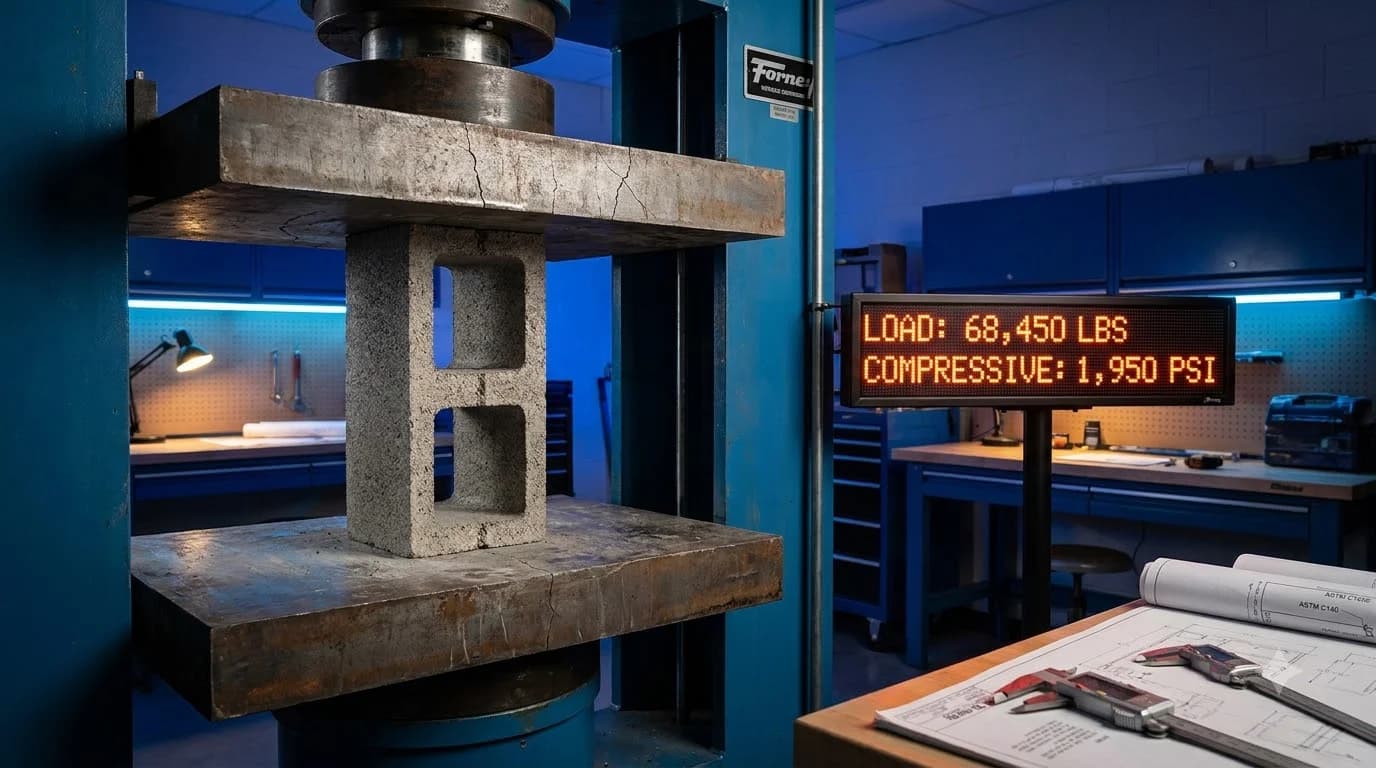
How Much Weight Can a Cinder Block Hold? (Load Capacity)
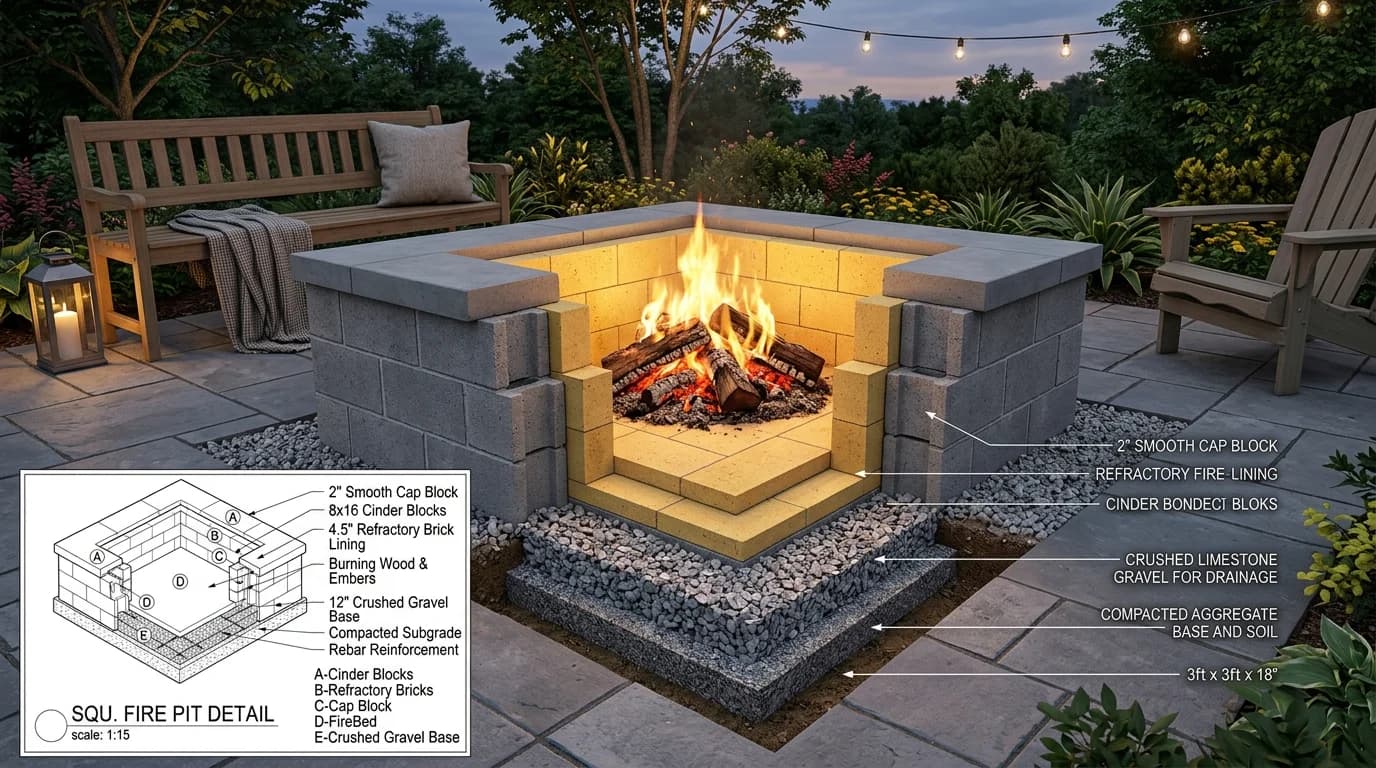
Can You Build a Fire Pit with Cinder Blocks? (Safety & Plans)
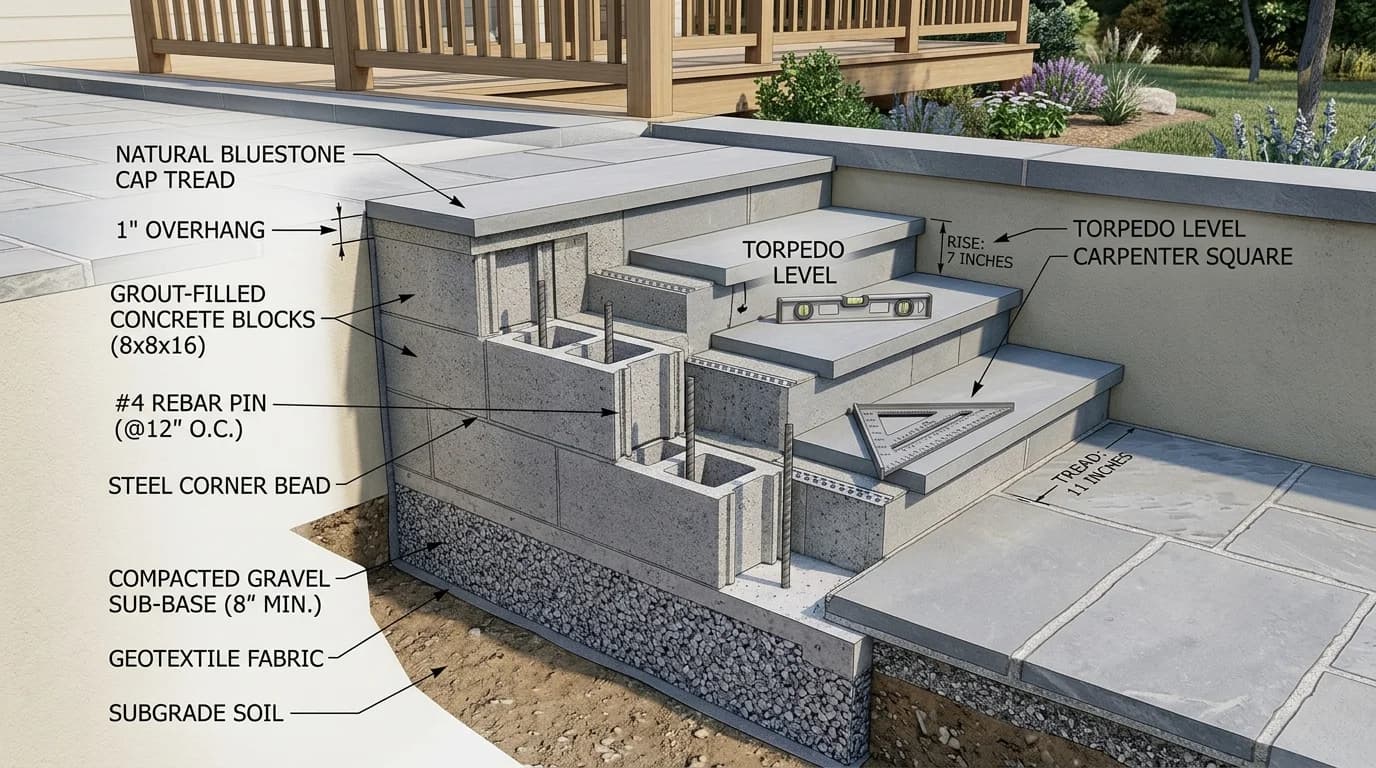
How to Build Outdoor Cinder Block Steps & Stairs