Quick Engineering Rule: Three Densities, Identical 2,000 PSI Compressive Strength
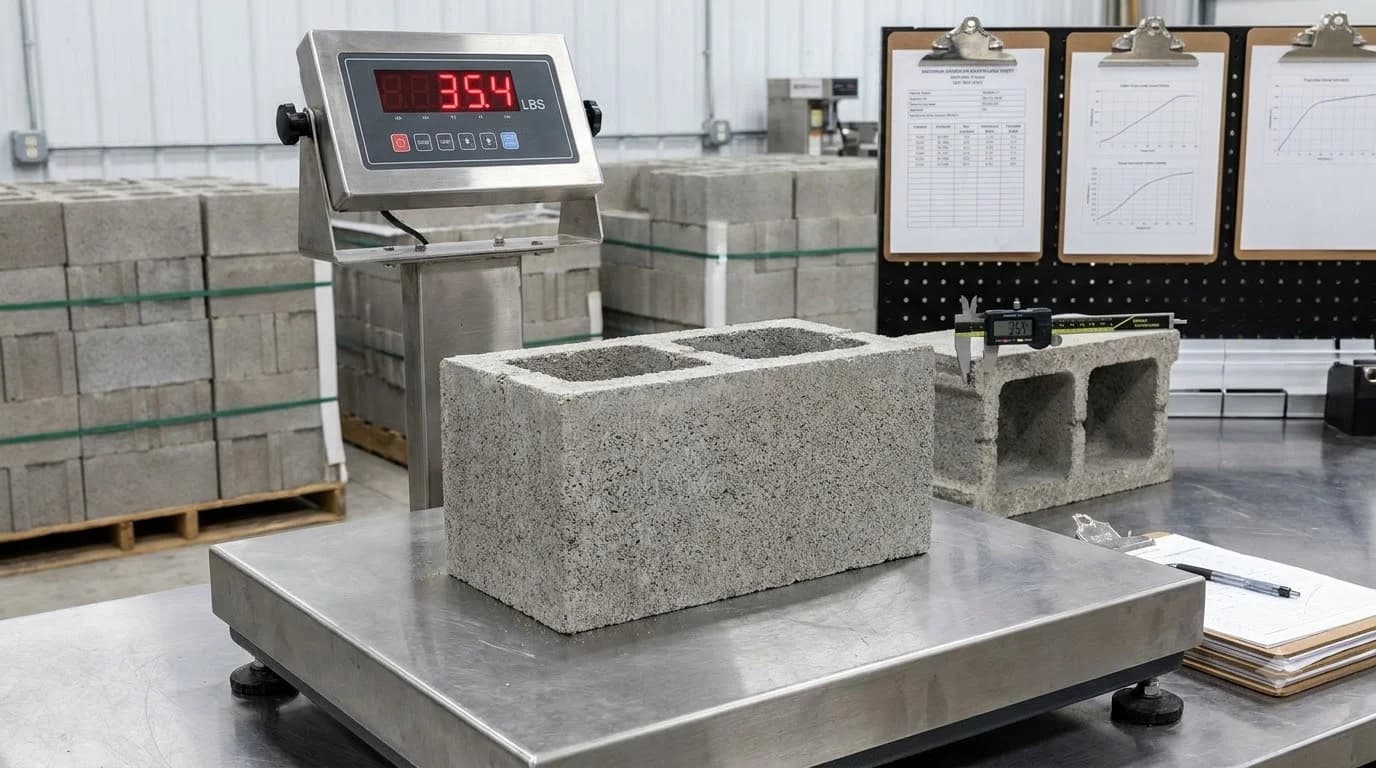
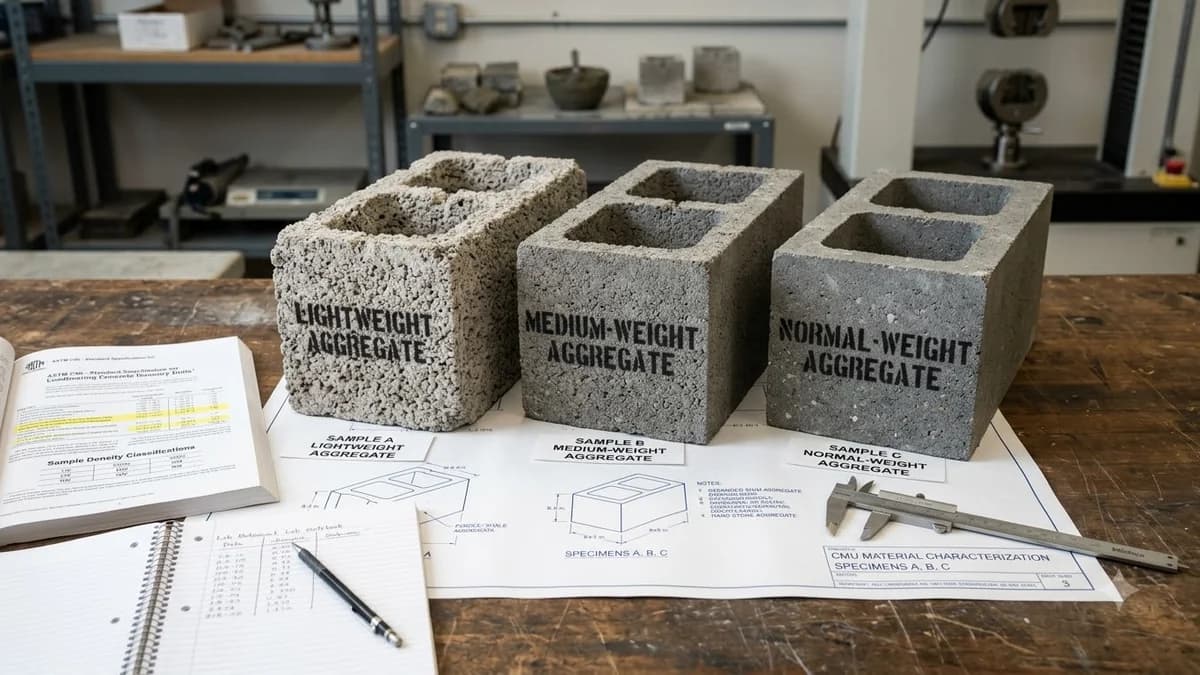
Under ASTM C90, concrete blocks are classified by oven-dry density: Lightweight (< 105 lb/cu ft; 25-29 lbs per 8" block), Medium Weight (105-125 lb/cu ft; 31-36 lbs), and Normal Weight (> 125 lb/cu ft; 38-44 lbs). All three classes share the exact same structural minimum compressive strength requirement of 2,000 psi net area. Lightweight excels in thermal resistance, fire rating, and mason laying speed; Normal Weight excels in acoustic mass (STC 50+), ballast weight, and lowest moisture absorption.
1. ASTM C90 Density Classifications & Aggregate Mineralogy
ASTM C90 (Standard Specification for Loadbearing Concrete Masonry Units) establishes the architectural and physical benchmarks for hollow and solid concrete blocks used in structural walls, foundations, and retaining structures. Rather than classifying blocks by dimensions or trade names, ASTM C90 partitions units into three strictly measured oven-dry density tiers:
- Lightweight CMU (Oven-Dry Density < 105 lb/cu ft / 1,680 kg/m³): Manufactured with rotary kiln-expanded aggregates such as expanded shale, slate, clay, or natural pumice meeting ASTM C331. The internal cellular pore structure of these expanded minerals significantly reduces unit weight (averaging 25 to 29 lbs for a standard 8x8x16-inch hollow block) without sacrificing loadbearing compressive capacity.
- Medium Weight CMU (Oven-Dry Density 105 to 125 lb/cu ft / 1,680 to 2,000 kg/m³): Produced by blending lightweight synthetic aggregates with standard washed concrete sand or crushed stone. A standard 8x8x16-inch unit weighs between 31 and 36 lbs. Medium weight blocks represent over 60% of all CMUs laid in North American commercial construction because they strike the optimal balance between unit material cost, mason productivity, and structural performance.
- Normal Weight CMU (Oven-Dry Density > 125 lb/cu ft / 2,000 kg/m³): Formulated with dense natural mineral aggregates governed by ASTM C33, including crushed limestone, granite, basalt, and river gravel. An 8x8x16-inch hollow unit weighs between 38 and 44 lbs, while a solid 8-inch unit can exceed 55 lbs. Normal weight blocks offer maximum density, high acoustic dampening, and the lowest moisture absorption limits.
2. ASTM C90 Physical Specifications & Engineering Matrix
Review the mandatory ASTM C90 physical property minimums, thermal insulation metrics, fire ratings, and 2026 material price benchmarks across density classes:
| ASTM C90 Density Tier | Oven-Dry Density | 8x8x16 Hollow Weight | Max Water Absorption | 2-Hr Fire Equiv. Thickness | Sound Class (STC) | 2026 Block Price |
|---|---|---|---|---|---|---|
| Lightweight | < 105 lb/cu ft | 25 - 29 lbs | 18 lb/cu ft (288 kg/m³) | 3.2 in (81 mm) | STC 44 - 46 | $2.40 - $3.40 |
| Medium Weight | 105 - 125 lb/cu ft | 31 - 36 lbs | 15 lb/cu ft (240 kg/m³) | 3.7 in (94 mm) | STC 47 - 49 | $1.95 - $2.75 |
| Normal Weight | > 125 lb/cu ft | 38 - 44 lbs | 13 lb/cu ft (208 kg/m³) | 4.2 in (107 mm) | STC 50 - 54 | $1.75 - $2.45 |
3. Fire Resistance, Acoustic Mass & Thermal Performance
Architectural specification of block density directly dictates compliance with building envelope energy codes (ASHRAE 90.1 / IECC) and life safety fire separations under IBC Chapter 7 (Fire and Smoke Protection Features):
Fire Resistance (IBC 722)
Fire endurance is calculated using the Equivalent Solid Thickness method. Expanded lightweight aggregates conduct heat much slower than dense quartz or limestone. Consequently, an 8-inch lightweight CMU achieves a 3-to-4 hour fire rating with less solid volume than a normal weight block.
Acoustic Isolation (STC)
Sound transmission is strictly governed by the physical Mass Law. Normal Weight CMUs provide substantial mass (over 50 lbs/sq ft of wall surface), achieving Sound Transmission Class ratings of STC 50 to 54. This makes normal weight blocks ideal for school party walls, mechanical rooms, and cinema partitions.
Thermal R-Value
Hollow lightweight CMUs provide thermal R-values of 1.7 to 2.2 uninsulated (up to R-8.5 to R-10 when core cavities are injected with expanded vermiculite or closed-cell foam inserts). Normal weight blocks exhibit higher thermal conductivity, with base R-values of 1.1 to 1.4.
4. Laboratory Testing Methodology (ASTM C140)
To verify that a batch of concrete masonry units satisfies ASTM C90 compliance, certified independent laboratories perform testing under ASTM C140 (Standard Test Methods for Sampling and Testing Concrete Masonry Units and Related Units):
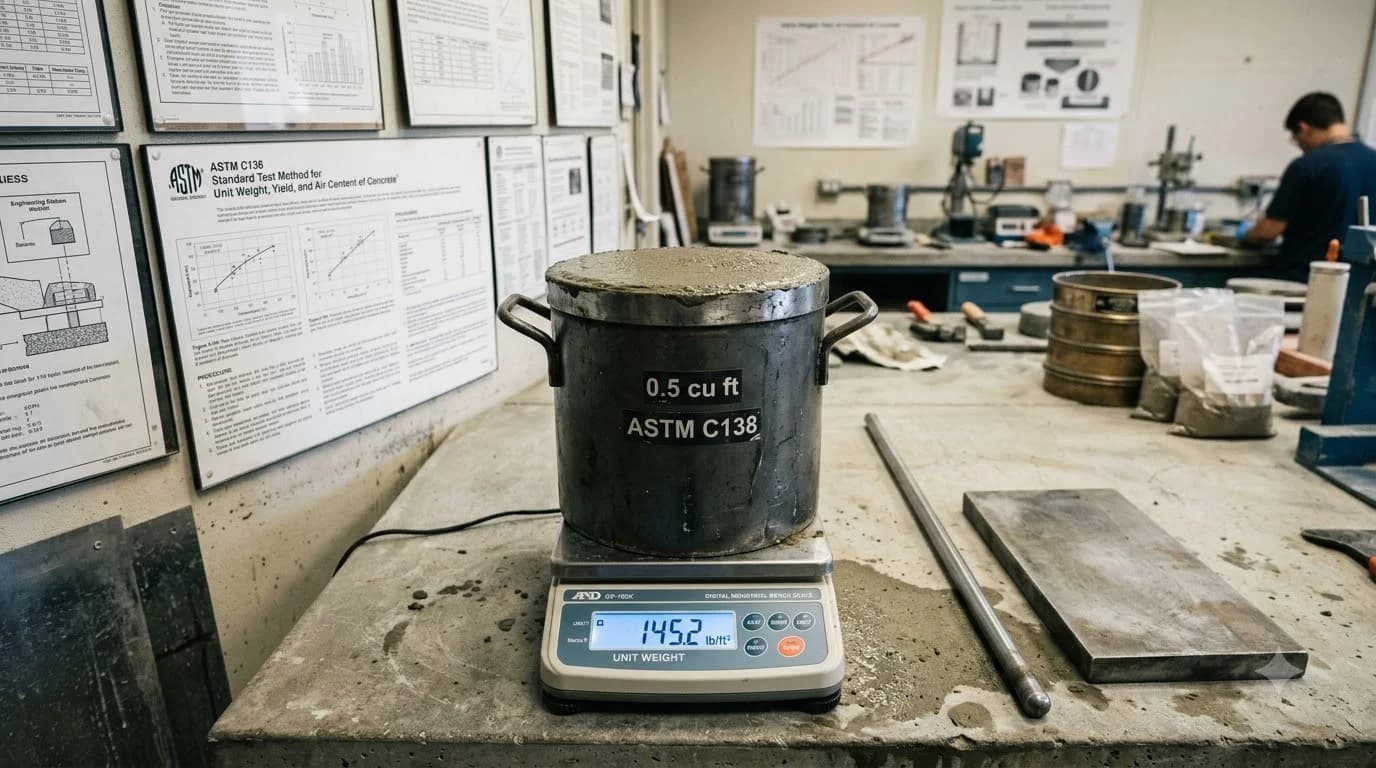
Density & Absorption Calculation: Three representative block specimens are selected at random. Each unit is submerged in water for 24 hours to record its immersed weight (W_i). The saturated surface-dry weight (W_s) is measured immediately upon removal from water. Finally, the unit is dried in a ventilated oven at 212°F to 239°F (100°C to 115°C) until mass loss ceases, establishing the oven-dry weight (W_d). The physical properties are calculated as:
Oven-Dry Density (lb/cu ft) = [W_d / (W_s - W_i)] × 62.4
Moisture Absorption (lb/cu ft) = [(W_s - W_d) / (W_s - W_i)] × 62.4
Percent Absorption (%) = [(W_s - W_d) / W_d] × 100
Compressive Strength Verification: Specimens are capped with high-strength sulfur capping compound or unbonded elastomeric pads (ASTM C1552) and subjected to axial hydraulic compression. The failure load is divided by the net cross-sectional area (accounting for core voids) to confirm the unit achieves the required 2,000 psi minimum net area strength.
5. Structural Design, Mason Productivity & Trucking Logistics
The selection of block density carries massive financial and physical ramifications for structural engineers, general contractors, and logistics coordinators:
- Structural Dead Loads & Foundation Footings: In multi-story buildings, substituting Lightweight CMU for Normal Weight reduces building structural dead load by 30%. This substantially downsizes poured footing widths under IRC Section R403 / IBC Chapter 18, reduces post-tensioned slab thickness, and lowers seismic lateral inertial forces ($V = C_s \cdot W$) in Seismic Design Categories C through F.
- Mason Ergonomics & Daily Laying Speed: A journeyman mason lays approximately 120 to 160 standard 8-inch blocks per day. Handling 28-lb Lightweight units compared to 42-lb Normal Weight units reduces the mason's daily lifting strain by nearly 2,000 lbs per shift. Jobsite studies demonstrate an 8% to 15% increase in daily production output when lightweight masonry is specified.
- DOT Freight Limits & Pallet Weight Calculations: A standard US tandem-axle flatbed trailer is legally restricted to approximately 48,000 lbs of cargo. A standard pallet contains 108 units of 8x8x16 CMUs:
• Lightweight: 108 × 28 lbs = 3,024 lbs/pallet → 15 pallets (1,620 blocks) per truckload.
• Medium Weight: 108 × 34 lbs = 3,672 lbs/pallet → 13 pallets (1,404 blocks) per truckload.
• Normal Weight: 108 × 42 lbs = 4,536 lbs/pallet → 10 pallets (1,080 blocks) per truckload.
Choosing Lightweight saves up to 33% on freight transport costs over long hauling distances.
5 Costly Concrete Block Density Mistakes to Avoid
1. Overloading Flatbed Trucks with Normal Weight Blocks
Dispatchers who calculate flatbed hauling payloads assuming a 30-lb average unit weight will severely overload legal 80,000-lb gross highway limits when shipping Normal Weight units (42+ lbs each), risking heavy DOT fines and axle damage.
2. Confusing Lightweight CMUs with Antique Cinder Blocks
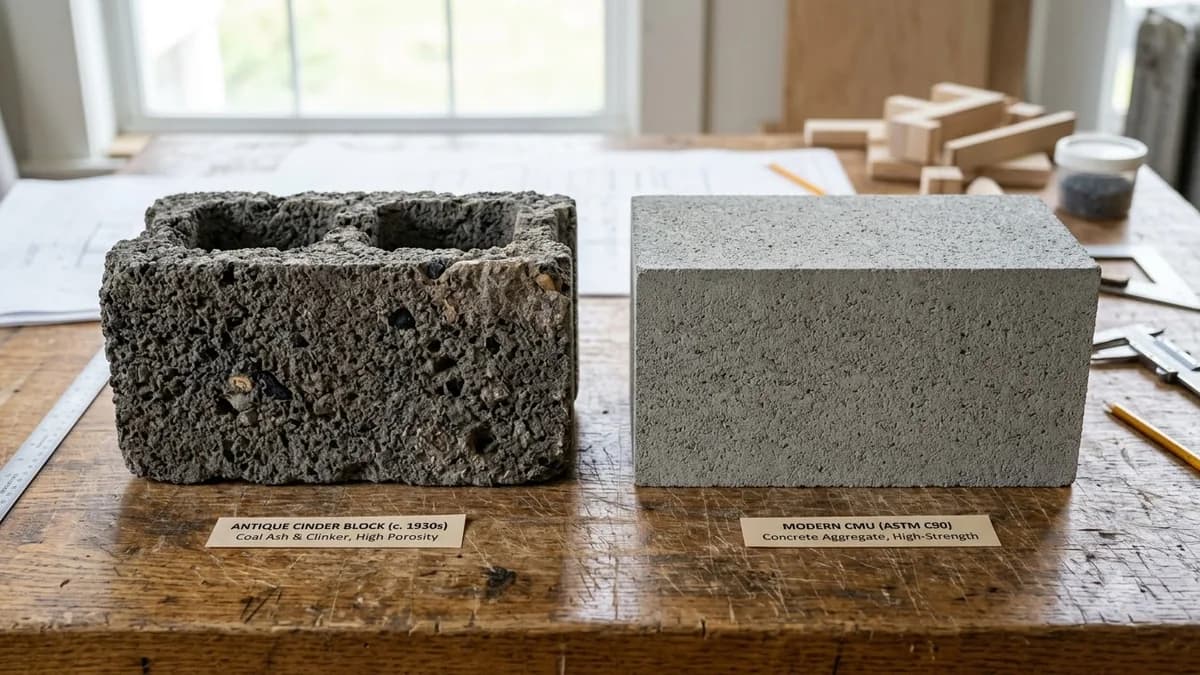
Lightweight ASTM C90 blocks are high-strength structural units manufactured with rotary-kiln expanded shale, clay, or slate. They must never be confused with obsolete 1940s coal-cinder blocks, which were non-loadbearing and crumbly.
3. Neglecting Moisture Absorption on Below-Grade Basements
Lightweight CMUs have a maximum water absorption limit of 18 lb/cu ft compared to 13 lb/cu ft for Normal Weight. Below grade, lightweight foundation walls require high-grade elastomeric waterproofing membranes to prevent subterranean water transmission.
4. Underestimating Acoustic Transmission in Lightweight Walls
Lightweight CMUs exhibit lower acoustic mass (STC 44-46) than Normal Weight units (STC 50-54). Specifying lightweight blocks for party walls between residential condominium units without core grout or resilient channels can fail STC 50 building code minimums.
5. Disregarding Seismic Mass Differences in Structural Calculations
Structural engineers who substitute Normal Weight CMUs during construction on a building engineered with Lightweight CMU dead loads will dramatically increase seismic shear wall forces and building overturning moments beyond footing design limits.
Calculating Pallets and Hauling Weight?
Estimate total blocks, pallet count, dry weight, mortar bags, and core grout volume for any wall size.
Frequently Asked Questions
What are the three official ASTM C90 concrete block density classes?
ASTM C90 categorizes concrete masonry units into three official density classifications based on oven-dry unit weight: Lightweight (less than 105 lb/cu ft / 1,680 kg/m³), Medium Weight (105 to 125 lb/cu ft / 1,680 to 2,000 kg/m³), and Normal Weight (greater than 125 lb/cu ft / 2,000 kg/m³).
How much does a standard 8x8x16 cinder block weigh in each density class?
For a standard 8x8x16-inch hollow CMU, an ASTM C90 Lightweight block weighs 25 to 29 lbs (11.3 to 13.2 kg), a Medium Weight block weighs 31 to 36 lbs (14.1 to 16.3 kg), and a Normal Weight block weighs 38 to 44 lbs (17.2 to 20.0 kg).
Are Lightweight CMU blocks structurally weaker than Normal Weight blocks?
No. ASTM C90 mandates an identical minimum net area compressive strength of 2,000 psi (13.8 MPa) across all three density tiers. Lightweight units achieve this loadbearing strength by utilizing high-strength rotary kiln-expanded shale, clay, or slate aggregates rather than weaker filler materials.
Which concrete block density tier provides superior fire resistance and insulation?
Lightweight CMUs deliver significantly higher fire resistance (up to a 4-hour fire endurance rating under IBC Chapter 7) and superior thermal insulation (R-values up to 1.9 to 2.2 uninsulated) because the microscopic cellular pores in expanded aggregates impede conductive thermal heat transfer.
How do density classes affect pallet weights and DOT trucking logistics in 2026?
A standard pallet of 108 blocks weighs approximately 2,900 to 3,200 lbs in Lightweight, 3,450 to 3,900 lbs in Medium Weight, and 4,100 to 4,650 lbs in Normal Weight. Consequently, a standard 48,000-lb legal flatbed truck payload can carry 15 pallets of Lightweight blocks (1,620 units) but only 10 to 11 pallets of Normal Weight blocks (1,080 units).
Building Codes & Primary Standards Cited
Standard Specification for Loadbearing Concrete Masonry Units
Governs mandatory physical requirements, density classifications, compressive strength minimums, and absorption limits for hollow and solid CMUs.
Standard Test Methods for Sampling and Testing Concrete Masonry Units
Establishes standardized testing procedures for oven-dry density, moisture absorption, net area calculation, and compressive strength.
Building Code Requirements and Specification for Masonry Structures
Authoritative American structural engineering design standard for reinforced concrete masonry shear walls, axial loads, and seismic design.
Estimations adhere to standard North American modular 3/8-inch mortar joint physics and 5% to 10% material waste factors. Local municipal building inspectors, stamped architectural blueprints, and local frost depth requirements supersede general reference guidelines.
Popular Quick Estimates
Pre-engineered takeoffs & benchmarks matched to this project
Related Calculators
Specialized tools for foundation, core fill, and budgeting
Dry block weight, filled core weight and hauling loads
Commercial load-bearing concrete masonry units
Actual vs nominal dimensions and ASTM C90 specifications
Standard nominal 8x8x16 block takeoff with mortar joints
Blogs & Construction Guides
Technical articles, IRC code standards, rebar schedules & freight logistics
Weight of Concrete per Cubic Foot: 2026 Density Specs
CMU vs Cinder Block vs Concrete Block
How Wide and Long is a Cinder Block?