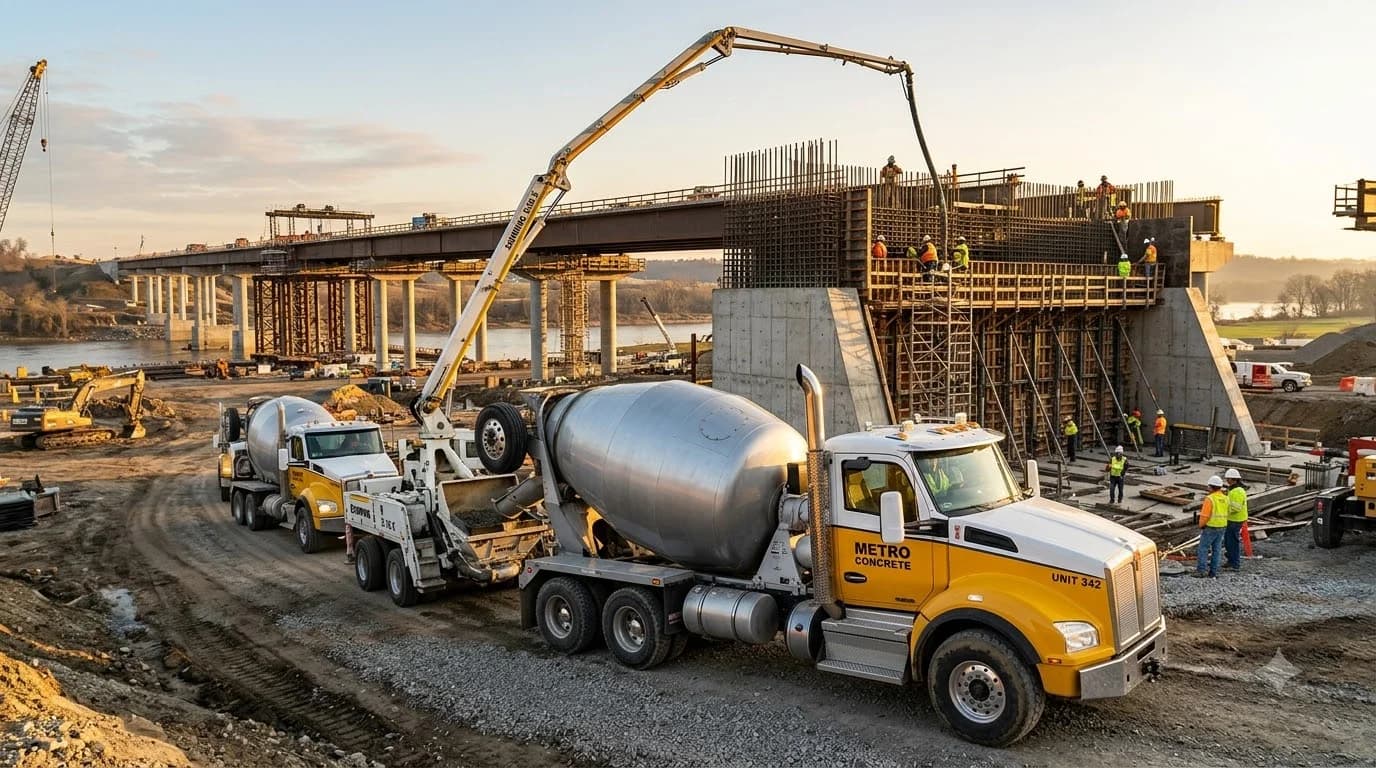
Direct Answer: How Many Yards Fit in a Cement Truck?
A standard full-size commercial ready-mix concrete truck carries 9 to 10 cubic yards of concrete (yielding 243 to 270 cubic feet). While the rotating steel mixing drum itself has a gross geometric volume of roughly 14 to 15 cubic yards, it can only be filled to approximately 63% of drum capacity (ASTM C94) to allow room for the internal spiral blades to mix and agitate the heavy aggregate. Furthermore, state DOT highway weight limits cap the legal payload at 10 cubic yards.
1. Concrete Delivery Truck Types & Capacity Specifications
Not all concrete delivery vehicles are identical. Suppliers operate different truck configurations based on municipal weight limits, residential street widths, and batching technology:
| Truck Configuration | Max Legal Load | Concrete Weight | Gross Vehicle Weight (GVWR) | Best Use Case |
|---|---|---|---|---|
| Standard 3-Axle Rear-Discharge | 8.0 – 9.0 yd³ | 32,400 – 36,500 lbs | 58,000 – 62,000 lbs | Standard residential suburban pours |
| Standard 4-Axle (Bridge Booster) | 10.0 yd³ | 40,500 lbs | 66,000 – 72,000 lbs | Commercial foundations, slabs & driveways |
| Front-Discharge Mixer | 10.0 – 11.0 yd³ | 40,500 – 44,500 lbs | 70,000 – 76,000 lbs | Direct chute placement controlled by driver in cab |
| Mini-Mixer (Short-Load Truck) | 3.0 – 5.0 yd³ | 12,000 – 20,000 lbs | 28,000 – 38,000 lbs | Tight urban driveways, alleys & small pads |
| Volumetric On-Site Batcher | 1.0 – 12.0 yd³ | Batched on demand | Up to 74,000 lbs | Zero waste; pay only for exact yards poured |
2. Weight Physics: Why Cement Trucks Destroy Residential Driveways
One of the most catastrophic mistakes in residential concrete construction is allowing a loaded ready-mix truck to drive onto an existing residential concrete or asphalt driveway.
A standard residential concrete driveway is 4 inches thick and engineered to support passenger cars and light pickup trucks weighing up to 6,000 to 8,000 pounds. A fully loaded ready-mix truck weighs roughly 70,000 pounds (35 tons). Driving that mass onto a 4-inch slab will inevitably crush subgrade voids, punch through the concrete, crack curbs, and collapse underground PVC drainage or septic pipes.
Never sign a driver's "curb release / property damage waiver" permitting them to leave the public paved street unless you have verified that your driveway is an unreinforced gravel track or an engineered 8-inch industrial commercial slab.
3. Chute Extensions & Delivery Reach Logistics
Concrete leaves the truck barrel by flowing down gravity chutes. Understanding the limitations of chute geometry is critical for staging your pour:
- Standard Chute Length: Ready-mix trucks carry three or four folding chute extensions totaling 16 to 18 feet in length from the rear bumper.
- Gravity Slope Requirement: To slide down the chute freely without excessive added water, the chute must maintain a minimum downward pitch of 2.5 to 3 inches per foot. The further the chute extends horizontally, the lower the exit point becomes, making it difficult to pour tall wall forms without a pump.
- Beyond 18 Feet: If the forms are located more than 18 feet from where the truck can safely park, you have two choices:
- Wheelbarrows / Power Buggies: Low cost, but requires a 4-to-6 person crew wheeling 5 to 6 trips per cubic yard.
- Trailer Line Pump ($600 – $900 fee): Pushes concrete through flexible 2.5-inch hoses over 200 feet into backyards with zero property turf damage.
4. Costly Concrete Delivery Gotchas to Avoid
1. Overhead Wire Clearance (<13.5 Feet)
Ready-mix trucks stand 12.5 to 13.0 feet tall. Low-hanging residential utility, cable, or electrical drop wires that hang below 13.5 feet will snag the truck drum, tearing wires down and halting the pour immediately.
2. The 90-Minute ASTM C94 Hydration Clock
Concrete starts hydrating the second water touches cement powder in the batch plant drum. Under ASTM C94, concrete must be fully discharged within 90 minutes. If traffic delays the truck for 60 minutes, you will only have 30 minutes to place and finish the mix before it stiffens.
3. Environmental Washout Area Preparation
EPA regulations prohibit drivers from rinsing wet concrete chutes into city storm drains, gutters, or public streets. You must designate a contained earthen pit lined with 6-mil plastic, or an empty wheelbarrow, for the driver to rinse out their chute.
4. Under-Ordering by 1/2 Yard
If you miscalculate and run short by just 1/2 yard, the batch plant must send a separate truck. You will be billed for the 1/2 yard PLUS a $120 to $160 short-load fee, and the 45-minute delay will cause a structural cold joint.
Calculate Exact Truckloads for Your Project
Enter your slab or foundation dimensions to calculate cubic yards, truck counts, and short-load fees.
Frequently Asked Questions
How many cubic yards of concrete are in a standard cement truck?
A standard commercial ready-mix transit mixer truck holds between 9 and 10 cubic yards of concrete under legal highway gross vehicle weight ratings (GVWR). While the physical steel drum volume is roughly 14 to 15 cubic yards to allow mixing agitation space, highway axle limits restrict the legal load to 10 yards.
How many 80-pound bags of concrete equal one truckload?
A standard 10-cubic-yard ready-mix truckload equals exactly 450 bags of 80-pound concrete mix (10 yd³ × 45 bags/yd³ = 450 bags), or 600 bags of 60-pound mix, representing roughly 36,000 pounds of dry aggregate and cement.
How heavy is a fully loaded cement truck?
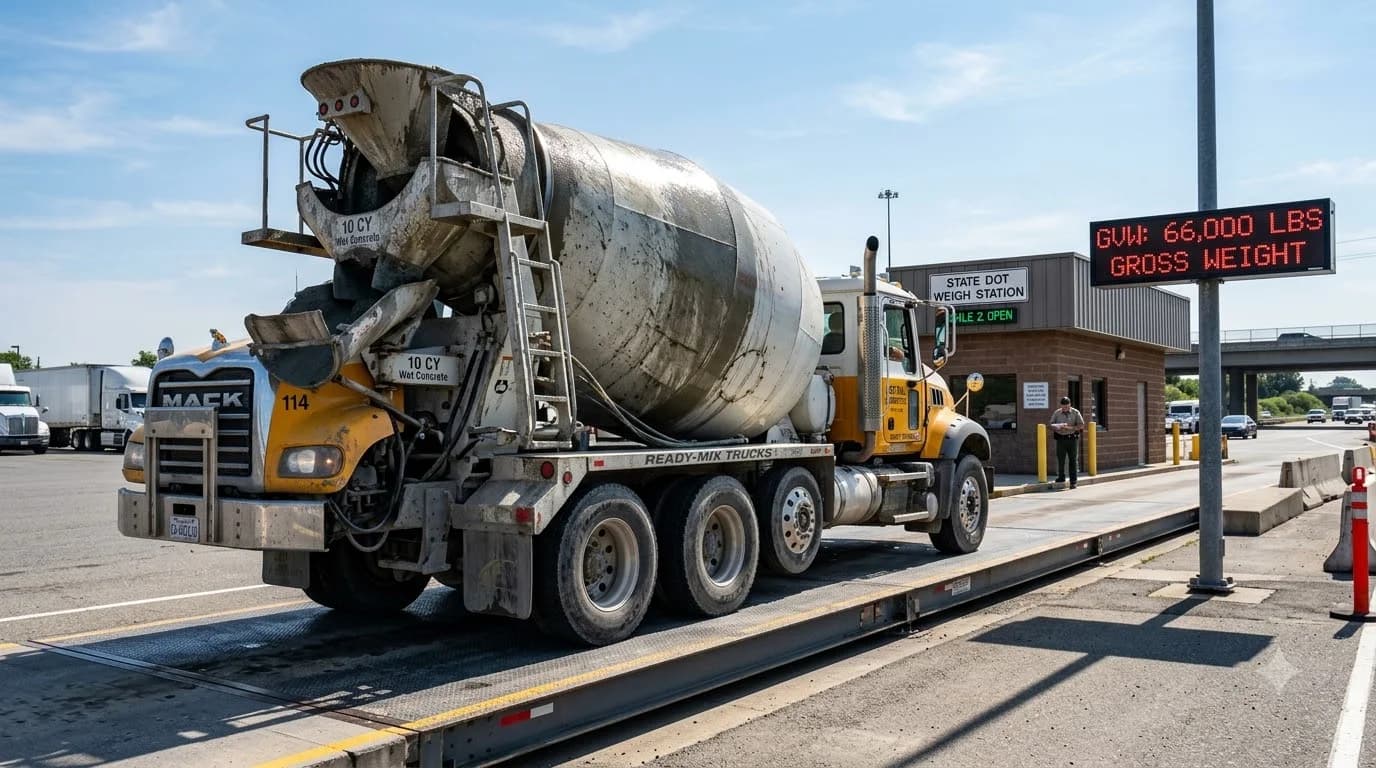
A fully loaded 10-yard concrete truck weighs approximately 66,000 to 72,000 pounds (33 to 36 tons). The empty truck chassis weighs around 26,000 to 30,000 lbs, and 10 yards of wet concrete adds roughly 40,500 lbs (at 4,050 lbs per cubic yard).
How far can a cement truck chute reach from the bumper?
Standard gravity discharge chutes attached to the rear of a ready-mix truck reach between 16 and 18 feet when all 3 or 4 folding chute sections are extended. Beyond 18 feet, you must move the material using wheelbarrows, power buggies, or a mechanical concrete pump.
How long can concrete stay in the truck drum before going bad?
Under ASTM C94 (Standard Specification for Ready-Mixed Concrete), discharge of the concrete must be completed within 90 minutes (or before the drum has turned 300 revolutions) after water is introduced at the batching plant. In hot summer weather exceeding 85°F, this window is reduced to 60 minutes.
Building Codes & Primary Standards Cited
Standard Specification for Ready-Mixed Concrete
Governs batching tolerances, drum volume limits (max 63% fill for mixing), and 90-minute time restrictions.
Federal Highway Administration Bridge Gross Weight Formula
Regulates commercial vehicle axle weight distribution to prevent highway bridge and pavement structural damage.
Guide for Measuring, Mixing, Transporting, and Placing Concrete
Authoritative American Concrete Institute guidelines for chute delivery, pump lines, and consolidation.
Estimations adhere to standard North American modular 3/8-inch mortar joint physics and 5% to 10% material waste factors. Local municipal building inspectors, stamped architectural blueprints, and local frost depth requirements supersede general reference guidelines.
Popular Quick Estimates
Pre-engineered takeoffs & benchmarks matched to this project
Related Calculators
Specialized tools for foundation, core fill, and budgeting
Dry block weight, filled core weight and hauling loads
Brick, block, and stone joint mortar bags and masonry sand
Type S and M bags, cubic feet and batching sand volume
Primer, acrylic block filler and topcoat paint gallons
Blogs & Construction Guides
Technical articles, IRC code standards, rebar schedules & freight logistics
How Much Does a Cement Truck Weigh? (2026 GVWR Specs)
Cinder Block Pallet Weight & Truck Hauling Guide
How to Calculate Concrete Yards: Step-by-Step Math