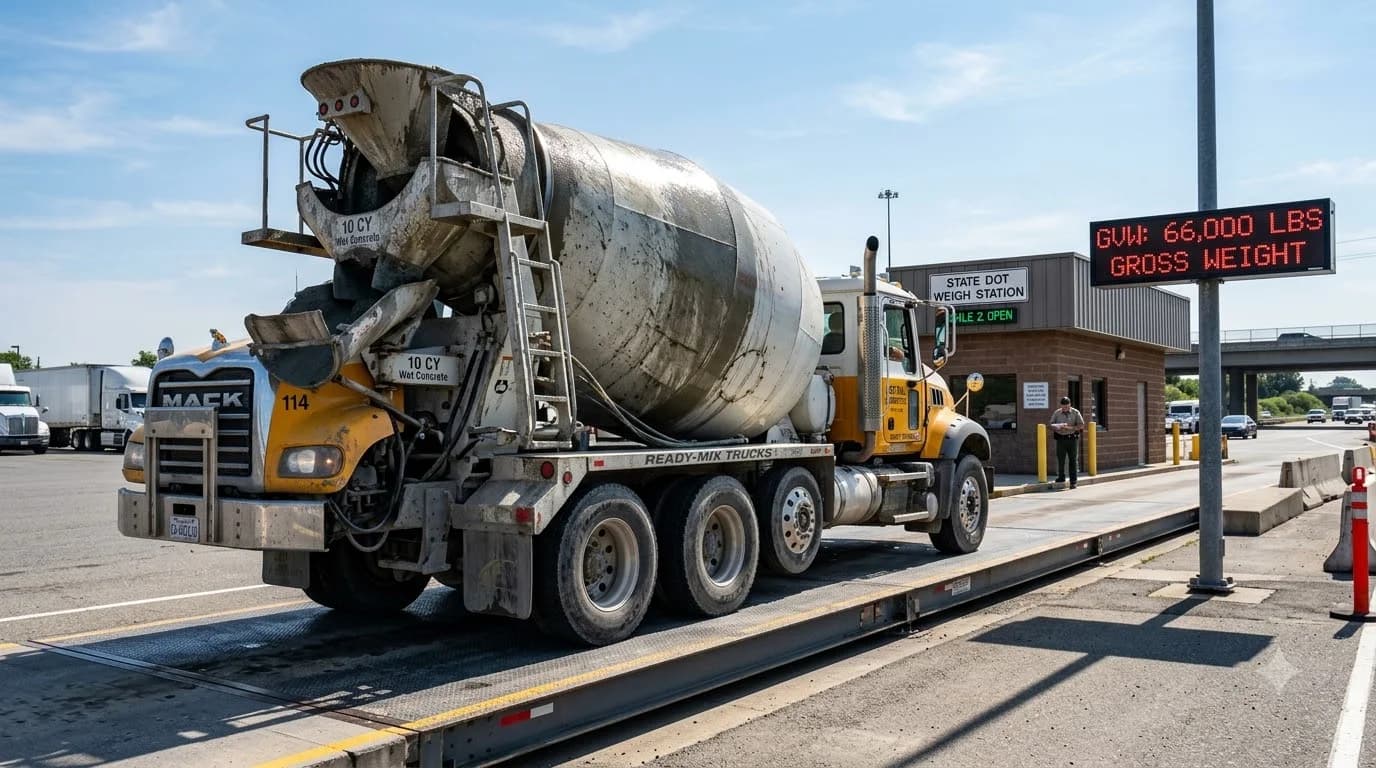
1. The Weight Breakdown: Empty Truck vs. Full Wet Payload
To understand why concrete transit mixers exert such staggering ground pressure, consider the individual components that comprise their total operating mass:
Truck Chassis & Drum
A heavy-duty vocational diesel truck chassis (Mack, Peterbilt, Freightliner, Kenworth) with heavy double-frame rails, tandem drive axles, rotating AR-400 abrasion-resistant steel drum, and auxiliary hydrostatic drive weighs 24,000 to 28,000 lbs empty.
Washout Water & Fuel
Mixers carry an onboard pressurized water tank (150 to 250 gallons) for jobsite slump adjustments and chute washout. At 8.34 lbs per gallon, a full water tank plus 60 gallons of diesel fuel adds approximately 2,000 lbs of operating weight.
Wet Ready-Mix Payload
Under ASTM C138, standard 4,000 PSI normal-weight concrete weighs roughly 150 lbs per cubic foot, or 4,050 lbs per cubic yard. A standard 10-yard delivery delivers 40,500 lbs of artificial liquid stone directly into the drum.
2. Transit Mixer Weight by Axle Configuration & Capacity
Mixer trucks utilize different axle arrangements to distribute weight legally across road bridges. Review the standard North American commercial models:
| Truck Type & Axles | Max Concrete | Empty Tare Weight | Payload Weight | Loaded GVW (lbs) | Loaded (Tons) |
|---|---|---|---|---|---|
| 3-Axle Standard (1 Steer, 2 Drive) | 7.5 cu yds | 25,500 lbs | 30,375 lbs | 55,875 lbs | 27.9 tons |
| 4-Axle Drop Pusher (1 Steer, 1 Lift, 2 Drive) | 9.0 cu yds | 27,500 lbs | 36,450 lbs | 63,950 lbs | 32.0 tons |
| 5-Axle Bridge Master (with rear booster) | 10.5 cu yds | 31,000 lbs | 42,525 lbs | 73,525 lbs | 36.8 tons |
| Front-Discharge (Oshkosh / Terex 4-Axle) | 10.0 cu yds | 30,500 lbs | 40,500 lbs | 71,000 lbs | 35.5 tons |
| Max Highway Legal Limit (Federal) | 11.0 cu yds | Var. | Var. | 80,000 lbs max | 40.0 tons |
3. The Federal Bridge Gross Weight Formula (23 U.S.C. 127)
To prevent commercial vehicles from overstressing highway bridge decks, Congress enacted the Federal Bridge Gross Weight Formula. The law caps individual single axles at 20,000 lbs, tandem axle groupings at 34,000 lbs, and total gross vehicle weight at 80,000 lbs.
Because standard short-wheelbase 3-axle dump chassis would concentrate too much weight into a 20-foot footprint, ready-mix companies install trailing "booster axles" (often nicknamed "tails" or "stingers") that fold down behind the discharge chute on highways to artificially expand the axle spread "L" to over 36 feet.
4. Why Cement Trucks Shatter Residential Driveways
1. 10x Load Overcapacity
Residential concrete driveways are 4 inches thick, engineered for 4,000 to 6,000-lb sedans. A 70,000-lb truck places 17,000 lbs on each dual rear tire set, instantly exceeding flexural shear limits.
2. Crushing Underground Utilities
PVC septic pipes, sewer laterals, water lines, and irrigation piping buried 12 to 24 inches beneath the driveway apron will be crushed under wheel loads, causing thousands in subterranean plumbing leaks.
3. Driveway Damage Waivers
Ready-mix drivers will present a legal waiver before pulling past the street curb. Signing it absolves the supplier of all legal and financial responsibility when your driveway fractures.
4. Mud Subgrade Sink-Holes
If the soil beneath a driveway or lawn is damp from rain, heavy mixer tires will sink 18 inches into the mud, trapping the truck. Heavy-duty commercial tow truck extraction costs upwards of $800 to $1,500.
5. The 3 Safe Alternatives for Distant Pours
When your backyard patio, pool deck, or foundation footing is farther than 16 feet from the street curb, use these proven material transport methods:
- Trailer-Mounted Ground Line Pump ($450 – $750 / half day): A mobile line pump parks at the street curb next to the mixer. Flexible 4-inch rubber delivery hoses snake through gates and around landscaping up to 300 feet away, delivering concrete effortlessly without risking property damage.
- Motorized Power Buggy / Georgia Buggy ($120 – $180 / day rental): A motorized tracked or rubber-tired buggy carries 16 cubic feet (roughly 2,400 lbs) of wet concrete per trip, distributing weight over wide tracks across lawns protected with OSB sheets.
- Manual Wheelbarrow Hauling Crew: For small pours under 3 cubic yards, a coordinated 3-man crew using heavy-duty 6-cu-ft contractor wheelbarrows can transport concrete across plywood ground runways in under 45 minutes.
6. Front-Discharge vs. Rear-Discharge Trucks & Standby Fees
In North American ready-mix operations, contractors encounter two fundamentally different mixer chassis configurations:
Front-Discharge Mixers
The driver steers directly into the pour site and controls hydraulic chute angle and rotation from an in-cab joystick. Highly efficient for curb-and-gutter and footings, but carries a higher front-axle weight.
Rear-Discharge Mixers
The traditional design where a ground worker operates manual chute fold-downs and throttle levers at the rear bumper. Requires a spotter for backing into tight suburban driveways.
Standby Demurrage Fees
Ready-mix dispatchers allow an average of 5 to 7 minutes per cubic yard (roughly 60 minutes total for 10 yards) for free unloading. Exceeding this window incurs demurrage surcharges of $90 to $180 per hour.
Frequently Asked Questions
Can a fully loaded concrete truck cross a residential sidewalk?
Never drive a concrete transit mixer directly over a standard 4-inch residential sidewalk or curb. The massive 20,000-lb single-axle load will instantly crush the unreinforced concrete and collapse municipal water or gas service lines buried shallowly underneath. If crossing is mandatory, lay heavy timber cribbing and 1-inch thick structural steel road plates to bridge the load.
What is the Federal Bridge Law formula for concrete mixer trucks?
The Federal Bridge Gross Weight Formula (23 U.S.C. 127) restricts the maximum gross weight of commercial vehicles based on axle spacing and axle count: W = 500 * [LN / (N - 1) + 12N + 36]. Ready-mix companies add retractable pusher lift axles and rear trailing booster axles to extend the wheel base and legally carry 9 to 10 cubic yards (up to 80,000 lbs) on federal highways.
How many tons does a 10-yard concrete mixer truck weigh?
A standard 10-cubic-yard concrete mixer truck weighs between 66,000 and 73,500 lbs fully loaded, which equals 33 to 36.75 US short tons. The empty tare truck weighs roughly 26,000 to 30,000 lbs (13 to 15 tons), while the 10 yards of wet concrete add 40,500 lbs (20.25 tons) of payload.
Will a concrete mixer truck ruin my residential asphalt or concrete driveway?
Yes, in nearly all cases. Residential driveways are engineered for personal vehicles weighing 4,000 to 8,000 lbs. A 70,000-lb concrete mixer exceeds residential subgrade bearing capacity by nearly 1,000%, causing edge punch-through fractures, crushed subbase stone, and shattered underground drainage pipes. Most ready-mix suppliers require homeowners to sign a driveway damage waiver before leaving the street.
How far can a concrete truck reach with its discharge chutes?
Standard ready-mix transit mixers carry 3 to 4 chute sections that attach to the main discharge funnel. The maximum gravity chute reach extends roughly 14 to 18 feet from the rear bumper. If your pour site is located further than 18 feet from where the truck can safely park, you must schedule a concrete pump truck, power Georgia buggies, or a manual wheelbarrow crew.
Building Codes & Primary Standards Cited
Federal-Aid Highways - Vehicle Weight Limitations
Codifies the Federal Bridge Gross Weight Formula and axle spacing restrictions for commercial vehicles.
Truck Size and Weight, Route Designations
Governs commercial vehicle axle loading and oversize vehicle permitting protocols.
Guide for Measuring, Mixing, Transporting, and Placing Concrete
Technical standards for drum rotation speed, discharge timing, and placement logistics.
Standard Specification for Ready-Mixed Concrete
Defines batch discharge time limits (90 minutes or 300 drum revolutions) following water introduction.
Estimations adhere to standard North American modular 3/8-inch mortar joint physics and 5% to 10% material waste factors. Local municipal building inspectors, stamped architectural blueprints, and local frost depth requirements supersede general reference guidelines.
Popular Quick Estimates
Pre-engineered takeoffs & benchmarks matched to this project
Related Calculators
Specialized tools for foundation, core fill, and budgeting
Dry block weight, filled core weight and hauling loads
Brick, block, and stone joint mortar bags and masonry sand
Type S and M bags, cubic feet and batching sand volume
Straight and multi-wall runs with mortar and waste allowances
Blogs & Construction Guides
Technical articles, IRC code standards, rebar schedules & freight logistics
Cinder Block Pallet Weight & Truck Hauling Guide
How Many Yards of Concrete in a Cement Truck?
How Much Weight Can a Cinder Block Hold? (Load Capacity)