CMU R-Value Calculator
Calculate bare and core-filled concrete masonry unit (CMU) wall R-values, assembly U-factors, 4-cu-ft loose-fill insulation bags, and IECC Zone 4 mass wall compliance across 6" to 12" ASTM C90 block densities.
CMU Wall R-Value, U-Factor & Core-Fill Insulation Takeoff
cinderblockscalculator.com/cmu-r-value-calculator
Date: 11/13/2026
Reference: ASHRAE 90.1 / IECC Mass Wall / ASTM C90
| Thermal / Material Metric | Basis / Standard | Calculated Value |
|---|---|---|
| Bare CMU Wall R-Value | ASTM C90 normal-weight + 0.85 air films | R-2 |
| Core-Filled CMU R-Value | Loose-Fill Perlite (ASTM C549) (+R-2 core gain) | R-4 |
| Total Assembly R-Value | Core-filled CMU + R-5 continuous exterior | R-9 |
| Assembly U-Factor | 1 / Total Assembly R-Value | 0.111 Btu/(h·ft²·°F) |
| 4-Cu-Ft Loose-Fill Core Bags | 450 ungrouted CMUs + 5% settling margin | 26 bags |
| IECC Zone 4 Mass-Wall Check | Assembly ≥ R-7.6 or continuous ≥ R-5.7 ci | PASS |
CMU Thermal Assembly Math (R-Value, U-Factor & Core Fill)
Evaluating a concrete masonry unit (CMU) enclosure differs from stud-framed walls because hollow concrete webs bypass core insulation via parallel-path conduction while masonry mass stores and delays diurnal heat flow. Total wall thermal resistance combines interior and exterior air-film resistances (0.68 + 0.17 = 0.85), the bare CMU path resistance by width and ASTM C90 concrete density, any ungrouted core-fill boost, and continuous exterior insulation: U = 1 ÷ R_total.
Worked Example: 40 × 10 ft (400 sq ft) 8" Normal CMU + Perlite + R-5 Exterior Continuous Insulation
1. Wall Area & Unit Count = 40 ft × 10 ft = 400 sq ft → ceil(400 × 1.125) = 450 net CMUs
2. Bare 8" Normal-Weight CMU = 1.10 masonry + 0.85 air films = R-2.0 (U-0.500)
3. Core-Filled CMU (+2.0 perlite boost) = 2.0 + 2.0 = R-4.0 (U-0.250)
4. Total Assembly (+ R-5 exterior ci) = 4.0 + 5.0 = R-9.0 (U-0.111 · Passes Zone 4 ≥ R-7.6)
5. Loose-Fill Perlite Order: ceil((450 units × 0.22 cu ft/unit × 1.05 settling) ÷ 4 cu ft/bag) = 26 bags (4 cu ft each)
Need an exact structural block count, mortar allowance, or bond beam grout takeoff before pricing insulation? Run your wall layout through our Concrete Block Calculator and confirm nominal versus actual cell dimensions on the CMU Block Dimensions specification guide.
Why Continuous Exterior Insulation Beats Core Fill Alone
Under ASHRAE 90.1 and the International Energy Conservation Code (IECC), concrete masonry walls are classified as mass walls when they meet minimum heat-capacity thresholds (typically ≥ 7 Btu/ft²·°F, or ≥ 5 Btu/ft²·°F for lightweight units). Even with lower-conductivity lightweight aggregates, uninsulated concrete webs create direct conductive paths unless interrupted by continuous insulation (ci).
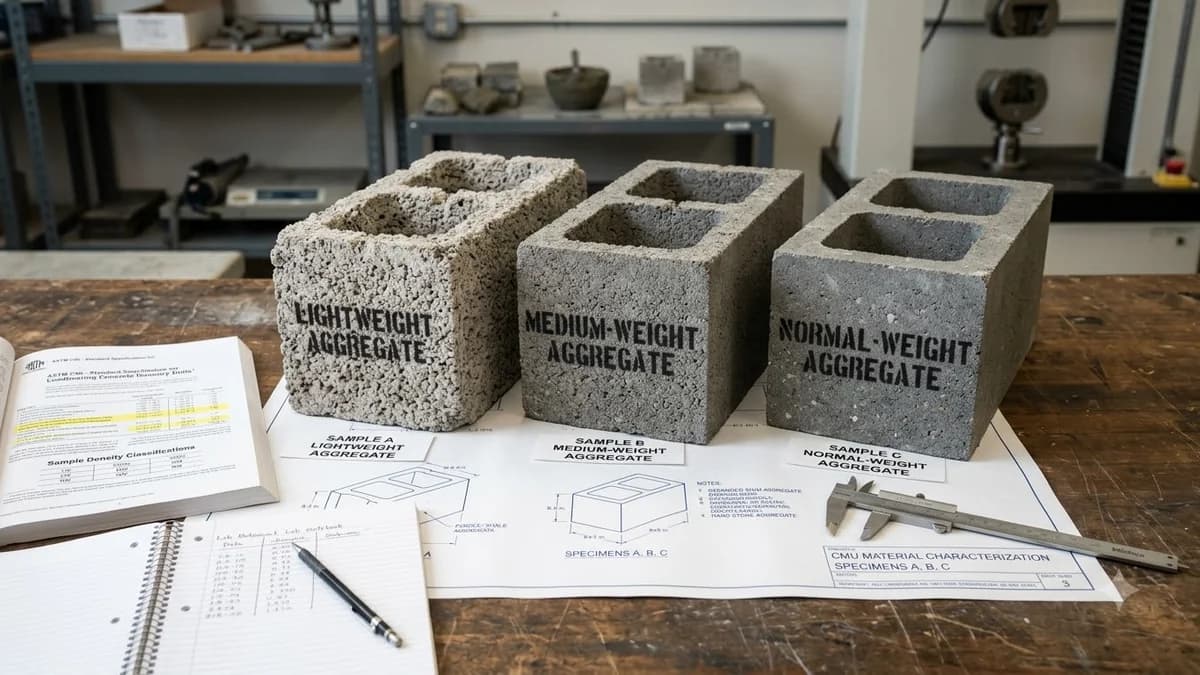
ASTM C90 Concrete Density Classes
Normal Weight (≥125 pcf) uses dense sand and crushed stone, yielding maximum compressive mass and acoustic damping at R-1.9 to R-2.3 bare. Medium Weight (105–125 pcf) blends natural and expanded aggregates, while Lightweight (<105 pcf) uses expanded clay, shale, or pumice to lift bare 8" CMU resistance to R-2.9.
Perlite, EPS Beads vs. Molded Foam Inserts
Loose-fill perlite (ASTM C549) and EPS beads pour easily after walls reach story height, wrapping around horizontal wire ties. Molded foam inserts deliver slightly higher thermal boost (+R-3.0 on 8" CMU) when installed course by course inside ungrouted cells, whereas structural grouted cells cannot receive core insulation.
For multi-wythe insulated masonry veneers with continuous rigid foam inside a drained air space, compare assembly thicknesses and wall-tie spacing using our Cavity Wall Calculator. For below-grade foundation walls and stem-wall thermal detailing, verify regional frost embedment depths in our US Frost Depth by State Guide.
Table 1: CMU Thermal R-Value & U-Factor Matrix by Width, Density & Core Fill
The matrix below matches the ASHRAE 90.1 / ASTM C90 calculation engine for ungrouted concrete masonry walls before adding exterior continuous rigid insulation (includes 0.85 interior + exterior air-film R-value).
| Nominal Width | ASTM C90 Density | Empty Cores | Perlite Fill | EPS Beads | Foam Inserts |
|---|---|---|---|---|---|
| 6" CMU | Normal (≥125 pcf) | R-1.9 (U-0.526) | R-3.1 (U-0.323) | R-3.5 (U-0.286) | R-3.7 (U-0.270) |
| 6" CMU | Medium (105–125 pcf) | R-2.2 (U-0.455) | R-3.4 (U-0.294) | R-3.8 (U-0.263) | R-4.0 (U-0.250) |
| 6" CMU | Lightweight (<105 pcf) | R-2.5 (U-0.400) | R-3.7 (U-0.270) | R-4.1 (U-0.244) | R-4.3 (U-0.233) |
| 8" CMU | Normal (≥125 pcf) | R-2.0 (U-0.500) | R-4.0 (U-0.250) | R-4.6 (U-0.217) | R-5.0 (U-0.200) |
| 8" CMU | Medium (105–125 pcf) | R-2.4 (U-0.417) | R-4.4 (U-0.227) | R-5.0 (U-0.200) | R-5.4 (U-0.185) |
| 8" CMU | Lightweight (<105 pcf) | R-2.9 (U-0.345) | R-4.9 (U-0.204) | R-5.5 (U-0.182) | R-5.9 (U-0.169) |
| 10" CMU | Normal (≥125 pcf) | R-2.2 (U-0.455) | R-4.8 (U-0.208) | R-5.6 (U-0.179) | R-6.0 (U-0.167) |
| 10" CMU | Medium (105–125 pcf) | R-2.6 (U-0.385) | R-5.2 (U-0.192) | R-6.0 (U-0.167) | R-6.4 (U-0.156) |
| 10" CMU | Lightweight (<105 pcf) | R-3.2 (U-0.313) | R-5.8 (U-0.172) | R-6.6 (U-0.152) | R-7.0 (U-0.143) |
| 12" CMU | Normal (≥125 pcf) | R-2.3 (U-0.435) | R-5.4 (U-0.185) | R-6.5 (U-0.154) | R-6.9 (U-0.145) |
| 12" CMU | Medium (105–125 pcf) | R-2.8 (U-0.357) | R-5.9 (U-0.169) | R-7.0 (U-0.143) | R-7.4 (U-0.135) |
| 12" CMU | Lightweight (<105 pcf) | R-3.5 (U-0.286) | R-6.6 (U-0.152) | R-7.7 (U-0.130) | R-8.1 (U-0.123) |
Table 2: IECC & ASHRAE 90.1 Mass Wall Insulation Targets by Climate Zone
Use these illustrative IECC / ASHRAE 90.1 mass-wall continuous insulation (ci) and assembly U-factor benchmarks as a planning check. Always verify the exact code edition and exterior vs. interior mass-wall path adopted by your local jurisdiction.
| IECC Climate Zone | Residential Mass Wall (Ext. ci) | Commercial Mass Wall (ASHRAE 90.1) | Illustrative Compliant CMU Assembly |
|---|---|---|---|
| Zones 1 & 2 (Hot / Humid & Dry) | R-3 / R-4 ext. ci | R-5.7 ci (U-0.151) | 8" Normal CMU + Perlite + R-5 continuous exterior foam |
| Zone 3 (Warm Mixed / Marine) | R-5 / R-8 ext. ci | R-7.6 ci (U-0.123) | 8" Normal CMU + EPS Beads + R-5 to R-7.5 exterior rigid foam |
| Zone 4 (Mixed Humid / Marine) | R-5 / R-8 ext. ci | R-9.5 ci (U-0.104) | 8" Medium CMU + Perlite/EPS + R-7.5 to R-10 exterior ci |
| Zone 5 (Cool / Northern) | R-13 / R-17 ext. ci | R-11.4 ci (U-0.090) | 8"–12" Lightweight CMU + Foam Inserts + R-10 to R-15 ci |
| Zone 6 (Cold) | R-15 / R-20 ext. ci | R-13.3 ci (U-0.080) | 12" Lightweight CMU + EPS + R-12 to R-15 ci (or cavity wall) |
| Zones 7 & 8 (Very Cold / Subarctic) | R-19 / R-21 ext. ci | R-15.2 ci (U-0.071) | 12" Lightweight CMU + multi-layer R-15+ exterior ci cavity |
Field Installation Notes for Core-Filled & Insulated CMU Walls
- Keep Grouted Cells Separate: Vertical rebar cells and horizontal bond-beam courses filled with structural grout cannot hold loose-fill perlite or EPS beads. Install mesh grout-stop screens under bond beams so loose fill does not drop past solid courses or waste bags.
- Control Moisture Before Pouring Loose Fill: Ensure hollow CMU cores are dry and free of mortar droppings before pouring perlite or EPS beads, and cap the wall top promptly to prevent windblown rain from saturating unsealed cores.
- Seal Exterior Continuous Foam Joints: Tape vertical and horizontal seams on exterior XPS or polyiso boards, lap flashing over window headers, and coordinate shelf-angle or veneer-tie thermal breaks to protect the calculated assembly U-factor.
Material estimates depend on the selected dimensions, product yields, and waste allowance.
CMU R-Value & Mass Wall Insulation FAQs
Code-grounded answers on concrete masonry unit thermal resistance, parallel-path bridging, loose-fill core bags, and IECC compliance.
What is the R-value of a bare 8-inch concrete masonry unit wall?
An uninsulated, normal-weight 8-inch concrete masonry unit (CMU) wall with empty air cores provides a bare thermal resistance of roughly R-2.0 (including standard interior and exterior air-film resistances totaling 0.85, which corresponds to a U-factor of 0.500 Btu/(h·ft²·°F)). Switching to lightweight ASTM C90 aggregate raises the bare 8-inch CMU rating to approximately R-2.9 before adding core fill or continuous insulation.
Why does core insulation alone yield less R-value than expected in CMU walls?
In a hollow concrete masonry unit, solid concrete webs and face shells occupy roughly 25% to 35% of the wall cross-section and act as parallel-path thermal bridges around insulated cores. Under ASHRAE 90.1 isothermal-plane and parallel-path calculations, filling an 8-inch normal-weight CMU wall with loose-fill perlite adds about R-2.0 (reaching R-4.0 total) rather than the center-of-core R-value of the perlite alone.
How many 4-cubic-foot bags of perlite or EPS beads fill an 8-inch CMU wall?
Each ungrouted 8×8×16 concrete masonry unit holds approximately 0.22 cubic feet of core volume. On a 40 × 10 ft wall (400 sq ft, or 450 net units at 1.125 units/sq ft), total ungrouted core volume with a 5% settling margin is 103.95 cubic feet, requiring 26 bags of 4-cu-ft loose-fill perlite or EPS beads. If cores are partially grouted for rebar every 32 or 48 inches, deduct the grouted cell volume before ordering.
What is the IECC and ASHRAE 90.1 Zone 4 mass wall insulation requirement?
Climate Zone 4 mixed-humid and mixed-marine mass wall assemblies typically target a maximum commercial assembly U-factor around U-0.104 to U-0.123 (roughly R-8.1 to R-9.6 effective) or prescriptive continuous insulation of R-5.7 ci to R-7.6 ci depending on the adopted IECC edition and residential versus commercial occupancy. This tool flags Zone 4 mass-wall compliance whenever total assembly resistance reaches R-7.6 or exterior continuous insulation meets R-5.7 ci.
Should continuous rigid insulation go on the exterior or interior of a CMU wall?
Placing continuous rigid foam (XPS, EPS, or foil-faced polyiso) on the exterior side of a concrete masonry unit wall delivers superior thermal mass performance under ASHRAE 90.1 and IECC rules. Exterior continuous insulation shields the concrete mass from outdoor temperature swings, eliminates thermal bridging at slab edges and bond beams, and keeps the masonry warm to prevent interior condensation.
How does concrete unit density affect CMU thermal resistance?
Lower-density aggregates contain microscopic air pores that slow conductive heat transfer through concrete webs and face shells. An 8-inch lightweight CMU (under 105 pcf per ASTM C90) reaches R-2.9 bare and R-4.9 with perlite core fill, compared with R-2.0 bare and R-4.0 with perlite for normal-weight concrete (125+ pcf). Because thermal mass heat-capacity credits also depend on wall weight, confirm both U-factor and heat capacity when sizing HVAC loads.
Popular Quick Estimates
Illustrative takeoffs with stated assumptions; verify project quantities
1000 Sq Ft Sizing
High-volume logistics & bulk pallet freight
10x10 Wall Estimate
Standard residential yard & garden wall run
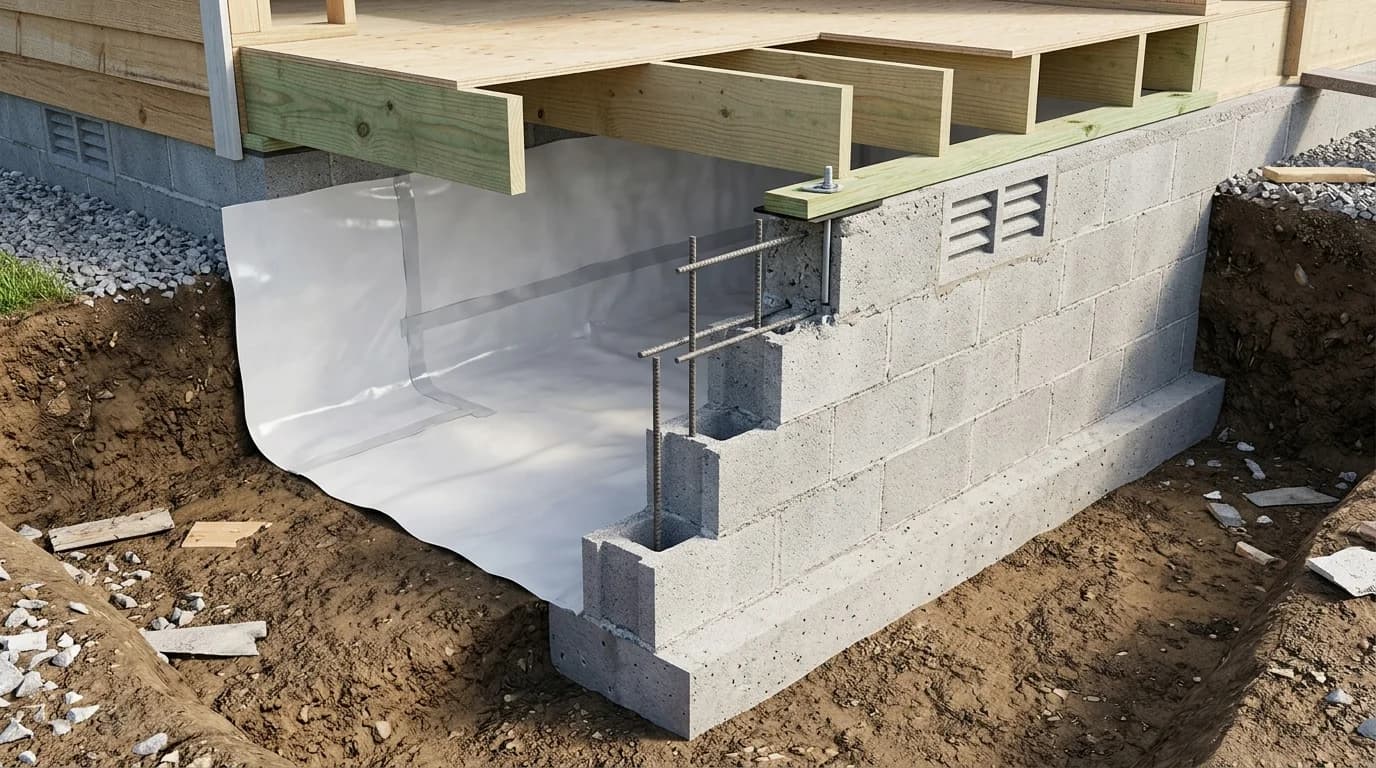
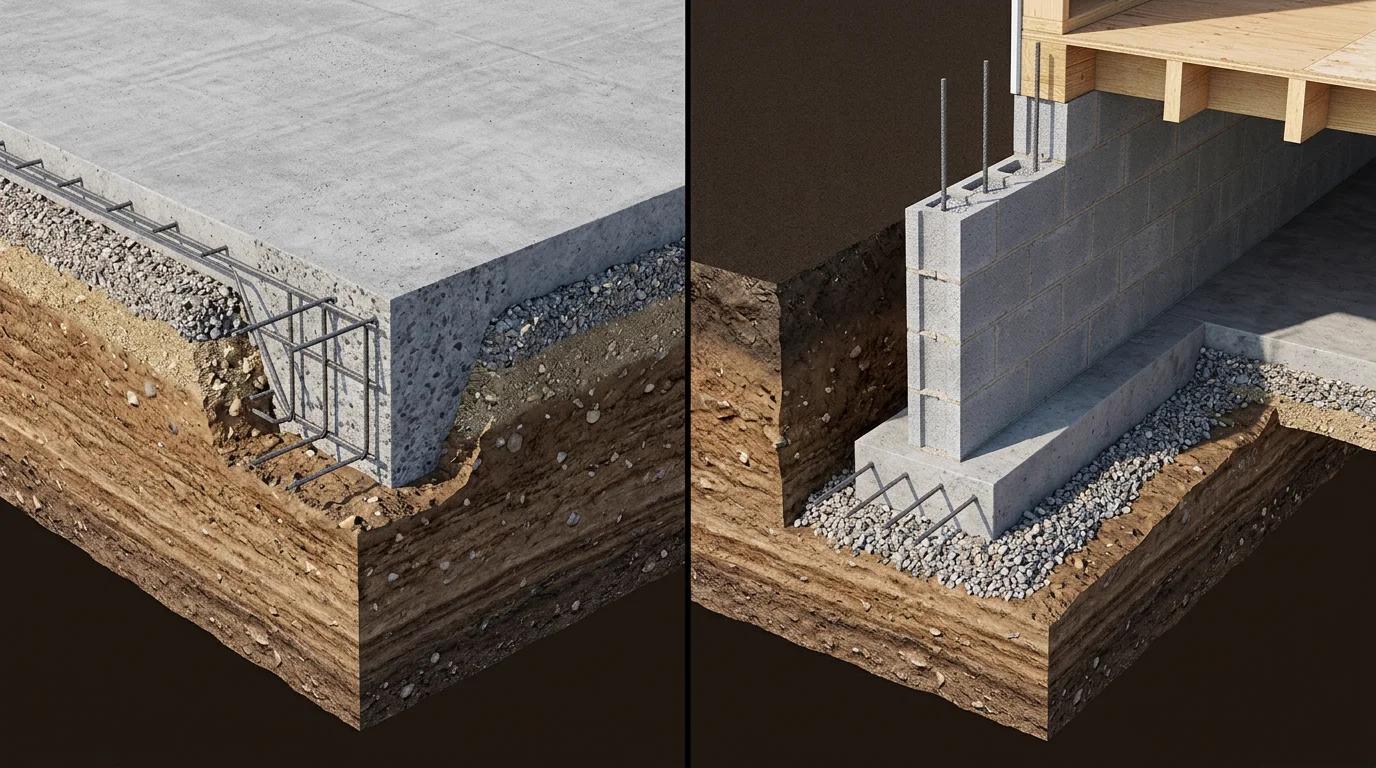
Crawlspace Stem Wall
Course-height example; footing design is site-specific
Standard CMU Weight
Illustrative hollow-unit range; check supplier specs
Related Calculators
Specialized tools for foundation, core fill, and budgeting
Heavyweight structural blocks and bond beam units
Commercial CMU backup, rigid insulation, adjustable ties & veneer brick
Equivalent thickness, hourly fire resistance ratings and core fill
Sound Transmission Class ratings, wall mass, and core grouting acoustic isolation
Blogs & Construction Guides
Practical guides to block sizing, material estimates and project planning
CMU Weight & Density Classes: ASTM C90 Concrete Blocks
Monolithic Slab vs Stem Wall Foundation: Cost & Frost Guide
Running Bond vs Stack Bond CMU: TMS 402 & Rebar Guide