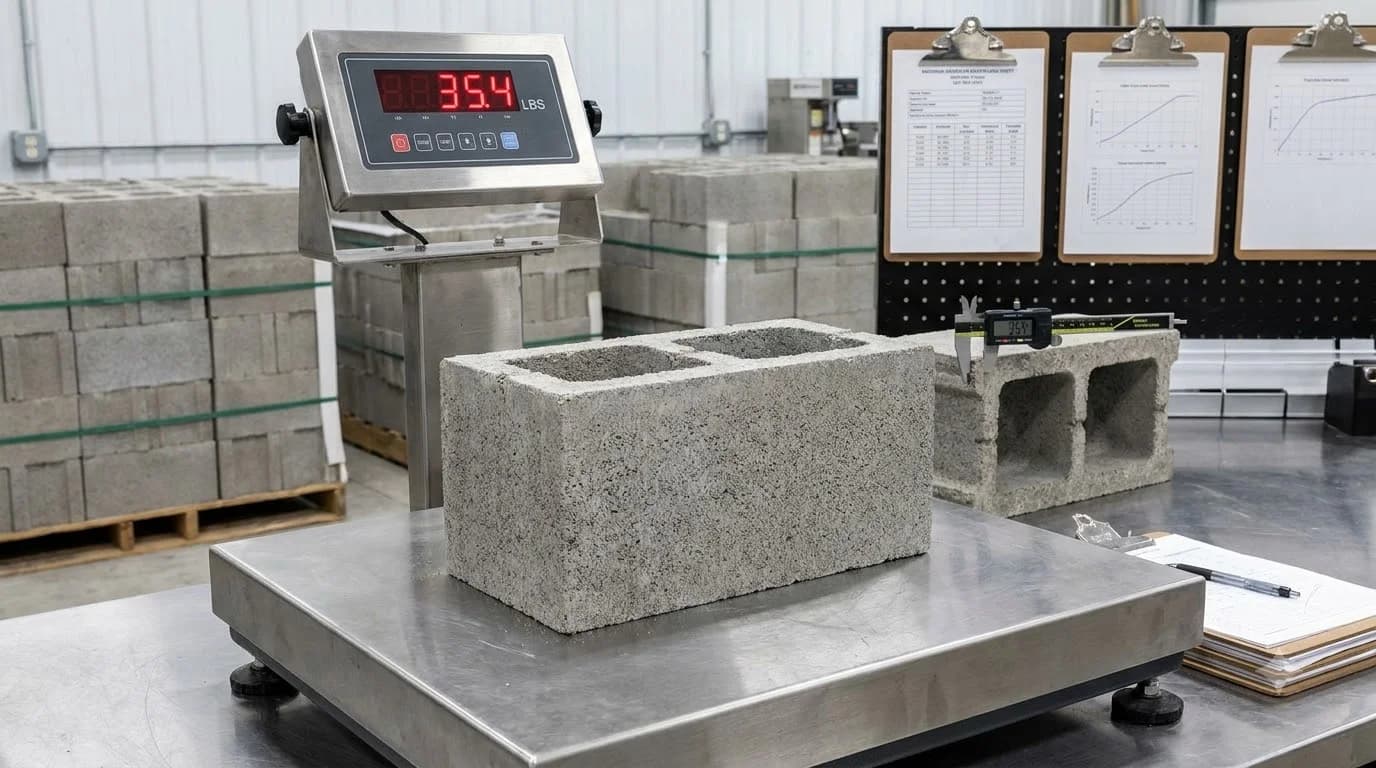
Concrete Bin Block Calculator
Estimate 2×2×6 precast concrete bin blocks, 3-ft half-block running bond end units, top cap blocks, total wall tonnage, 44,000-lb flatbed truckloads, and compacted #57 stone leveling pads.
2×2×6 Interlocking Ecology & Retaining Wall Material Schedule
https://cinderblockscalculator.com/concrete-bin-block-calculator
Date: 11/13/2026
Payload Basis: 44,000-lb Legal Flatbed
| Material / Freight Item | Specification / Formula Basis | Quantity |
|---|---|---|
| 6-ft Full Precast Blocks | 2' × 2' × 6' interlocking ecology unit (@ 3,900 lb) | 17 units |
| 3-ft Half Precast Blocks | 2' × 2' × 3' running-bond end / remainder unit (~52% weight) | 2 units |
| Top Cap Coping Blocks | Not included in takeoff | 0 units |
| Total Precast Concrete Units | 216 sq ft vertical wall face | 19 blocks |
| Total Precast Tonnage | 70,356 lb total concrete mass | 35.2 tons |
| Flatbed Freight Truckloads | Rounded up at 44,000-lb legal highway payload | 2 load(s) |
| Compacted #57 Stone Leveling Pad | 36" wide × 8" deep trench @ 1.4 tons/yd³ | 3.7 tons |
Precast Concrete Bin Blocks, Ecology Blocks & 2×2×6 MAFIA Blocks
Known regionally as precast concrete bin blocks, ecology blocks, interlocking landscape blocks, or 2×2×6 MAFIA blocks, these massive modular precast units are cast in steel forms using returned or batch-plant ready-mix concrete. Each full unit measures 2 ft tall by 2 ft deep by 6 ft long (24" × 24" × 72") with cast-in interlocking shear cones, pyramids, or V-grooves on top and matching recesses underneath, plus a recessed galvanized lifting loop for crane, telehandler, or excavator rigging.
Because dry-stacked ecology blocks rely on dead-weight friction and mechanical shear keys rather than wet mortar beds, crew productivity is fast—an experienced operator and ground rigger can set 30 to 50 blocks per day once the gravel base pad is compacted and laser-leveled. Common applications include aggregate and mulch storage bunkers, highway and site perimeter barriers, heavy gravity retaining walls, and industrial loading-dock wing walls.
Running-Bond Half-Block Math, Tonnage & Worked Takeoff Example
Odd-numbered courses (1, 3, 5) lay end-to-end using full 6-ft units plus a 3-ft remainder block when the run is not divisible by 6 ft. When half-block running-bond end stagger is active, every even-numbered course (2, 4, 6) begins and ends with a 3-ft half block (2×2×3 ft), shifting all vertical joints by 3 ft so upper blocks bridge cleanly across lower seams.
Worked Example: 36-ft × 3-Course (6 ft High) Aggregate Bay Wall (@ 3,900 lb/unit)
1. Odd Courses (Course 1 & Course 3): 36 ft ÷ 6 ft = 6 full blocks each → 12 full 6-ft blocks
2. Even Course (Course 2, running-bond ends): (36 − 6) ÷ 6 = 5 full blocks + 2 end half blocks → 5 full + 2 half 3-ft blocks
3. Total Precast Units: 12 + 5 = 17 full 6-ft blocks + 2 half 3-ft blocks = 19 units total
4. Total Concrete Weight: (17 × 3,900 lb) + (2 × 3,900 × 0.52) = 66,300 + 4,056 = 70,356 lb (35.2 short tons)
5. Flatbed Freight Loads: ceil(70,356 ÷ 44,000 lb) = 2 flatbed truckloads
6. #57 Stone Base Pad (36" × 8"): (36 × 3 × 0.667 ÷ 27) × 1.4 tons/yd³ = 3.7 tons compacted stone
Table 1: Precast Concrete Bin Block Unit Dimensions, Weights & Flatbed Capacity
Actual cast tolerances and shear-cone geometry vary slightly by regional precast plant. Confirm lifting loop rating and unit weight on the supplier's shop ticket before mobilizing rigging equipment.
| Precast Unit Type | Nominal Size (H × D × L) | Concrete Vol. | Unit Weight Range | 44,000-lb Flatbed | Primary Wall Function |
|---|---|---|---|---|---|
| 6-ft Full Bin Block | 24" × 24" × 72" (2' × 2' × 6') | 0.89 yd³ (24.0 cu ft) | 3,600 – 4,200 lb | 10 – 12 units / load | Primary running-bond wall & bay course |
| 3-ft Half Bin Block | 24" × 24" × 36" (2' × 2' × 3') | 0.46 yd³ (~12.5 cu ft) | 1,870 – 2,180 lb | 20 – 23 units / load | Even-course running-bond end stagger & odd spans |
| 6-ft Flat Top Cap | 12" × 24" × 72" (1' × 2' × 6') | 0.40 yd³ (~10.8 cu ft) | 1,620 – 1,890 lb | 23 – 27 units / load | Flat-top finished coping covering shear knobs |
| Corner / L-Return Unit | 24" × 24" × 48"–72" | 0.59 – 0.89 yd³ | 2,400 – 3,900 lb | 11 – 18 units / load | 90° material bay partitions & wing-wall returns |
Table 2: Bin Block Takeoff Matrix by Wall Length & Course Height (3,900 lb Basis)
Reference quantities below assume running-bond half-block end stagger enabled, no top cap blocks, 3,900 lb per 6-ft block, and 44,000-lb legal flatbed truckload limits.
| Wall Length | #57 Stone Pad | 2 Courses (4 ft High) | 3 Courses (6 ft High) | 4 Courses (8 ft High) |
|---|---|---|---|---|
| 18 ft | 1.9 tons | 5 full / 2 half · 11.8 t (1 load) | 8 full / 2 half · 17.6 t (1 load) | 10 full / 4 half · 23.6 t (2 loads) |
| 24 ft | 2.5 tons | 7 full / 2 half · 15.7 t (1 load) | 11 full / 2 half · 23.5 t (2 loads) | 14 full / 4 half · 31.4 t (2 loads) |
| 36 ft | 3.7 tons | 11 full / 2 half · 23.5 t (2 loads) | 17 full / 2 half · 35.2 t (2 loads) | 22 full / 4 half · 47.0 t (3 loads) |
| 48 ft | 5.0 tons | 15 full / 2 half · 31.3 t (2 loads) | 23 full / 2 half · 46.9 t (3 loads) | 30 full / 4 half · 62.6 t (3 loads) |
| 60 ft | 6.2 tons | 19 full / 2 half · 39.1 t (2 loads) | 29 full / 2 half · 58.6 t (3 loads) | 38 full / 4 half · 78.2 t (4 loads) |
Site Preparation, #57 Stone Leveling Pad & Rigging Field Checklist
Every 6-ft ecology block concentrates nearly 2 tons onto a 12 sq ft footprint. Skipping base compaction or drainage causes differential settlement that opens wide vertical gaps between upper courses.
- Undisturbed Subgrade & Geotextile: Strip all turf, roots, and soft clay down to firm mineral subgrade, then line the trench with non-woven geotextile separation fabric so fines cannot pump upward into the stone pad.
- Compacted 36" × 8" #57 Stone Pad: Extend the crushed stone footing at least 6 inches beyond both the front toe and back heel of the 24-inch-deep block, screeded dead level longitudinally and cross-checked with a laser level.
- Backfill Drainage for Retaining Sections: Place a 4-inch perforated drain pipe at the bottom heel wrapped in filter fabric with at least 12 inches of clean #57 stone chimney backfill behind the wall to relieve hydrostatic water pressure.
- Rigging & Equipment Reach Verification: Inspect every recessed rebar or wire-rope lifting loop before hoisting, use rated clevis shackles with a spreader bar where specified, and verify crane or excavator chart capacity at full reach radius before trucks arrive.
Related Concrete Wall & Volume Resources
Material estimates depend on the selected dimensions, product yields, and waste allowance.
Concrete Bin Block & Ecology Wall FAQs
Practical engineering answers covering 2×2×6 MAFIA block unit weights, 44,000-lb flatbed truckloads, running-bond stagger, and compacted #57 stone leveling pads.
How much does a standard 2×2×6 precast concrete bin block weigh?
A solid 2×2×6 precast concrete bin block (24 inches high × 24 inches deep × 72 inches long, containing roughly 24 cubic feet or 0.89 cubic yards of concrete) typically weighs between 3,600 and 4,200 lb depending on aggregate density and shear-key recesses, with 3,800 to 4,000 lb as the most common precast yard average. Half-size 2×2×3 blocks weigh roughly 52% of a full block (about 1,950 to 2,100 lb).
How many 2×2×6 ecology blocks fit on a standard flatbed truck?
Because federal interstate gross vehicle weight limits generally cap highway flatbed legal payloads near 44,000 lb (22 short tons), a standard semi-flatbed carries 10 to 11 full 2×2×6 precast concrete bin blocks per load at 3,900 to 4,000 lb each. Heavy-haul multi-axle trailers or local lowboy permits may carry more, so always verify axle limits and forklift or crane unloading access with your precast supplier.
Why do interlocking landscape block walls use 3-ft half blocks on even courses?
Placing a 3-ft half block (2×2×3 ft) at each end of every even-numbered course offsets vertical head joints by 50% in a true running bond. Staggering joints locks each upper course across two lower blocks via cast-in shear cones or V-grooves, preventing vertical crack planes and eliminating the need to saw-cut massive 24-inch-thick concrete units on site.
What base pad is required under precast concrete bin blocks?
Most precast producers and retaining wall details specify a compacted crushed stone leveling pad at least 36 inches wide and 6 to 8 inches deep using clean #57 crushed stone (or dense-graded aggregate compacted in lifts) over undisturbed subgrade and geotextile separation fabric. On a 36-ft wall, a 36-inch wide by 8-inch deep #57 stone trench requires roughly 3.7 tons (about 2.7 cubic yards) of crushed stone.
How tall can you stack 2×2×6 MAFIA blocks without engineering?
Freestanding material storage dividers and unretained gravity walls are commonly stacked 2 to 3 courses high (4 to 6 ft), while earth-retaining walls above 4 ft (2 courses) or walls supporting sloped backfill, equipment surcharges, or vehicle traffic generally require a licensed geotechnical or structural engineer's design under local building codes, incorporating setback batter, base embedment, and perimeter drainage.
Do precast concrete bin blocks require mortar between courses?
No. Precast concrete bin blocks, ecology blocks, and interlocking landscape blocks are dry-stacked gravity units that rely on their 3,600 to 4,200 lb self-weight and cast-in top shear knobs, domes, or tongue-and-groove keys for lateral alignment. Where retaining backfill, install non-woven geotextile fabric and free-draining #57 stone behind the joints rather than mortar.
Popular Quick Estimates
Illustrative takeoffs with stated assumptions; verify project quantities
Retaining Wall Budget
Illustrative budget range; replace with local quotes
Standard CMU Weight
Illustrative hollow-unit range; check supplier specs
1000 Sq Ft Sizing
High-volume logistics & bulk pallet freight
Crawlspace Stem Wall
Course-height example; footing design is site-specific
Related Calculators
Specialized tools for foundation, core fill, and budgeting
Segmental retaining wall blocks, capstones, leveling pad gravel, and drainage rock
Cubic yards, bags, and slab volume for flatwork and footings
Estimate #57 drainage gravel, perforated pipe and filter fabric
Precast 16, 24, and 36-in wall cap stones, mitered corners, drip flashing, and mortar
Blogs & Construction Guides
Practical guides to block sizing, material estimates and project planning
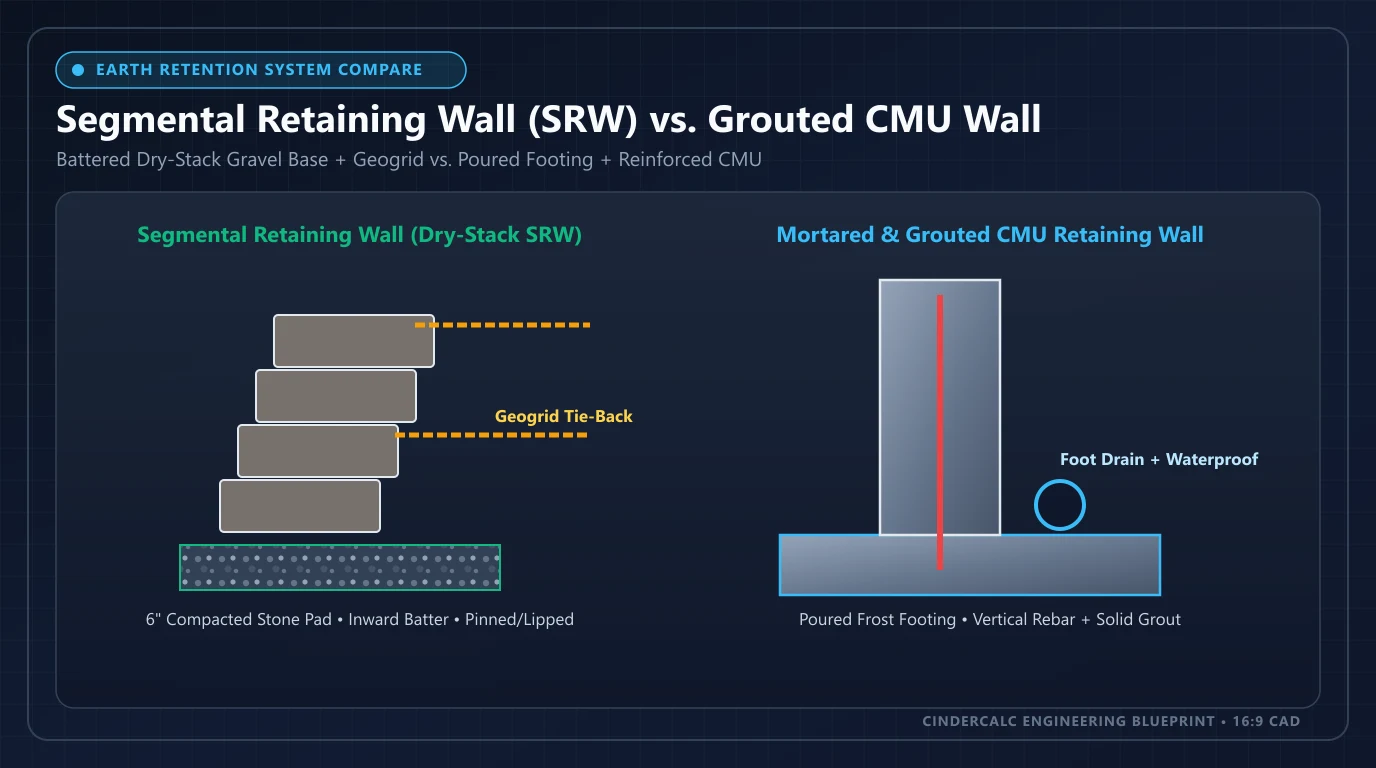
Segmental Retaining Wall vs CMU Block: Cost & Code Guide
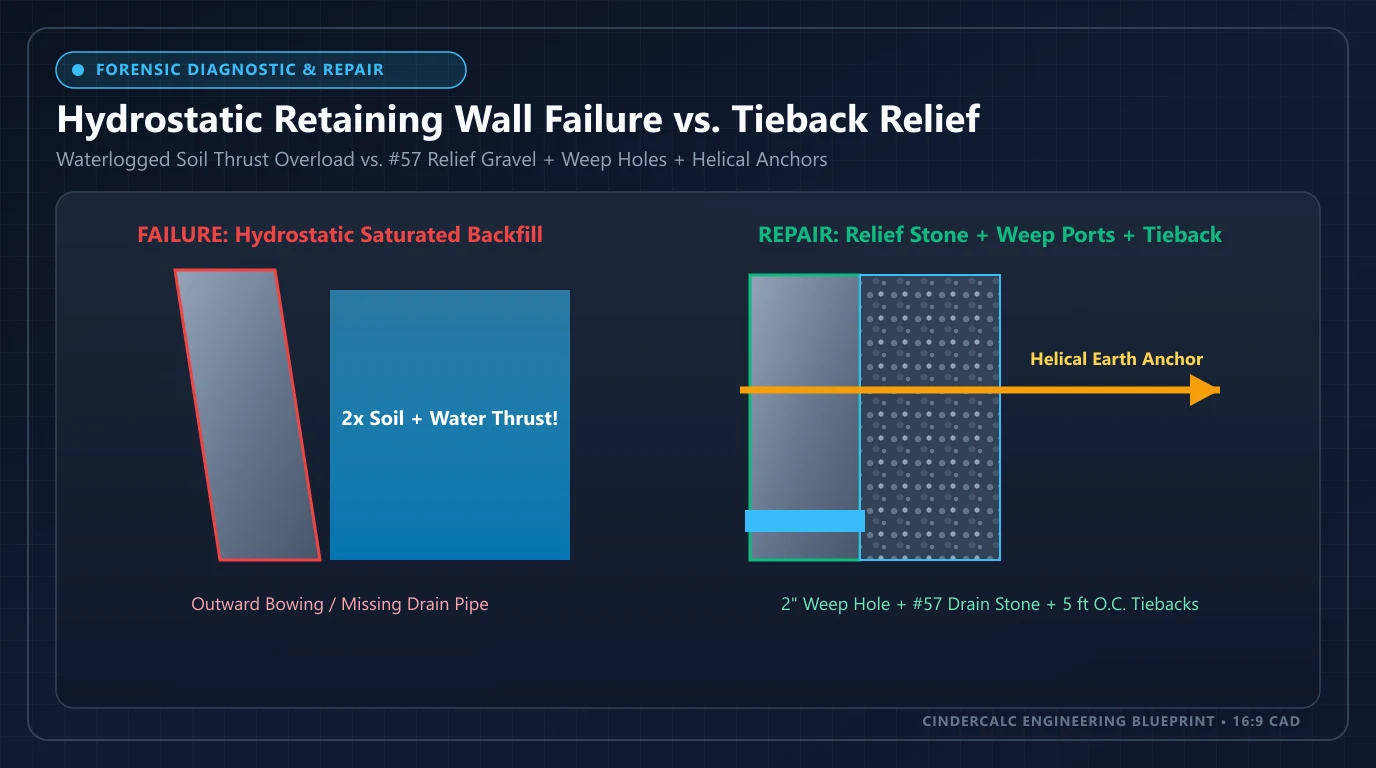
Retaining Wall Failure: 4 Causes, Thresholds & Repair
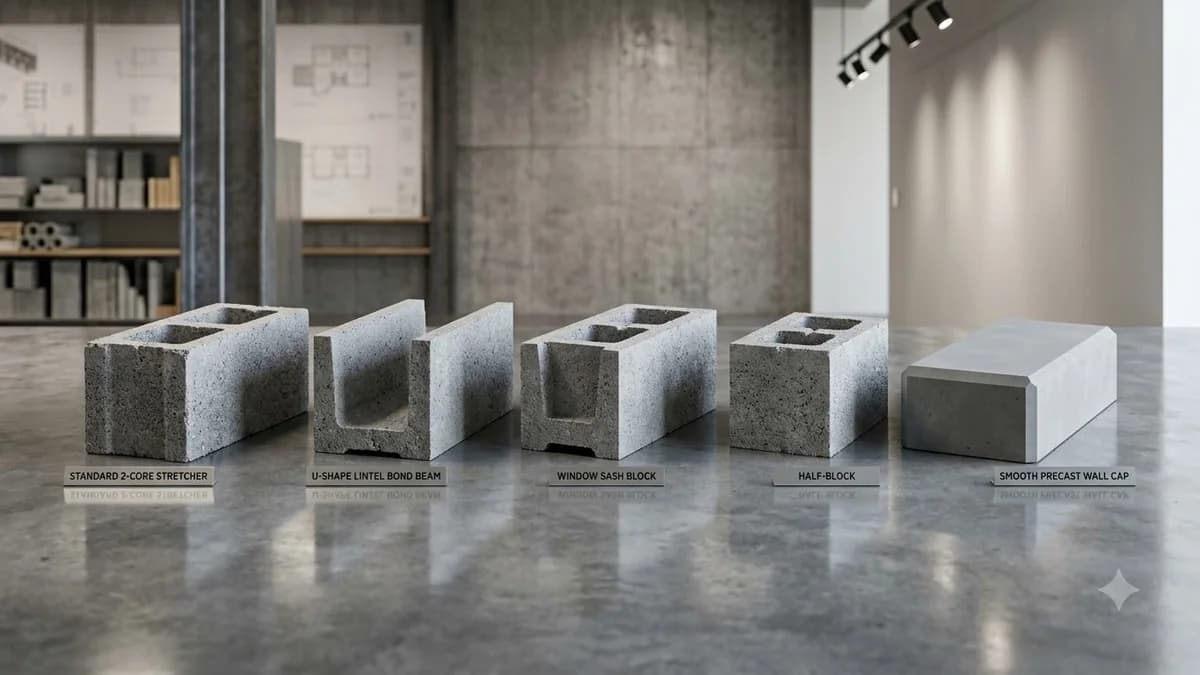
Types of Concrete Blocks: Shapes & Uses